wayground logo

Free Printable Worksheets

Font size

S
M
L
XL
Worksheets

Wave Basics and EM Spectrum 2018

Total questions: 94

Worksheet time: 3615secs
Name
Class
Date
1.
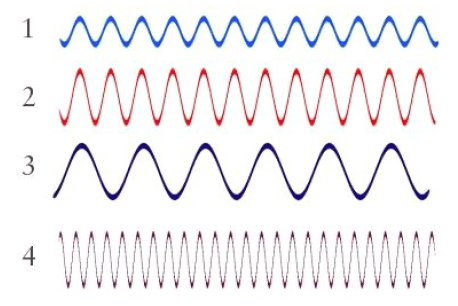
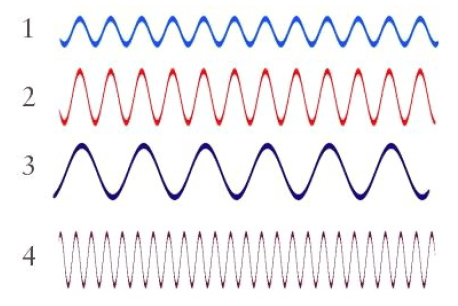
Which wave in the diagram has the greatest frequency?
a)
1
b)
2
c)
3
d)
4
2.
Which of the following can sound travel through?
a)
solid
b)
liquid
c)
gas
d)
all of the above
3.
regular disturbances that carry energy through matter or space
a)
crest
b)
energy
c)
wave
d)
trough
4.
When a wave strikes and object and bounces off. (example echo)
a)
medium
b)
refraction
c)
reflection
d)
interference
5.
When a wave bends as it passes through at an angle from one medium to another.(example: pencil in a glass of water-)
a)
medium
b)
refraction
c)
reflection
d)
interference
6.
A wave carries...?
a)
energy only
b)
matter only
c)
energy and matter
d)
neither
7.
What kind of waves can travel through space?
a)
electromagnetic waves
b)
compressional waves
c)
longitudinal waves
d)
sound waves
8.
The lowest part of the wave is called the ?
a)
frequency
b)
crest
c)
amplitude
d)
trough
9.
The highest point of a wave is called the ?
a)
crest
b)
trough
c)
wavelength
d)
frequency
10.
What is the measure of how many waves pass a point in a second?
a)
frequency
b)
wavelength
c)
midpoint
d)
crest and trough
11.
Amplitude is a measure of how much _________ the wave is carrying
a)
energy
b)
matter
c)
medium
d)
frequency
12.
The longer the _____________  the ______________ the frequency.
a)
wavelength, lower
b)
wavelength, higher
c)
amplitude, lower
d)
amplitude, higher
13.
Which wave has a greater frequency?
a)
A
b)
B
14.
You can't hear sounds in outer space because there is no
a)
matter
b)
light
c)
energy
d)
heat
15.
What do seismic waves and sound waves have in common?
a)
they're mechanical waves
b)
they're electromagnetic waves
c)
they're transverse waves
d)
they're permanent waves
16.
When a wave's amplitude increases it means
a)
it's carrying more energy
b)
its wavelength gets longer
c)
its frequency increases
d)
its wavelength decreases
17.
Of the following, ________ have the greatest frequency of the electromagnetic spectrum.
a)
ultraviolet rays
b)
gamma rays
c)
radio
d)
visible waves
18.
All waves carry ________ as they travel from one place to another.
a)
matter
b)
space
c)
energy
d)
water
19.
Light is a form of 
a)
energy
b)
radiation
c)
reflection
20.
Light travels in a straight line
a)
True
b)
False
21.
Visible light is ...
a)
Light bulb
b)
sun
c)
light that we can see with our natural eye
d)
fire
22.

Wave Speed = wave length x frequency. If an ocean wave has a wave length of 15 meters and a frequency of 3Hz what is the speed of the wave?

a)

10 meters / second

b)

5 meters / second

c)

3 meters / second

d)

4 meters / second

23.

When I comb or brush my hair I use a mirror. Light from my hair is __________ off the mirror and into my eyes.

a)

refracted

b)

reflected

c)

diffracted

d)

absorbed

24.

Refraction occurs when

a)

a ray of light is bent.

b)

a ray of light bounces off a mirror.

c)

a fraction of light escapes a dark hole.

25.

Light waves are typically _______________ when they encounter a dark surface.

a)

refracted

b)

reflected

c)

absorbed

26.

Radio waves are ____________ through a broadcast tower.

a)

dispatched

b)

transmitted

c)

conducted

d)

reducted

27.

___________ occurs when a wave encounters an object. The wave goes around the object.

a)

Reflection

b)

Refraction

c)

Diffraction

28.
When a sound wave hits a wall and echoes back, this is an example of what?
a)
Refraction
b)
Diffraction
c)
Reflection
d)
Interference
29.
This image is representing what wave interaction?
a)
Refraction
b)
Diffraction
c)
Reflection
d)
Interference
30.
What is the reason the pencil appears different under water?
a)
Interference
b)
Refraction
c)
Diffraction
d)
Reflection
31.
An interaction that occurs when 2 waves meet is known as what?
a)
Diffraction
b)
Standing wave
c)
Interference
d)
Resonance
32.
When 2 waves meet and there amplitude increases it is known as what?
a)
Constructive Interference
b)
Amplitude Addition
c)
Positive Interference
d)
Destructive Interference
33.
Interference that causes a wave that appears to be standing still is known as what?
a)
Standing wave
b)
Resonance
c)
Destructive Interference
d)
Constructive Interference
34.
True or False: Every object has at least one natural frequency.
a)
True
b)
False
35.
True or False: The angle of incidence always equals the angle of reflection
a)
True
b)
False
36.
This causes rainbows
a)
Reflection
b)
Refraction
c)
Magic rays of sunshine
d)
Diffraction
37.
An interaction between 2 waves that causes a smaller amplitude
a)
Constructive interference
b)
Destructive interference
c)
Resonance
d)
Diffraction
38.
What determines the amplitude of a wave?
a)
Amount of energy
b)
Speed of wave
c)
Wavelength
d)
Frequency
39.
When a wave moves around a barrier or though an opening it is known as what?
a)
Diffraction
b)
Refraction
c)
Rarefaction
d)
Destruction
40.
When an object or wave hits a surface through which it cannot pass, it bounces back. What is this?
a)
Diffraction
b)
Reflection
c)
Refraction
d)
Resonance
41.
When a wave enters a new medium and one side of the wave changes speed before the other it causes the wave to.....
a)
Break
b)
Fold
c)
Bend
d)
Ignite
42.
When an incoming wave and a reflected wave have the same frequency, they make a ____________________
a)
Standing wave
b)
Distorted wave
c)
Broken wave
d)
Transverse wave
43.
Constructive interference will cause the wave to 
a)
Increase its displacement
b)
Decrease its displacement 
c)
Make its displacement stay the same
44.
A standing wave appears to be staying in one place.
a)
True
b)
False
45.
Destructive interference is 
a)
When the two waves affect  each other in a negative way 
b)
The two waves add together and produce a single wave of greater amplitude
c)
Are in phase 
46.
Constructive interference is
a)
When two waves affect one another in  a positive way.
b)
Produce a single wave of greater amplitude (add together)
c)
Both
47.
What is interference?  
a)
occurs when two or more waves overlap and combine 
b)
occurs when two or more waves combine and neutralize each other 
c)
when one waves travels alone
48.
Which wave in the diagram has the greatest wavelength?
a)
1
b)
2
c)
3
d)
4
49.
Which wave behavior do noise cancelling headphones use?
a)
diffraction
b)
refraction
c)
constructive interference
d)
destructive interference
50.
Resonance occurs when
a)
an object is forced to vibrate at its natural frequency.
b)
sound changes speed in going from one medium to another.
c)
the amplitude of a wave is amplified.
d)
sound makes multiple reflections
51.
Sound travels fastest through what type of medium?
a)
pond water
b)
cold air
c)
iced tea
d)
wooden desk
52.
Which letter shows reflection? 
a)
Pathway A
b)
Pathway B
c)
Pathway C
d)
Pathway D
53.
Which term explains the path of the light ray in this diagram?
a)
Convection
b)
Scattering
c)
Absorption
d)
Refraction
54.
What do you see when water droplets refract and diffract sunlight?
a)
thunderstorm
b)
eclipse
c)
rainbow
d)
clouds
55.
What does it mean to refract?
a)
bounce off
b)
to bend
c)
curve outward
d)
reflect
56.
What happens when light hits a mirror?
a)
it makes a color
b)
it reflects
c)
it makes a rainbow
d)
it passes through
57.
A prism could best be described as which of the following?
a)
A triangle with an opening on one side and another side that absorbs light.
b)
A triangle object that allows light to enter and be refracted out into colors
c)
A pyramid shaped object that reflects the rats of the rainbow 
d)
A triangular object that absorbs the light from a rainbow 
58.
What is the name of a material in which waves, like sound waves, seismic waves, and waves in a slinky 
a)
Vacuum
b)
Medium
c)
Mechanical
d)
Space
59.
What is reflected?
a)
The bending of light as it passes through one material to another
b)
The bouncing of light from a surface
c)
Materials that allow all light to pass through
d)
Letting light through but scattering it
60.
True or false? Visible light is a form of radiant energy that moves in transverse waves
a)
True
b)
False
61.
True or false? The two types of interference are constructive and destructive interference.
a)
True
b)
False
62.
The reflection of a wave is --
a)
the change in amplitude of a wave when it bounces off a barrier.
b)
the change in frequency of a wave when it bounces off a barrier.
c)
the change in velocity of a wave when it bounces off a barrier.
d)
the change in direction of a wave when it bounces off a barrier.
63.
What is occurring in this gif.?
a)
Refraction
b)
Diffraction
c)
Resonance
d)
Radiation
64.
These waves are experiencing
a)
Reflection
b)
Refraction
c)
Diffraction
d)
Diffusion
65.
________is when a surface directs light beams in many different directions.
a)
Refraction
b)
Scattering
c)
Absorption
d)
Transmission
66.
A ray of light is incident on a plane mirror and the angle of incidence is 25 degrees. What is the angle of reflection?
a)
A. 0 degrees
b)
B. 50 degrees
c)
C. 90 degrees
d)
D. 25 degrees
67.
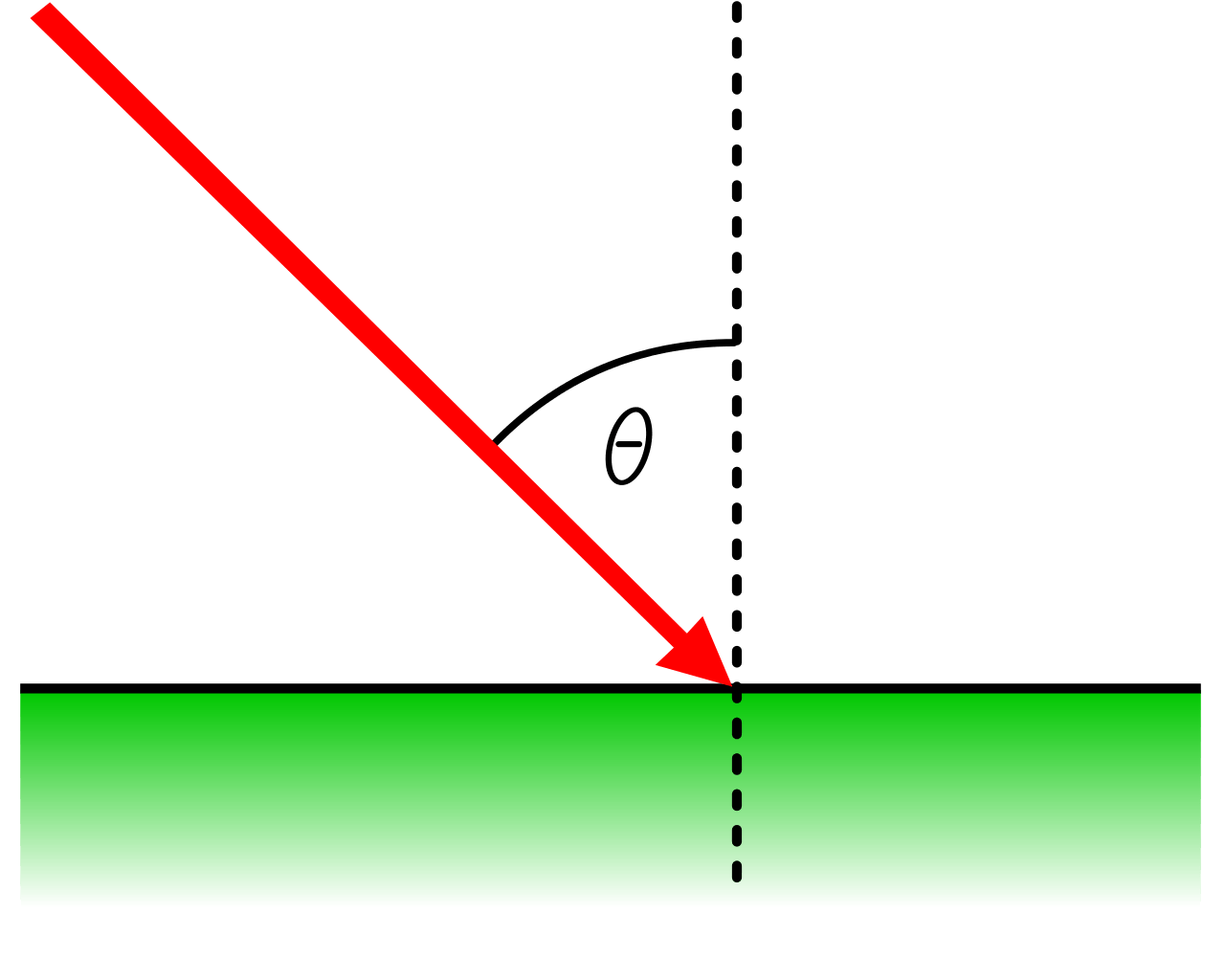
The Law of Reflection:
The angle of incidence is _________ the angle of reflection
a)
bigger than
b)
the same as
c)
smaller than
68.
According to the Law of reflection, a light ray striking a mirror
a)
continues moving through the mirror in the same direction
b)
moves into the mirror at a slightly different angle
c)
bounces off the mirror toward the direction it came from
d)
bounces off the mirror at the same angle it hits.
69.
The fact the two angles are the same is an example of....
a)
Refraction
b)
Angle of Incidence
c)
Law of reflection
d)
Magnification
70.
We see a green shamrock as being green because:
a)
All of the colors are absorbed except for green.
b)
All of the colors are being reflected except for green.
71.
What is the incident ray?
a)
The ray of light leaving the mirror
b)
The ray of light approaching the mirror
72.
Why does the lower part of the child appear so much different in size from the upper part?
a)
The light rays that travel through water and then into air are refracted.
b)
The light rays that travel through water and then into air are enlarged.
c)
The light rays that travel through air and then into water are reflected.
d)
The light rays that travel through air and then into water are reduced.
73.
Section B1a
Given that the angle of incidence = 30 degrees
a. Draw a ray diagram, labelling clearly the normal, incident ray, angle of incidence, reflected ray and angle of reflection accurately.
Which is the correct diagam? 
a)
A
b)
B
c)
C
d)
D
74.
The combination of two or more waves that result in a single wave
a)
A. diffraction
b)
B. resonance
c)
C. reflection
d)
D. interference
75.
a)
Constructive Interference
b)
Destructive Interference
c)
Reflection
d)
Refraction
76.
What is happening in this picture?
a)
Reflection
b)
Refraction
c)
Diffraction
d)
Absorption
77.
What is happening in this picture?
a)
Reflection
b)
Refraction
c)
Diffraction
d)
Absorption
78.
What is happening in this picture?
a)
Reflection
b)
Refraction
c)
Diffraction
d)
Absorption
79.
Which explanation best describes the formation of  a rainbow.
a)
refraction, due to waves slowing down as it enters the water from air 
b)
refraction, due to waves speeding up as it enters the water from air
c)
diffraction, due to waves slowing down as it enters the water from air 
d)
diffraction, due to waves slowing down as it enters the water from air 
80.
Light travels in ....
a)
Longitudinal Waves
b)
Transverse Waves
81.
Whats happens when nonpolarized light goes through a vertical polarized lenses?
a)
No Light Comes Out
b)
Only horizontal polarized lights comes out
c)
Only vertical polarized lights comes out
d)
Nonpolarized light comes out
82.
What type polarization light comes of glare from horizontal surface?
a)
Horizontal
b)
Vertical
c)
None
d)
All
83.
What type polarization light is blocked with sunglassses?
a)
Horizontal
b)
Vertical
c)
None
d)
All
84.

#4 represents the only area of the EM Spectrum that humans can see.

#4 represents which type of wave?

a)

radio

b)

UV

c)

Visible Light

d)

X-ray

85.
_______ carry the greatest amount of energy. 
a)
x-rays
b)
gamma rays
c)
infrared rays
d)
visible light
86.

Why do black surfaces (like an asphalt road) get hotter than white surfaces (like the sidewalk)?

a)

black surfaces reflect all light

b)

black surfaces transmit all light

c)

black surfaces absorb all light

d)

white surfaces absorb all light

87.

Why does an apple look red?

a)

it refracts red light

b)

it reflects red light

c)

it absorbs red light

d)

it transmits red light

88.
EM waves  
a)
Must travel through a vacuum
b)
Can travel through a medium or a vacuum
c)
Are the same type of wave as mechanical waves
d)
Can only travel through a vacuum
89.
when light waves vibrate in only one direction
a)
polarization
b)
regular reflection
c)
refraction
d)
diffuse reflection
90.
All electromagnetic waves have the same...
a)
frequency
b)
speed
c)
wavelength
d)
energy
91.

Refer to the image. Observe the light passing through three layered materials and bending at each boundary. Rank the three materials in order of increasing index of refraction.

a)

A < B < C

b)

B < C < A

c)

A = B < C

d)

C < B < A

e)

C < A = B

92.

The fundamental particle of the electromagnetic spectrum is

a)

wave

b)

photon

c)

amplitude

93.

Which letter shows refraction?

a)

Pathway A

b)

Pathway B

c)

Pathway C

d)

Pathway D

94.

What section of the EM spectrum is not visible to our eyes because the wavelength is absorbed by our eye or lens before reaching the retina

a)

x-rays

b)

infrared rays

c)

microwaves

d)

ultraviolet waves