
 Worksheets
Physics review
Total questions: 90
Worksheet time: 1hrs 28mins
Name
Class
Date
1.

Which of the blocks above has balanced forces acting on it?
a)
A
b)
B
c)
C
d)
D
2.
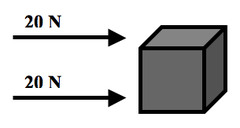
What is the net force?
a)
40 N left
b)
0 N Balalnced
c)
400 N right
d)
40 N right
3.
The force that opposes the motion of two surfaces sliding past each other is called ___________.
a)
acceleration
b)
inertia
c)
friction
d)
unbalanced
4.
What units are used to measure force?
a)
Kilogram
b)
Meter
c)
Pascal
d)
Newton
5.

A ____________ is a push or a pull on an object.
a)
friction
b)
force
c)
magnet
d)
gravity
6.
___________ is the amount of matter in an object.
a)
mass
b)
weight
c)
volume
d)
force
7.

On which surface would friction be the greatest?
a)
carpet
b)
ice
c)
snow
d)
water
8.
What is velocity?
a)
the quickness of an object
b)
the location of an object
c)
acceleration
d)
speed with the specific direction
9.

How will this object move?
a)
It won't move.
b)
It will move to the right.
c)
It will move to the left.
d)
It will move up.
10.

In a tug of war the left team pulls with a force of 200N. The right team pulls with a force of 150N. What is the resultant force?
a)
50N to the left.
b)
350N to the left.
c)
350N to the right.
d)
50N to the right.
11.

If these teams are pulling with the same amount of force what will happen?
a)
The left team will win.
b)
They will not move at all.
c)
The right team will win.
d)
Both will fall down.
12.

Calculate the Net Force.
a)
60N, Left
b)
40N, Right
c)
0 N
d)
60N, Right
13.

Calculate the Net Force.
a)
40N, Left
b)
40N, Right
c)
0N, Balanced
d)
75N, Right
14.

Is this item Balanced or Unbalanced?
a)
Balanced
b)
Unbalanced
c)
neither balanced or unbalanced
15.
In a normal environment, why does a bowling ball and feather hit the ground at different times when dropped from the same height?
a)
They don't; they hit the ground at the same time.
b)
One is more dense than the other.
c)
One is heavier than the other.
d)
Air resistance
16.
In a normal environment, why does a bowling ball and feather hit the ground at different times when dropped from the same height?
a)
They don't; they hit the ground at the same time.
b)
One is more dense than the other.
c)
One is heavier than the other.
d)
Air resistance
17.
The tendency of an object at rest to stay at rest unless it is acted upon by a force is called ___________________
a)
inertia
b)
motion
c)
gravity
d)
lubricant
18.

What is the net force?
a)
400 N Up
b)
400 N Down
c)
- 400 N Down
d)
800 N Down
19.

During which interval is the object slowing down?
a)
A to B
b)
D to E
c)
E to F
d)
G to H
20.

During which interval are the forces on the object BALANCED (Net Force= 0 N)?
a)
A to B
b)
B to C
c)
D to E
d)
F to G
21.

Which runner stopped for a rest?
a)
Albert
b)
Bob
c)
Charlie
22.

Which runner won the race?
a)
Albert
b)
Bob
c)
Charlie
23.

How long did one of the runner's rest?
a)
8 seconds
b)
13 seconds
c)
5 seconds
d)
50 seconds
24.
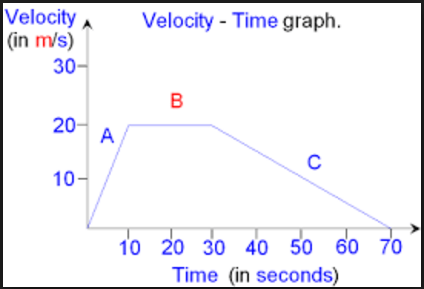
This is a velocity-time graph. What is the object doing in segment A?
a)
Positive acceleration
b)
Negative acceleration
c)
Constant Velocity
d)
Not moving
25.

This is a velocity-time graph. What is the object doing in segment B?
a)
Positive acceleration
b)
Negative acceleration
c)
Constant Velocity
d)
Not moving
26.

Calculate the acceleration for segment A.
a)
2 m/s2
b)
20 m/s2
c)
-2 m/s2
d)
0 m/s2
27.
Acceleration is
a)
increasing speed
b)
decreasing speed
c)
changing direction
d)
all of the above
28.

During which interval is the object speeding up?
a)
A to B
b)
B to C
c)
D to E
d)
E to F
29.

What does this graph represent?
a)
Constant speed
b)
Acceleration
c)
Not moving
30.
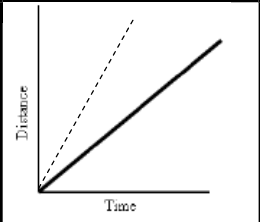
What does this graph represent?
a)
Constant Speed
b)
Acceleration
c)
Not moving
31.
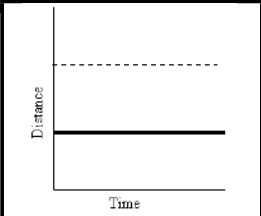
What does this graph represent?
a)
Constant speed
b)
Acceleration
c)
Not moving
32.
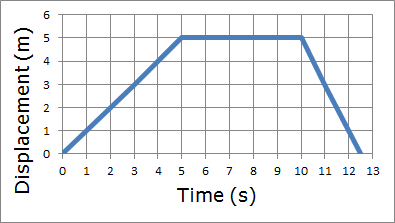
According to the graph how fast does the person travel in the first 5 seconds?
a)
2 m/s
b)
10 m/s
c)
12.5 m/s
d)
1 m/s
33.

The line C-D shows...
a)
Constant acceleration
b)
Constant speed
c)
deceleration
d)
sationary
34.
The SI unit for acceleration is
a)
mph
b)
m/s
c)
m/s2
35.
Acceleration: is the rate of change in ___________.
a)
speed
b)
distance
c)
velocity
d)
displacement
36.
What law is best described by inertia?
a)
1st
b)
2nd
c)
3rd
37.

a)
1st
b)
2nd
c)
3rd
38.

a)
1st
b)
2nd
c)
3rd
39.

a)
1st
b)
2nd
c)
3rd
40.

a)
1st
b)
2nd
c)
3rd
41.

a)
1st
b)
2nd
c)
3rd
42.

a)
1st
b)
2nd
c)
3rd
43.
Object at rest stays at rest.
a)
1st
b)
2nd
c)
3rd
44.
Equal and Opposite
a)
1st
b)
2nd
c)
3rd
45.
Force exerted between the surfaces of two objects.
a)
Friction
b)
Inertia
c)
Force
d)
Gravity
46.
Objects tendency to resist change
a)
Friction
b)
Inertia
c)
Force
d)
Gravity
47.
Objects attraction to one another - like us to earth.
a)
Friction
b)
Inertia
c)
Force
d)
Gravity
48.

A magician pulls a tablecloth out from under dishes and glasses on a table without disturbing them.
a)
Newton's 1st Law
b)
Newton's 2nd Law
c)
Newton's 3rd Law
49.

A person not paying attention while skateboarding hits a rock. The skateboard stops...they don't.
a)
The Law of Inertia
b)
The Law of Acceleration
c)
The Law of Conservation of Momentum
50.

Pushing a child on a swing is easier than pushing an adult on the same swing, because the adult has more mass and requires more force to accelerate.
a)
Newton's 1st Law
b)
Newton's 2nd Law
c)
Newton's 3rd Law
51.

A soccer ball accelerates more than a bowling ball when thrown with the same force.
a)
Law of Inertia
b)
Law of Acceleration
c)
Law of Conservation of Momentum
52.
Energy due to motion is ____________ energy.
a)
Potential
b)
Energy
c)
Kinetic
d)
Friction
53.
The faster an object moves, the ________ kinetic energy it has.
a)
more
b)
less
c)
none of the above
d)
all of the above
54.
__________ is stored energy.
a)
Potential
b)
Kinetic
c)
None of the above
d)
All of the above
55.
When you are holding a book, energy is stored between the book and Earth; this type of energy is called ________ potential energy.
a)
Kinetic
b)
Elastic
c)
Gravitional
d)
Chemical
56.
Food has _________ energy.
a)
Potential
b)
Kinetic
c)
None of the above
d)
All of the above
57.
Can energy be destroyed?
a)
no
b)
yes
58.
Can energy be changed?
a)
yes
b)
no
59.

What kind of energy is in a moving skateboard?
a)
Potential
b)
Kinetic
61.

What kind of energy is in a rock at the edge of a cliff?
a)
Potential
b)
Kinetic
61.
What kind of energy is in a rock at the edge of a cliff?
a)
Potential
b)
Kinetic
62.
Energy can not be created or destroyed, only converted from one form to another.
a)
true
b)
false
63.
Energy can be _____________ or changed from one type to another.
a)
destroyed
b)
transferred
c)
created
d)
ignored
64.

What kind of energy is in a battery?
a)
Potential
b)
Kinetic
65.
When plants convert the sun's energy into food, which type of energy is it?
a)
electrical
b)
chemical
c)
thermal
d)
radiant
66.

What kind of energy does this device use?
a)
Chemical
b)
Electrical
c)
Mechanical
d)
Nuclear
67.

A battery converts what type of energy to another?
a)
sound to kinetic
b)
light to heat
c)
mechanical to electrical
d)
chemical to electrical
68.

The glow sticks produce light for a short amount of time. The light from the glow stick is a conversion from what to what?
a)
thermal to light
b)
gravitational to potential
c)
radiant to electrical
d)
chemical to light
69.
Energy stored in the height of an object is called ___________ potential energy.
a)
Elastic
b)
Chemical
c)
Gravitational
d)
Nuclear
70.
Gravitational potential energy depends on the ________ and ________ of the object.
a)
Height and mass
b)
Friction and movement
c)
Mass and Movement
d)
Height and Friction
71.
When you stretch a rubber band, you are storing __________ energy.
a)
kinetic
b)
potential
c)
none of the above
d)
all of the above
72.

At which point is potential energy greatest?
a)
W
b)
X
c)
Y
d)
Z
73.

What kind of energy is represented in this picture?
a)
Thermal
b)
Potential
c)
Nuclear
d)
Mechanical
74.

What type of energy is in this picture?
a)
Kinetic
b)
Potential
c)
Chemical
d)
Sound
75.
On a roller coaster, where is maximum kinetic energy?
a)
At the bottom of a big hill
b)
When going around a corner
c)
When going upside down
d)
At the top of a big hill
76.
Energy stored in food and fuels
a)
Gravitational potential energy
b)
Chemical Potential Energy
c)
Elastic Potential Energy
d)
Energy
77.
Energy stored in food and fuels
a)
Gravitational potential energy
b)
Chemical Potential Energy
c)
Elastic Potential Energy
d)
Energy
78.
Who is the most awesome science teacher?
a)
Ms. Oliver :-)
b)
Ms. Frizzle
c)
Bill Nye
d)
Einstein
79.
Football A has a greater mass than football B. Which football will have greater acceleration when both are thrown with the same force in the same direction?
a)
Football A
b)
Football B
c)
They will have the same acceleration
d)
Mass has no effect on acceleration
80.
True or false. The appropriate units for velocity are m/s2
a)
True
b)
False
81.
What are the appropriate units to describe acceleration?
a)
m/s
b)
m/s2
c)
cm
d)
there are no units associated with acceleration
82.
How can Newton's second law be represented mathematically?
a)
F=MA
b)
M= F/A
c)
A= F/M
d)
All are correct
83.
Why would one ball accelerate more than the other when pushed with the same amount of force?
a)
Different weights
b)
Different forces
c)
Different masses
d)
Different sizes
84.
A 20 kg bike accelerates at 10 m/s2. what was the force
a)
25 Newtons
b)
20 Newtons
c)
200 Newtons
d)
10 Newtons
85.
20 N is the
a)
mass
b)
weight
c)
force
d)
acceleration
86.
45 m/s2 is the...
a)
Mass
b)
Force
c)
Acceleration
d)
weight
87.
An object with a mass of 2.0 kg accelerates 2.0 m/s2 when an unknown force is applied to it. What is the amount of the force?
a)
4 N
b)
0.4 N
c)
1 N
d)
0.1 N
88.
An object accelerates 3.0 m/s2 when a force of 6.0 newtons is applied to it. What is the mass of the object?
a)
2 N
b)
18 N
c)
0.5 N
d)
0.05 N
89.
An object accelerates 5 m/s2 when a force of 20 newtons is applied to it. What is the mass of the object?
a)
4 N
b)
20 N
c)
0.5 N
d)
2 N
90.
What is the acceleration of a 1,000 kg car pushed with a force of 12,000 N?
a)
12 m/s/s
b)
3 m/s/s
100 %

