
NEW
Font size
 Worksheets
Bio Species and Classification
Total questions: 39
Worksheet time: 30mins

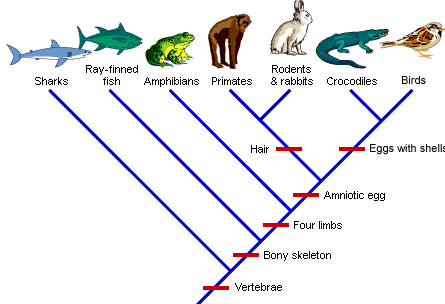
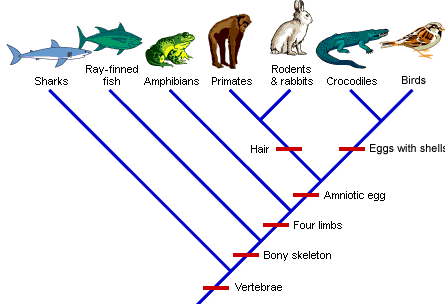


Based on their names, you know that the baboons Papio annubis and Papio cynocephalus do NOT belong to the same
class
family
genus
species
The correct sequence from the broadest (largest) to the most specific(smallest) taxonomic levels is
Family, phylum, class, kingdom, order, species, and genus
Kingdom, phylum, class, order, family, genus, and species
Kingdom, phylum, order, class, family, genus, and species
Species, genus, family, order, class, phylum, and kingdom
Which level is after the order?
class
family
genius
phylum
What level is after class?
kingdom
phylum
family
order
Members of this domain are unicellular, prokaryotic, and they live in some extreme environments.
Domain Eukaryota
Domain Archaebacterial
Domain Bacteria
Organisms are unicellular, prokaryotic, and ecologically diverse. They range from free-living soil organisms to deadly parasites.
Domain Eukaryota
Domain Bacteria
domain Archaebacterial
This domain consists of all organisms that have a nucleus.
Domain Eukaryota
Domain Archaebacterial
Domain Bacteria
In the Great Lakes region of North America, gray wolves and coyotes are similar species but do not mate because their breeding periods occur at different times of the year.
Geographic isolation
Behavioral isolation
Temporal isolation
The females of two species of fruit fly, Drosophila melanogaster and Drosophila simulans release slightly different mating hormones called pheromones, which are used to attract male mates.
Geographic isolation
Behavioral isolation
Temporal isolation
A type of isolation in which two populations become separated by a physical barrier such as a canyon, river, lake, preventing the two populations from interbreeding.
Geographic isolation
Behavioral isolation
Temporal isolation
A type of isolation where two species whose ranges overlap have different periods of sexual activity or breeding seasons.
Geographic isolation
Behavioral isolation
Temporal isolation

