
 Worksheets
A&P Unit 6
Total questions: 74
Worksheet time: 42mins
Name
Class
Date
1.

a)
Quadriceps
b)
Satorius
c)
Hamstring
d)
Gastronecmius
2.

a)
Latissmius Dorise
b)
Erectors
c)
Deltoids
d)
Abdominal
3.

a)
Buccinator
b)
Occuli
c)
Satorius
d)
Gastronecmius
4.

a)
Abdominal
b)
External Oblique
c)
Erectors
d)
Satorius
5.

a)
Tricep
b)
Deltoid
c)
Hamstring
d)
Bicep
6.

a)
Buccinator
b)
Occuli
c)
Pectorals
d)
Soulius
7.

a)
Trapezius
b)
Gluteals
c)
Deltoid
d)
Hamstring
8.

a)
Hamstrin
b)
Quadricep
c)
Tibialis Anterior
d)
Gastrocenmius
9.

a)
Glutueal
b)
Hamstring
c)
Quadricep
d)
External Oblique
10.

a)
Pectoral
b)
Tricep
c)
Bicep
d)
Deltoid
11.

a)
Hamstring
b)
Quadriceps
c)
Gastronecmius
d)
Satorius
12.

a)
Abdominal
b)
External Oblique
c)
Pectorals
d)
Trapezius
13.

a)
Hamstring
b)
Quadriceps
c)
Bicep
d)
Satorius
14.

a)
Latissimius Dorsi
b)
Trapezius
c)
Triceps
d)
Erectors
15.

a)
Biceps
b)
Triceps
c)
Occuli
d)
Trapezius
16.
What is your cardiac muscle?
a)
heart
b)
brain
c)
lungs
d)
gluteus maximus
17.
What kind of muscle do you move on purpose?
a)
voluntary
b)
involuntary
c)
cardiac
d)
heart
18.
About how many muscles are in your body?
a)
206
b)
300
c)
over 600
d)
1,000
19.
What muscle is on your femur?
a)
Abs
b)
Bicep
c)
Gluteus Maximus
d)
Quads
20.
Skeletal muscles are attached to _________.
a)
organs
b)
heart
c)
bones
d)
lungs
21.
What is another name for your voluntary muscles?
a)
skeletal
b)
involuntary
c)
smooth
d)
cardiac
22.
What ties muscles to bones?
a)
cartilage
b)
tendons
c)
ligaments
d)
flexors
23.
tissue that connects bone to bone
a)
ligament
b)
tendon
c)
tissue
d)
muscle
24.

Name the chest muscle highlighted in yellow.
a)
Biceps
b)
Pecs
c)
Triceps
d)
Hamstrings
25.

This man is flexing his......
a)
Triceps
b)
Biceps
c)
Fliceps
d)
Glutes
26.

a is pointing to
a)
deltoid
b)
trapezius
c)
biceps brachii
d)
triceps brachii
27.

c is pointing to
a)
external oblique
b)
rectus abdominus
c)
transverse abdominus
d)
internal oblique
28.

d is pointing to
a)
quadriceps
b)
hamstrings
c)
gastrocnemius
d)
gluteus maximus
29.
Where would you find the deltoid?
a)
Forearm
b)
Shoulder
c)
Back
d)
Chest
30.
The gastrocnemius muscle is likely to be contracted when you:
a)
Play computer games.
b)
Bench press.
c)
Stand on your tip toes.
d)
Chew your food.
31.
What major muscle do you sit on?
a)
latissimus dorsi
b)
quadricep
c)
bicep
d)
gluteous maximus
32.
Shrugging your shoulders uses your:
a)
trapezius
b)
hamstring
c)
tricep
d)
oblique
33.
What term means "In front of"?
a)
anterior
b)
inferior
c)
posterior
d)
superior
34.

Letter H is the ___
a)
Orbicularis Oris
b)
Masseter
c)
Frotalis
d)
Orbicularis Oculi
35.
Muscle responsible for raising the eye brows
a)
Temporalis
b)
Frotalis
c)
Zygomaticus
d)
Masseter
36.
Hamstrings are found on the _____ side of the body
a)
Anterior
b)
Posterior
37.

Action flexes the arm at the shoulder.
a)
Biceps brachii
b)
Pectoralis major
c)
Trapezius
d)
Triceps brachii
38.

Action is to extend forearm at the elbow.
a)
Pectoralis major
b)
Deltoid
c)
Biceps brachii
d)
Triceps brachii
39.
What part of the body does the gastrocnemius move?
a)
hand
b)
wrist
c)
hip
d)
foot
40.
Which muscle rotates and flexes your head?
a)
masseter
b)
temporalis
c)
platysma
d)
sternocleidomastoid
41.

What is the name of muscle number 6?
a)
orbicularis oculi
b)
temporalis
c)
platysma
d)
epicranial aponeurosis
42.

Action of the quadriceps?
a)
extends leg at knee
b)
extends thigh at hip
c)
flexes leg at knee
d)
flexes thigh at hip
43.

What muscle type is this?
a)
cardiac
b)
skeletal
c)
smooth
44.
Which muscle type is striated?
a)
cardiac
b)
skeletal
c)
smooth
d)
cardiac and skeletal
45.
What type of muscle lines the inside of the stomach?
a)
cardiac
b)
skeletal
c)
smooth
46.
What type of muscle is/are voluntary?
a)
smooth and cardiac
b)
smooth
c)
skeletal and smooth
d)
skeletal
47.
What type of muscle(s) is involuntary?
a)
skeletal and smooth
b)
cardiac and skeletal
c)
smooth and cardiac
d)
skeletal
48.
What type of muscle is not banded or striated?
a)
cardiac
b)
skeletal
c)
smooth
49.

What type of muscle tissue is this?
a)
cardiac
b)
skeletal
c)
smooth
50.
What is the name of the Thick filaments?
a)
Actin
b)
Myosin
c)
Myoglobin
d)
Titan
51.
What is the name of the thin filaments in the muscle cell?
a)
Actin
b)
Myosin
c)
Myoglobin
d)
Titan
52.
The neurotransmitter that signals muscle contraction is called...
a)
Ach
b)
Myosin
c)
Actin
d)
Calcium
53.

The plasma membrane of a skeletal muscle cell is called the:
a)
sarcomere
b)
myofilament
c)
sarcolemma
d)
sarcoplasm
54.
What is the name of the contractile unit in a muscle cell?
a)
fascicle
b)
sarcomere
c)
tendon
d)
endomysium
55.
Region where a motor neuron comes in close contact with a muscle cell.
a)
neurotransmitter
b)
muscular dystrophy
c)
muscle tension
d)
neuromuscular junction
56.
What two chemicals are necessary for muscle contraction to occur?
a)
Niacin and Potassium
b)
Calcium and ATP
c)
Sodium and Potassium
d)
Ach and Potassium
57.
___ and ___ are regulatory proteins bound to actin.
a)
Troponin and tropomyosin
b)
Myosin and actin
c)
Calcium and Oxygen
d)
Glycogen and hemoglobin
58.
What is the structure that stores the Calcium in the muscle cell.
a)
Sarcoplasm
b)
Sarcolemma
c)
Sarcoplasmic Reticulum
d)
Myoglobin
59.
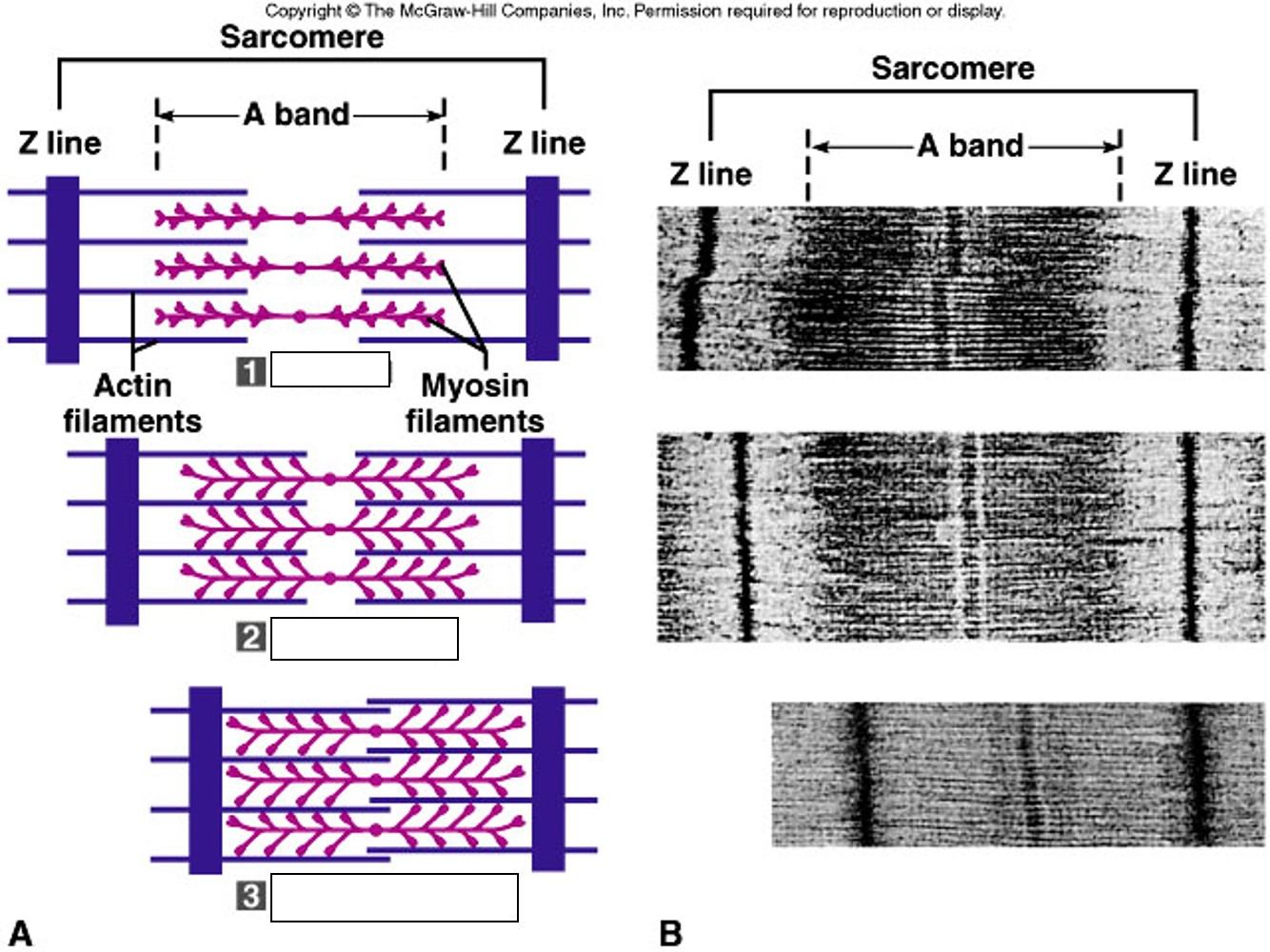
What state is the sarcomere in #1
a)
Relaxed
b)
Contracting
c)
Fully Contracted
d)
None of the above
60.
What state is the sarcomere in #2
a)
Relaxed
b)
Contracting
c)
Fully Contracted
d)
None of the above
61.
What is a crossbridge?
a)
Where myosin binds to actin
b)
Where the calcium crosses into the cytoplasm
c)
Where calcium binds with troponin
d)
None of the answers are correct.
62.
Muscles are attached to bones by _____.
a)
Ligaments
b)
Tendons
c)
Cartilage
d)
Axons
63.
Another name for a muscle cell.
a)
Fiber
b)
Sacrolemma
c)
Sacromere
d)
Fascicle
64.
Ribbon like organelle found in muscle cells that have a banded appearance
a)
sarcomere
b)
myofibril
c)
fascicle
d)
actin
65.

a)
Orbicularis Oris
b)
Orbicularis Oculi
c)
Corrugator
d)
Occipitals
66.

a)
Buccinator
b)
Zygomaticus Major
c)
Zygomaticus Minor
d)
Masseter
67.

a)
Masseter
b)
Buccinator
c)
Platysma
d)
Sternoclidomastoid
68.

a)
Mentalis
b)
Platysma
c)
Sternoclidomastoid
d)
Risorius
69.

Name the muscle
a)
Levator Scapula
b)
Trapezius
c)
Rhomboids major
d)
Latissimus Dorsi
70.

a)
rhomboids
b)
infraspinatus
c)
erector spinae
d)
middle trapezius
71.
The disorder the causes widespread pain in the muscles and skeletal system and causes fatigue, not thought to be caused by inflammation.
a)
fibromylagia
b)
dystonia
c)
myositis
d)
myasthenia gravis
72.
stretch or tear in the ligament
a)
sprain
b)
straom
c)
tetanus
d)
cramp
73.
What is Muscular Dystrophy?
a)
Weaker muscles
b)
Stronger muscles
c)
collapsing muscles
d)
bigger than normal muscles
74.
Can muscular dystrophy be cured?
a)
No
b)
Yes
100 %

