wayground logo

Free Printable Worksheets

NEW

Font size

S
M
L
XL
Worksheets

Unit 4 Part 2

Total questions: 80

Worksheet time: 4hrs 36mins

Name
Class
Date
1.
The purpose of selective breeding is to 
a)
Get bigger animals
b)
get smaller animals
c)
create animals with desirable traits
d)
create animals with bad traits
2.
Problems with selective breeding include
a)
Better animals
b)
More Meat
c)
Animals can have bad health problems
d)
more diversity
3.
It is very common for yellow labs to have bad hips. This is because owners want purebred yellow labs who are good hunting dogs.  This is an example of 
a)
Natural Selection
b)
Selective breeding
c)
Mitosis
d)
Fossil Record
4.
The transfer of a gene from the DNA of one organism into another organism in order to produce an organism with desired traits.
a)
Genetic Engineering
b)
Karyotype
c)
Pedigree
d)
Genome
5.
The process of selecting a few organisms with desired traits to serve as parents of the next generation.
a)
Gene Therapy
b)
Genome
c)
Selective Breeding
d)
Pedigree
6.
Selective, deliberate change of genes by man. (Putting genes from one organism into another)
a)
Genetic Engineering
b)
Cloning
c)
Hybridization
d)
Inbreeding
7.

All of the following statements are reasons for selective breeding except:

a)

To produce offspring with desirable characteristics

b)

Farmers increase their profit by improving crops

c)

To improve the quality of food products

d)

To increase migration patterns

8.

What is a negative outcome to genetic engineering?

a)

A decrease in genetic diversity of the crops.

b)

An increase in the use of pesticides.

c)

An increase in the contamination of the water supply.

d)

A decrease in crop productivity.

9.

Inserted gene can enable an animal to make certain proteins in its milk, blood, sperm or eggs. Which of the following is NOT true about transgenic animals?

a)

Transgenic animals can easily be tested for the new gene.

b)

Transgenic animals cannot pass their ability to produce the desired drug to its offspring.

c)

Transgenic DNA may insert its into the genome in a way that disrupts the animal's normal gene function.

d)

Transgenic animals can produce the desired drug at high levels without endangering its own health.

10.

Which of the following describes the main benefit of completing The Human Genome Project?

a)

patenting specific human genes

b)

identifying genetically-based diseases

c)

cloning humans

d)

designing new human genes

11.

Rice, the most popular crop in the world, can be successfully grown only in certain places. If trends in climate change continue, the areas in which rice currently grows will be significantly reduced. Which of the following is the best way that biotechnology can keep the harvest of rice from decreasing?

a)

Identifying new areas with soil fertile enough for rice production.

b)

Sending clouds with dry ice to produce more rainfall where it is needed.

c)

Genetically engineering rice crops that are tolerant to changes in the environment.

d)

Developing clean energy sources to reduce carbon dioxide production worldwide.

12.
Which process is used to copy DNA in the nucleus?
a)
replication
b)
transcription
c)
translation
13.
Which process is used to make mRNA from the DNA in the nucleus?
a)
transcription
b)
translation
c)
replication 
14.
Which RNA bases would pair with TACGAA in transcription
a)
AUGCUU
b)
ATGCTT
c)
GCATCC
d)
GCAUCC
15.
In DNA replication, which enzyme is responsible for building the new DNA strand?
a)
helicase
b)
polymerase
c)
ligase
d)
primase
16.

Where does transcription take place in Eukaryotes?

a)

nucleus

b)

cytoplasm

c)

ribosome

17.
What is occurring in this picture?
a)
Translation
b)
Replication
c)
Translocation
d)
Transcription
18.
One difference between DNA and RNA is that....
a)
Only RNA has the base Uracil
b)
only RNA contains the base Thymine
c)
only RNA contains the base Cytocine
d)
only RNA contained the base Guanine
19.
What process is being shown here?
a)
Replication
b)
Translation
c)
Transcription
20.
The process represented in the diagram produces a molecule that is complementary to the template strand of DNA. What type of molecule is produced?
a)
New DNA
b)
Polypeptide
c)
Messenger RNA
d)
Carbohydrate
21.
what does mRNA do?
a)
carry info from genes to ribosomes
b)
carry amino acids to ribosomes
c)
help with RNA splicing
d)
make up ribosomes
22.
True or false:  RNA is double-stranded.
a)
true
b)
false
c)
it depends on the type
23.
Which of these bases does not exist in RNA?
a)
C
b)
T
c)
U
d)
A
24.

Where does transcription take place in Eukaryotes?

a)

nucleus

b)

ribosome

c)

cytoplasm

d)

smooth ER

25.
DNA codes for...
a)
cholesterol
b)
proteins
c)
fatty acids
d)
a sandwich
26.
Which of the following best describes a DNA molecule?
a)
double helix
b)
contains ribose
c)
made of amino acids
d)
contains Uracil
27.
Which of the following units are repeatedly joined together to form a strand of DNA?
a)
amino acids
b)
nucleotides
c)
fatty acids
d)
polysaccharides
28.
Which best expresses the relationship between genes and DNA?
a)
Genes contain DNA
b)
DNA destroys genes
c)
Both contain chromosomes
d)
The are unrelated
29.
What's important about hydrogen bonds?
a)
They are strong to hold the DNA together
b)
They are weak and easy to open
c)
They are tripple bonds
d)
They are double bonds
30.
Which of these is the Central Dogma of Biology in the correct order?
a)
DNA --> mRNA --> protein
b)
DNA --> protein  --> mRNA
c)
mRNA --> DNA --> protein
d)
protein --> DNA --> mRNA
31.
This is a DNA strand. Which is the mRNA strand that would be made through transCription
TACGAA
a)
AUGCUU
b)
ATGCTT
c)
GCATCC
d)
GCAUCC
32.
Where does transCription take place?
a)
in the nucleus
b)
outside the nucleus in the cytoplasm
c)
on a ribosome
33.
_______ is made during transCription and ________ is made during transLation.
a)
mRNA / a protein
b)
a protein / mRNA
c)
Ribosome / Nucleus
d)
mRNA / tRNA
34.
What type of bonds are forming during transLation?
a)
Peptide bonds
b)
Hydrogen bonds
c)
Acid bonds
35.
How many amino acids are coded for by this sequence of nucleotides:
ATG GGA ACT CCA
a)
4
b)
2
c)
6
d)
12
36.
Which process does this picture show?
a)
TransCription
b)
TransLation
c)
Replication
37.
Which process does this picture show?
a)
TransCription
b)
TransLation
c)
Replication
38.
What process does this picture show?
a)
TransLation
b)
Replication
c)
TransCription
39.
Which of these is NOT TRUE
a)
only DNA is double stranded
b)
DNA is stuck in the nucleus, mRNA can leave nucleus
c)
RNA is short, DNA is long
d)
The bases in DNA are the same as RNA - ATCG
40.
The job of tRNA is to
a)
tRNA carries amino acids to the ribisomes
b)
tRNA makes up ribisomes
c)
tRNA is a message, a copy of the DNA code
d)
tRNA contains all the genes in the genome
41.
Amino acids are joined together in order to form
a)
DNA
b)
ribosomes
c)
proteins 
d)
RNA
42.
TransLation is the process where
a)
mRNA is created in the Nucleus
b)
the info in mRNA is used to form a protein 
c)
glucose molecules are made
d)
is where lipids are synthesised
43.
What mutation has occurred here? 
T-G-A-C-C-A
T-G-A-G-C-A
a)
Substitution
b)
Deletion
c)
Insertion
d)
Frameshift 
44.
Are all mutations bad?
a)
Yes
b)
No
45.
In a molecule of double-stranded DNA, the amount of Adenine present is always equal to the amount of
a)
cytosine
b)
guanine
c)
thymine
d)
uracil
46.
Any change in the sequence of DNA is...
a)
transgenic shift
b)
Single Genotype
c)
Monohybrid Trait
d)
Mutation
47.
DNA molecule segment is : TTACGCAAG
The mutated DNA segment is TTACGCAAC. This is an example of ___ mutation.
a)
Substitution
b)
Insertion
c)
Inversion
d)
Translocation
48.
Which organelle is DNA usually found in?
a)
cell membrane
b)
vacuole
c)
chloroplast
d)
nucleus
49.
What is a codon?
a)
It is a three letter section of bases that are read by ribosomes to stamp amino acids into a protein
b)
They are the codes on the DNA (hence "code-on"
c)
It is a type of mutation that occurs when there has been a substitution, deletion or insertion.
d)
It is a made up word for this quiz. Nice try, Wampler.
50.
What are the building blocks of proteins called?
a)
DNA
b)
RNA
c)
Ribosomes
d)
Amino Acids
51.
Why are insertion and deletion (frameshift) mutations so harmful?
a)
They change all of the codons from the mutation on down the line, which changes the amino acid sequence
b)
They insert things that an organism doesn't need.
c)
They often delete things that organisms need.
d)
Insertion and deletions are not any more harmful than substitution mutations.
52.
Why is the order of amino acids so important?
a)
The order of amino acids dictates what shape the protein will fold into.
b)
It is not important. The protein folding chamber will force the protein to fold into the correct shape.
53.
What is the function of the ribosome in a cell?
a)
To take DNA and turn it into amino acids
b)
To take RNA and read the codons to assemble amino acids
c)
To take amino acids and stamp them together into RNA
d)
To take proteins and stamp them into amino acids.
54.
ATTTGAGCC- Original
ATTGAGCC - Mutated
The example above is an example of a 
a)
Insertion- Frameshift
b)
Deletion- Substitution
c)
Deletion -Frameshift
d)
All of the above
55.
DNA molecule segment is : TTACGCAAG
The mutated DNA segment is TTCGCAAG. This is an example of ___ mutation.
a)
Substitution
b)
Deletion
c)
Insertion
d)
Inversion
56.
What molecule is shown in the double helix diagram shown?
a)
DAN
b)
RAN
c)
DNA
d)
RNA
57.
If you are a boy, what percent of your genes did you get from your dad?
a)
25%
b)
50%
c)
75%
d)
100%
58.
What is the central dogma of biology?
a)
Proteins are made from RNA that assembles amino acids through DNA ribosomes.
b)
RNA copies all information for an organism onto DNA which assembles ribosomes, and creates amino acids from proteins
c)
DNA is the blueprint for an organism. RNA copies specific sections that need to be built and transfers that information to a ribosome which assembles proteins out of amino acids.
d)
RNA is the blueprint for an organism. It copies its information onto DNA, which takes amino acids (like lego building blocks) and assembles those acids into proteins.
59.
Would a mutation in the DNA of a skin cell be passed on to an organism's offspring?
a)
Yes, because any change to the DNA is passed on to the offspring
b)
Maybe. Sex cells only use half of the body's genetic code. It might get the copy of a gene that wasn't mutated.
c)
No. Only mutations that occur in the gametes (sex cells) are passed on to the offspring
d)
Without knowing the animal, it would be hard to tell whether or not the mutation would be passed on.
60.
Which RNA bases would pair with TACGAA in transcription
a)
AUGCUU
b)
ATGCTT
c)
GCATCC
d)
GCAUCC
61.
Using the codon chart here or at your table to identify the amino acid sequence:
AUG-CCA-GUA-GGG-UAA
a)
MET-HIS-ALA-GLY-STOP
b)
MET-PRO-GLY-VAL-STOP
c)
MET-PRO-VAL-GLY-STOP
d)
MET-THR-SER-ASP-STOP
62.
Which amino acid is made from the RNA codon ACC?
a)
Tyrosine
b)
Isoleucine
c)
Threonine
d)
Valine
63.

A medical test indicates that a patient has a defective protein. This condition is most likely due to a change in the directions coded in the

a)

number of carbon atoms in sugar molecules.

b)

sequence of nucleotides in DNA.

c)

number of hydrogen atoms in starch molecules.

d)

sequence of inorganic molecules.

64.

Which of these mutations is an organisms most likely to pass on to its offspring?

a)

A chromosomal mutation in a gamete.

b)

A point mutation in an autosome.

c)

A chromosomal mutation in an autosome.

d)

A gene mutation in an autosome.

65.

A beneficial mutation happens in a body cell. Where will this mutation happen?

a)

in the organism's immediate offspring only

b)

In the organism only

c)

in the organism and its immediate offspring only

d)

in the organism, its offspring, and all of its direct descendants

66.
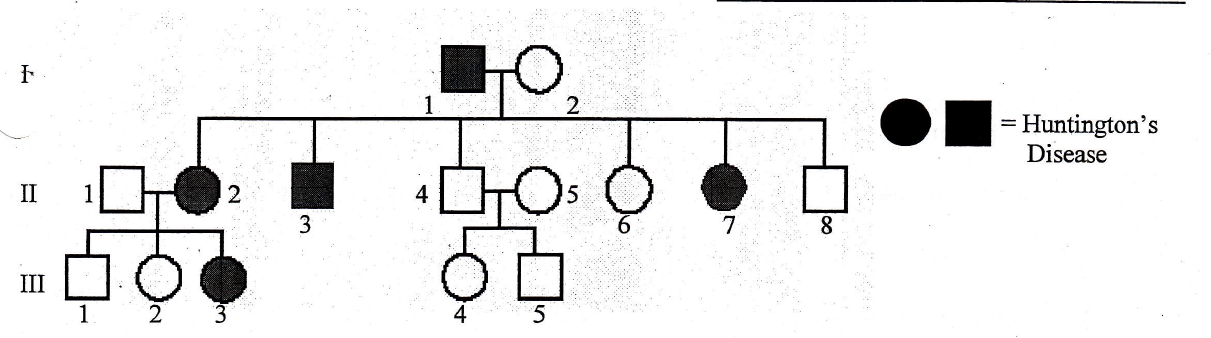
How many generations are shown in this pedigree?
a)
1
b)
2
c)
3
d)
4
67.
Which individual in the first generation is a carrier?
a)
The male
b)
The female
c)
individual 1
d)
None of the above
68.
How many kids did the mother and father from the first generation have?
a)
2
b)
4
c)
5
d)
6
69.
How many boys did the mother and father from the first generation have?
a)
2
b)
4
c)
5
d)
6
70.
How many girls did the mother and father from the first generation have?
a)
2
b)
4
c)
5
d)
6
71.
In the second generation-how many people have the disease or display the physical trait?
a)
2
b)
4
c)
5
d)
6
72.
In the second generation-how many people are carriers of the trait?
a)
2
b)
3
c)
5
d)
6
73.
How many individuals are there in the 3rd generation?
a)
2
b)
3
c)
4
d)
6
74.
How many people in this whole pedigree have the trait/disease?
a)
2
b)
3
c)
4
d)
6
75.
There are no carriers for Huntington's Disease- you either have it or you don't. Is Huntington's disease caused by a dominant or recessive trait?
a)
Dominant
b)
Recessive
76.
How many girls did II-1 and II-2 have?
a)
1
b)
2
c)
3
d)
4
77.
How are individuals I-2 and III-5 related?
a)
Grandpa and grandson
b)
Mom and son
c)
Uncle and nephew
d)
Grandma and grandson
78.
How many children did individuals I-1 and I-2 have?
a)
2
b)
4
c)
6
d)
8
79.
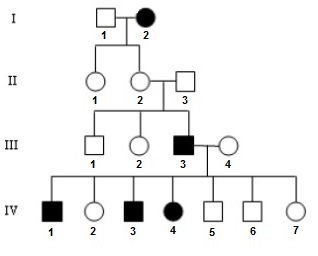
This pedigree represents the inheritance of hemophilia in this family. How many of the females have the hemophilia trait?
a)
8
b)
5
c)
2
d)
3
80.
Does this pedigree show a dominant or recessive trait?
a)
Dominant
b)
Recessive