wayground logo

Free Printable Worksheets

Font size

S
M
L
XL
Worksheets

Anatomy Bones Review

Total questions: 145

Worksheet time: 2hrs 35mins

Name
Class
Date
1.
a)
Pelvis
b)
Sacrum
c)
Sternum
d)
Scapula
2.
a)
Pelvis
b)
Sacrum
c)
Sternum
d)
Scapula
3.

Which vertebrae comes after cervical?

a)

Cervical vertebrae

b)

Thoracic vertebrae

c)

Lumbar vertebrae

d)

Sacrum

4.

Which are the topmost in the vertebral column?

a)

Cervical vertebrae

b)

Thoracic vertebrae

c)

Lumbar vertebrae

d)

Sacrum

5.

Which vertebrae supports your back?

a)

Cervical vertebrae

b)

Thoracic vertebrae

c)

Lumbar vertebrae

d)

Sacrum

6.

Which of the following is also known as the tailbone?

a)

Atlas

b)

Axis

c)

Sacrum

d)

Coccyx

7.

Which bone makes the forehead?

a)

Frontal bone

b)

Parietal bone

c)

Occipital bone

d)

Temporal bone

8.

Which bone is butterfly shaped?

a)

Frontal bone

b)

Ethmoid bone

c)

Nasal bone

d)

Sphenoid bone

9.

Which bones are also known as the malar bone?

a)

Zygomatic bones

b)

Parietal bones

c)

Occipital bones

d)

Temporal bones

10.

Which bone comprises the upper jaw?

a)

Zygomatic

b)

Maxilla

c)

Mandible

d)

Nasal

11.

Which bone is also known as the collar bone?

a)

Clavicle

b)

Sternum

c)

Scapula

d)

Humerus

12.

Which bone is also known as the shoulder blade?

a)

Clavicle

b)

Sternum

c)

Scapula

d)

Humerus

13.

Which bone is the long bone of the upper arm?

a)

Clavicle

b)

Sternum

c)

Scapula

d)

Humerus

14.

Which bones are connected to the wrist bones and finger bones?

a)

Metacarpals

b)

Metatarsals

c)

Carpals

d)

Phalanges

15.

Which bone is present in the forearm?

a)

Humerus

b)

Ulna

c)

Tibia

d)

Fibula

16.

Which bone is also known as the thigh bone?

a)

Tibia

b)

Fibula

c)

Femur

d)

Pelvis

17.

Which bone connects the knee and ankle joint?

a)

Tibia

b)

Tarsals

c)

Femur

d)

Patella

18.

Ribs from 1-7:

a)

True ribs

b)

False ribs

c)

Floating ribs

d)

None of the above

19.

What are the last two ribs known as?

a)

True ribs

b)

False ribs

c)

Floating ribs

d)

None of the above

20.

Classify the Highlighted bones based on their shape!

a)

Irregular Bones

b)

Short Bones

c)

Flat Bones

d)

Long Bones

21.

Bones can be classified in three major groups, which are:

a)

Flat, Long and Small

b)

Short, Big and Flat

c)

Long, Short and Flat

d)

Upper, lower and central

22.
a)
Occipital
b)
Parietal
c)
Temporal
d)
Sphenoid
23.
a)
Mandible
b)
Parietal
c)
Temporal
d)
Sphenoid
24.
a)
Zygomatic
b)
Temporal
c)
Parietal
d)
Lacrimal
25.
a)
Zygomatic
b)
Temporal
c)
Parietal
d)
Occipital 
26.
a)
Zygomatic
b)
Frontal
c)
Parietal
d)
Lacrimal
27.
a)
Zygomatic
b)
Temporal
c)
Parietal
d)
Lacrimal
28.
a)
Maxilla
b)
Parietal
c)
Temporal
d)
Sphenoid
29.
a)
Mandible
b)
Parietal
c)
Temporal
d)
Sphenoid
30.
Who has more bones: an adult or a baby?
a)
baby
b)
adult
c)
both have the same
d)
neither have bones
31.
Joint that allows gliding movement.
a)
Plane
b)
Pivot
c)
Ball and Socket
d)
Hinge
32.
What are the two types of cartilaginous joints?
a)
Gomphoses and Synchondroses
b)
Sutures and Syndesmoses
c)
Synchondrosis and Symphses
d)
Pivot and Plane
33.
Joint type that only allows flexion and extension.
a)
Ball and Socket
b)
Hinge
c)
Condyloid
d)
Saddle
34.
These joints all have a fibrous capsule lined with synovial membrane surrounding a joint cavity
a)
fibrous
b)
cartilaginous
c)
synovial
35.
Joints between skull bones
a)
diarthrotic/synovial
b)
fibrous/suture
c)
amphiarthrotic/epiphyseal disk
36.
The joint between the tibia and fibula is?
a)
a gomphosis
b)
a syndesmoses
c)
a cartilaginous joint
d)
a synovial joint
37.
Cartilagenous joints are connected by  
a)
synovial fluid
b)
fibrous connective tissue. 
c)
hyaline cartilage or fibrocartilage
d)
a joint capsule
38.
Fluid-filled sacs containing synovial fluid are called  
a)
bursae
b)
menisci
c)
ligaments
d)
tendons
39.
The shoulder joint is
a)
Hinge
b)
Gliding
c)
Ball and socket
d)
Pivot
40.
This type of joint allows the C1 and C2 to rotate as in shaking your head no
a)
condyloid
b)
gliding
c)
pivot
d)
saddle
41.
The functional unit that makes up compact bone is called the
a)
Osteon
b)
Trabeculae
c)
Central Canal
d)
Osteocyte
42.
What part of an osteon is number 3 pointing to?
a)
Lamellae
b)
Central Canal
c)
Osteocyte
d)
Canaliculi
43.
What part of an osteon is number 2 pointing to?
a)
Lamellae
b)
Central Canal
c)
Lacunae
d)
Osteocyte
44.
What part of an osteon is number 4 pointing to?
a)
Lamellae
b)
Central Canal
c)
Osteocyte
d)
Canaliculi
45.
What part of an osteon is number 5 pointing to?
a)
Lamellae
b)
Central Canal
c)
Osteocyte
d)
Canaliculi
46.
What part of an osteon is number 6pointing to?
a)
Lacunae
b)
Central Canal
c)
Osteocyte
d)
Canaliculi
47.

F?

a)

osteon

b)

periosteum

c)

Haversian canal

d)

blood vessels

48.
What is the purpose of the canaliculi?
a)
Connect Lacunae and osteocytes together
b)
Safe space for osteocytes to reside
c)
Space for blood vessels and nerves
d)
To manage the bone
49.
What is the purpose of the central canal?
a)
Connect Lacunae and osteocytes together
b)
provide strength and resilience to bone
c)
Space for blood vessels and nerves
d)
To manage the bone
50.
The bones of the head and trunk form the
a)
axial skeleton
b)
appendicular skeleton
c)
skellie skeleton
d)
bones 
51.
Which of these is a flat bone?
a)
Vertebra
b)
Tibia
c)
Fibula
d)
Frontal
52.

The epiphysis is

a)

The length of the bone

b)

The ends of a bone

c)

Hard compact bone

d)

The shaft of a bone

53.

Osteocytes are

a)

Mature bone cells

b)

Bone destroying cells

c)

Bone forming cells

d)

Cancerous bone

54.

The Diaphysis is also known as

a)

A- The shaft of the bone

b)

B- The ends of bones

c)

C- Spongy Bone

d)

D- Both A & B

e)

E- Both A & C

55.
The shaft of the bone is also called the
a)
epiphysis
b)
diaphysis
c)
endosteum
d)
periosteum
56.
The hardest, most dense part of the bone tissue is the
a)
periosteum
b)
spongy bone
c)
osteoblast
d)
compact bone
57.
This type of bone is solid throughout except for the central canals and lacunae.
a)
Compact Bone
b)
Spongy or Cancellous Bone
58.
This type of bone is porous, allowing blood vessels to move through it and containing bone marrow.
a)
Compact Bone
b)
Spongy or Cancellous Bone
59.
Structure A
a)
head
b)
greater trochanter
c)
lesser trochanter
d)
lateral epicondyle
60.
Structure B
a)
head
b)
greater trochanter
c)
lesser trochanter
d)
lateral epicondyle
61.
Structure C
a)
head
b)
greater trochanter
c)
lesser trochanter
d)
lateral epicondyle
62.
Structure D
a)
medial epicondyle
b)
lateral epicondyle
c)
medial condyle
d)
lateral condyle
63.
Structure E
a)
medial epicondyle
b)
lateral epicondyle
c)
medial condyle
d)
lateral condyle
64.
Structure G
a)
medial epicondyle
b)
lateral epicondyle
c)
medial condyle
d)
lateral condyle
65.
Structure F
a)
medial epicondyle
b)
lateral epicondyle
c)
medial condyle
d)
lateral condyle
66.
Which feature is C?
a)
Head
b)
Neck
c)
Intercondylar fossa
d)
Fovea capitis
67.
Which feature is A?
a)
Head
b)
Fovea capitis
c)
Neck
d)
Patellar surface
68.
Diarthrosis joint
a)
hip
b)
skull
c)
spinal column
69.
Name this part of the bone.
a)
Pelvic bone
b)
Ishium
c)
Pubic symphysis
d)
Coccyx
70.
Name these bones.
a)
Metatarsals
b)
Tarsals
c)
Phalanges
d)
Calcaneous
71.
Name these bones.
a)
Phalanges
b)
Metacarpals
c)
Carpals
d)
Tarsals
72.
What bones make up the shoulder girdle? 
a)
Scapula and Clavicle 
b)
Tibia and Fibula 
c)
Carpal and Metacarpal
d)
Deltoid and Scapula 
73.

The bone that makes up the brachium is the...

a)

Tibia

b)

Radius

c)

Ulna

d)

Humerus

74.
The two bones that make up the forearm are the....
a)
Vertebrae and skull
b)
Ulna and radius
c)
Tibia and fibula 
d)
Clavicle and scapula 
75.
The lateral and medial malleolus form...
a)
The middle and outer parts of the ankle. 
b)
A site for muscle attachment. 
c)
A protection point for the tibia and fibula. 
76.
The pelvis of a female is _____ as compared to a male.
a)
wide and circular
b)
wide and heart-shaped
c)
narrow and circular
d)
narrow and heart-shaped
77.

Identify the highlighted part of this bone

a)

Iliac crest

b)

Pubis

c)

Ilium

d)

Ischium

78.

Identify the highlighted bone area

a)

Sacrum

b)

Pubis

c)

Ilium

d)

Pelvic girdle

79.

Name the foot bone series shaded in blue.

a)

Tarsals

b)

Metacarpals

c)

Metatarsals

d)

Phalanges

80.

Which bones are highlighted

a)

carpals

b)

tarsals

c)

metacarpals

d)

metatarsals

81.
The kneepcap is also known as the 
a)
tibia
b)
fibula 
c)
patella
d)
femur
82.
Structure A
a)
head
b)
sulcus
c)
greater tubercle
d)
medial epicondyle
83.
Structure B
a)
greater tubercle
b)
lesser tubercle
c)
sulcus
d)
lateral epicondyle
84.
Structure C
a)
greater tubercle
b)
lesser tubercle
c)
sulcus
d)
head
85.
Structure D
a)
greater tubercle
b)
lesser tubercle
c)
sulcus
d)
head
86.
Structure F
a)
medial epicondyle
b)
lateral epicondyle
c)
trochlea
d)
capitulum
87.
Structure G
a)
medial epicondyle
b)
lateral epicondyle
c)
trochlea
d)
capitulum
88.
Structure F
a)
lateral epicondyle
b)
medial epicondyle
c)
trochlea
d)
olecranon fossa
89.
What bone is this?
a)
3rd proximal metacarpal
b)
2nd distal phalynx
c)
3rd distal phalynx
d)
3rd intermediate metacarpal
90.
What is this?
a)
Head of Radius
b)
Olecranon Process
c)
Capitulum
d)
Trochlea
91.
What is this?
a)
Acromion
b)
Glenoid Fossa
c)
Coracoid Process
d)
Head of Scapula
92.
What portion of the Scapula articulates with the Clavicle?
a)
Acromion
b)
Glenoid Fossa
c)
Coracoid Process
93.
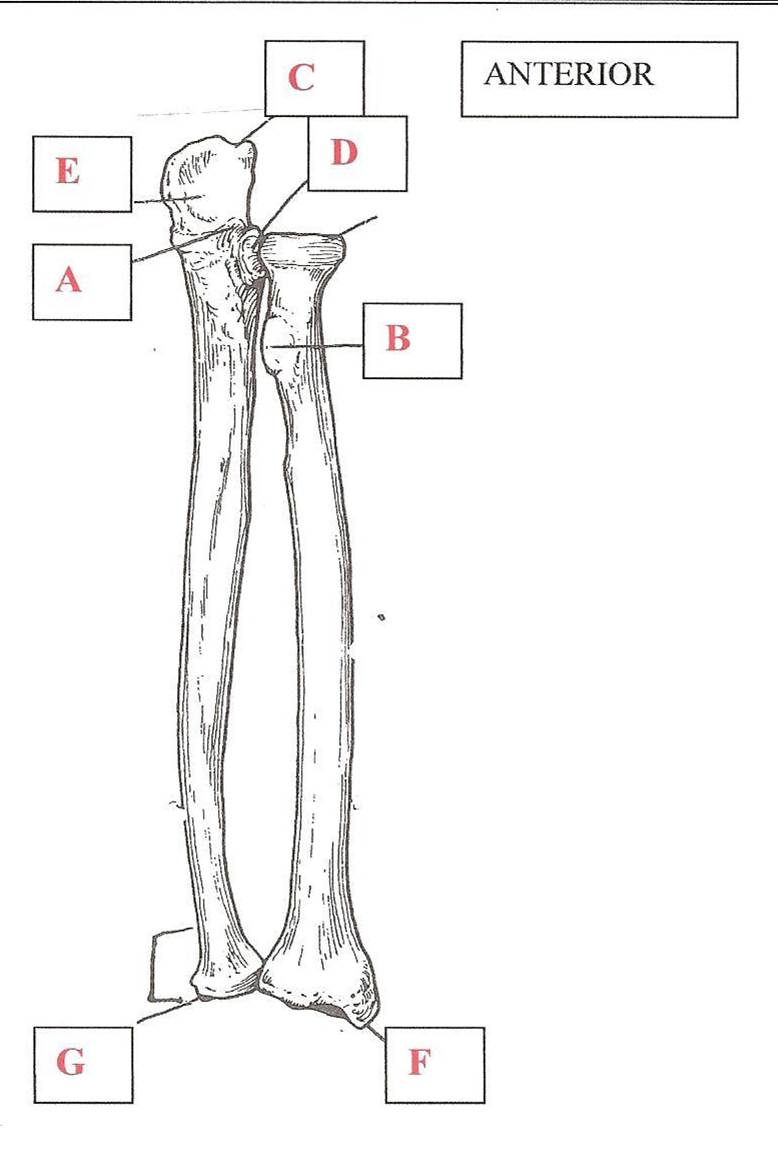
Label G
a)
Styloid process of ulna
b)
Styloid process of radius
c)
Radial tuberosity
d)
Olecranon process
94.
Label B
a)
Styloid process of ulna
b)
Styloid process of radius
c)
Radial tuberosity
d)
Olecranon process
95.

The clavicle attaches to the ___ medially.

a)

tibia

b)

scapula

c)

sternum

d)

carpal

96.
Structure B
a)
trochlear notch
b)
radial notch
c)
ulnar notch
d)
olecranon process
97.
Structure F
a)
trochlear notch
b)
radial notch
c)
ulnar notch
d)
olecranon notch
98.
Structure G
a)
coracoid process
b)
acromion process
c)
scapular spine
d)
glenoid cavity
99.
Structure H
a)
coracoid process
b)
acromion process
c)
suprascapular notch
d)
glenoid cavity
100.
Structure I
a)
coracoid process
b)
acromion process
c)
scapular spine
d)
glenoid cavity
101.
Structure J
a)
supraspinous fossa
b)
infraspinous fossa
c)
subscapular fossa
d)
moo fossa
102.
Structure H
a)
scapular spine
b)
acromion process
c)
coracoid process
d)
glenoid cavity
103.
Structure K
a)
scapular spine
b)
acromion process
c)
coracoid process
d)
glenoid cavity
104.

What is number 3? Bony projection laterally from the vertebra.

a)

Demifacet

b)

Superior Articular Facet

c)

Transverse Process

d)

Lamina

105.

What is number 6? C'mon. EASY!

a)

Pedicle

b)

Body

c)

Transverse Process

d)

Inferior Articular Facet

106.
How many cervical vertebrae exist in the spine? 
a)
7
b)
12
c)
5
d)
4
107.
The brown represents 
a)
transverse process
b)
spinous process
c)
foramen 
d)
body 
108.
There are __________ lumbar vertebrae. 
a)
12
b)
5
c)
7
d)
6
109.
Thin columns of bones that point out to the left and right sides (lateral) of the body. 
a)
spinous process
b)
intervertebral disc
c)
transverse process
d)
vertebral foramen 
110.
Inferior portion of the sternum; made of cartilage; cone shaped
a)
coracoid process
b)
acromion process
c)
xiphoid process
d)
scapula
111.
How many pairs of true ribs are there? 
a)
12
b)
2
c)
5
d)
7
112.
Which bone does the sternal end of the clavicle attach to?
a)
Body
b)
Manubrium
c)
Xiphoid Process
d)
Vertebral Rib 1
113.
What two bones make up the shoulder girdle?
a)
Scapula and Clavicle
b)
Scapula and Humerus
c)
Humerus and Clavicle
d)
Sternum and Clavicle
114.

What is number 2? Bony projection that articulates with the vertebra above it.

a)

Demifacet

b)

Superior Articular Facet

c)

Lamina

d)

Pedicle

115.

The arrow is pointing to this, where the spinal cord traverses through.

a)

Vertebral Foramen

b)

Foramen

c)

Intervertebral Foramen

d)

Hole in vertebra

116.
What is the name of the first Cervical Vertebrae?
a)
Compass
b)
Telamon
c)
Atlas
d)
Axis
117.
How many floating ribs are there? 
a)
12
b)
2
c)
4
118.
a)
true ribs; 7 pair
b)
true ribs; 5 pair
c)
false ribs; 7 pair
d)
false ribs; 5 pair
119.
a)
body of sternum
b)
manubrium
c)
xiphoid process
d)
costal cartilage
120.
Structure A
a)
lateral condyle
b)
medial condyle
c)
tibial head
d)
fibular head
121.
Structure B
a)
lateral condyle
b)
medial condyle
c)
tibial head
d)
fibular head
122.
Structure D
a)
lateral condyle
b)
medial condyle
c)
lateral malleolus
d)
medial malleolus
123.
Structure E
a)
lateral condyle
b)
medial condyle
c)
lateral malleolus
d)
medial malleolus
124.
a)

Calcaneous

b)

Talus

c)

Navicular

d)

Cuboid

125.
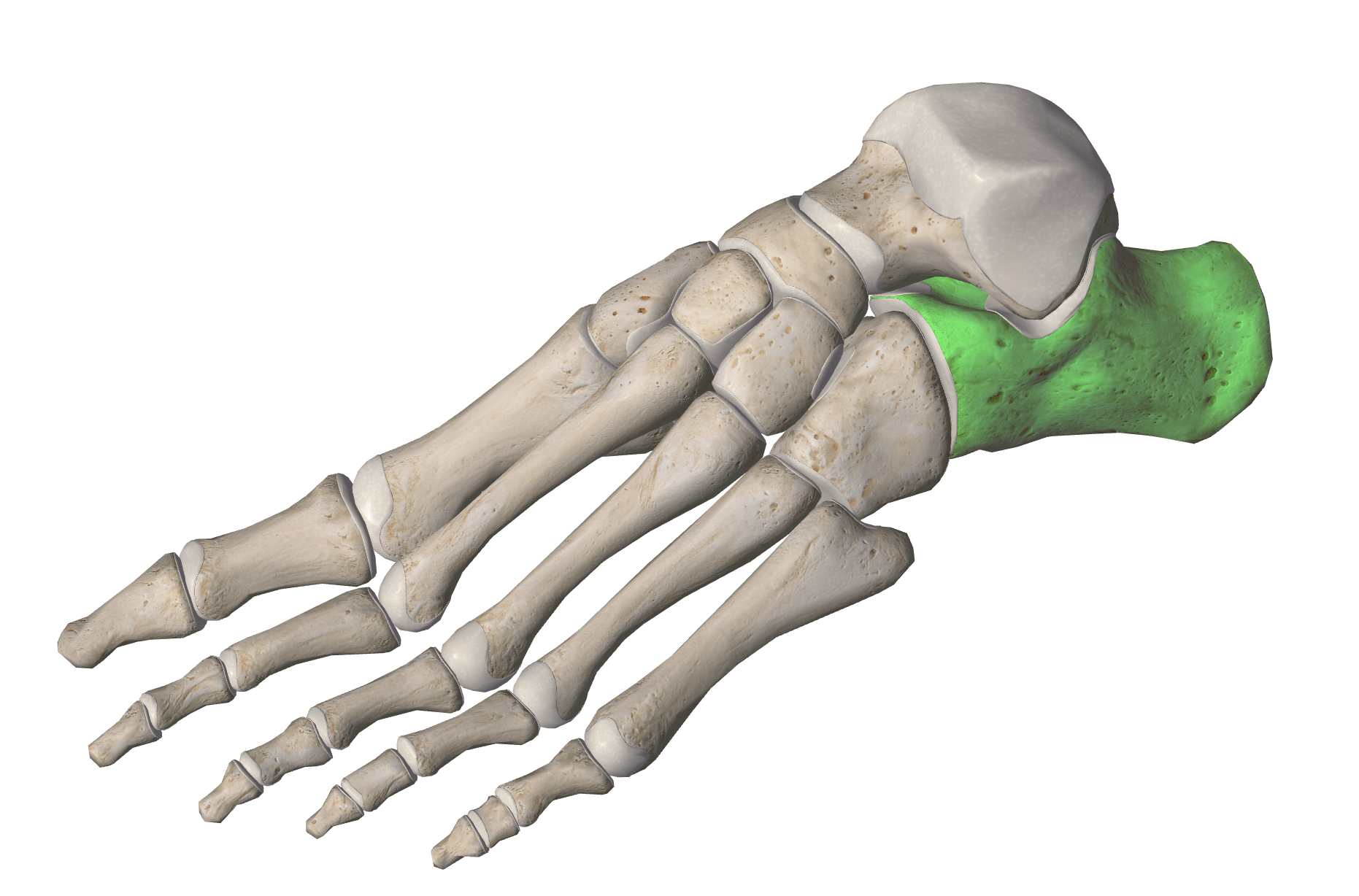
Name the bone shown in green.
a)
Femur
b)
Calcanous
c)
Patella 
d)
Fibula
126.

Arm Flexion

a)
b)
c)
d)
127.

Arm Extension

a)
b)
c)
d)
128.

Head Flexion

a)
b)
129.

Head Extension

a)
b)
130.

Abduction

a)
b)
131.

Adduction

a)
b)
132.

Planterflexion

a)
b)
133.

Inversion

a)
b)
134.

Eversion

a)
b)
135.

Supination

a)
b)
136.

Pronation

a)
b)
137.

Protraction

a)
b)
138.

Retraction

a)
b)
139.
Identify the joint action being performed.
a)
Circumduction
b)
Lateral Rotation
c)
Medial Rotation
d)
Eversion
140.
During endochondral ossification
a)
hyaline cartilage turns into bone 
b)
fibrocartilage turns into bone
c)
elastic cartilage turns into bone
d)
bone differentiates into cartilage
141.
Bones that originate within sheetlike layers of connective tissue.
a)
partial bones
b)
chondritic bones
c)
intramembranous bones
d)
endochondral bones
142.
Bone forming cells are called...
a)
osteoblasts
b)
osteocytes
c)
osteoclasts
d)
osteons
143.
Multinucleated cells that break down the calcified matrix of bone.
a)
osteoblasts
b)
osteoclasts
c)
osteons
d)
osteocytes
144.

The band of cartilage in the long bone epiphysis that grows

a)

zone of ossification

b)

ephiphyseal plate

c)

hyaline plate

d)

Z line

145.
The outer covering of a bone is called the
a)
Periosteum
b)
Pericardium
c)
Endosteum
d)
Peritoneum