
 Worksheets
Mrs Disney Y10- Biology Respiration Quiz
Total questions: 34
Worksheet time: 27mins
Name
Class
Date
1.
Cellular respiration takes place in the
a)
nucleus
b)
cytoplasm
c)
ribosomes
d)
mitochondria
2.
Which is not a waste product of cellular respiration?
a)
Water
b)
Heat
c)
Carbon Dioxide
d)
Oxygen
3.
This means that oxygen is needed
a)
anaerobic
b)
aerobic
4.
All living things do which of the following?
a)
Chemosynthesis
b)
Respiration
c)
photosynthesis
d)
all of the answers
5.
What is one of the reactants of cellular respiration?
a)
energy
b)
glucose
c)
carbon dioxide
d)
water
6.
______________ produces the most ATP.
a)
photosnthesis
b)
aerobic respiration
c)
anaerobic respiration
d)
glycolysis
7.
What happens to your breathing rate when you exercise?
a)
It increases
b)
It decreases
c)
It stays the same
8.
Which organ excretes carbon dioxide?
a)
Lungs
b)
Liver
c)
Heart
d)
Kidney
9.
What are the products of aerobic respiration?
a)
Glucose and oxygen
b)
Carbon dioxide and water
c)
Lactic acid
d)
Carbon monoxide
10.
What type of respiration requires oxygen?
a)
Aerobic
b)
Anaerobic
11.
Aerobic respiration is different from anaerobic respiration in that aerobic respiration needs...
a)
chlorophyll
b)
carbon dioxide
c)
glucose
d)
oxygen
12.
Anaerobic respiration.....
a)
doesn't require CO2
b)
requires CO2
c)
doesn't require oxygen
d)
requires oxygen
13.
Cellular Respiration's goal is to
a)
make water
b)
make ATP
c)
make glucose
d)
make oxygen
14.
Where does aerobic respiration occur?
a)
glucose molecule
b)
mitochondria
c)
cytoplasm
d)
chloroplast
15.

you breathe in oxygen for
a)
photosynthesis
b)
anaerobic respiration
c)
fermentation
d)
aerobic respiration
16.

When you exercise, your heart beats faster to...
a)
spread oxygen throughout your body more quickly.
b)
make you feel excited.
c)
let you know you're working hard.
17.
What type of cells carries oxygen?
a)
red blood cells
b)
white blood cells
c)
neurons
18.
What is the main bone structure that protects the lungs
a)
Vertebrae
b)
Rib cage
c)
Skull
d)
Pelvis
19.

What is the organ "x"
a)
Heart
b)
Lungs
c)
Diaphragm
d)
Trachea
20.

What is tube that is also known as your wind pipe?
a)
esophogus
b)
bronchi
c)
trachea
d)
alveoli
21.
Location of gas exchange
a)
alveoli
b)
myocardium
c)
raveoli
d)
pulmonary vent
22.
Air moves into the lungs due to
a)
decreased air pressure in lungs
b)
pressure of diaphragm on lungs
c)
throat muscles contracting
d)
active transport
23.
Oxygen from the air enters the blood stream at what location?
a)
Cardiac Notch
b)
Pulmonary Vein
c)
Alveoli
d)
Paranasal Sinuses
24.

When you breathe, your lungs take in ___ and remove ___.
a)
air/oxygen
b)
oxygen/carbon dioxide
c)
carbon dioxide/waste
d)
waste/air
25.
What surrounds the alveoli?
a)
oxygen
b)
carbon dioxide
c)
capillaries
d)
bronchioles
26.
Which of the following is true?
a)
CO2 concentration is higher in the capillaries than the alveoli
b)
CO2 concentration is higher in the alveoli than the capillaries
c)
O2 concentration is higher in the capillaries than the alveoli
d)
O2 concentration is lower in the alveoli than the capillaries
27.
Which of the following is true?
a)
Oxygen diffuses along the concentration gradient from the alveoli into the capillaries
b)
Oxygen diffuses against the concentration gradient from the alveoli into the capillaries
c)
Oxygen diffuses along a concentration gradient from the capillaries to the alveoli
d)
Oxygen diffuses against the concentration gradient from the capillaries to the alveoli
28.
Which of the following are features of the alveoli that adapt them to gas exchange?
I. High surface area
II. Thin walls
III. Dry surfaces
I. High surface area
II. Thin walls
III. Dry surfaces
a)
I and II only
b)
I only
c)
II and III
d)
I, II and III
29.
When air pressure inside the lungs is less than air pressure in the atmosphere...
a)
Air moves into the lungs
b)
Air moves out of the lungs
30.
For air to flow into the lungs, the pressure inside the alveoli must become lower than the atmospheric pressure. How does this occur?
a)
By decreasing lung size
b)
By coughing
c)
By increasing lung size
31.
When the diaphragm contracts and moves down, the lungs are...
a)
expanding with air
b)
shrinking - pushing air out
32.
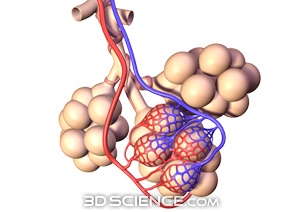
The air sacs that are covered with capillaries where gas exchange takes place
a)
bronchi
b)
lungs
c)
oxygen
d)
alveoli
33.
During cellular respiration, what happens to the carbon dioxide?
a)
It
leaves the alveoli and is exhaled from the lungs
b)
It leaves the bloodstream and enters the alveoli
c)
It leaves the cells and enters the bloodstream
d)
It leaves the alveoli and enters the bloodstream
34.
Which is the correct word equation for aerobic respiration?
a)
glucose + carbon dioxide= oxygen + water + energy
b)
glucose= energy + water
c)
glucose + oxygen = energy + water + carbon dioxide
d)
carbon dioxide + oxygen = glucose + energy
100 %

