Wayground logo

Free Printable Worksheets

Font size

S
M
L
XL
Worksheets

Circulatory System

Total questions: 59

Worksheet time: 41mins

Name
Class
Date
1.
Why are the walls of the left ventricle thicker than that of the right ventricle?
a)
The left ventricle must force blood into all the capillaries of the lungs 
b)
the left ventricle doesn't skip leg day
c)
This is false, the walls of the right ventricle are thicker
d)
Blood from the left ventricle is pumped throught the entire body 
2.

Receives oxygenated blood from the lungs

a)

Right Ventricle

b)

Left Ventricle

c)

Right Atrium

d)

Left Atrium

3.
A flap of tissue that prevents blood from flowing backward
a)
Aorta
b)
Atrium
c)
Septum
d)
Valve
4.
Carries the blood from the ventricle to the body
a)
Aorta
b)
Atrium
c)
Valve
d)
Septum
5.
Receives blood from the body that is low in oxygen and high in carbon dioxide
a)
Right Atrium
b)
Right Ventricle
c)
Left Atrium
d)
Left Ventricle
6.
Pumps deoxygenated blood to the lungs
a)
Right Ventricle
b)
Right Atrium
c)
Left Ventricle
d)
Left Atrium
7.
Circulation involving the lungs is called...
a)
Pulmonary Circulation
b)
Cutaneous Circulation
c)
Systemic Circulation
d)
Cardiac Convendency 
8.

Which contract in unison?

a)
Top chambers, then bottom chambers.
b)
Right Chambers, then the Left Chambers
c)
All four chambers beat in unison.
9.

The 'Lubb' sound of the heart's beat are caused by....

a)
Atrioventricular valves closing
b)
Semilunar Valves closing
c)
Blood flowing through the Pulmonary Trunk and Aorta
d)
Blood Flowing down into the venticles
10.

The 'Dupp' sound of the heart's beat are caused by....

a)
Atrioventricular valves closing
b)
Semilunar Valves closing
c)
Blood flowing through the Pulmonary Trunk and Aorta
d)
Blood Flowing down into the venticles
11.

The Vena Cava delivers blood to the heart into the.....

a)

left atrium

b)

right atrium

c)

left ventricle

d)

right ventricle

12.
What is the definition of the Cardiac Cycle?
a)
the contraction of the atria
b)
the sequence of events that occur during one complete heartbeat
c)
the contraction and relaxation of the ventricles
d)
the circulation of blood in the heart
13.

Heart murmurs are indicative of the valves of the heart not functioning properly.

a)
True
b)
False
14.
Abnormal or unusual heart sounds.
a)
Congestive heart failure (CHF)
b)
Heart murmurs
c)
Bradycardia
d)
Tachycardia
15.
What do capillaries, the smallest blood vessels, do?
a)
Exchange O2 only
b)
Exchange CO2 only
c)
exchange nutrients and  oxygen for waste 
d)
break down foods
16.
What are the 4 components of blood?
a)
White blood cells, Platelets, bone marrow, and oxygen
b)
Plasma, Platelets, yellow blood cells, and nutrients
c)
Plasma, White blood cells, red blood cells, and Platelets
d)
Platelets, Red blood cells
17.
Which does not make up the circulatory system?
a)
heart
b)
blood
c)
lungs
d)
blood vessels
18.
Where does the blood go after it goes into the pulmonary arteries?
a)
lungs
b)
heart
c)
head
d)
hands
19.

Which vein delivers blood from the abdomen and legs to the heart?

a)
inferior vena cava
b)
superior vena cava
c)
pulmonary veins
20.
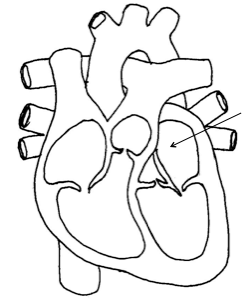
2?
a)
Heart
b)
Right Ventricle
c)
Left Atrium
d)
Left Ventricle
21.
How many chambers does the heart have ? 
a)
4
b)
6
c)
3
d)
1
22.
Identify
a)
Aorta
b)
Pulmonary Vein
c)
Superior Vena Cava
d)
Inferior Vena Cava
23.
What does Deoxygenated mean?
a)
Oxygen-rich
b)
Blood flow
c)
Oxygen-poor
d)
Water Flow
24.
Name this part.
a)
Left ventricle
b)
Pulmonary artery
c)
Right atrium
d)
Pulmonary veins
25.
Name this part.
a)
Right atrium
b)
Left ventricle
c)
Right ventricle
d)
Left atrium
26.
______ carry blood to the heart.
a)
Arteries
b)
Veins
c)
Capillaries
d)
Vena Cava
27.
_____ carries blood away from the heart.
a)
Blood cells
b)
Veins
c)
Capillaries
d)
Arteries
28.
What is #8?
a)
Left Ventricle
b)
Tricuspid Valve
c)
Septum
d)
Pulmonary Valve
29.
What part of blood is responsible for carrying oxygen and carbon dioxide to body cells?
a)
Erythrocytes
b)
Leukocytes
c)
Thrombocytes
d)
Plasma
30.
What part of blood is responsible for carrying wastes, nutrients, and minerals?
a)
Erythrocytes
b)
Leukocytes
c)
Thrombocytes
d)
Plasma
31.
Which leukocyte engulfs bacteria in tissues?
a)
neutrophils
b)
monocytes
c)
eosinophils
d)
basophils
32.
Which leukocyte can fight parasitic infections and help in allergic reactions?
a)
neutrophils
b)
monocytes
c)
eosinophils
d)
basophils
33.
Which leukocyte produces histamine in response to an allergen?
a)
neutrophils
b)
monocytes
c)
eosinophils
d)
basophils
34.

erythrocyte

a)

platelet

b)

white blood cell

c)

red blood cell

d)

plasma

35.

leukocyte

a)

red blood cell

b)

white blood cell

c)

serum

d)

platelet

36.

thrombocyte

a)

red blood cell

b)

white blood cell

c)

platelet

d)

serum

37.
Which component of blood is responsible for helping to stop bleeding?
a)
platelets
b)
red blood cells
c)
white blood cells
d)
plasma
38.
Which is which?
a)
Artery is A, vein is B
b)
Artery is B, vein is A
39.

What am I? I connect the arteries to the capillaries

a)

Arteriole

b)

Venule

40.

What am I? I connect the capillaries to the veins

a)

Arteriole

b)

Venule

41.

What am I? I am the outer layer of an artery or vein

a)

Tunica externa

b)

Tunica media

c)

Tunica intima

42.

What am I? I am the middle layer of an artery or vein

a)

Tunica externa

b)

Tunica media

c)

Tunica intima

43.

What am I? I am the inside layer of an artery or vein, or the only layer of a capillary

a)

Tunica externa

b)

Tunica media

c)

Tunica intima

44.
causes the blood vessel to constrict during the blood clotting process
a)
thrombin
b)
erythropoietin
c)
hemoglobin
d)
seratonin
45.

The three layers of the heart are as follows:

a)

myocardium, pericardium, endocardium

b)

myocardium, endocardium, pericardium

c)

myocardium, endocarditis, endocardium

d)

myocardium, exocardium, pericardium

46.
This is the thickest layer of the heart
a)
Pericardium
b)
Endocardium
c)
Myocardium
d)
Epicardium
47.
The layer of the heart that forms a smooth, protective lining of the heart chambers and valves is the _______________.
a)
endocardium
b)
myocardium
c)
epicardium
d)
parietal pericardium
48.
What is the order of blood vessels once blood leaves the heart?
a)

arteries

b)

arterioles

c)

capillaries

d)

venules

e)

veins

1)
2)
3)
4)
5)
49.
All arteries carry oxygenated blood and all veins carry deoxygenated blood.
a)
True
b)
False
50.

The process by which white blood cells travel through the walls of blood vessels is termed

a)

diffusion

b)

diapedesis

c)

filtration

d)

chemotaxis

51.

Oxygenated blood nourishing the myocardium comes from vessels that branch off the aorta called

a)

pulmonary arteries

b)

pulmonary veins

c)

coronary arteries

d)

venae cavae

52.
Which component of blood is the liquid part that makes up about 55% of its volume?
a)
Red Blood Cells (RBCs)
b)
White Blood Cells (WBCs)
c)
Platelets
d)
Plasma
53.

What is the largest artery in the body?

a)

Pulmonary Artery

b)

Superior Vena Cava

c)

Inferior vena cava

d)

Aorta

54.

The three arterial branches of the aortic arch are:

(select three)

a)

Brachiocephalic trunk

b)

Left common carotid artery

c)

Left subclavian artery

d)

thoracic aorta

55.

Which of these veins does NOT drain into the superior vena cava?

a)

Radial & ulnar veins

b)

Cephalic Vein

c)

Basilic Vein

d)

Common iliac vein

56.

Which of these veins is the longest in the body and receives drainage from the legs?

a)

Azygos Vein

b)

Great Saphenous Vein

c)

Common Iliac Vein

d)

Brachiocephalic Veins

57.

The hepatic portal vein carries blood to the _______ where it is processed before returning to the systemic circulation.

a)

Brain

b)

Stomach

c)

Liver

d)

Lungs

58.

In which direction does blood primarily flow in arteries?

a)

Away from the heart

b)

Toward the heart

c)

Both away from and toward the heart

d)

Parallel to the heart

59.

Which area of the brain controls the rhythm of the heart?

a)

brain stem

b)

cardiac region

c)

medulla oblongata

d)

all of these