wayground logo

Free Printable Worksheets

NEW

Font size

S
M
L
XL
Worksheets

Human Biology Unit 3 Review

Total questions: 64

Worksheet time: 2hrs 31mins

Name
Class
Date
1.
What is Dendrite
a)
nerve fibers that carry message to cell body
b)
allow nerve impulses to pass from one neuron to next neuron
c)
nerve fibers that carry message from the cell body
d)
fat covering of the neuron
2.
If I step on a nail...what type of neurons take the response to my muscles?
a)
motor
b)
interneurons
c)
sensory
d)
not neurons, muscle tissue sends the response
3.

The 2 ions that are important in nerve conduction and action potential are:

a)

Potassium and calcium

b)

Sodium and potassium

c)

Sodium and calcium

d)

Sodium, calcium, and potassium

4.

Which structure is responsible for balance?

a)

Cerebellum

b)

Cerebrum

c)

Thalamus

d)

Hypothalamus

5.

Flight- fight response is controlled by what division?

a)

Parasympathetic

b)

Sympathetic

c)

Somatic

d)

Afferent

6.

The emotional part of the brain is mostly controlled by which structure?

a)

Thalamus

b)

Limbic system

c)

Epithalamus

d)

Cerebrum

7.

Which of the following is a chemical signal that diffuses across the gap between adjacent neurons to convey a message to the next cell?

a)

neurotransmitter

b)

synapse

c)

dendrite

d)

action potential

8.

________ is created by an insufficient amount of several neurotransmitters, such as serotonin, dopamine, and norepinephrine, for extended periods of time.

a)

Depression

b)

Parkinson's

c)

Alzheimer's

d)

Happiness

9.

Which part of the brain is responsible for hand-eye coordination?

a)

cerbellum

b)

hypothalumus

c)

brain stem

d)

cortex

10.

The purpose of the cerebellum is to help you?

a)

remain coordinated

b)

regulate hunger and thirst

c)

keep alert

d)

blink your eyes

11.

Two broad classes of neurons are...

a)

up neurons and down neurons

b)

left neurons and right neurons

c)

motor neurons and sensory neurons

d)

in neurons and out neurons

12.
Responsible for bright light and color
a)
cones
b)
rods
c)
cornea
13.
inability or decreased ability to see colors - Usually caused by impairment of cones 
a)
cataract
b)
color blindness
c)
conjunctivitis
d)
detached retina
14.
The optic disc is located on the:
a)
cornea
b)
sclera
c)
retina
15.
______ pain originates in an internal organ yet is felt in another region of the skin. 
a)
referred pain
b)
phantom pain
16.

________ is stimulated by changes in pressure or movement

a)

Equillibrium

b)

Mechanoreceptors

c)

Thermoreceptors

d)

Chemoreceptors

17.

This spot on the retina has

not rods or cones and

creates...

a)

Glacoma

b)

Optic Nerves

c)

Upside down images

d)

A Blind Spot

18.
The sense of hearing detects ________________ stimuli.
a)
electromagnetic
b)
thermal
c)
mechanical
d)
chemical
19.
a signal molecule that transmits nerve impulses across synapses
a)
neuron
b)
neurotransmitter
c)
nerve
d)
action potential
20.
nerve impulse
a)
action potential
b)
resting potential
c)
membrane potential
d)
synapse
21.
When a neuron is depolarized, what are the first channels to open?
a)
Sodium
b)
Potassium
c)
Calcium
d)
ACTH
22.
When a neuron is resting, the inside of the axon has a ____________ charge.
a)
positive
b)
negative
23.

What maintains the resting membrane potential in a neuron?

a)

sodium-potassium pumps

b)

sodium channels

c)

potassium channels

d)

gravity

24.

The endocrine system is in charge of...

a)

giving signals to nerves.

b)

controlling and regulating body processes chemically through hormones.

c)

the excretion of waste.

d)

breaking down nutrients.

25.

What hormone lowers calcium in blood?

a)

Prolactin

b)

Insulin

c)

Progesterone

d)

Calcitonin

26.

What hormone prevents water loss?

a)

Growth hormone

b)

Vasopressin

c)

Oxytocin

d)

T3

27.

What hormone is responsible for a flight-or-fight response?

a)

Androgens

b)

Adrenaline

c)

Progesterone

d)

Follicle-stimulating hormone

28.
Which of the following anterior pituitary hormones stimulates Cortisol production?
a)
Adrenocorticotropic hormone
b)
Insulin like growth factors
c)
Luteinizing hormone
d)
Prolactin
29.
Which of the following hormones opposes the action of parathyroid hormone?
a)
Thyroid stimulating hormone
b)
Testosterone
c)
Insulin
d)
Calcitonin
30.
The gland(s) most responsible for controlling your growth is
a)
The endocrine gland.
b)
The pituitary gland.
c)
The adrenal glands.
d)
The thymus gland.
31.
Insulin and glucagon;
a)
Are secreted by the beta cells of the islets of Langerhans
b)
Elevate blood glucose
c)
Are secreted in response to declining plasma levels of glucose
d)
Are secreted by the pancreas and are concerned with the regulation of blood glucose
32.
Disease of the pancreas where no insulin is produced causing patients to have high blood sugars
a)
diabetes mellitus type 1
b)
graves disease
c)
addisons disease
d)
diabetes insipidus
33.
Disease caused by excessive growth hormone released by the pituitary gland during early years.
a)
acromegaly
b)
gigantism
c)
cretinism
d)
dwarfism
34.
Disease caused from overproduction of growth hormone during the adult years
a)
gigantism
b)
myxedema
c)
cushing syndrome
d)
acromegaly
35.
Disease caused from hyposecretion of growth hormone inhibiting growth in the bones and muscles
a)
insomnia
b)
acromegaly
c)
pitutary dwarfism
d)
addisons disease
36.
Hypothyroidism that results in bulging eyes
a)
insomnia
b)
cushing syndrome
c)
addisons disease
d)
graves disease
37.

What is the job Growth Hormone (GH)?

a)

A hormone secreted by the pituitary gland that stimulates the production of cortisol that is produced by the adrenal glands.

b)

A hormone that increases growth in animal or plant cells, especially used by animals.

c)

The endocrine system's most influential gland. Under the influence of the hypothalamus, the pituitary regulates growth and controls other endocrine glands.

d)

A hormone created by the pituitary gland that is used to stimulate the production of sperm.

38.
There are two types of antigens - A and B
a)
True
b)
False
39.
O blood type 
a)
contains little oxygen
b)
is not a blood type
c)
contains excessive oxygen
d)
has no antigens
40.
White Blood Cells fight off infection and germs
a)
True
b)
False
41.
What part of blood is responsible for carrying wastes, nutrients, and minerals?
a)
Erythrocytes
b)
Leukocytes
c)
Thrombocytes
d)
Plasma
42.
What part of blood eats up pathogens and dead cells?
a)
leukocytes
b)
plasma
c)
platelets
d)
erythrocytes
43.
Blood vessels that carry blood away from the heart.
a)
arteries
b)
blood
c)
vein
d)
circulation
44.
Blood vessels that carry blood back toward the heart.
a)
veins
b)
small intestine
c)
arteries
d)
blood
45.
Through which vessel does gas exchange happen?
a)
artery
b)
vein
c)
capillaries
d)
liver
46.
the pressure exerted on the blood vessels when the heart beats
a)
systolic
b)
diastolic
47.
What direction does conduction in the heart travel?
a)
Atria to ventricles
b)
Ventricles to atria
48.
This "pacemaker" controls the heart beat
a)
Sinoatrial Node
b)
Atrioventricular node
c)
Purkinje fibers
d)
AV Bundle
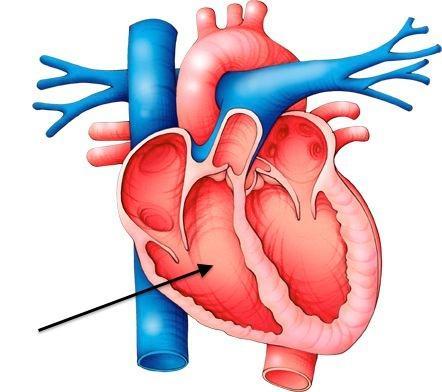
49.
Identify
a)
Left atrium
b)
Right atrium
c)
Left ventricle
d)
Right ventricle
50.

1. What part of the heart delivers un-oxygenated blood to the lungs?

a)

Pulmonary artery

b)

Pulmonary vein

c)

Aorta

d)

Left Ventricle

51.

3. The blood enters on the left side of the heart through the ______________ and enters the left atrium. It then passes through the _____________to enter the left ventricle.

a)

pulmonary vein, mitral valve

b)

pulmonary artery, mitral valve

c)

pulmonary vein, tricuspid valve

d)

pulmonary artery, aortic valve

52.

True or False: Pulmonary veins take un-oxygenated blood away from the heart.

a)

True

b)

False

53.
What is the difference between lymph and blood?
a)
Blood contains erythrocytes
b)
Lymph contains platelets
c)
Blood contains monocytes
d)
Lymph contains wastes
54.

How do platelets help people stop bleeding?

a)

They don't. Arteries do.

b)

by sticking to the wall of the blood vessels and promote clotting

c)

by taking oxygen-rich blood from the heart to all parts of the body.

d)

by exhanging nutrients and waste

55.

Platelets help with

a)

oxygen

b)

breathing

c)

clotting

d)

plaque

56.

With high blood pressure blood vessels are _______making the heart work harder.

a)

narrowed

b)

widened

c)

collapsed

d)

gone

57.

The upper chambers of the heart are the:

a)

atria

b)

ventricles

c)

plasma

d)

capillaries

58.

The lower chambers of the heart are called:

a)

atria

b)

ventricles

c)

veins

d)

plasma

59.
What is a piece of clot that has broken off and entered circulation?
a)
Embolus
b)
Sickle cell
c)
Western blot
d)
Mononucleosis
60.

The nurse is assessing the client’s electrocardiography (ECG). What does the P wave on the ECG tracing represent?

a)

Contraction of the atria

b)

Contraction of the ventricles

c)

Depolarization of the atria

d)

Depolarization of the ventricles

61.

A patient is admitted for diagnosis of an electrocardiogram abnormality. Which wave should the nurse plan care based upon changes in the patient’s ventricular depolarization?

a)

P wave

b)

QRS complex

c)

U wave

d)

T wave

62.

The nurse is reviewing cardiac anatomy with a patient scheduled for pacemaker insertion. Where should the nurse identify the location of the sinus node for the patient?

a)

Left atrium

b)

Right atrium

c)

Left ventricle

d)

Right ventricle

63.

The Vena Cava delivers blood to the heart into the.....

a)

left atrium

b)

right atrium

c)

left ventricle

d)

right ventricle

64.
The 'Lub' sound of the heart's LUB DUB? are the....
a)
Atrioventricular valves closing
b)
Semilunar Valves closing
c)
Blood flowing through the Pulmonary Trunk and Aorta
d)
Blood Flowing down into the venticles