
Font size
 Worksheets
Test Review Properties of Matter
Total questions: 50
Worksheet time: 28mins
In a hot summer day
ice cubes in your drink have less energy
molecules in the air move faster
the air in your balloon contracts
Imagine you have a glass of water. The water molecules in the glass
are tightly packed together and stay in a fixed position.
have no viscosity.
decrease in volume with increasing temperature.
are free to move around one another but still touch.
Consider a cup of hot coffee. As the coffee cools down and the particles in it move slower and
the coffee becomes colder.
the coffee becomes warmer.
the coffee has more energy.
the coffee has less energy.
During a cold winter night as the temperature drops, the particles in the air outside your window ...
speed up and move farther apart
speed up and move closer together
slow down and move farther apart
slow down and move closer together
When you heat up a pot of water on the stove, the water molecules...
speed up and move closer
speed up and move farther apart
slow down and move closer together
slow down and move farther apart

Which of the following statements is NOT true of all different types of matter?
They are made of atoms and molecules
The particles are always in motion
The particles always move at the same speed
The arrangement of the particles determines the state of matter.

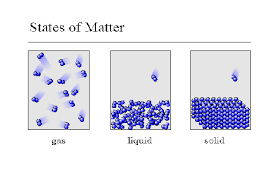
Which state of matter has particles arranged like this?
solid
liquid
gas
plasma

Which state of matter has particles arranged like this?
solid
liquid
gas
plasma

Which state of matter has particles arranged like this?
solid
liquid
gas
plasma
To move from a gas to a liquid, energy needs to be
added
taken away
To move from a solid to a gas, energy needs to be
added
taken away
To move from a liquid to a solid, energy needs to be
added
taken away
To move from a liquid to a gas, energy needs to be
added
taken away
During a cold winter day, when ice starts to melt, it reaches a certain temperature. This temperature is the same as its
temperature at which it starts to freeze.
temperature at which water vapor starts to condense.
temperature at which it starts to boil.

Which segment on the graph represents freezing?
segment AB
segment BC
segment CD
segment DE

During segment D the substance is
boiling.
melting.
freezing.
condensing.

During segment EF the substance is a
solid
liquid
gas

During which segment is the substance a liquid?
A
B
C
D

What is the substance's boiling point, based on the heating curve?
55 C
90 C
120 C
30 C

Based on the heating curve, this substance's melting/freezing point is
2700 C
4000 C
500 C
1500 C


Which of the following examples represents a physical change?


A teacher is demonstrating physical and chemical changes to her class. Which action should they use to demonstrate a chemical change?
Cutting a piece of paper with scissors.
Folding a piece of paper into an airplane.
Ripping a piece of paper with their hands.
Burning a piece of paper with a match.

Properties that describe how a substance looks, feels, or its state of matter, etc. are __________________.
Chemical properties
Physical properties


Why does the image best represent an example of a physical change?
The pencil can no longer be used.
The pencil is a different size.
The materials making up the pencil did not change.
The materials making up the pencil are different.

Select the physical properties.
colorless liquid
soluble in water
vaporize at 48 degrees
acid is reactive with zinc
Separating a solution like sand and water using a filter is a...
physical change
chemical change
change of form
change of state
Boiling is......(select 2)
a physical change
chemical change
change of state
producing a new gas substance
Select the possible signs of a chemical change.
produces sound and light
produces heat
changes state
changes size
changes shape
Oil and water separate because of...
the physical property of melting point
the physical property of state
the physical property of density
the chemical property of flammability
the chemical property of reactivity
Separating sugar and water through evaporation is a...... (select 2)
physical change for water
physical change for sugar
chemical change for water
chemical change for sugar
Select the chemical change.
grounding flour
melting crayons in the sunshine
fireworks exploding
roads expanding when its cold
Photosynthesis is a...
physical change
chemical change
Digestion is a....
physical change
chemical change

Which is more dense and why? (select 2)
Ice
Warm Water
Cold Water
the molecules are more tightly packed
the molecules are more spread out
Objects will sink in water if their density is....
less than 1 g/mL
more than 1 g/mL
equal to 1 g/mL
When a gas becomes a liquid...(select 2)
the particles spread out
the particles lose energy
the temperature rises
the particle motion decreases
the type of particle changes
The state of matter with the least particle motion is.....
solid
liquid
gas
plasma
Solid to Liquid = (select 2)
more energy
less energy
higher temperature
lower temperature

