
 Worksheets
Water Unit
Total questions: 77
Worksheet time: 1hrs 24mins
Name
Class
Date
1.
What two elements make up water?
a)
Helium and oxygen
b)
Hydrogen and oxygen
c)
helium and carbon
d)
oxygen and carbon
2.

What part of the water cycle does this picture show?
a)
condensation
b)
precipitation
c)
evaporation
3.
Which of these is an example of precipitation?
a)
snow
b)
air
c)
clouds
d)
vapor
4.
Which is the opposite of condensation?
a)
runoff
b)
evaporation
c)
precipitation
d)
transpiration
5.
Snow, sleet, hail, and rain are all examples of ________________.
a)
evaporation
b)
condensation
c)
accumulation
d)
precipitation
6.

What is it called when WATER is FORMED from an LIQUID to a WATER VAPOR Oor an [GAS]?
a)
EVAPORATION
b)
PRECIPITATION
c)
TRANSPIRATION
7.

What is it called when plants give off water vapor as a waste product?
a)
condensation
b)
evaporation
c)
sublimation
d)
transpiration
8.
When water _________, dew forms.
a)
Melts
b)
Evaporates
c)
Condenses
d)
Precipitates
9.
What is the water cycle?
a)
the 3 forms of water
b)
the movement of water on, above, or below the surface of the Earth
c)
when water melts
d)
when clouds form
10.
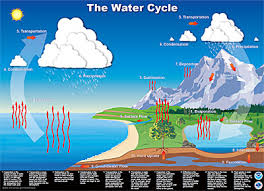
During which stage do clouds form?
a)
condensation
b)
evaporation
c)
precipitation
11.
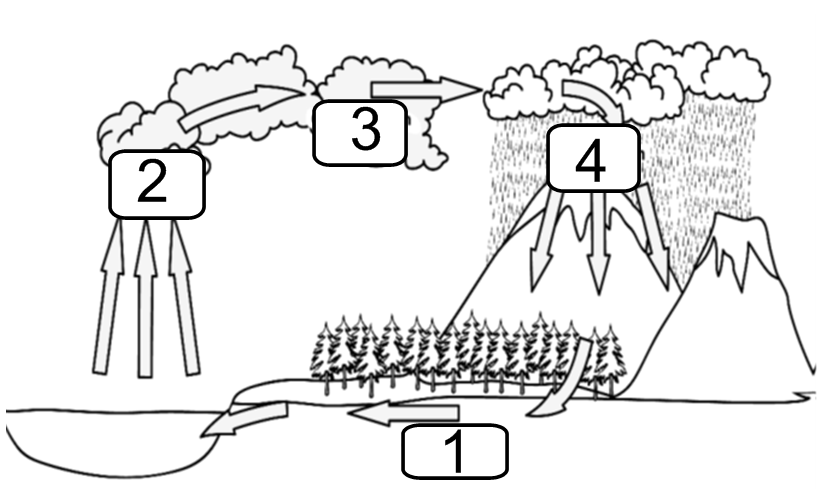
Which stage does the #2 show in the diagram?
a)
condensation
b)
evaporation
c)
precipitation
d)
run off
12.

Which stage does the #3 show in the diagram?
a)
condensation
b)
evaporation
c)
precipitation
d)
run off
13.

what does the #4 show in the diagram?
a)
condensation
b)
evaporation
c)
precipitation
d)
run off
14.
What is the process during which water cools and turns from a gas to a liquid?
a)
Codensation
b)
Runoff
c)
Precipitation
d)
Evaporation
15.
The first step in the water cycle
a)
evaporation
b)
condensation
c)
precipitation
d)
there is no first step
16.
Any type of liquid or solid water that falls to earth's surface
a)
evaporation
b)
condensation
c)
precipitation
d)
runoff
17.
The ________ is the driving force of the earth's surface.
a)
sun
b)
moon
c)
stars
18.
The water cycle has no start or end
a)
true
b)
false
19.
Precipitation occurs because
a)
the droplets evaporate in the air
b)
the droplets are too light for the air to hold
c)
the droplets are too heavy for the air to hold
20.
The water cycle is also known as ..........
a)
Hypertonic Solution
b)
Hydrological Cycle
c)
Hyperlogical Cycle
d)
None of these
21.
What is a huge, slow-moving mass of ice and snow called?
a)
well
b)
glacier
c)
river system
d)
geyser
22.
What is a layer of rock or sediment that holds water?
a)
glacier
b)
well
c)
aquifer
d)
natural spring
23.
97% of the Earth's water is located in....
a)
ground wat
b)
the ocean
c)
lakes, rivers, and streams
d)
glaciers
24.

What comes after evaporation during the water cycle?
How does this occur?
How does this occur?
a)
Water evaporates into water vapor
b)
Water vapor condenses and forms a cloud
c)
Water precipitates to the ground
d)
Water runs down into the hydrosphere
25.

What could happen when a drop of water falls back to earth?
a)
it goes underground then into oceans,lakes, or rivers
b)
it goes into your mouth
c)
it goes underground
d)
it goes to the beach
26.

Does warm water evaporate quicker than cold water?
a)
Yes
b)
No
27.

Is humidity the amount of water in the air?
a)
Yes
b)
No
28.

What causes water vapor to move?
a)
wind
b)
snow
c)
water
d)
lava
29.

Fresh water makes up what percent of the Earth's water?
a)
5%
b)
10%
c)
4%
d)
3%
30.

Most of the Fresh water on Earth is
a)
in the ocean
b)
underground
c)
frozen
d)
in rivers
31.

A watershed is an
a)
area that drains into a stream or river
b)
section of land that juts into the ocean
c)
the shoreline of the ocean
d)
the end of a continent
32.

Which ocean is our largest ocean?
a)
Artic
b)
Indian
c)
Atlantic
d)
Pacific
33.

The largest reservoir of fresh water on Earth is found in
a)
glaciers
b)
harbors
c)
gulfs
d)
bays
34.
What percentage of the Earth's Water is salt water?
a)
75%
b)
97%
c)
3%
d)
2%
35.
The majority of FRESH LIQUID water on Earth is found
a)
In rivers
b)
In Lakes
c)
Underground
d)
Wetlands
36.
A layer of rock that water can penetrate is called
a)
permeable
b)
impermeable
c)
wetland
d)
aerated
37.
What causes deep currents?
a)
differences in density
b)
wind
c)
weather
d)
Coriolis effect
38.
What causes surface currents?
a)
global wind
b)
salinity
c)
wind
d)
density
39.
Which process will increase the salinity of ocean water?
a)
evaporation
b)
currents
c)
Coriolis effect
d)
density
40.
How will the melting of icecaps change the salinity of ocean water?
a)
raise the salinity
b)
lower the salinity
c)
no change to the salinity
d)
I have no idea
41.
How are salts added to the ocean?
a)
precipitation
b)
evaporation
c)
erosion from land
d)
density
42.
As the ocean depth increases, how to temperature and density change?
a)
it gets colder and more dense
b)
it gets colder and less dense
c)
it gets warmer and more dense
d)
it gets warmer and less dense
43.
What is a deep valley in the ocean formed at a convergent boundary?
a)
continental shelf
b)
mid-ocean ridge
c)
trench
d)
abyssal plain
44.
What is a flat plain deep in the ocean?
a)
abyssal plain
b)
trench
c)
mid ocean ridge
d)
continental shelf
45.
What is a long, underwater mountain chain formed at a divergent plate boundary?
a)
trench
b)
mid-ocean ridge
c)
continental shelf
d)
continental rise
46.
What is the primary cause of waves?
a)
wind
b)
density
c)
salinity
d)
the moon
47.
What is the measure of the amount of dissolved salts in a liquid?
a)
density
b)
salinity
c)
density
d)
Coriolis effect
48.
If the first low tide of the day occurs at 4 AM, the next low tide will occur around
a)
4 PM
b)
noon
c)
10 AM
d)
4 AM the next day
49.
We have _____ tides each day.
a)
1 high and 1 low
b)
2 high and 2 low
c)
4 high
d)
it depends
50.
What causes tides?
a)
wind
b)
differences in density
c)
gravity from the moon
d)
plate tectonics
51.
Where is the most dense ocean water?
a)
deep in the ocean
b)
at the surface
c)
in the middle layer
d)
at the coast
52.
How does the moon affect Earth?
a)
it causes plate tectonics
b)
it causes tides
c)
it causes wind
d)
it causes the weather
53.
Where does most water vapor in the air come from?
a)
transpiration
b)
evaporation from groundwater
c)
evaporation from oceans
d)
precipitatoin
54.
How does the moon, Earth, and sun being aligned impact tides?
a)
it creates spring tides
b)
it creates neap tides
c)
it cancels out tides
d)
it causes dense tides
55.
Both the moon and sun create tides. Why does the moon have a greater effect?
a)
the moon is a solid
b)
the moon is larger than the sun
c)
the moon is farther from the Earth
d)
the moon is closer to the Earth
56.
How does the gravitational pull of the moon impact Earth's oceans?
a)
it causes the ocean to bulge on the side nearest the moon and opposite the moon
b)
it causes the water to buldge on the side farthest from the moon
c)
it does not affect Earth's oceans
d)
the affect is random
57.
How could an understanding of surface currents help early explorers and traders?
a)
it helped them find quicker sailing routes
b)
it kept their boat from sinking
c)
it helped them find passengers
d)
it kept them rich
58.
What is the name of the area of the ocean floor where you would play at the beach?
a)
abyssal plain
b)
trench
c)
continental shelf
d)
continental slope
59.
The total amount of water on Earth is
a)
increasing
b)
decreasing
c)
staying the same
60.
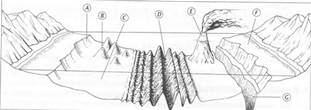
What is letter D?
a)
Cont. Shelf
b)
Mid-Ocean Ridge
c)
Volcanic Island
d)
Seamount
61.
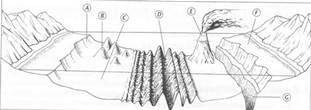
What is letter E?
a)
Volcanic Island
b)
Seamount
c)
Mid-Ocean Ridge
d)
Abyssal Plain
62.
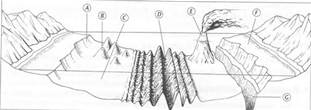
What is letter G?
a)
Mid-Ocean Ridge
b)
Rift
c)
Trench
d)
Cont. Shelf
63.
The gradually sloping part of a continent that extends under the ocean is the...
a)
continental slope
b)
continental shelf
c)
abyssal plain
d)
trench
64.
Seamount is similiar to...
a)
a volcanic island
b)
a small mountain or volcano
c)
The Great Plains
d)
The Grand Canyon
65.
The place where new ocean floor forms is called the...
a)
mid ocean ridge
b)
abyssal plain
c)
trench
d)
continental shelf
66.
The shallowest(least deep) part of the ocean is the ____________________
a)
trench
b)
abyssal plain
c)
continental shelf
d)
continental slope
67.
the deepest part of the ocean
a)
trenches
b)
abyssal plain
c)
ocean basin
d)
rift
68.
What is the difference between a volcanic island & a seamount?
a)
A volcanic island rises above the water & a seamount does not
b)
A seamount rises above the water & a volcanic island does not
c)
Both the seamount & volcanic island are underwater
d)
Both the seamount & the volcanic island rise above the water
69.
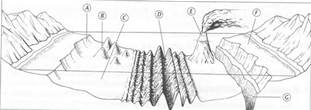
What is letter A?
a)
Cont. Shelf
b)
Cont. Slope
c)
Seamount
d)
Abyssal Plain
70.
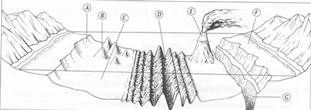
What is letter C?
a)
Mid-Ocean Ridge
b)
Cont. Shelf
c)
Cont. Slope
d)
Abyssal Plain
71.

What letter is B?
a)
Cont. Shelf
b)
Cont. Slope
c)
Mid-Ocean Ridge
d)
Seamount
72.
Surface currents are a result of
a)
Global Wind Patterns
b)
Earth's Rotation
c)
Density
d)
All of the above
73.
Deep Ocean currents are a result of
a)
Global Wind Patterns
b)
Earth's Rotation
c)
Density
d)
All of the above
74.
The Gulf stream carries _____________ water from the east coast of The United States to the West coast of Europe.
a)
Cold
b)
Warm
c)
Freezing
d)
Fresh
75.
Warm ocean currents generally come from
a)
The North Pole
b)
The South Pole
c)
The Equator
d)
Both A and B
76.
Cold ocean currents generally come from
a)
The North Pole
b)
The South Pole
c)
The Equator
d)
Both A and B
77.
A strong surface current that runs along the east coast of the United States and carries warm water to Europe.
a)
California Current
b)
Global Conveyor Belt
c)
Gulf Stream
d)
Surface Current
100 %

