wayground logo

Free Printable Worksheets

NEW

Font size

S
M
L
XL
Worksheets

CFA #3: Earth Science Final

Total questions: 54

Worksheet time: 52mins

Name
Class
Date
1.
Diamond has a hardness of ___ on Mohs Hardness Scale.
a)
1
b)
5
c)
8
d)
10
2.
By definition, a mineral has which of the following characteristic(s)?
a)
definite chemical composition
b)
crystal structure
c)
naturally occuring
d)
all of the above
3.
A naturally occurring, inorganic solid with a crystal structure and a definite chemical composition is referring to
a)
density
b)
streak
c)
mineral
d)
non silicate mineral
4.
A mineral's resistance to being scratched is called?
a)
streak
b)
luster
c)
hardness
d)
heft
5.
What does the Mohs Scale measure?
a)
Streak
b)
Luster
c)
Hardness
d)
Cleavage
6.
What are the two most useful tests when identifying a mineral
a)
streak and color
b)
color and luster
c)
cleavage and fracture
d)
streak and hardness
7.
___________ is the color of powdered mineral.
a)
Luster
b)
Streak
c)
Fracture
8.
Minerals are identified by observing their ___________.
a)
physical properties
b)
name
c)
location
9.
Which mineral property is being shown here?
a)
luster
b)
hardness
c)
cleavage
d)
streak
10.
This rock was formed when molten rock cooled into a solid. What type of rock is it?
a)
Igneous Rock
b)
Metamorphic Rock
c)
Sedimentary Rock
11.
This rock was formed when molten rock cooled into a solid. What type of rock is it?
a)
Igneous Rock
b)
Metamorphic Rock
c)
Sedimentary Rock
12.
What is sedimentary?
a)
Formed by heat and pressure
b)
Formed by heat and cooling
c)
Layered rock formed by compaction
d)
All of the above
13.
Fossils are only found in
a)
Sedimentary rocks
b)
Foliated Metamorphic rocks
c)
Igneous Rocks
d)
Nonfoliated Metamorphic rocks
14.
Extreme Heat and Pressure creates a _________ rock.
a)
Igneous
b)
Metamorphic
c)
Sedimentary
d)
Mineral
15.
what is the rock cycle.
a)
molten rock that is stored underground.
b)
rock material that forms where rocks are broken down into smaller pieces.
c)
a process that changes one type of rock into another type of rock.
16.
This rock is made from tiny pieces of other rocks that settled to the bottom of a valley millions of years ago. What type of rock is this?
a)
Sedimentary
b)
Igneous
c)
Metamorphic
17.
This rock started as lava that cooled and then was heated and put under pressure over time. What type of rock is this?
a)
Sedimentar
b)
Igneous
c)
Metamorphic
18.

In an undistrubed rock sequence, the youngest rock layer is located

a)

at the bottom of the sequence

b)

at the top of the sequence

c)

below the sedimentary rock layer

d)

below the unconformity

19.

shortest units of geologic time

a)

eons

b)

epochs

c)

eras

d)

periods

20.

largest subdivision of eons

a)

eons

b)

epochs

c)

eras

d)

periods

21.

According to the Law of Superposition, if sedimentary rock layers are deposited in a time sequence, which layer is the oldest layer?

a)

top layer

b)

bottom layer

22.

Choose the correct order of relative ages for the rock

layers below, starting with the oldest, and finishing with the youngest layer.

a)

B, C,D,A,E

b)

E,D,C,B,A

c)

A,B,C,E,D

d)

A,B,C,D,E

23.

To be an index fossil, a fossil must

a)

be present in rocks that are scattered over a small geographic area.

b)

contain remains of organisms that lived for a long period of geologic time.

c)

have features that clearly distinguish it from other fossils.

d)

be few in number.

24.

What Era are we currently in?

a)

Paleozoic

b)

Mesozoic

c)

Cenozoic

d)

Triassic

25.
How old do Paleontologists believe the Earth is?
a)
2015 years old
b)
3.6 billion years old
c)
4.6 billion years old
d)
4.6 million years old
26.
Place the following units in order, from smallest to largest.
a)
Epoch, period, eon
b)
Eon, epoch, period
c)
Period, eon, epoch
d)
Epoch, eon, period
27.
During which era did mammals first appear?
a)
Mesozoic Era
b)
Pre-Cambrian Time
c)
Paleozoic Era
d)
Cenozoic Era
28.
What is the top layer of the Earth's surface called? 
a)
Mantle
b)
Innercore
c)
Outercore
d)
Crust
29.
This layer of Earth is the thickest part
a)
crust
b)
outer core
c)
mantle
d)
inner core
30.
Where does the heat come from that drives this convection current in the mantle? 
a)
The sun
b)
The crust
c)
the mantle
d)
the core
31.
The part of the earth that includes the crust and the upper mantle and is split into tectonic plates is the
a)
lithosphere
b)
 crust
c)
asthenosphere
d)
mantle
32.
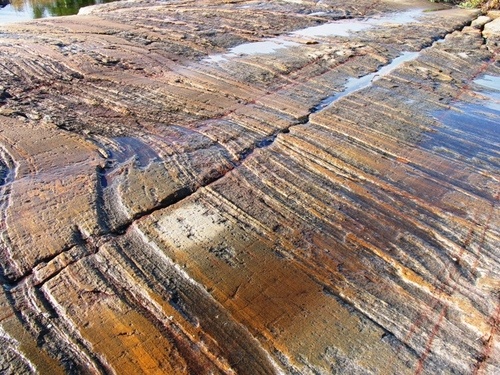
This is a picture of glacier scars found in Africa.  What are these evidence for?
a)
Africa has always been near the equator
b)
Africa was once in an area of the Earth that had a very cold climate
c)
The continents have not moved
d)
sea floor spreading
33.
What does the theory of continental drift state?
a)
The continents were once joined in a super-continent and have moved over time
b)
Continents are stationary and do not move
c)
The Earth is broken into lithospheric plates that move due to convection currents
d)
none of the above
34.
Which of the following is evidence that supports continental drift?
a)
the presence of penguins at both the equator and Antarctica
b)
fossils of the same plant have been found on several continents
c)
the presence of glacial features in Antarctica
d)
the presence of volcanic rock in Antarctica
35.
Then what "mechanism" is behind the theory of Continental Drift to work?
a)
Plate Tectonics
b)
Revolution of the Earth
c)
Plate Boundaries
36.
When one tectonic plate __________ under another at a convergent boundary it sinks back in the mantle.
a)
subducts
b)
falls
c)
sinks
37.

Sea-floor spreading begins at the

a)

Deep ocean trench

b)

Mid-ocean ridge

c)

Continent's edge

38.
What is the best explanation for why oceanic crust is subducted by continental crust?
a)
The oceanic crust is cooler than continental crust.
b)
Continental crust is denser than oceanic crust.
c)
Oceanic crust is denser than continental crust.
d)
The oceanic crust is hotter than continental crust.
39.
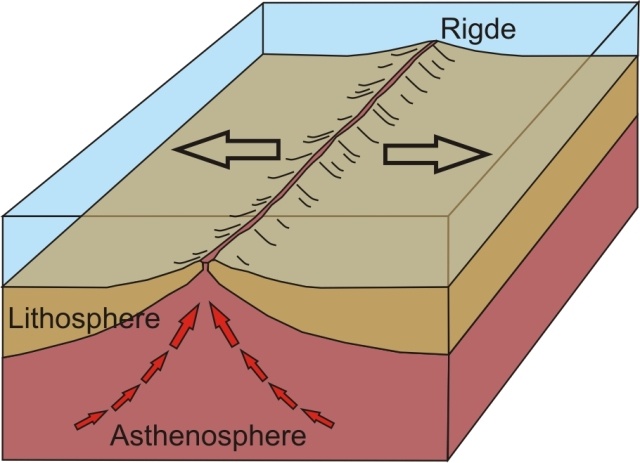
What kind of plate boundary is shown here?
a)
divergent
b)
convergent
c)
transform
d)
subducting
40.
What kind of plate boundary is shown here?
a)
divergent
b)
convergent
c)
transform
d)
submergent
41.
What kind of plate boundary is shown here?
a)
divergent
b)
convergent
c)
transform
d)
strike slip
42.
What is the opening in Earth's crust through which molten rock, gases, and ash erupt?
a)
Divergent Boundary
b)
Magma
c)
Subduction Boundary
d)
Volcano
43.
What type of boundary do earthquakes happen on?
a)
transform
b)
epicenter
c)
divergent
d)
convergent
44.
A sleeping volcano is called what?
a)
active
b)
dormant
c)
extinct
45.

What are the causes of tsunami?

a)

Pressure in the atmosphere

b)

Rain

c)

Under water earthquake

46.
Rain washing away soil from a hillside
a)
Weathering
b)
Erosion
c)
Deposition
47.
Flood waters moving soil from one location to another
a)
Weathering
b)
Erosion
c)
Deposition
48.

What river carved the Grand Canyon?

a)

Rio Grande River

b)

Arkansas River

c)

Mississippi River

d)

Colorado River

49.
Land forms made from dissolving limestone
a)
Soil
b)
Bedrock
c)
Karst
d)
Calcium
50.

This feature is formed when the roof of an underground cave collapses.

a)

stalagmite

b)

sink hole

c)

stalactite

d)

pillar

51.

What flattened out northern Indiana?

a)

continental glacier

b)

a tsunami

c)

an earthquake

d)

a shield volcano

52.

the Great Lakes were formed from:

a)

glaciers

b)

floods

c)

sinkholes

d)

rain

53.
What is the vocabulary word for the movement on the surface of the Earth resulting from underground movement between two plates?
a)
An Earthquake
b)
Shaking Earth
c)
Volcano
54.
The Ring of Fire is famous for
a)
deadly volcanoes
b)
terrible earthquakes
c)
terrifying tsunamis
d)
all of the above