Wayground logo

Free Printable Worksheets

Font size

S
M
L
XL
Worksheets

1st Semester EXAM

Total questions: 77

Worksheet time: 57mins

Name
Class
Date
1.

The SI unit for time is the __?__.

a)

hours (h)

b)

liter (L)

c)

gram (g)

d)

second (s)

2.

The SI unit for temperature is __?__.

a)

degree fahrenheit (° F)

b)

degree celsius (° C)

c)

degree centigrade (°C)

3.

What is the correct SI unit for mass?

a)

meters

b)

newtons

c)

pounds

d)

grams

4.

What SI unit is used to measure length?

a)

meters

b)

liters

c)

seconds

d)

kilograms

5.

What is the proper SI unit for solid volume?

a)

cm3

b)

m

c)

g

d)

L

6.

A sample has a mass of 30 g and a volume of 5 ml. Calculate the density. d=m/v

a)

35 g/ml

b)

6 g/ml

c)

0.17 g/ml

d)

150 g/ml

7.

What is the proper SI unit for liquid volume?

a)

cm3

b)

m

c)

g

d)

L

8.
What is the volume of the battery?
a)
17 cm3
b)
5 cm3
c)
22 cm3
d)
24 ml
9.
Which box has a higher density?  
a)
Box A
b)
Box B
c)
cannot be determined
d)
they are the same
10.

What is the name of this tool?

a)

Beaker

b)

Test tube

c)

Funnel

d)

Graduated Cylinder

11.

What does this tool measure?

a)

Time

b)

Mass

c)

Volume

d)

Length

12.

What does this tool measure?

a)

Length

b)

Mass

c)

Liquid volume

d)

height

13.
Kilo-  means 
a)
1000
b)
100
c)
10
d)
1/1000
14.
Centi-   means
a)
0.01
b)
1/1000
c)
100
d)
10
15.
km is the abreviation for...
a)
kilometer
b)
kilogram
c)
kiloliter
16.
mm is the abreviation for...
a)
millimeter
b)
metric meters
c)
10
d)
100
17.
Salt has a chemical formula of NaCl.  Salt is a...
a)
Compound
b)
Element
c)
Mixture
d)
None of the Above
18.

Which of the following is not a compound?

a)

HCl

b)

Ne

c)

NaCl

d)

CO2

19.
What cannot be broken down into other substances?
a)
Compound
b)
Mixture
c)
Solids
d)
Element
20.
What cannot be broken down into other substances?
a)
Compound
b)
Mixture
c)
Solids
d)
Element
21.
What is made up two or more elements that are chemically combined?
a)
Element
b)
Mixture
c)
Compound
d)
Solids
22.
A combination of substances that are not chemically combined is called a(n)____________. 
a)
mixture
b)
compound
c)
physical
23.
An element is made up of only one kind of _____.
a)
isotope
b)
plastic
c)
atom
d)
metal
24.

Which one can be found on the periodic table

a)

Compound

b)

Element

25.

What is salad?

a)

element

b)

compound

c)

homogeneous mixture

d)

heterogeneous mixture

26.
Classify the picture with the correct label.
a)
Element
b)
Compound
c)
Mixture of Elements
d)
Mixture of Compounds
27.
Classify the picture with the correct label.
a)
Element
b)
Compound
c)
Mixture of Elements and Compounds
d)
Mixture of Elements
28.
Classify the picture with the correct label.
a)
Element
b)
Compound
c)
Mixture of Elements & Compounds
d)
Mixture of Compounds
29.
Classify the picture with the correct label.
a)
Compounds
b)
Mixture of Elements
c)
Mixture of Compounds
d)
Mixture of Elements & Compounds
30.
If a mixture has components you can see it is a...
a)
solution
b)
compound
c)
homogeneous mixture
d)
heterogeneous mixture
31.

Which is a homogeneous mixture?

a)

Sand

b)

Trail mix

c)

Pizza

d)

Grape juice

32.
A mixture that appears to be evenly mixed throughout:
a)
an atom
b)
a compound
c)
a homogeneous mixture
d)
a heterogeneous mixture
33.
A mixture that may have different sized particles and does NOT appear to be evenly mixed throughout:
a)
an atom
b)
a compound
c)
a homogeneous mixture
d)
a heterogeneous mixture
34.
Mixtures are separated through ___________changes.
a)
mixture
b)
compound
c)
physical
35.
The horizontal row on the periodic table is called a
a)
group
b)
family
c)
period
d)
atomic number
36.

A vertical column is called...

a)

group/family

b)

tower

c)

period

d)

crew

37.
The number at the bottom of each square on the periodic table is the ...
a)
atomic number
b)
atomic mass
c)
chemical symbol
d)
element name
38.
The number at the top of each square on the periodic table is the ...
a)
atomic number
b)
atomic mass
c)
Chemical Symbol
d)
Element Name
39.

Iron, copper, silver, and gold are in which family on the periodic table?

a)

Alkaline-earth Metals

b)

Transition Metals

c)

Alkali Metals

d)

Halogens

40.
Most of the elements on the periodic table are classified as _____.
a)
Metals
b)
Nonmetals
c)
Metalloids
d)
Periods
41.

This class of elements have properties of both metals and nonmetals are sometimes called "semiconductors."

a)

Metals

b)

Nonmetals

c)

Metalloids

d)

Groups

42.

Which group/family of the periodic table is composed of inert (not reactive) gases that are located in group 18?

a)

alkali metals

b)

alkaline earth metals

c)

halogens

d)

noble gases

43.

Which element is not a metal?

a)

Na

b)

Fe

c)

Al

d)

B

44.
Which is a halogen?
a)
Helium
b)
Chlorine
c)
Oxygen
d)
Neptune
45.
Which is an alkali metal?
a)
Magnesium
b)
Iron
c)
Sodium
d)
Europium
46.

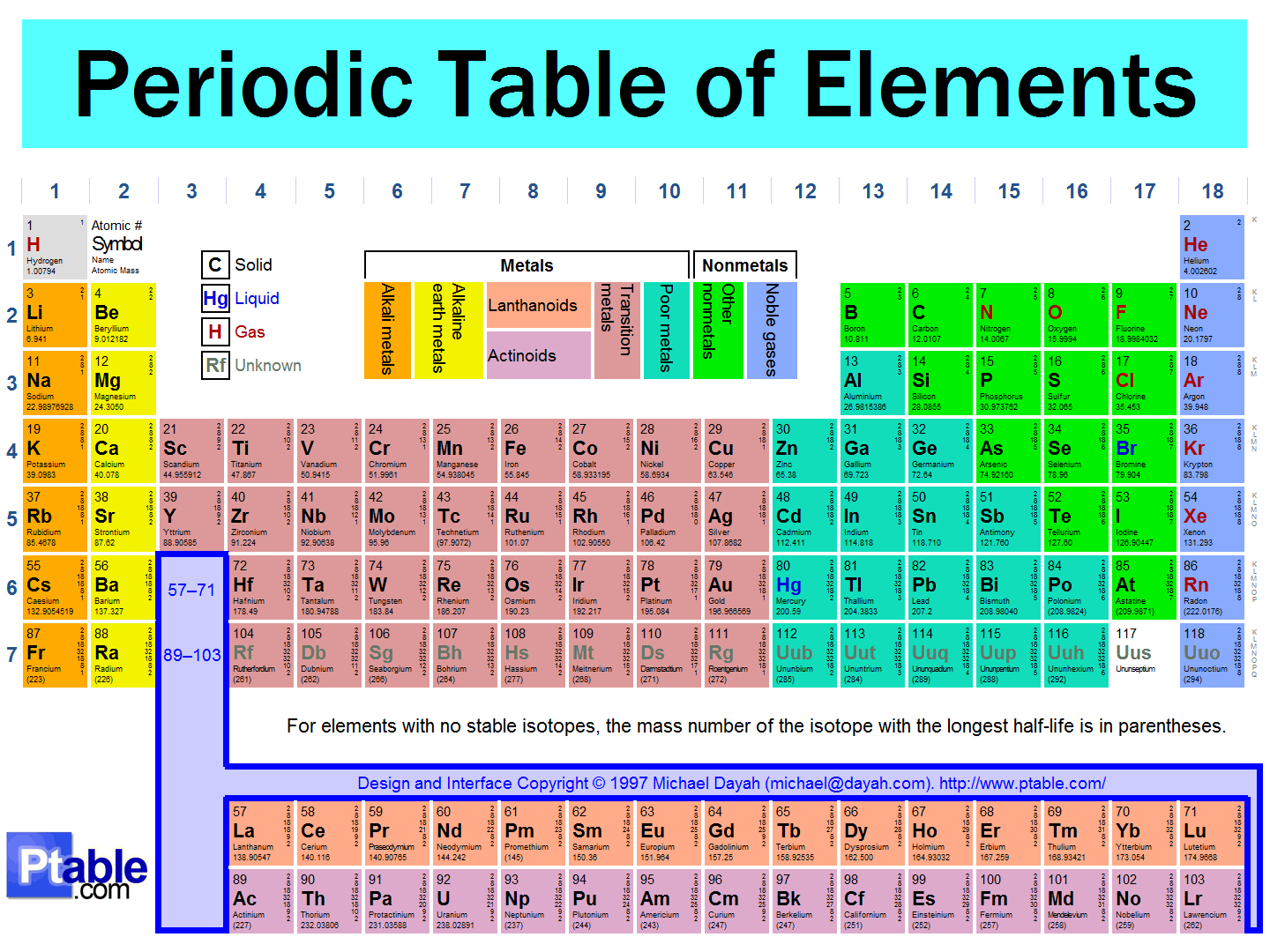
The period for Bromine is ___________.

a)

3

b)

2

c)

4

47.

Beryllium is in group/family number______.

a)

Group 2

b)

Group 3

c)

Group 4

d)

Group 7

48.
The positive particles of an atom are 
a)
electrons 
b)
positrons 
c)
neutrons 
d)
protons 
49.
Particles in an atom that are neutral and have no charge are 
a)
negatrons 
b)
electrons 
c)
neutrons 
d)
protons 
50.

The smallest particle of an element that retains it's properties is an _____________________?

a)

Compound

b)

Atom

c)

Chemical

d)

Element

51.
The subatomic particle with a negative charge is the
a)
electron
b)
proton
c)
neutron
d)
nucleus 
52.
What is the atomic number?
a)
the number of protons
b)
the number of protons and neutrons
c)
the number of neutrons
d)
the number of protons and electrons
53.

What is the mass number?

a)

the number of protons

b)

the sum of protons and neutrons

c)

the number of neutrons

d)

the sum of protons and electrons

54.
Two atoms of the same element but with different mass numbers are called________
a)
electrons
b)
isotopes
c)
variables
d)
electron cloud
55.
How many neutrons does the isotope of lithium have?
a)
8
b)
3
c)
4
d)
5
56.
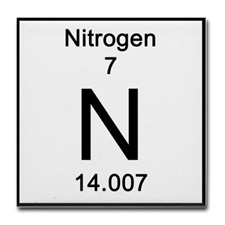
What is the number of protons that the element in this image contain?
a)
14
b)
7
c)
15
d)
18
57.

What is the atomic mass of "F"

a)

9

b)

28

c)

17

d)

19

58.

The central region of an atom where its neutrons and protons are is its

a)

nucleus

b)

electron cloud

c)

core

d)

center

59.
The particles that are found in the nucleus of an atom are
a)
neutrons and electrons
b)
electrons only
c)
protons and neutrons
d)
protons and electrons
60.
Where are electrons of an atom found?
a)
Nucleus
b)
Electron Cloud
c)
Some are in the nucleus and some in the electron cloud.
d)
They are moving everywhere.
61.

Which is true about the mass of subatomic particles

a)

electrons have a mass of 1 amu

b)

neutron have no mass

c)

protons and neutrons each have a mass of 1 amu

d)

protons have no mass

62.
How many electrons can the 1st electron shell hold?
a)
2
b)
3
c)
8
d)
18
63.
How many valence electrons do atoms in group 16 have?
a)
4
b)
5
c)
6
d)
7
64.

How many valence electrons do elements in Group 1 have?

a)

1

b)

2

c)

3

d)

4

65.
What is an ion?
a)
A Charged Atom
b)
A Large Atom
c)
A Small Atom
d)
A Cute Atom
66.
Cations are...
a)
Positive
b)
Negative
c)
Neutral
d)
Purring
67.

An atom becomes _________ when it gains electrons.

a)

Positive

b)

Negative

c)

Neutral

d)

Invisible

68.
Anions are...
a)
Positive
b)
Negative
c)
Neutral
d)
Crying
69.

An atom becomes _______ when it loses electrons.

a)

Positive

b)

Negative

c)

Neutral

d)

Invisible

70.

Why are ions formed?

a)

To make our lives difficult

b)

Because atoms want to be stable (8 valence electrons)

c)

Because atoms have the same number of protons and electrons

d)

Because atoms gained neutrons

71.
What is the charge on an Aluminium ion?
a)
3
b)
+3
c)
+2
d)
+1
72.

What will the charge be for all stable ions formed by group 17 elements?

a)

-1

b)

-2

c)

+2

d)

+1

73.
What elements generally make an ionic bond?
a)
metal and nonmetal
b)
2 or more nonmetals
c)
metal
d)
none of the above
74.
What two types of atoms make a covalent bond?
a)
2 Nonmetals
b)
1 Nonmetal and 1 Metal
c)
2 Metals
d)
2 Noble Gases
75.
Predict the bond that will form between Be and F.
a)
Ionic
b)
Covalent
76.

This is a correct dot diagram for nitrogen (N)

a)

true

b)

false

77.

Samples of two different solid substances are observed in a lab. It is known that one sample is an ionic compound and the other is a covalent compound. The samples are placed in separate test tubes, which are then held over a flame. Sample 1 begins to melt in 12.5 seconds. After 2 minutes over the flame, sample 2 does not melt. What is the best conclusion from these observations?

a)

Sample 1 is an ionic compound and sample 2 is a covalent compound

b)

Sample 2 is a covalent compound, but sample 1 is unknown because it did not melt

c)

Sample 1 is a covalent compound and sample 2 is an ionic compound

d)

They cannot be identified by this experiment