wayground logo

Free Printable Worksheets

Font size

S
M
L
XL
Worksheets

Forces & Motion

Total questions: 75

Worksheet time: 24mins

Name
Class
Date
1.
The overall force acting on an object after all the forces are combined is called a 
a)
net force
b)
unbalanced force
c)
balanced force
2.
When the net force is zero what type of force is acting on the objects? 
a)
balanced force
b)
unbalanced force
3.
When the resulting force is greater than zero what type of force is acting on the objects? 
a)
balanced force
b)
unbalanced force
4.
A force that opposes the motion of objects that touch as they move past each other. 
a)
vector
b)
gravity
c)
friction 
5.
A force that acts between any two masses is called: 
a)
friction
b)
vectors
c)
gravity
6.
What is a measure of the change of velocity of a moving object?
a)
speed
b)
acceleration
c)
motion 
d)
velocity 
7.
If the velocity vector and acceleration vectors are moving in the same direction then
a)
speed will increase.
b)
speed will decrease.
c)
speed will be constant. 
8.
Which is not an example of acceleration?
a)
Driving at a constant speed 
b)
A bat hitting a ball
c)
Throwing a football 
d)
Kicking a soccer ball
9.
Balanced forces always have a net force of 
a)
10 N
b)
0 W
c)
10 W
d)
0 N
10.
The SI unit for force is 
a)
Watt (W)
b)
Power (P)
c)
Newton (N)
d)
Force (F)
11.
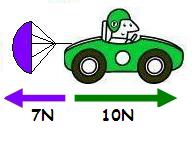
What is the net force of the object?
a)
10 N
b)
25 N
c)
5 N
d)
0 N
12.
Force is a vector because 
a)
it has size
b)
it has direction
c)
it has both size and direction
13.
If two forces act in the same direction on an object, then the forces are 
a)
added 
b)
subtracted 
c)
multiplied 
d)
divided
14.
If two forces act in opposite directions on an object then the forces are 
a)
added 
b)
subtracted 
c)
multiplied 
d)
divided 
15.
Velocity is equal to 
a)
acceleration / time
b)
time / acceleartion
c)
acceleration x time 
d)
acceleration + time 
16.
If a force of 50 Newton's was applied to an object with a mass of 500 grams, what will the object's acceleration be?
a)
10 m/s^2
b)
.1 m/s^2
c)
100 m/s^2
d)
1 m/s^2
17.

When the first American astronauts were planning to walk on the moon, they knew that the gravity on the moon is less than the gravity on Earth. With this information what did the astronauts expect to be the MOST different on the Moon.

a)

their mass

b)

their weight

c)

their height

d)

their volume

18.

One person pulls on a rope with a force of 400 N to the left. Another person pulls on the rope opposite end with a force of 600 N to the right. What is the unbalanced net force?

a)

200 N to the right

b)

400 N to the right

c)

600 N to the right

d)

1000 N to the right

19.

A student runs a distance of 2 meters in 15 seconds. What is his speed?

a)

13 m/s

b)

0.133 m/s

c)

133 m/s

d)

13.30 m/s

20.

Lauren walks 100 meters in 30 seconds. What is her speed?

a)

3.33 m/s

b)

333 m/s

c)

.333 m/s

d)

33.33 m/s

21.

Patrick traveled at a speed of 18 km/h for two hours. What was the distance traveled?

a)

18 km

b)

9 km

c)

36 km

d)

20 km

22.

An object with a mass of 2.0 kg accelerates 2.0 m/s2 when an unknown force is applied to it. What is the amount of the force?

a)

40 N

b)

4.0 N

c)

.40 N

d)

400 N

23.

Distance travelled per unit time

a)

gravity

b)

acceleration

c)

speed

d)

velocity

24.

The speed of an object in a particular direction

a)

Newton's 1st Law

b)

acceleration

c)

speed

d)

velocity

25.

The rate at which velocity changes

a)

velocity

b)

acceleration

c)

gravity

d)

Newton's 3rd Law

26.

What is the net force?

a)

3 N

b)

3 N, right

c)

17 N, right

d)

3 N, left

27.

An object has a mass of 10 kg. What is its weight?

a)

0.10 kg

b)

0.10 N

c)

100 kg

d)

100 N

28.
This is a velocity-time graph.  What is the object doing in segment A?
a)
Positive acceleration
b)
Negative acceleration
c)
Constant Velocity
d)
Not moving
29.

A drag racer accelerated from 0 m/s to 40 m/s in 5 s. What was the acceleration?

a)

0 m/s

b)

8 m/s2

c)

200 m/s2

d)

0.125 m/s

30.

The gradient (slope) of a distance-time graph gives the _____ of the object.

a)

distance

b)

time

c)

speed

d)

acceleration

31.

A quantity that has no direction is referred to as a

a)

vector quantity

b)

scalar quantity

32.
A quantity that is has magnitude and  direction is referred to as a
a)
vector quantity
b)
scalar quantity
33.
An object can be moving for 10 seconds and still have zero displacement.
a)
True
b)
False
34.
You run from your house to a friend's house that is 3 km away. You then walk home. The distance you traveled is 6 km. What is your displacement? 
a)
6  km
b)
0 km
35.
A _________ quantity is completely described by magnitude alone. A _________ quantity is
completely described by a magnitude with a direction.
a)
vector, scalar
b)
scalar, vector
36.
Speed is a __________ quantity and velocity is a __________ quantity.
a)
scalar, vector
b)
vector, scalar
37.
The fastest trains are magnetically levitated above the rails to avoid friction (and are therefore called
MagLev trains...cool, huh?). The fastest trains travel about 250 km in a half an hour. What is their
average speed in km/hour?
a)
250 km/hr
b)
500 km/hr
c)
125 km/hr
38.
A hummingbird averages a speed of about 45 km/hour (Cool facts: They visit up to 1000 flowers per day, and reach maximum speed, while diving, up to 160 km/hour!). Ruby-throated hummingbirds take a non-stop trip across Gulf of Mexico in which they fly for 18 hours straight! How far is the trip across the Gulf of Mexico at their average speed?
a)
810 km
b)
2.5 km
c)
3.6 km
d)
360 km
39.
A car slows down from +32 m/s to +8 m/s in 4 s. The acceleration is 
a)
6 m/s/s opposite the motion
b)
2m/s/s in the direction of motion
c)
8 m/s/s opposite the motion
40.

An airplane accelerates down a runway at 3.20 m/s/s

for 8 s until it finally lifts off the ground.

Determine the velocity at take-off.

a)

0.4 m/s

b)

25.6 m/s

c)

2.5 m/s

41.
A cheetah travels 75 m in 3 s. What is her velocity over the interval?
a)
225 m/s
b)
25 m/s 
c)
0.04 m/s
42.

Watch the animation. Choose the option that best describes the motion.

a)

The object travels east at a constant speed.

b)

The object travels west at a constant speed.

c)

The object is traveling west and speeding up.

d)

The object is traveling east and speeding up.

43.

Watch the animation. Choose the option that best describes the motion.

a)

The object travels east and speeds up, pauses then travels west and speeds up.

b)

The object travels east at a constant speed, then immediately travels west at constant speed.

c)

The object travels west at a constant speed, pauses then travels east at constant speed.

d)

The object travels east at a constant speed, pauses then travels west at constant speed.

44.

Look at the position graph shown. Describe the motion during Segment A. During Segment A, the object...

a)

has constant speed to the east.

b)

has constant speed to the west.

c)

is speeding up and traveling east.

d)

is speeding up and traveling west.

e)

is slowing down and traveling east.

45.

Look at the position graph shown. Describe the motion during Segment B. During Segment B, the object...

a)

has constant speed to the east.

b)

has constant speed to the west.

c)

is speeding up and traveling east.

d)

is speeding up and traveling west.

e)

is slowing down and traveling west.

46.

The velocity of the object during segment A is ___.

a)

-15 m/s

b)

-10 m/s

c)

+ 15 m/s

d)

40 m/s

e)

4 m/s

47.

You are being shown a POSITION graph and a VELOCITY graph. Which segments show constant speed, east?

a)

A and D

b)

B and C

c)

C and D

d)

C and F

e)

None

48.

Which line on the graph shows an object that started from rest? (Check all that apply.)

a)

A

b)

B

c)

C

d)

None

49.
What is the formula to calculate speed?
a)
S = t/d
b)
S = d/t
c)
S = d x t
d)
S = t x d
50.
What is velocity?
a)
the quickness of an object
b)
the location of an object
c)
acceleration
d)
speed in a specific direction
51.
A change in velocity over time is known as:
a)
acceleration
b)
constant speed
c)
average speed
d)
displacement
52.
The unit we use to measure acceleration is ___. 
a)
meters / second 
b)
meters 
c)
seconds 
d)
meters / second / second 
53.
At 60 seconds, how far had this object traveled? 
a)
0 m
b)
10 m
c)
20 m
d)
40 m
54.
A ball is thrown downward from the top of a roof with a speed of 25 m/s. After 2 s, its velocity will be:
a)
19.6 m/s
b)
-5.4 m/s
c)
-44.6 m/s
d)
44.6 m/s
55.

How much time would it take for an object to fall 4.7 meters?

a)

0.959 s

b)

4.79 s

c)

0.979 s

56.
If a car is traveling forward at 15 m/s, how fast will it be going in 1.2 seconds if the acceleration is -10 m/s2?
a)
27 m/s
b)
3 m/s
c)
-27 m/s
d)
-3 m/s
57.
A boat travels 12.0 m while it reduces its velocity from 9.5 m/s to 5.5 m/s. What is the magnitude of the boat’s acceleration while it travels the 12.0 m?
a)
1.3 m/s2
b)
2.5 m/s2
c)
3.0 m/s2
d)
7.5 m/s2
58.
A car is traveling at 21.0 m/s. It slows to a stop at a constant rate over 5.00 s. How far does the car travel during those 5.00 seconds before it stops? 
a)
4.20 m
b)
52.5 m
c)
105 m
d)
158 m
59.

A dog runs with an initial speed of 7.5 m/s to a stop in 15 seconds. What is the dog's acceleration?

a)

-7.5 m/s

b)

-7.5 m/s2

c)

-0.5 m/s2

d)

7.5 mi//hr

60.
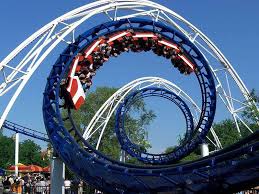
A roller coasters accelerates from an initial velocity of 6.0 m/s to a final velocity of 70 m/s over 4 seconds.  What's the acceleration?
a)
24 m/s2
b)
18 m/s2
c)
16 m/s2
d)
16 m/s
61.
A ball is thrown downward from the top of a roof with a speed of 25 m/s. After 2 s, its velocity will be:
a)
19.6 m/s
b)
-5.4 m/s
c)
-44.6 m/s
d)
44.6 m/s
62.
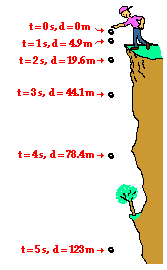
What happens to the velocity of a ball as it is dropped off a cliff? 
a)
It decreases at a uniform rate 
b)
It increases at a uniform rate 
c)
It is constant 
d)
It increases at a non-uniform rate
63.

What is the average velocity of the object between 10 and 15 seconds?

a)

6 m/s

b)

1.5 m/s

c)

-4 m/s

d)

0 m/s

64.

What is the average velocity of the object between 0 and 10 seconds?

a)

6.0 m/s

b)

1.5 m/s

c)

-4 m/s

d)

0 m/s

65.

A car goes from rest to 30 m/s. If it takes the car 40 seconds to reach that speed then what is the car's rate of acceleration?

a)

1.33 m/s2

b)

0.75 m/s2

c)

10 m/s2

d)

0 m/s2

66.

What is the rate of acceleration of the object between 0 and 4 seconds?

a)

1 m/s

b)

0 m/s2

c)

-1 m/s2

d)

1 m/s2

67.

Which graph(s) represents a constant velocity?

a)

a and c

b)

b and c

c)

c

d)

a and b

68.
What is this graph representing?
a)
Constant Speed
b)
Acceleration (speeding up)
c)
Deceleration (slowing down)
d)
No motion
69.
At 60 seconds, how far had this object traveled? 
a)
0 m
b)
10 m
c)
20 m
d)
40 m
70.
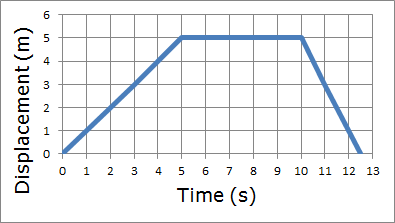
What is the person doing from 5 seconds to 10 seconds?
a)
Walking 
b)
Running
c)
Standing Still 
d)
Walking Fast
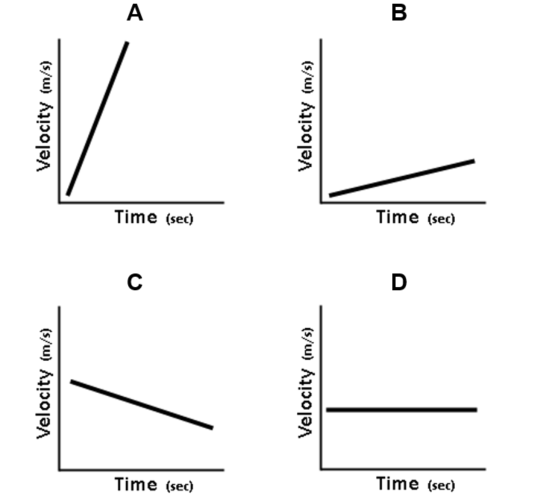
71.
Which graph represents zero acceleration (constant velocity)?
a)
A
b)
B
c)
C
d)
D
72.

The graph above represents position x versus time t for an object being acted on by a constant force.  The average speed during the interval between 1 s and 2 s is most nearly

a)

2 m/s 

b)

4 m/s 

c)

5 m/s

d)

6 m/s

73.

Starting from rest, a vehicle accelerates on a straight level road at the rate of 4.0 m/s2 for 5.0 s. What is the speed of the vehicle at the end of this time interval?

a)

1.3 m/s

b)

10 m/s

c)

20 m/s

d)

80 m/s

74.

Starting from rest, a vehicle accelerates on a straight level road at the rate of 4.0 m/s2 for 5.0 s. What is the total distance the vehicle travels during this time interval?

a)

20 m

b)

25 m

c)

40 m

d)

50 m

75.

An object is thrown vertically upward in a region where g is constant and air resistance is negligible. Its speed is recorded from the moment it leaves the thrower’s hand until it reaches its maximum height. Which of the following graphs best represents the object’s speed v versus time t?

a)
b)
c)
d)