wayground logo

Free Printable Worksheets

Font size

S
M
L
XL
Worksheets

Semester 1 Final Exam Review

Total questions: 65

Worksheet time: 1hrs 4mins

Name
Class
Date
1.
Two objects at different temperatures are in contact. Which of the following happens to their thermal energy?
a)
Their thermal energies remain the same.
b)
Thermal energy passes from the cooler object to the warmer object
c)
Thermal energy passes from the warmer object to the cooler object.
d)
Thermal energy passes back and forth equally between the two objects.
2.
Friction is a force that acts in an ___________ direction of movement.
a)
similar
b)
opposite
c)
parallel
d)
west
3.
A type of friction that occurs when air pushes against a moving object causing it to decelerate.
a)
surface area
b)
air resistance
c)
velocity
d)
gravity 
4.
What does friction produce?
a)
light
b)
sound
c)
heat
d)
gravity
5.
The rougher the surface, the faster an object will travel over the surface.
a)
True
b)
False
6.
Why is the net force 0 in the image?
a)
Because the elephants are the same size
b)
Because they are both pulling the same amount of force in opposite directions
c)
Because they are elephants
d)
Because they are pulling away from each other.
7.

The tendency of an object to resist a change in its motion is called

a)

acceleration

b)

inertia

c)

mass

d)

frame of reference

8.
8 N to the left , and 4 N to the right. Find the net force. Is this balanced 
a)
12 N Right  No
b)
4 N Left  No
c)
12 N Right  Yes
d)
4 N Left  Yes
9.
With unbalanced forces, the object will move in the direction of the _______ force.
a)
larger 
b)
smaller 
c)
equal 
10.
You and your dad are moving the couch from one side to another. Your dad pushes with a force of 35 N to the right and you push with a force of 25 N right. What is the net force on the couch?
a)
60 N right
b)
10 N left
c)
60 n right
d)
50 N left
11.

What type of energy is in this picture?

a)

Kinetic

b)

Potential

c)

Electromagnetic

12.

What kind of energy is shown in the picture?

a)

Thermal (kinetic) energy

b)

Chemical (kinetic) energy

c)

Chemical (potential) energy

d)

Mechanical (kinetic) energy

13.
What kind of energy is associated with vibrations?
a)
mechanical energy
b)
electrical energy
c)
light energy
d)
sound energy
14.
What type of energy increases as molecules move faster? 
a)
mechanical energy
b)
electrical energy
c)
thermal energy
d)
sound energy
15.
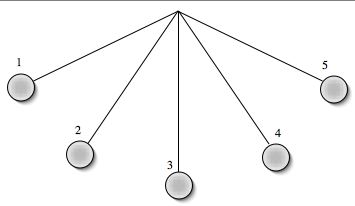
When a pendulum swings, at which point is kinetic energy highest?
a)
1
b)
2
c)
3
d)
4
16.

A battery converts ___________ energy to ____________ energy.

a)

sound to kinetic

b)

light to heat

c)

mechanical to electrical

d)

chemical to electrical

17.
What machine changes electrical energy into light and sound energy?
a)
battery
b)
lightbulb
c)
alarm clock
d)
apple
18.
What two factors effect the amount of energy a wave has?
a)
Frequency and wavelength
b)
Frequency and amplitude
c)
Amplitude and rest
d)
Wavelength and crest
19.
When the amplitude of a wave increases, what happens to the wavelength?
a)
The frequency increases.
b)
The wavelength increases.
c)
The wavelength decreases.
d)
Nothing happens, the two are not related.
20.
When the frequency of a wave increases, what happens to the wavelength?
a)
The wavelength and amplitude both increase.
b)
The wavelength increases.
c)
The wavelength decreases.
d)
Nothing happens, the two are not related.
21.
What kind of wave can travel through space?
a)
electromagnetic waves
b)
compressional waves
c)
transverse waves
d)
longitudinal waves
22.
If you replace the paper clip with a plastic spoon, what happens?
a)
The bulb doesn't light
b)
The bulb is dimmer
c)
The wires get hot
d)
There is no change
23.
What kind of circuit is this?
a)
series
b)
parallel
24.
What kind of circuit is this?
a)
Series
b)
Consecutive
c)
Parallel
d)
Training
25.

In a series circuit the more light bulbs you add, the brighter they get.

a)

False

b)

True

26.
If you increase the resistance of a circuit, what happens?
a)
Current decreases
b)
Current increases
c)
Electrons disappear
d)
Bulbs get brighter
27.

This circuit is .....?

a)

open

b)

parallel

c)

closed

d)

The cutest little circuit evah!

28.
What is an example of a RESISTOR?
a)
Light bulb
b)
Plastic
c)
Water
29.
Where should the fulcrum be placed in order for the student to use the least amount of effort possible? 
a)
point A
b)
point B
c)
point C
d)
point D
30.
What is the mechanical advantage of the  LAST inclined plane in the picture?
a)
1
b)
2
c)
3
d)
4
31.
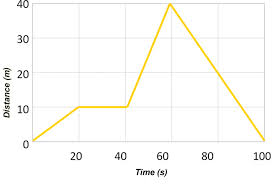
How long did it take this object to travel back to its reference/starting point?
a)
20 s
b)
30 s
c)
60 s
d)
100 s
32.
What is happening at C?
a)
Stationary
b)
Accelerating
c)
Fast steady speed; moving away from the starting position
d)
Slower steady speed; moving away from the starting position
33.

What is happening in this graph from point B to C?

a)

The object is going down a hill.

b)

The object is returning to its starting location.

c)

The object is slowing down.

d)

The object is staying still.

34.
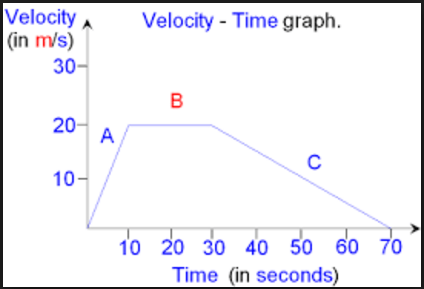
This is a velocity-time graph.  What is the object doing in segment B?
a)
Positive acceleration
b)
Negative acceleration
c)
Constant Velocity
d)
Not moving
35.

What kind of acceleration is shown here?

a)

positive

b)

negative

c)

no acceleration

36.
This is a velocity-time graph.  What is the acceleration for segment C?
a)
Positive acceleration
b)
Negative acceleration
c)
Constant Velocity
d)
Not moving
37.
If the particles in an object have more kinetic energy, what must be true?
a)
The object's temperature is lower
b)
The object's temperature is higher
c)
The object moves faster
d)
The object is heavier
38.
Heat is thermal energy that flows between objects that differ in___.
a)
temperature
b)
radiation
c)
thermal energy
d)
specific heat
39.
The molecules of a liquid vs. a gas...
a)
Move slower in a gas.
b)
Move slower in a liquid.
40.
If you place some Gatorade in a cooler with ice...
a)
It's particles will speed up.
b)
It's particles will slow down.
41.

Water with energy removed will....

a)

warm.

b)

cool.

42.
What kind of energy is in a rock at the edge of a cliff?
a)
Potential
b)
Kinetic
43.
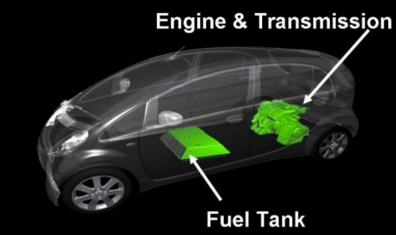
Gasoline in a car tank (car is not on).
a)
Potential
b)
Kinetic
44.
Which would be greater at Position 2?
a)
Potential Energy
b)
Kinetic Energy
45.
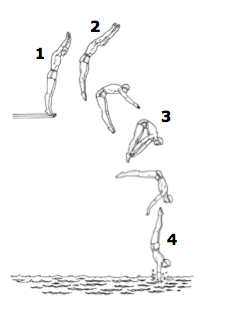
2. The diagram to the right represents a diver’s motion from the top of a high diving board into a pool of water. At what point does the diver have the greatest kinetic energy and the least potential energy?
a)
1
b)
2
c)
3
d)
4
46.
The glow sticks produce light for a short amount of time. The light from the glow stick is a conversion from what to what?
a)
thermal to light
b)
gravitational to potential
c)
radiant to electrical
d)
chemical to light
47.
You serve a volley ball with a mass of 2.1 kg. The ball leaves your hand with a speed of 30 m/s. Calculate the ball's kinetic energy. 
a)
1890 J
b)
3780 J
c)
945 J
d)
31.5 J
48.
Water has a specific heat of 4,184 J/KgºC.  Wood has a specific heat of 1,760 J/KgºC.  Which material requires more energy to raise the temperature 1ºC?
a)
Wood
b)
Water
c)
Both are the same
49.
The amount of energy required to raise the temperature 1ºC for every kilogram is called____?
a)
Thermal Energy
b)
Specific Heat
c)
Temperature
d)
Kinetic Energy
50.
Copper, stainless steel, carbon steel, and zinc were all heated using the same thermal energy.  What material would be the coolest after being heated?
a)
Copper
b)
Carbon Steel
c)
Zinc
d)
Stainless Steel
51.
The specific heat of aluminum is 0.21 cal/g°C.  How much heat(Q) is released when a 10 g piece of aluminum foil is taken out of the oven and cools from 100° to 50°?
a)
105 J
b)
10.5 J
c)
1.05 J
52.
There are four cups of hot cocoa. The cup sizes are shown. The temperature of the cocoa in each cup is 25 degrees Celsius. Which cup has the MOST thermal energy?
a)
Large cup (Trenta)
b)
Small cup (Tall)
c)
Venti
d)
All three are the same temperature so they have same thermal energy
53.
Three blacksmiths are making new cooking pots. One uses aluminum, one uses copper, and one uses iron. Which substance will cool the fastest?
a)
aluminum
b)
copper
c)
iron
d)
they all cool at the same rate
54.
How much energy is required to heat up 12kg of copper from 10 °C to 120 °C?  (The specific heat of copper is 390 J/kg °C).
a)
46800 J
b)
561600 J
c)
514800 J
55.

A wave's energy is directly proportional to its...

a)

wavelength

b)

frequency

c)

amplitude

d)

speed

56.

What type of wave has the smallest wavelength?

a)

Gamma

b)

Ultraviolet

c)

Infared

d)

Radio

57.
What is the wave's amplitude?
a)
4 cm
b)
5 cm
c)
6 cm
d)
8 cm
58.
How loud or soft a sound is, is related to the _____________ of the wave
a)
amplitude
b)
frequency
c)
wave length
d)
rest position
59.
The changing pitch of a police siren as the car moves past you
a)
sound interfernce
b)
doppler effect
c)
constructive interference
d)
destructive interference
60.
Sound travels fastest through what type of medium?
a)
pond water
b)
cold air
c)
iced tea
d)
wooden desk
61.
What is "?" ?
a)
rarefaction
b)
compression
c)
expansion
d)
reflection
62.
Which letter shows reflection? 
a)
Pathway A
b)
Pathway B
c)
Pathway C
d)
Pathway D
63.
This image is representing what wave interaction?
a)
Refraction
b)
Diffraction
c)
Reflection
d)
Interference
64.
Which of the following is sound unable to travel through?
a)
vacuum/space
b)
gas/air
c)
liquid/gasoline
d)
solid/metal
65.
Which of the following forms of electromagnetic radiation has the lowest frequency,longest wavelength, and carries the least amount of energy?
a)
radio
b)
gamma
c)
infrared
d)
visible