Wayground logo

Free Printable Worksheets

Font size

S
M
L
XL
Worksheets

iGCSE P.E Anatomy and Physiology 50 Question Challenge

Total questions: 50

Worksheet time: 34mins

Name
Class
Date
1.

What bone is highlighted?

a)

Radius

b)

Ulna

c)

Humerus

d)

Carpals

2.

What bone is highlighted?

a)

Radius

b)

Ulna

c)

Humerus

d)

Carpals

3.

What bone is highlighted?

a)

Femur

b)

Tibia

c)

Fibula

d)

Humerus

4.
Ligaments connect:
a)
Bone to bone
b)
Muscle to bone
c)
Joint to joint
d)
Bone to joint
5.
What is the name for the connector that attaches muscle to bone?
a)
ligament
b)
tendon
c)
patella
d)
string
6.
Bob is very small. He needs to stand on his "tip toe's" to reach the cookie jar on the top shelf of the cupboard.  What is the movement of his ankles?
a)
Plantar Flexion
b)
Extension
c)
Dorsiflexion
d)
Anterior Rotation
7.
When doing a star jump, what is the type of movement of the arms when the move outwards from the body?
a)
Abduction
b)
Adduction
c)
Extension
d)
Flexsion
8.
Moving a body part towards the midline is
a)
adduction.
b)
abduction.
c)
rotation.
d)
protraction.
9.
The knee joint is
a)
Hinge
b)
Gliding
c)
Ball and socket
d)
Pivot
10.
This type of joint allows the your first two vertebrate to rotate as in shaking your head no
a)
condyloid
b)
gliding
c)
pivot
d)
saddle
11.
Hip and shoulder have examples of this type of joint
a)
ball and socket
b)
condyloid
c)
hinge
d)
gliding
12.

What bone is this?

a)

Collar Bone

b)

Clavicle

c)

Shoulder

d)

Sternum

13.

What bone is this?

a)

Metacarpals

b)

Metatarsals

c)

Carpals

d)

Phalanges

14.

What type of muscle fibres would Usain Bolt want most of?

a)

Type 1

b)

Type 2a

c)

Type 2x

15.

A first class lever is when?

a)

Fulcrum is between the effort and the load

b)

Load between fulcrum and effort

c)

Effort between fulcrum and load

16.

The movement at the ankle of the netball shooter is an example of what lever in use?

a)

1st Class

b)

2nd Class

c)

3rd Class

17.

The arm action of the tennis player is an example of what lever system in use?

a)

1st Class

b)

2nd Class

c)

3rd Class

18.
Which type of muscle is found in your heart?
a)
Skeletal
b)
Smooth
c)
Cardiac
d)
Straight
19.
What muscle
   
is this?
a)
Gastrocnemius
b)
Tibialis Anterior
c)
Extensor Digitorum Longus
d)
Plantaris
20.
 what muscle                                          is this?
a)
Rhomboid Major
b)
Trapesiuz
c)
Internal Oblique
d)
Latissimus Dorsi
21.
a)
Hamstring
b)
Gluteus Maximus
c)
External Oblique
d)
Gastrocnemius
22.
_______________ - muscles change length as they contract. It can either shorten the muscle or lengthen it. 
a)
Isometric contractions
b)
Isotonic contractions
c)
Concentric contraction
d)
Eccentric contraction
23.
_______________ - muscle contract, but stay the same length. An example is the muscles in the vertebral column that maintain the body's posture. 
a)
Isometric contractions
b)
Isotonic contractions
c)
Eccentric contractions
d)
Concentric contraction
24.
When a muscle shortens under tension it is called a...
a)
Concentric contraction
b)
Eccentric contraction
c)
Isometric contraction
25.
When a muscle lengthens under tension it is called a...
a)
Isometric contraction
b)
Eccentric contraction
c)
Concentric contration
26.
A wall sit is an example of which type of contraction?
a)
Eccentric
b)
Concentric
c)
Isometric
27.
Muscles work in pairs. What are these called?
a)
Symmetrical
b)
Agonistic
c)
Antagonistic
d)
Asymmetrical
28.
What would the predominant muscle fibre type be for this athlete?
a)
Slow Twitch
b)
Fast Twitch A
c)
Fast Twitch B
d)
Combination of Fast A and Fast B
29.
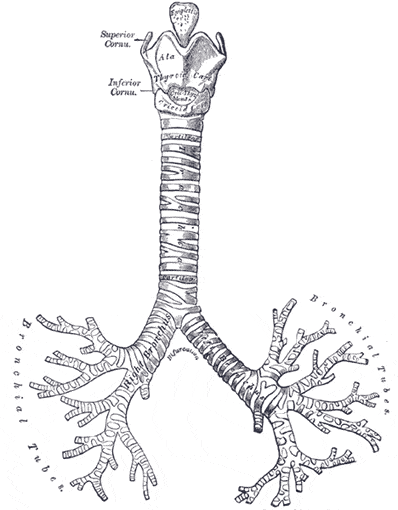
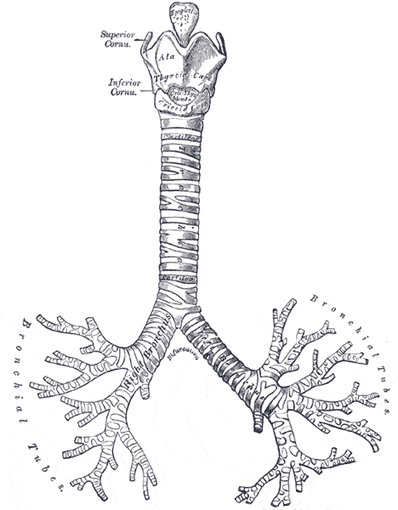
The two main branches from the trachea (one to each lung)
a)
bronchi
b)
alveoli
c)
capillaries
d)
bronchioles
30.
What is tube that is also known as your wind pipe?
a)
esophogus
b)
bronchi
c)
trachea
d)
alveoli
31.
The term used to describe the volume of air exchanged during normal inspiration and expiration is:
a)
inspiratory and expiratory reserve volume.
b)
vital capacity.
c)
 tidal volume. 
d)
residual volume.
32.
The vital capacity is equal to the sum of the:
a)
 inspiratory reserve volume, tidal volume, and inspiratory capacity.
b)
tidal volume, residual volume, and expiratory reserve volume.
c)
 inspiratory reserve volume, tidal volume, and expiratory reserve volume
d)
inspiratory capacity and the residual volume. 
33.
What helps to increase the volume of the thoracic cavity?
a)
ribs move up and out & diaphragm contracts and flattens
b)
ribs move down and in & diaphragm relaxes
c)
ribs move up and out & diaphragm relaxes
34.
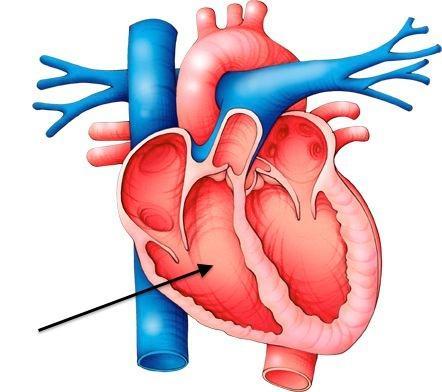
Identify
a)
Left atrium
b)
Right atrium
c)
Left ventricle
d)
Right ventricle
35.
This chamber of the heart RECEIVES blood returning from the body
a)
Right Atrium
b)
Right Ventricle
c)
Left Atrium
d)
Left Ventricle
36.
What is pulmonary circulation?
a)
Blood travelling to and from the lungs
b)
Blood travelling to and from the body
c)
A blood clot in the lungs
d)
The vessel that brings blood to the lungs
37.
Structure(s) that keep the blood flowing in one direction.
a)
Valve(s)
b)
Septum(s)
c)
Neuron(s)
d)
Bronchiole(s)
38.

Oxygen and carbon dioxide are transported between the blood and alveoli by way of

a)

exocytosis and endocytosis by endothelial cells

b)

diffusion from areas of higher concentration to lower concentration

c)

pinocytosis using fluid-filled vesicles

d)

active transport (using ATP) by protein carriers of endothelial cells

39.

What is the function of platelets in your blood

a)

fighting infection

b)

carrying oxygen

c)

clotting

d)

water balance

40.

What is haemoglobin

a)

A chemical that stimulates the production of red blood cells

b)

A molecule used in the clotting process

c)

A molecule that transports oxygen

d)

Another name for white blood cells

41.

What part of blood is responsible for carrying oxygen to body cells?

a)

Red Blood Cells

b)

White Blood Cells

c)

Platelets

d)

Plasma

42.
Which is the correct equation for anaerobic respiration in humans?
a)
glucose + lactic acid → carbon dioxide + water
b)
glucose → lactic acid + carbon dioxide
c)
glucose → lactic acid
43.

During exercise the volume of blood (ml) ejected from the heart per beat increases, this is known as?

a)

Increased Tidal Volume

b)

Increased Stroke Volume

c)

Increased Cardiac Output

d)

Increased Heart Rate

44.

Cardiac Output =

a)

Stroke Volume x Heart Rate

b)

Tidal Volume x Heart Rate

c)

Heart Rate x Cardiac Output

d)

Stroke Volume x Cardiac Output

45.

Adrenaline causes the heart rate to increase before exercise this is known as

a)

Heart Rate

b)

Anticipatory Rise

c)

Tidal Volume

d)

Cardiac Output

46.

A decrease in Heart Rate as a result of long term exercise is known as

a)

Lower HR

b)

Hypertrophy

c)

Bradycardia

d)

Pulmonary Growth

47.

The amount of air remaining in the lungs after a maximal expiration.

a)

tidal volume

b)

total lung capacity

c)

residual volume

d)

vital capacity

48.
What is the flexible tissue that helps cushion bones where they meet called?  
a)
ligaments
b)
cartilage
c)
tendons
d)
adipose
49.
What is meant by 'EPOC' in terms of oxygen debt?
a)
a) Extra Post Oxygen Consumption
b)
b) Extra Post Oxygen Condition
c)
c) Excess Pre-exercise Oxygen Consumption
d)
d) Excess Post-exercise Oxygen Consumption
50.

The equation that connects force, mass and acceleration is....

a)

F = a ÷ m

b)

F= m ÷a

c)

F= m × a

d)

F = m + a