
 Worksheets
Physical Science Midterm
Total questions: 70
Worksheet time: 56mins
Name
Class
Date
1.
A suggested solution to a problem is a _________________
a)
question
b)
hypothesis
c)
answer
2.
The _________ is a set of specific steps that help scientists solve problems.
a)
Design Process
b)
Scientific Method
c)
Dictionary
d)
Bar graph
3.
What is a quantitative observation
a)
Observation dealing with numbers
b)
Observation dealing with descriptions
4.
A student is planning an experiment to find out how the height from which he drops a ball affects how high the ball bounces. The dependent variable is the _____.
a)
Diameter of the ball
b)
Force acting on the ball
c)
Height that the ball bounces
d)
Height from which the ball is dropped
5.

What is the independent variable in this graph?
a)
Hours worked
b)
Dollars earned
c)
Total income
d)
Dollars earned per hour
6.

What is the name of this piece of science equipment?
a)
Beaker
b)
Flask
c)
Overflow can
d)
Graduated cylinder
7.

What is the name of this piece of science equipment?
a)
Erlenmeyer beaker
b)
Erlenmeyer flask
c)
Wide mouthed flask
d)
Graduated cylinder
8.
Which of the following is used to move small amounts of liquid from one container to another container?
a)
Test tube
b)
Graduated Cylinder
c)
Flask
d)
Pipette
9.
Which step of the scientific method means to ask yourself was your hypothesis right, partially right, or wrong? What did you learn?
a)
Conclusion
b)
Experiment
c)
Hypothesis
d)
Observation
10.

What is the volume of the fish?
a)
18.0 cm3
b)
6.0 cm3
c)
38.0 cm3
d)
8.0 cm3
11.
Molly investigated if the age of students caused them to be better drivers. What is the independent variable?
a)
Type of car
b)
Skill of driving
c)
Age of student
12.
Sam wanted to know if the color of the chair you sat in when taking a test affected your test grade. What is the independent variable.
a)
Color or chair
b)
Grade on test
c)
Age of students
13.
Robert wanted to know if the type of phone you used gave you better or worse service. What is the independent variable.
a)
Location of phone call
b)
Type of phone
c)
How good the service was
14.
This particle is found in the nucleus and has a positive charge
a)
Electron
b)
Proton
c)
Neutron
15.
This particle is found in the nucleus and has no charge
a)
Neutron
b)
Proton
c)
Electron
16.
This is a negatively charged particle found outside the nucleus
a)
Electron
b)
Proton
c)
Neutron
17.
The first person to ever talk about an atom was
a)
Democritus
b)
Rutherford
c)
Dalton
18.
How did Rutherford discover the proton?
a)
Cathode tube ray experiment
b)
Gold Foil Experiment
c)
Planetary Model
d)
Plum Pudding Model
19.

What scientist is best known for his "Plum Pudding" model of the atom?
a)
J.J. Tomson
b)
Ernest Rutherford
c)
John Dalton
d)
Democritus
20.
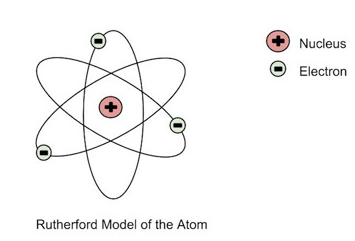
Rutherford's gold foil experiment provided evidence that...
a)
negative and positive charges are spread evenly throughout the atom.
b)
alpha particles have a positive charge.
c)
gold is not a dense as previously thought.
d)
there is a dense positively charged nucleus at the center of an atom.
21.
How much water would fit in a tank that is 10m deep, 5m wide and 10 meters tall?
a)
25m^3
b)
500m^3
c)
25m
d)
500m
22.
7,000 g = ____ kg
a)
70
b)
700
c)
7
d)
0.07
23.
Is 55,000 mg greater than, less than, or equal to 5 kg?
a)
greater than
b)
equal to
c)
less than
24.
Is 20 g greater than, less than, or equal to 2 kg?
a)
greater than
b)
less than
c)
equal to
25.
648 g = ____ mg
a)
6,480
b)
64,800
c)
648,000
d)
64.8
26.
15,000 g = ____ kg
a)
1.5
b)
150
c)
1,500
d)
15
27.

How did Mendeleev arrange the elements?
a)
alphabetical
b)
density
c)
melting point
d)
atomic mass
28.

The horizontal row on the periodic table is called a
a)
group
b)
family
c)
period
d)
atomic number
29.

A vertical column is called...
a)
group
b)
tower
c)
period
d)
crew
30.

Which of the following is the most metallic element in period 3?
a)
Boron (B)
b)
Sodium (Na)
c)
Argon (Ar)
d)
Silicon (Si)
31.

Most of the elements on the periodic table are classified as _____.
a)
Metals
b)
Nonmetals
c)
Metalloids
d)
Periods
32.
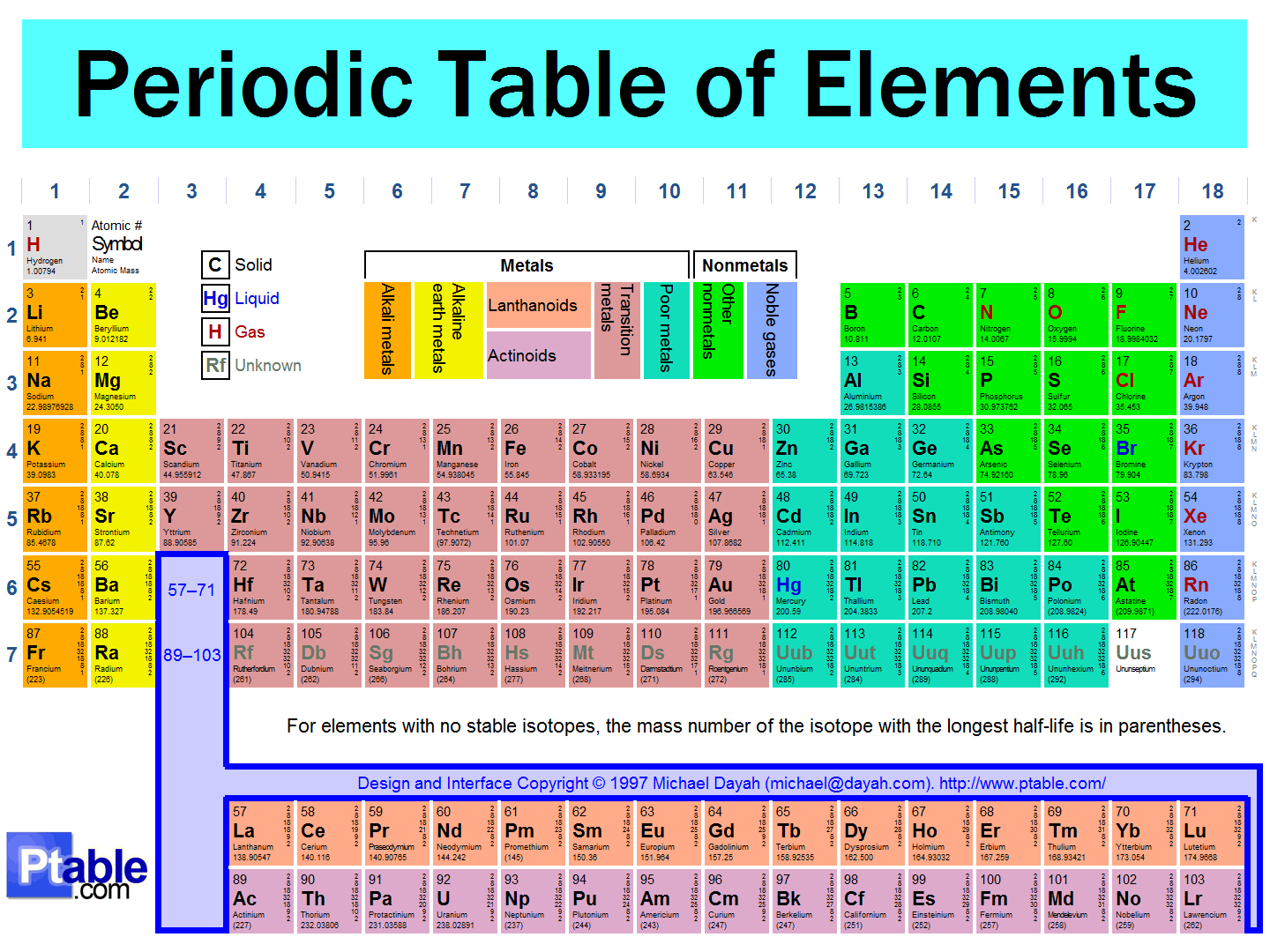
This class of elements are sometimes called "semiconductors."
a)
Metals
b)
Nonmetals
c)
Metalloids
d)
Groups
33.
Which group of the periodic table is composed of inert (not reactive) gases?
a)
alkali metals
b)
alkaline earth metals
c)
halogens
d)
noble gases
34.
Elements which are shiny, conduct electricity and heat are called
a)
metal
b)
nonmetal
c)
metalloid
d)
nonexistent
35.
Which is an alkali metal?
a)
Magnesium
b)
Iron
c)
Sodium
d)
Europium
36.
Which is a halogen?
a)
Helium
b)
Chlorine
c)
Oxygen
d)
Neptune
37.
A proton is....
a)
A negatively charged subatomic particle
b)
A positively charged subatomic particle
c)
A neutrally charged subatomic particle
d)
The only subatomic particle located in the nucleus
38.
A neutron has a charge of
a)
+2
b)
No charge
c)
-1
d)
+1
39.
The alkali metals have how many valence electrons?
a)
1
b)
2
c)
7
d)
8
40.
Calcium is most like which of the following?
a)
Barium
b)
Potassium
c)
Cesium
d)
Nitrogen
41.

The blue atoms are called
a)
metals
b)
nonmetals
c)
metalloids
d)
noble gases
42.
Which of the following is not a property of metals?
a)
brittle
b)
malleable
c)
lustrous
d)
conductive
43.
If a material can easily be drawn into the shape of a wire, it is
a)
Ductile
b)
Magnetic
c)
Malleable
d)
Reactive
44.
How many Valance electrons does Iodine Have?
a)
6
b)
16
c)
7
d)
17
45.
What is the name of the group that never reacts--ever ever they are stable with a full outermost ring!!!
a)
noble gases
b)
transition
c)
halogens
d)
borons
46.
Which group of METALS is the most reactive?
a)
Group 2- Alkaline Earth
b)
Group 17- Halogens
c)
Group 18- Noble Gases
d)
Group 1- Alkali metals
47.
The subatomic particle with a negative charge is the
a)
electron
b)
proton
c)
neutron
d)
nucleus
48.
Ionic Bonding involves...
a)
The transfer of protons
b)
The transfer of nuetrons
c)
The transfer of electrons
d)
None Of the above
49.
What do atoms that form positive ions tend to do?
a)
Tend to lose electrons
b)
Tend to lose protons
c)
Tend to gain electrons
d)
Tend to gain protons
50.
What usually forms the positive ion?
a)
Metal
b)
Non Metals
c)
None
51.
What happens when the sodium atom loses an electron?
a)
It become negatively charged
b)
It become positively charged
c)
none
52.
Covalent compounds
a)
Share electrons
b)
transfer electrons
c)
contain a sea of electrons
d)
conduct electricity
53.
What two types of atoms make a covalent bond?
a)
2 Nonmetals
b)
1 Nonmetal and 1 Metal
c)
2 Metals
d)
2 Noble Gases
54.
What charges attract?
a)
Opposite
b)
Same
55.
What charges repel?
a)
Same
b)
Opposite
56.
Predict the bond that will form between Be and F.
a)
Ionic
b)
Covalent
57.
Predict the bond that will form between Se and Cl.
a)
Ionic
b)
Covalent
58.
Predict the bond that will form between Sr and S.
a)
Ionic
b)
Covalent
59.
What is a valence electron?
a)
an electron that is found in the outermost shell of an atom.
b)
an electron found in the innermost shell of an atom.
c)
an electron found in the middle shell.
60.
What is the number of valence electrons for Silicon?
a)
1
b)
2
c)
6
d)
4
61.

How many valence electrons in this structure?
a)
6
b)
5
c)
4
d)
7
62.
What two types of atoms make a covalent bond?
a)
2 Nonmetals
b)
1 Nonmetal and 1 Metal
c)
2 Metals
d)
2 Noble Gases
63.

This is a correct dot diagram for neon (Ne)
a)
true
b)
false
64.

This could be the dot diagram of
a)
Ne
b)
H
c)
C
d)
F
65.

What is the correct formula for this molecule?
a)
NH
b)
N3H
c)
NH3
d)
NH4
66.
8. What type of Chemical Bonding is best defined as 'SHARING OF ELECTRONS '?
a)
a) Intermolecular Bonding
b)
b) Metallic Bonding
c)
c) Ionic Bonding
d)
d) Covalent Bonding
67.
The pH of a solution is tested, and it is found to be a basic solution. Of the following choices, what could the pH have been?
a)
3
b)
9
c)
7
d)
5
68.
Tastes bitter.
a)
Acids
b)
Bases
c)
Salts
d)
All
69.
On the pH scale what numbers are acids?
a)
8-14
b)
0-7
c)
7
d)
1
70.

Pollution causes the pH of rain water fall below 6. What is such type of rain called?
a)
Acid rain
b)
polluted rain
c)
low pH rain
100 %

