wayground logo

Free Printable Worksheets

Font size

S
M
L
XL
Worksheets

Bio 12 Nervous System

Total questions: 105

Worksheet time: 1hrs 9mins

Name
Class
Date
1.
What is Dendrite
a)
nerve fibers that carry message to cell body
b)
allow nerve impulses to pass from one neuron to next neuron
c)
nerve fibers that carry message from the cell body
d)
fat covering of the neuron
2.
How many nerves do we have in our body?
a)
3 nerves
b)
about a billion nerves
c)
a thousand nerves
3.

What part of the brain is number 1?

a)

Cerebrum

b)

Cerebellum

c)

Medulla

4.

What part of the brain is number 2?

a)

Cerebrum

b)

Cerebellum

c)

Medulla

5.

What part of the brain is number 3?

a)

Cerebrum

b)

Cerebellum

c)

Medulla

6.

These three parts work together to make up the Central Nervous System. They are the ________, ______, and _______.

a)

Brain, Spinal Cord, and Nerves

b)

Heart, Lungs, Brain

c)

Cerebrum, Cerebral Cortex, Cerebellum

7.

The three main parts of the brain are ______, _______, and ______.

a)

Cerebrum, spinal cord, heart

b)

Cerebrum, Cerebellum, Medulla

c)

Cerebrum, Medulla, Gray Matter

8.

The ________ is the largest part of the brain. It is in charge of language, speech, 5 senses, problem solving, movement, and thoughts.

a)

Cerebrum

b)

Cerebellum

c)

Medulla

9.

The ______ controls balance, posture, and coordination.

a)

Cerebrum

b)

Cerebellum

c)

Medulla

10.

The _______ is in charge of involuntary muscles movement such as breathing, your heart beat and your reflexes.

a)

Cerebrum

b)

Cerebellum

c)

Medulla

11.

Another name for the Medulla is the ______ _____.

a)

Brain Stem

b)

Spinal Cord

c)

Neuron

12.

Our ______ receive messages and send them to the brain. The brain sends messages to our body on how to respond.

a)

heart

b)

lungs

c)

nerves

13.
Which number shows the motor neuron?
a)
4
b)
5
c)
2
d)
1
14.
What neuron is this?
a)
Relay
b)
Motor
c)
Reflex
d)
Sensory
15.
What neuron is this?
a)
motor
b)
sensory
c)
relay
d)
reflex
16.
In this picture, the red line represents a(n)
a)
motor neuron
b)
sensory neuron
c)
receptor
d)
interneuron
17.
In this picture, the blue line represents a(n)
a)
interneuron
b)
motor neuron
c)
sensory neuron
d)
effector
18.
This picture is an example of a
a)
Nerve Impulse
b)
Reflex Arc
c)
Neural Arc
d)
Cerebral Processing
19.
The part labelled 1 is white in colour what is it that gives this colour?
a)
Bone
b)
Fat (myelin)
c)
Tendons
d)
Membrane
20.
Salivary glands are an example of ...
a)
A receptor
b)
A relay
c)
A detector
d)
An effector
21.
What is the role of the myelin on a neuron?
a)
Insulates
b)
Stimulates
c)
Relays
d)
Keeps warm
22.
What does the P in PNS stand for?
a)
Peretal 
b)
Peripheral 
c)
Poetal
d)
Prevalent 
23.
 The __________ coordinates the movement of skeletal muscles.
a)
cerebrum
b)
cerebellum
c)
brain stem
d)
neuron
24.
The __________ is the center of conscious thought.
a)
cerebrum
b)
brain stem
c)
cerebellum
d)
axon
25.
Several important involuntary functions, such as breathing and heartbeat, are controlled by the _
a)
dendrites
b)
cerebellum
c)
brain stem
d)
neurons
26.
Which of the following is not a part of the brain stem?
a)
Medulla oblongata
b)
Cerebellum
c)
Midbrain
d)
 Thalamus
27.
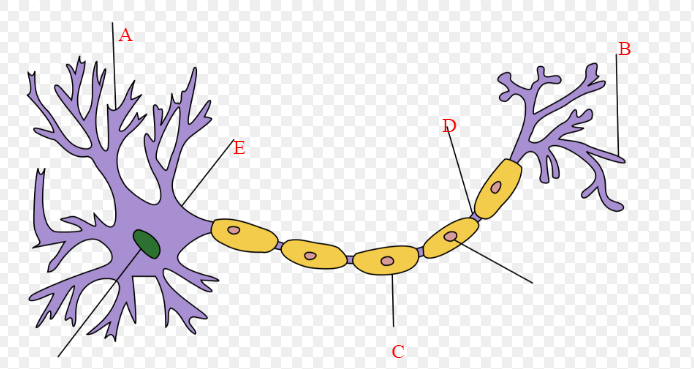
A
a)
Dendrite
b)
Axon
c)
Axon Terminal
d)
Cell Body
28.
E
a)
Synapse
b)
Cell Body
c)
Axon 
d)
Dendrite
29.
The correct direction of the neural impulse within one neuron.
a)
Axon Terminal to Dendrite
b)
Dendrite to Axon Terminal
c)
Cell Body to Axon
d)
Axon Terminal to Cell Body
30.
The tiny gap between neurons where nerve impulses are sent from one neuron to another.  It is where communication occurs between an axon and dendrite
a)
synapse
b)
axon terminal
c)
impulse
d)
myelin
31.
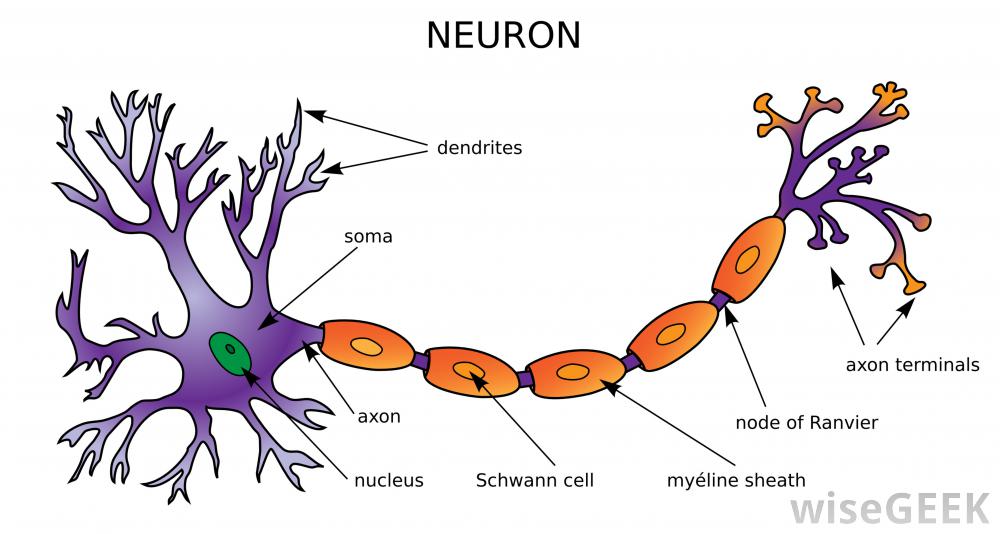
Identify the part of the neuron
a)
axon
b)
axon terminal
c)
dendrite
d)
Node of Nazier
32.
The part of the neuron that sends messages to other neurons
a)
axon
b)
dendrite
c)
cell body
d)
Schwann cell
33.
This releases neurotransmitters which are sent into the synaptic cleft for receptors on the dendrite to taste
a)
axon
b)
axon terminal
c)
gene
d)
neuron
34.
A chemical produced by neurons that carries messages to other neurons
a)
myelin sheath
b)
neurotransmitter
c)
axon
d)
axon terminal
35.

At resting potential, the ion distribution inside and outside of a neuron is such that __________ ions are most abundant on the outside of the cell, while __________ ions are most abundant on the inside of the cell.

a)

Potassium; sodium

b)

Sodium; potassium

c)

Calcium; potassium

d)

Calcium; sodium

36.

In the figure above, what is occurring at step #4?

a)

Neuron receives enough stimulation (15 mV), threshold is reached (-55mV)

b)

Na+ voltage channels open allowing Na+ to diffuse inward, depolarizing the membrane

c)

K+ voltage channels open and Na+ voltage channels open

d)

K+ voltage channels open allowing K+ to diffuse out, repolarizing the membrane.

e)

Hamsters. Massive amounts of hamsters

37.

When a neuron is at REST,

a)

the inside of the neuron is negatively charged compared to the outside.

b)

the inside of the neuron is positively charged compared to the outside.

c)

there is no charge difference established

d)

none of these is true

38.

An electrical impulse within a single neuron is called a

a)

synapse

b)

membrane potential

c)

action potential

d)

cell body

39.

Depolarization occurs when

a)

sodium channels open

b)

potassium channels open

c)

sodium channels close

d)

potassium channels close

40.

Depolarization is occuring at number

a)

1

b)

2

c)

4

d)

5

41.

Sodium channels are open during

a)

1

b)

2

c)

4

d)

5

42.

What maintains the resting membrane potential in a neuron?

a)

sodium-potassium pumps

b)

sodium channels

c)

potassium channels

d)

gravity

43.

Which of the following uses ACTIVE transport?

a)

sodium-potassium pump

b)

sodium channel

c)

potassium channel

d)

diffusion

44.
What number(s) on the graph represents the Resting Potential?
a)
1 and 2
b)
1 and 5
c)
2 and 3
d)
3 and 4
45.
-70 mV is the measure of a
a)
Threshold Potential
b)
Action Potential
c)
Resting Potential
d)
End Point Potential
46.
In resting potential, neurons have more _________ on the outside of the cell membrane.
a)
K+
b)
NaCl
c)
Na+
d)
Cl-
47.
In resting potential, neurons have more ____________ on the inside of the cell membrane.
a)
NaCl
b)
Na+
c)
K+
d)
Cl-
48.
As the action potential passes down the axon, what is signaled at the synaptic terminal?
a)
generation of new action potential
b)
release of K+
c)
release of neurotransmitters
d)
binding of ligands to synaptic terminals
49.
Why is -55 mV a significant number?
a)
This is the largest charge achieved during an action potential
b)
This is the threshold required to complete an action potential
c)
This is the resting charge of a neuron
d)
This is the charge when all the sodium is inside the cell
50.
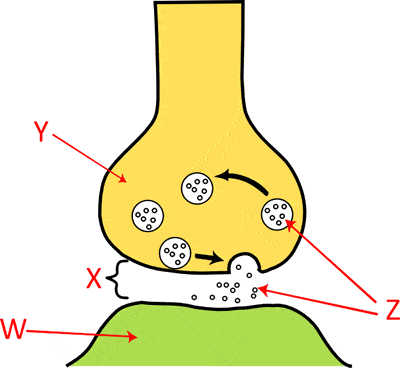
X
a)
Axon Terminal Button
b)
Neurotransmitters
c)
Dendrite
d)
Synapse
51.
W
a)
Axon Terminal Button
b)
Neurotransmitters
c)
Dendrite
d)
Synapse
52.
Z
a)
Dendrite
b)
Axon Terminal
c)
Neurotransmitters
d)
Synapse
53.
What generates a nerve impulse on the post-synaptic membrane? 
a)
Calcium binding with a receptor site
b)
Potassium leaking into the post-synaptic membrane 
c)
Neurotransmitter binding with receptor sites
d)
Neurotransmitter being removed from the synapse
54.
What is Acetylcholine mainly responsible for?
a)
mood
b)
alertness
c)
emotion
d)
muscle action
55.
Which neurotransmitter is mostly responisble for alertness and arousal?
a)
Norepinephrine
b)
Serotonin
c)
Dopamine
d)
GABA
56.
Serotonin is responsible for ________
a)
movement
b)
learning
c)
alertness and arousal
d)
mood, sleep & hunger
57.
What is the function of the neurotransmitter GABA?
a)
 Slow or calm things down
b)
Speed up brain activity
c)
Induce uncontrollable yelling
d)
Sexual stimulation
58.
Which neurotransmitter is mostly responsible for alertness and arousal?
a)
Norepinephrine
b)
Serotonin
c)
Dopamine
d)
GABA
59.
What is a neurotransmitter?
a)
fatty covering of the axon
b)
nerve cell
c)
chemical messenger
d)
gap between neurons
60.
What is the part highlighted in red?
a)
Cerebrum
b)
Cerebellum
c)
Brain Stem
d)
Diencephalon
61.
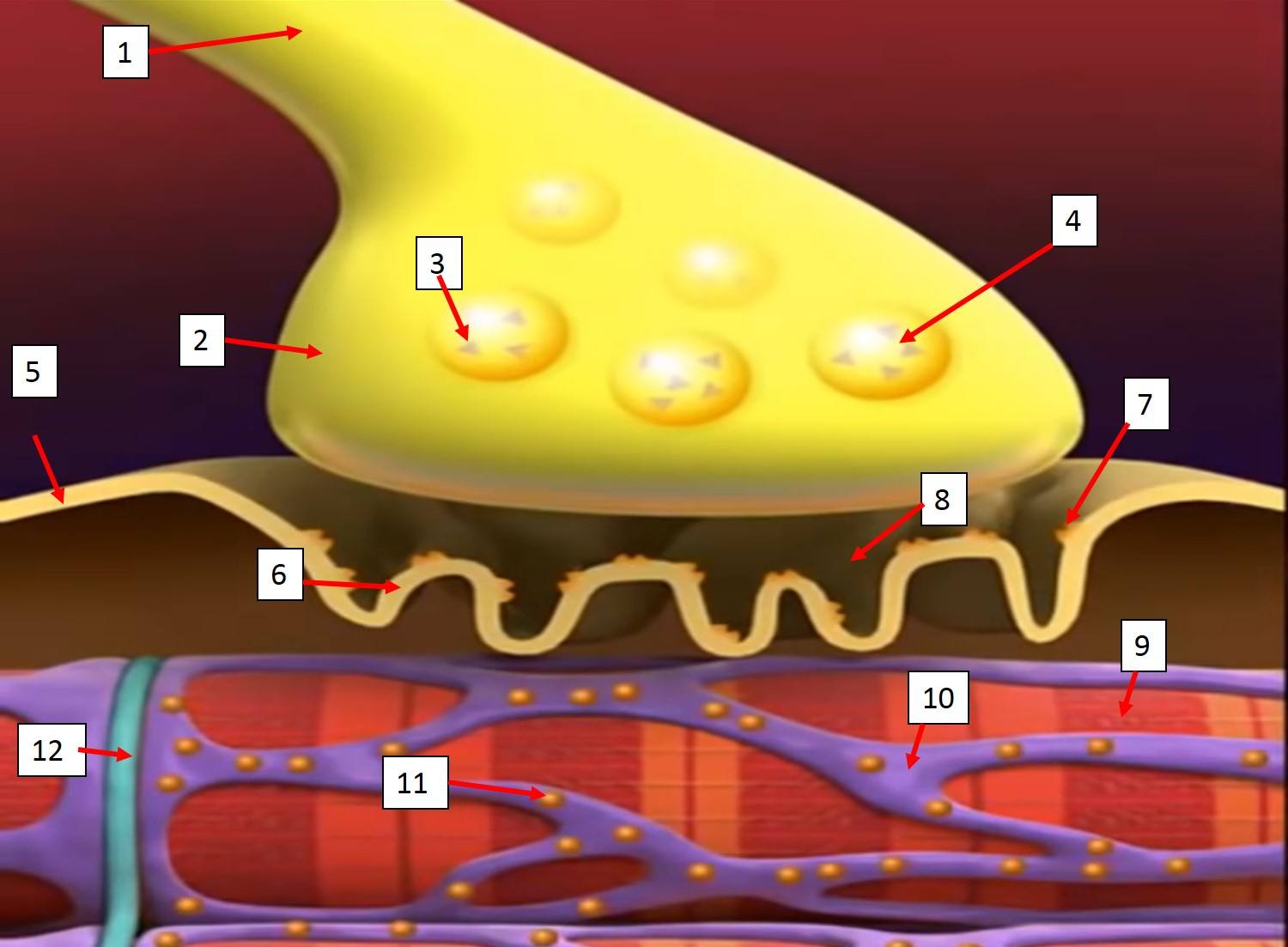
This structure stores the synaptic vesicles
a)
Axon Terminal
b)
Sarcoplasmic Reticulum
c)
Synaptic Cleft
d)
Synaptic Vesicles
62.
What neurotransmitter floods the brain during addiction
a)
Dopamine
b)
Cortisol
c)
Seratonin
d)
Oxycontin
63.
Which neurotransmitter is involved in the "Fight of Flight" response?
a)
Acetylcholine
b)
Endorphins
c)
Norepinephrine
d)
Serotonin
64.
What is the insulating membrane that surrounds parts of the axon that helps the impulses travel faster called?
a)
Axon
b)
Dendrites
c)
Node of Ranvier
d)
Myelin Sheath
65.

The autonomic nervous system is a branch of your ... nervous system.

a)

central

b)

peripheral

66.

What are the two divisions of the autonomic nervous system?

a)

central and peripheral

b)

parasympathetic and sympathetic

c)

brain and spinal cord

d)

nerves and ganglia

67.

The parasympathetic division is responsible for...

a)

fight

b)

flight

c)

stress

d)

relaxation

68.

The sympathetic division is responsible for...

a)

stress

b)

relaxation

c)

digestion

d)

resting

69.

Which one coordinates the inner organs?

a)

somatic nervous system

b)

autonomic nervous system

70.

They relax airways.

a)

sympathetic nerves

b)

parasympathetic nerves

71.

They dilate pupils.

a)

sympathetic nerves

b)

parasympathetic nerves

72.

They stimulate the activity of the intestines.

a)

sympathetic nerves

b)

parasympathetic nerves

73.

They slow heartbeat.

a)

sympathetic nerves

b)

parasympathetic nerves

74.

They stimulate salivation.

a)

sympathetic nerves

b)

parasympathetic nerves

75.
You're giving a speech in front of the class (most of you would feel this)
a)
sympathetic
b)
parasympathetic
76.
laying in a hammock reading a book
a)
sympathetic
b)
parasympathetic
77.

If Jessica accidentally touches the stove while cooking and she immediately pulls her hand back, this is an example of the autonomic nervous system.

a)

True

b)

False

78.

The following picture represents the

a)

Autonomic Nervous System

b)

Sympathetic Division

c)

Parasympathetic division

d)

Somatic nervous system

79.

The following picture represents the

a)

Autonomic Nervous System

b)

Sympathetic Division

c)

Somatic nervous system

d)

Parasympathetic division

80.

The Sensory Neuron is part of the

a)

Peripheral Nervous System

b)

Central Nervous System

81.

Which Neuron is this?

a)

Sensory Neuron

b)

Inter Neuron

c)

Motor Neuron

82.

Which Neuron is this?

a)

Sensory Neuron

b)

Inter Neuron

c)

Motor Neuron

83.

The Inter Neuron is part of the

a)

Peripheral Nervous System

b)

Central Nervous System

84.

A bundle of neurons is called a...

a)

Super Neuron

b)

Mega Neuron

c)

Nerve

d)

Inter Neuron

85.

Which Neuron is this?

a)

Sensory Neuron

b)

Inter Neuron

c)

Motor Neuron

86.

The Motor Neuron is part of the

a)

Peripheral Nervous System

b)

Central Nervous System

87.

B

a)

Dendrite

b)

Axon

c)

Axon Terminal

d)

Cell Body

88.
What two things are found in the central nervous system?
a)
brain/spinal cord
b)
spinal cord/motor neurons
c)
motor/sensory neurons
d)
only brain
89.

What are the two functions of the cerebrospinal fluid?

a)

protection of nerve tissue from injury

b)

storing memories

c)

providing nutrients and oxygen for the neurons

d)

sorting out feelings

e)

focusing

90.

What does the medulla oblongata not control?

a)

breathing

b)

heart rate

c)

thinking

d)

blood pressure

e)

salivation

91.

Which one coordinates movements?

a)

cerebellum

b)

reticular formation

c)

thalamus

d)

hypothalamus

92.

Which part sorts out sensory information before sending it to the cortex?

a)

hypothalamus

b)

thalamus

c)

cerebrum

d)

medulla

93.

Which one controls hunger and thirst?

a)

hypothalamus

b)

cerebellum

c)

reticular formation

d)

thalamus

94.

Which one has two hemispheres?

a)

thalamus

b)

medulla

c)

reticular formation

d)

cerebrum

95.

Why can't you tickle yourself?

a)

because of the medulla oblongata

b)

because of the cerebellum

c)

because of the hypothalamus

d)

because of the thalamus

e)

because of the lungs

96.

The cortical regions at the back of the brain, housing the visual cortex

a)

Temporal Lobe

b)

Occipital Lobe

c)

Frontal Lobe

d)

Parietal Lobe

97.

Cortical lobes that process sounds, including speech

a)

Temporal Lobe

b)

Occipital Lobe

c)

Parietal Lobe

d)

Frontal Lobe

98.

Lying towards the back and top of the brain; involved in touch sensation and in perceiving spatial relationships

a)

Parietal Lobe

b)

Frontal Lobe

c)

Occipital Lobe

d)

Temporal Lobe

99.

Front of the brain; especially involved in movement and thinking

a)

Occipital Lobe

b)

Frontal Lobe

c)

Parietal Lobe

d)

Temporal Lobe

100.

The band of nerve cells that connects the two cerebral hemispheres

a)

motor cortex

b)

somatosensory cortex

c)

corpus collosum

d)

medulla

101.

The visual processing areas of the cortex in the occipital and temporal lobes

a)

Auditory Cortex

b)

Motor Cortex

c)

Visual Cortex

d)

Somatosensory Cortex

102.

The brain's blood testing laboratory, constantly monitoring the blood to determine the condition of the body

a)

Medulla

b)

Pons

c)

Hypothalamus

d)

Hippocampus

103.

Regulates brain activity during sleep and dreaming

a)

Pons

b)

Medulla

c)

Amygdala

d)

Thalamus

104.

The brain stem structure that controls breathing and heart rate

a)

Amygdala

b)

Thalamus

c)

Pons

d)

Medulla

105.

Nearly all the messages going into or out of the brain go through this relay station

a)

Thalamus

b)

Pons

c)

Amygdala

d)

Medulla