
 Worksheets
Physics Semester Review
Total questions: 93
Worksheet time: 1hrs 24mins
For an object to change velocity, it must have a(n) _________ acting on it.
Force
Area
Effort
Scalar
A boat moving away from you as you jump out of it demonstrates which of Newton's Laws?
Newton's First Law
Newtons's Second Law
Newton's Third Law
Newton's Law of Gravity
There are two cars involved in a head-on collision. One car has twice the mass of the other. The car with more mass hits the car with smaller mass with __________ force.
No
Less
Equal
More
An elevator with a mass of 1500 kg accelerates upward at 1.63 m/s2. What is the force acting on the elevator’s support cable?
495 N
222 N
2444 N
1100 N
What force is required to accelerate a 60 kg cart at 2.0 m/s2 forward?
120.0 N
12.0 N
1200.0 N
There isn't enough information to tell

What is the name of the missing force in this free body diagram?
Tension Force
Normal Force
Weight Force
Frictional Force

If these boys are pulling with the same amount of force. What will happen?
The boy on the left will win
The boy on the right will win
Neither will move
Both will fall down
Which graph presents an object moving with a constant positive velocity?


A tennis ball is thrown straight up with an initial velocity of 20.0 m/s. It is caught at the same distance above the ground that it was thrown from. How long is the ball in the air?
4.1 s
2.04 s
5.0 s
1.5 s

Describe the curve located on the graph between 0 seconds and 2 seconds.
It shows constant velocity
It shows constant acceleration
It show the object standing still
It shows constant displacement

Describe the curve located on the graph between 2 seconds and 7 seconds.
It shows constant velocity
It shows constant accleration
It shows the object standing still
It shows constant displacement
Choose the correct definition:
Force
A push or pull exerted on an object
object or objects of interest that can interact with each other and the external world
the vector sum of all the forces on an object
The tendency of an object to resist changes in velocity
Choose the correct definition:
Inertia
The tendency of an object to resist changes in velocity
The support force acting on an object
the specific name for the force exerted by a rope or a string
the perpendicular contact force exerted by a surface on another object
Choose the correct definition:
Drag Force
the gravitational force exerted on an object
the constant velocity of a falling object when the force of air resistance is equal in magnitude and opposite in direction to the force of gravity
the force exerted by a fluid on the object moving through the fluid; it depends on the object's motion and properties, and the fluid's properties
a physical model that represents the forces acting on a system
Choose the correct definition:
Newton's First Law
States that an object at rest will remain at rest, and a moving object will continue moving in a straight line with constant speed, if and only if the net force acting on that object is zero.
states that the acceleration of an object is proportional to the net force and inversely proportional to the mass of the object being accelerated
states that all forces come in pairs and that the two forces in a pair act on different objects and are equal in strength and opposite in direction
an object's apparent weight of zero that results when there are no contact forces pushing up on the object
Choose the correct definition:
Newton's Second Law
States that an object at rest will remain at rest, and a moving object will continue moving in a straight line with constant speed, if and only if the net force acting on that object is zero.
states that the acceleration of an object is proportional to the net force and inversely proportional to the mass of the object being accelerated
states that all forces come in pairs and that the two forces in a pair act on different objects and are equal in strength and opposite in direction
an object's apparent weight of zero that results when there are no contact forces pushing up on the object
Choose the correct definition:
Newton's Third Law
States that an object at rest will remain at rest, and a moving object will continue moving in a straight line with constant speed, if and only if the net force acting on that object is zero.
states that the acceleration of an object is proportional to the net force and inversely proportional to the mass of the object being accelerated
states that all forces come in pairs and that the two forces in a pair act on different objects and are equal in strength and opposite in direction
an object's apparent weight of zero that results when there are no contact forces pushing up on the object
What is the unit for the velocity?
meters
m/s
Hertz
seconds
What is the unit for the gravitational force?
newtons
m/s
Hertz
seconds
Which of the following is considered good laboratory practice?
Wearing open-toed shoes
Eating while you work
Working alone with electrical equipment
None of these
Which of the following is something that you should always do while working with electricity?
Rewire the circuit before each experiment
Make sure that your batteries are different
use equipment that has frayed power cords
Make sure that both the area and your hands are completely dry at all times
Which of the following is the base SI unit for mass?
grams
milligrams
kilograms
pounds
Which of the following is the correct prefix for 1000000?
Centi-
Micro-
Mega-
Kilo-
A motion diagram is a diagram that does which of the following?
Adds together average speeds of all objects in the diagram
Uses drawings to depict the vectors of the velocities involved in the diagram
Uses a series of dots to represent the motions of an object
Takes a series of photographs at equal time intervals and overlays them to see how the position changes over time
A vector must always have both
Distance and velocity
magnitude and direction
direction and acceleration
magnitude and time

The graph show the velocity of a car that is moving in a straight line. During which of the following intervals are the forces on the car balanced?
q to r
r to s
s to t
t to u

A 45 kg child on a skateboard experiences a 75 N force as shown in the image. What is the acceleration of the child?
1.6 m/s2
2.0 m/s2
0.6 m/s2
25.0 m/s2

An upward force of 150 N is applied to a box weighing 70 N. Which of the following is the free-body diagram for this situation?
A
B
C
D
You throw a ball upward with an initial velocity of 20 m/s. 4 seconds later, you catch it at the same height that it was thrown. How fast is the ball moving at the top of its upward path?
0 m/s
5 m/s
1 m/s
20 m/s
What is another name for Newton's First Law of motion?
The law of momentum
The law of inertia
The law of acceleration
The law of gravity
Net force is defined as:
The total effort present on an object
The vector sum of all forces on an object
The composite of all forces acting on an object
The total sum of all resistance acting on an object
Which of the following is Newton's Second Law?
a force is needed to keep an object moving
the acceleration of an object is proportional to the net force exerted on the object and inversely proportional to the mass of the object.
objects remain either at rest or continue moving in a straight line with constant speed only if the net force on that object is zero.
all forces come in pairs.
A scale on Earth shows that you weight 885N. What is your mass?
90 kg
110 kg
8673 kg
75 kg
Average acceleration is defined as
The change in an object's velocity during a measurable time interval divided by that specific time interval
The center-seeking acceleration of an object moving in a circle at a constant speed
A push or a pull exerted on an object
The attractive force between two objects that is directly proportional to the mass of the objects
An elevator with a mass of 2000 kg accelerates upward at 1.63 m/s2. What is the force acting on the elevator’s support cable?
3260 N
326.0 N
1100 N
1226 N
You throw a tennis ball straight up with an initial velocity of 22.5 m/s. It is caught at the same distance above the ground. Neglecting air resistance, what is the tennis ball’s velocity when it returns your hand?
22.5 m/s
19.4 m/s
9.8 m/s
25.6 m/s

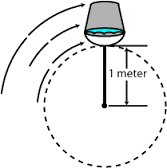

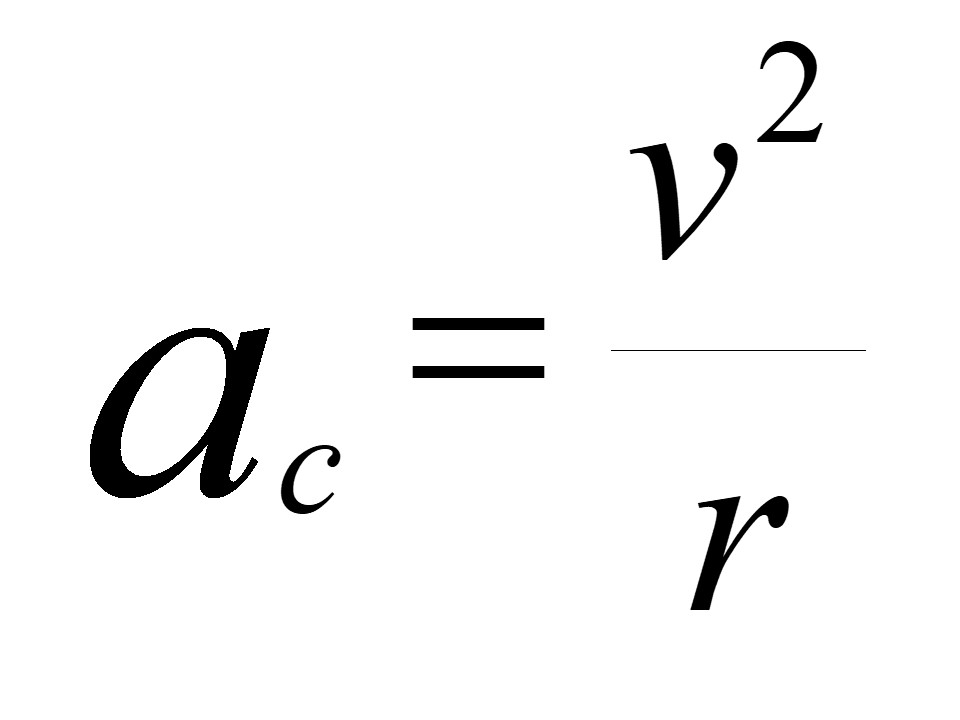
What's the centripetal acceleration of an object traveling 2.3 m/s around a circle of diameter 0.6 m?
5 m/s2
17.63 m/s2
10 m/s2
8.81 m/s2
A bicycle has a period of 0.3s . What is the
speed of its tires if their radius is 30 cm?
6 m/s
3 m/s
60 m/s
30 m/s
The drum of a washing machine rotates 1800 times in 3 minutes. What is the period?
0.1 s
0.2 s
0.3 s
0.5 s
A toy car is following a circular path with a constant speed of v=3 m/s . If the radius of the circular path is 1 m, find The centripetal acceleration of the car
30 m/s2
3 m/s2
9 m/s2
6 m/s2
A 10kg car travels at a constant speed of 20.0 m/s around a horizontal circular track. Which diagram correctly represent the direction of the car's velocity (v) and the direction of the centripetal force (Fc) acting on the car at a particular moment?



If Earth's mass was cut in half, what would happen to your mass?
Increase because gravitational force increases
decrease because gravitational force decreases
decrease because gravitational force increases
nothing, your mass is not affected by Earth's mass
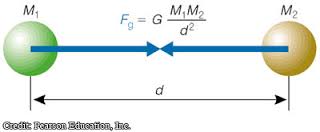
Two masses m1 and m2 are separated by a distance R and gravitaional force between them is F. If m1 is doubled and m2 is halved the new Force will be
2F
F
F/2
4F
F/4
What is the gravitational force between two identical 50,000 kg asteroids whose centers of mass are separated by 1000 m?
2500 N
3.3 x 10⁻¹² N
1.67 x 10⁻⁴ N
1.67 x 10⁻⁷ N
Einstein's theory of gravity states that gravity is the warping of which of the following?
Space
Time
Space and time
Space-time
Gravity can warp light, causing us to see objects in different locations, or as distorted images of themselves.
True
False
The force of static friction between a box sliding on a surface depends on the ____ .
Surface area of the box
Speed of the box
Normal force
Force causing the motion
A motion diagram is a diagram that does which of the following?
Adds together average speeds of all objects in the diagram
Uses a series of dots to represent the motions of an object
Uses drawings to depict the vectors of the velocities involved in the diagram
Takes a series of photographs at equal time intervals and overlays them to see how the position changes over time
A scale on Earth shows that you weight 885N. What is your mass?
90 kg
110 kg
8673 kg
75 kg
To conserve angular momentum, if the axis of rotation and moment of inertia of a spinning object decreases, the ________ of that object increases
Angular Velocity
Force
Net Torque
Impulse
According to Newton’s ____ law, an object with no net force acting on it remains at rest or in motion with a constant velocity.
First
Second
Third
None of the above
Basket ball A is dropped from a height of 10 meters. At the exact same time, basketball B is pushed off of a ledge sideways with a horizontal velocity of 1 m/s, also from a height of 10 meters. Which basketball will hit the ground first?
Basketball A
Basketball B
They hit at the same time
There is not enough information to determine which hits first
A person is standing on roller blades and is holding a heavy medicine ball. If he throws the ball horizontally to the right, his resulting motion will be ________________________.
Forward
Backward
Right
Left
Suppose you are an astronaut spacewalking outside your spacecraft to repair a broken part. In fixing the part, you have drifted several meters from your spacecraft. You are now at rest and are still holding a bag filled with tools. Using Newton's Laws, how could you return to your ship?
Throw the tool bag in the opposite direction that you want to go
Throw the tool bag in the same direction that you want to go
Spin the tool bag around you in a circle
None of the above
If the radius of the string is .3 meters long and the stopper makes 5 revolutions per second, what is the speed of the stopper?
9.4 m/s
12.2 m/s
8.1 m/s
14 m/s
What's the centripetal acceleration of an object traveling 2.3 m/s around a circle of diameter 0.6 m?
17.63 m/s2
15.22 m/s2
22.01 m/s2
14.34 m/s2

