wayground logo

Free Printable Worksheets

Font size

S
M
L
XL
Worksheets

Genetics & DNA (Unit 4 Review)

Total questions: 68

Worksheet time: 54mins

Name
Class
Date
1.

What are nucleotides made of?

a)

sugar, phosphate, nitrogen base

b)

phosphate, adenine, nitrogen base

c)

thymine, adenine, cytosine

d)

phosphate, nitrogen, adenine

2.
Which of the following best describes a DNA molecule?
a)
double helix
b)
contains ribose
c)
made of amino acids
d)
contains Uracil
3.

Adenine bonds with ______________.

a)

guanine

b)

thymine

c)

cytosine

d)

adenine

4.

Guanine bonds with ______________.

a)

adenine

b)

guanine

c)

cytosine

d)

thymine

5.
Why is DNA important?
a)
it is very small and very complicated
b)
it's in everything
c)
it serves as the blueprint for traits of all living things
d)
because we eat it every day for energy
6.
What are the 4 nitrogen bases?
a)
adenine, thymine, cytoplasm, and guanine
b)
adenine, thymine cytosine, and guanine
c)
adenine, thymine, cytosine, and gylcerol
d)
adenine, thymine, cytosine, and glucose
7.
Which organelle is DNA usually found in?
a)
cell membrane
b)
vacuole
c)
chloroplast
d)
nucleus
8.

Which sequence of DNA bases would pair with this partial strand:

ATG TGA CAG

a)

ATG TGA CAG

b)

TAC ACT GTC

c)

GTA AGT GAC

d)

CAT TCA CTG

9.

In asexual reproduction, all of the offspring are:

a)

physically identical

b)

genetically identical

c)

physically and genetically identical

d)

not identical

10.

A hydra reproduces when an outgrowth, or bud, forms and continues to develop until if falls off of the parent. This is an example of:

a)

binary Fission

b)

sporulation

c)

budding

d)

vegetative propagation

11.

How many parent(s)are needed for asexual reproduction?

a)

4

b)

1

c)

9

d)

100

12.

When a starfish grows a new body off a broken arm, what kind of reproduction is this?

a)

sexual

b)

differentiation

c)

asexual

d)

specialization

13.
What does heredity mean?
a)
DNA being passed down from one generation to the next.
b)
Passing down acquired characteristics to your offspring.
c)
Leaving money in a will to your children
d)
all DNA is kept in the nucleus
14.
Where is all the genetic material inside a cell?
a)
nucleus
b)
vacuole
c)
cell membrane
d)
ribosome
15.

The offspring from asexually reproduced organisms are?

a)

different than their parents

b)

identical to parents

c)

like a combination from both parents

d)

a different species

16.

Genetic variation means

a)

genetic differences in a population or species

b)

genetic similarities between a population or species

17.

What is one disadvantage of sexual reproduction?

a)

only one parent needed

b)

offspring are exact copies of parents

c)

happens very quickly

d)

needs two parents

18.
Which of the following genotypes is homozygous recessive?
a)
RR
b)
Rr
c)
rr
d)
None of the Above
19.

Brown (B) is dominant over white (b). Which genotye is for brown fur?

a)

BB

b)

Bb

c)

bb

d)

both BB and Bb

20.

This image shows a...

a)

Punnett square

b)

phenotype

c)

genotype

d)

dominant allele

21.
A phenotype is the...
a)
letter combination
b)
dominant gene
c)
recessive gene
d)
physical appearance
22.

Dominant alleles are...

a)

capital

b)

lowercase

c)

both

d)

neither

23.

Recessive alleles are...

a)

capital

b)

lowercase

c)

both

d)

neither

24.

The genotype Tt is...

a)

homozygous dominant

b)

homozygous recessive

c)

heterozygous

d)

none of these

25.
Heterozygous is when...
a)
the alleles are the same
b)
the alleles are different
c)
the alleles are absent
d)
the alleles are present
26.
In a heterozygous genotype, the ___________ allele takes over in the phenotype.
a)
recessive
b)
dominant
c)
lower case letter
d)
both 
27.
T - tall and t = short
In the punnett square below, what belongs in the missing square
a)
tt
b)
Tt
c)
Bb
d)
TT
28.
G = green, g = yellow
The genotype for a yellow plant is...
a)
GG
b)
Gg
c)
gg
d)
all of the choices result in yellow
29.
B = brown fur  b = white fur
In the punnett square, what is the probability for white fur? 
a)
0%
b)
25%
c)
50%
d)
75%
30.
In plants, tall (T) is dominant to short (t). Perform the following cross: Tt x Tt. What is the probability of producing a short plant?
a)
0%
b)
25%
c)
50%
d)
75%
31.

Brown eyes (B) is dominant over blue eyes (b). Two brown eyed parents (Bb) have a baby. What is the chance the baby is blue eyed?

a)

0 %

b)

25%

c)

50%

d)

75%

32.
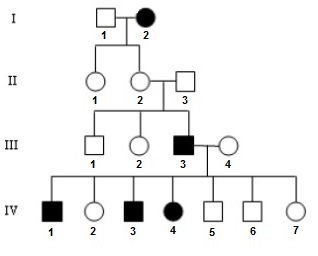
How many generations are shown in this pedigree?
a)
1
b)
2
c)
3
d)
4
33.
How many kids did the mother and father from the first generation have?
a)
2
b)
4
c)
5
d)
6
34.
This pedigree represents the inheritance of hemophilia in this family. How many of the females have the hemophilia trait?
a)
8
b)
5
c)
2
d)
3
35.
What do half colored symbols represent?
a)
The individual is a carrier (heterozygous).
b)
The individual expresses the trait.
c)
The individual has both recessive alleles.
d)
The individual has both dominant alleles.
36.
What does an open circle represent?
a)
Not Affected Male
b)
Not Affected Female
c)
Affected Male
d)
Affected Female
37.
Is this trait (the shaded individuals) dominant or recessive?
a)
dominant
b)
recessive
38.
In the second generation-how many people are carriers of the trait?
a)
2
b)
3
c)
5
d)
6
39.
How many females are in this pedigree?
a)
3
b)
4
c)
6
d)
7
40.

What mutation has occurred here?

T-G-A-C-C-A

T-G-A-G-C-A

a)

substitution

b)

deletion

c)

insertion

d)

frameshift

41.

DNA molecule segment is : TTACGCAAG

The mutated DNA segment is TTCGCAAG. This is an example of ___ mutation.

a)

substitution

b)

deletion

c)

insertion

d)

inversion

42.

A mutation is defined as:

a)

A change in the cell's structure

b)

Anything that changes in an embryo

c)

Any change in the physical features of a human

d)

A change in the DNA sequence

43.

What mutation has occurred here?

T-G-A-C-C-A

T-G-A-G-C-A

a)

substitution

b)

deletion

c)

insertion

d)

frameshift

44.
Who was Gregor Mendel?
a)
A French Botanist
b)
A German Physician
c)
An American Cowboy
d)
An Austrian Monk
45.

A trait that is expressed over other traits.

a)

recessive

b)

co-dominant

c)

incomplete dominant

d)

dominant

46.

A trait that is not expressed when a dominant allele is present.

a)

recessive

b)

co-dominant

c)

incomplete dominant

d)

dominant

47.

The physical or behavioral appearance of a trait

a)

phenotype

b)

DNA

c)

genotype

d)

genetics

48.

Two or more combinations of the same gene

a)

gene

b)

genotype

c)

phenotype

d)

alleles

49.

Genotype refers to the ...

a)

physical expression of the genes

b)

possible combination of alleles in a gene

c)

whether an allele is dominant or recessive

d)

how an organism will appear

50.
Which of the following is a phenotype?
a)
BB
b)
Bb
c)
bb
d)
Blue eyes
51.

The passing of genetic traits from parent to offspring.

a)

heredity

b)

trait

c)

gene

d)

allele

52.
G = green, g = yellow
The genotype for a yellow plant is...
a)
GG
b)
Gg
c)
gg
d)
all of the choices result in yellow
53.
Which characteristic would most likely be inherited by a baby?
a)
brown hair
b)
crying a lot
c)
ability to jump high
d)
his ability to talk
54.
Which best describes an inherited trait?
a)
a characteristic one chooses to express
b)
a characteristic one receives from the food one eats
c)
a characteristic that is passed on from one's parents
d)
a characteristic that is influenced by one's surroundings
55.

What is the purpose of MITOSIS?

a)

to create sex cells

b)

to kill off body cells

c)

to repair or replace body cells

56.
What percentage of chromosomes are handed down by a sperm cell?
a)
75%
b)
25%
c)
50%
d)
100%
57.
Sexual reproduction requires _____ parents and asexual reproduction requires ___ parents
a)
1,1
b)
2,2
c)
2,1
d)
1,2 
58.
What is an advantage of sexual reproduction?
a)
Allows genetic variation
b)
Only needs one parent
c)
Happens very quickly
d)
Offspring are exact copies of parent
59.
What is one disadvantage of sexual reproduction?
a)
Only one parent needed
b)
Off spring are exact copies of parents
c)
Happens very quickly
d)
Needs two parents
60.

Genetic mutations can be...

a)

beneficial, harmful, or neutral

b)

beneficial only

c)

harmful only

d)

neutral only

61.

Arrange the following structures from smallest to largest: chromosome, nucleus, cell, gene

a)

chromosome, nucleus, cell, gene

b)

gene, chromosome, nucleus, cell

c)

gene, cell, nucleus, chromosome

d)

chromosome, gene, cell, nucleus

62.

What is true about the sequence of bases found in DNA?

a)

It changes every time it replicates.

b)

It determines the characteristics that will be inherited.

c)

It directly controls the synthesis of starch within a cell.

d)

It is exactly the same in all organisms.

63.

Strand 1 of a DNA molecule contains the sequence GATCT. What would be the complementary sequence found on strand 2?

a)

CTAGA

b)

GATCT

c)

TAGGC

d)

AGCTT

64.

Strand 1 of a DNA molecule contains the sequence GTTGAT. What is the complementary base sequence of strand 2?

a)

GTTAAC

b)

CAATTG

c)

CAACTA

d)

CTCCGG

65.

The transfer of genes from parents to their offspring is known as

a)

differentiation

b)

immunity

c)

heredity

d)

evolution

66.

How many pairs of chromosomes are in a human being?

a)

23

b)

44

c)

89

d)

72

67.

A _______ is a segment of DNA that codes for a specific protein or RNA molecule.

a)

gene

b)

gamete

c)

chromosome

d)

chromatid

68.

The structure in the image is called a:

a)

Chromosome

b)

Karyotype

c)

Gene

d)

Protein