wayground logo

Free Printable Worksheets

Font size

S
M
L
XL
Worksheets

On Level Semester Exam Review

Total questions: 116

Worksheet time: 3hrs 19mins

Name
Class
Date
1.
Jack has a rock. The rock has a mass of 14g and a volume of 2cm3. What is the density of the rock?
a)
7 mL
b)
7 g/cm3
c)
28 g/cm3
d)
1/7 g/cm3
2.
Define the term "mass".
a)
Mass/Volume
b)
Anything that has mass and takes up space 
c)
The amount of space an object occupies.
d)
The amount of matter in an object.
3.
Volume is ...
a)
Mass/Volume
b)
The amount of matter in an object.
c)
The amount of space an object occupies.
d)
Anything that has mass and occupies space.
4.
Density is...
a)
the amount of mass in an object
b)
the amount of space an object takes up
c)
the amount of mass in a given space
d)
the weight of an object
5.
What is the study of matter and how it changes?
a)
matter
b)
chemistry
c)
substance
d)
properties
6.
Which one of these is a chemical property?
a)
melting point
b)
boiling point
c)
color
d)
flammability
7.
Flammability is an example of what property?
a)
Chemical property
b)
Physical property
8.
Which is an example of a physical property?
a)
ability to react with acid
b)
 state of matter
c)
flammability
d)
ability to react with oxygen
9.
Which of the following is a physical property?
a)
melting point
b)
flammability
c)
ability to rust
10.
A change in the size, shape, or state of matter.
a)
chemical change
b)
physical change
c)
chemical reaction
d)
electron change
11.
Ice melting
a)
Chemical Change
b)
Physical Change
12.
Wood burned in a fireplace
a)
Chemical Change
b)
Physical Change
13.
Cake batter baked in an oven
a)
Chemical Change
b)
Physical Change
14.
The melting point of ice is 00 C. This is an example of ________.
a)
physical intensive property
b)
physical extensive property
c)
Chemical change
d)
Chemical property
15.
The density of pyrite is 5g/cm. This is an example of 
a)
physical intensive property
b)
physical extensive property
c)
chemical change
d)
chemical property
16.
Wood burning is an example of _______
a)
physical intensive property
b)
physical extensive property
c)
chemical change
d)
Physical change
17.
Crumpling paper is an example of 
a)
physical change
b)
chemical change
c)
physical property
d)
chemical property
18.
The rose is red. This is an example of a 
a)
physical extensive property
b)
Chemical property
c)
physical intensive property
d)
physical change
19.
Which of the following is a good conductor of heat?
a)
Metal
b)
Nonmetal
c)
Metalloid
20.

One property of nonmetals is that it they are good conductors of electricity.

a)

true

b)

false

21.

Some characteristics of metals are that they are malleable and ductile.

a)

TRUE

b)

FALSE

22.
Which of the following properties refers to the ability of metals to be drawn into wires?
a)
A. malleability 
b)
B. compressibility
c)
C. ductility
d)
D. luster
23.
Metals appear to the _______ of the dark ziz-zag line on the periodic table. 
a)
A. right
b)
B. middle
c)
C. left
24.
Nonmetals occur to the ________of the dark zig-zag on the periodic table. 
a)
A. right
b)
B. middle
c)
C. left
25.
Silicon is a semiconductor and has properties of both metals and nonmetals. What type of element is Silicon? 
a)
Metal
b)
Nonmetal
c)
Metalloid
d)
Pretty
26.
A pure substance that cannot be broken down into anything simpler is a/an-
a)
atom
b)
element
c)
cell
d)
compound
27.
__________ are made from a combination of 2 or more elements.
a)
Solutions
b)
Pure Substances
c)
Compounds
d)
Elements
28.
Which of the following is an element?
a)
Sugar
b)
Salt
c)
Water
d)
Oxygen
29.
Which of these is a pure substance?
a)
bread
b)
table salt
c)
garden soil
d)
sea water
30.
A mixture that appears to be evenly mixed throughout:
a)
an atom
b)
a compound
c)
a homogeneous mixture
d)
a heterogeneous mixture
31.
 mixture that does NOT appear to be evenly mixed throughout:
a)
an atom
b)
a compound
c)
a homogeneous mixture
d)
a heterogeneous mixture
32.
How many neutrons in C-14?
a)
6
b)
7
c)
14
d)
8
33.
What quantities vary between isotopes of an element?
a)
protons, electrons, and atomic mass
b)
protons, electrons, and atomic number
c)
neutrons and electrons
d)
neutrons and atomic mass
34.
The positive particles of an atom are 
a)
electrons 
b)
positrons 
c)
neutrons 
d)
protons 
35.
the central region of an atom where its neutrons and protons are is its 
a)
nucleus 
b)
electron cloud
c)
core 
d)
center 
36.
Particles in an atom that are neutral and have no charge are 
a)
negatrons 
b)
electrons 
c)
neutrons 
d)
protons 
37.
A particle that moves around the nucleus is a(n)...
a)
Proton
b)
Neutron
c)
Electron
d)
Quark
38.
What is the atomic number?
a)
the number of protons
b)
the number of protons and neutrons
c)
the number of neutrons
d)
the number of protons and electrons
39.
What is the mass number?
a)
the number of protons
b)
the number of protons and neutrons
c)
the number of neutrons
d)
the number of protons and electrons
40.
Ions are: 
a)
atoms with a positive or negative charge
b)
atoms with no charge
c)
atoms with ONLY a positive charge
d)
atoms with ONLY a negative charge
41.
Two atoms of the same element but with different mass numbers are called________
a)
electrons
b)
isotopes
c)
variables
d)
electron cloud
42.
What scientist is best known for his "Plum Pudding" model of the atom?
a)
J.J. Tomson
b)
Ernest Rutherford
c)
John Dalton
d)
Democritus
43.
What contribution did John Dalton make to atomic theory? 
a)
He discovered that every atom was positively charged. 
b)
He discovered that every element consisted of one type of atom.  
c)
He discovered that atoms had nuclei. 
d)
He discovered that atoms could be divided into smaller parts. 
44.
J.J. Thomson provided evidence that an atom...
a)
is the smallest particle of matter
b)
contains negatively charged particles
c)
has an overall negative charge
d)
has an overall positive charge
45.
Rutherford's gold foil experiment provided evidence that...
a)
negative and positive charges are spread evenly throughout the atom.
b)
alpha particles have a positive charge.
c)
gold is not a dense as previously thought.
d)
there is a dense positively charged nucleus at the center of an atom.
46.
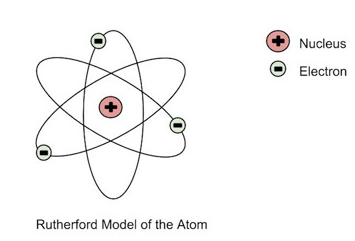
Who came up with this model of an atom?
a)
J.J. Thompson
b)
Ernest Rutherford
c)
Neils Bohr
d)
James Chadwick
47.
What atom matches this electron configuration?
1s22s22p63s23p64s23d10
a)
Zinc
b)
Copper
c)
Nickel
d)
Germanium
48.
What atom matches this electron configuration?
1s22s22p63s2
a)
Neon
b)
Magnesium
c)
Aluminum
d)
Potassium
49.
What is the noble gas configuration for boron?
a)
[He]1s22s2
b)
[He]2s22p2
c)
[He]2s22p1
d)
[Li]2s22p1
50.
[Ne]3s23p5 is the noble gas configuration for which element?
a)
chlorine
b)
fluorine
c)
sulfur
d)
aluminum
51.
There are 4 different types of subshells s,p,d,f
a)
true
b)
false
52.

In 1s2, the 1 means

a)

there is 1 electron

b)

the electrons are in the 1st energy level

c)

the shape is circular

d)

there is a -1 charge

53.

In 1s2, the s means

a)

the shape of the orbital is circular

b)

the shape of the orbital is figure 8

c)

there are six electrons

d)

it is neutral

54.

In 1s2, the 2 means

a)

there are 2 electrons in this level

b)

it is the 2nd energy level

c)

there is a +2 charge

d)

there is a -2 charge

55.
How many valence electrons does chlorine (Cl) have?
a)
2
b)
5
c)
6
d)
7
56.
How many valence electrons does carbon (C) have?
a)
3
b)
4
c)
5
d)
6
57.
This is a correct dot diagram for oxygen (O)
a)
true
b)
false
58.
This is a correct dot diagram for fluorine (F)
a)
true
b)
false
59.
Which of the following is an Alkali Metal? 
a)
Magnesium
b)
Chromium
c)
Sodium
d)
Fluorine 
60.
Which of the following is an Alkaline Earth Metal? 
a)
Calcium
b)
Lithium
c)
Phosphorus
d)
Copper 
61.
Which of the following is a transition metal? 
a)
Iron
b)
Oxygen
c)
Neon
d)
Barium
62.
Which of the following is a Halogen? 
a)
Bromine
b)
Rubidium
c)
Argon
d)
Beryllium
63.
Which of the following is a Noble Gas? 
a)
Krypton
b)
Chlorine
c)
Radium
d)
Gallium
64.
Which of the following is the most reactive group of metals? 
a)
Alkali
b)
Alkaline Earth
c)
Halogen
d)
Transition Metals
65.
Which of the following is the most reactive group of non-metals? 
a)
Alkali
b)
Alkali Earth
c)
Halogen
d)
Noble Gas
66.
Which of the following groups is inert? 
a)
Alkali
b)
Transition Metals
c)
Halogens
d)
Noble Gas
67.
Ionic Bonding involves...
a)
The transfer of protons
b)
The transfer of nuetrons 
c)
The transfer of electrons
d)
None Of the above
68.
What do atoms that form positive ions tend to do?
a)
Tend to lose electrons 
b)
Tend to lose protons
c)
Tend to gain electrons
d)
Tend to gain protons
69.
What usually forms the positive ion?
a)
Metal
b)
Non Metals
c)
None
70.
What usually forms the negative ion?
a)
nonmetals
b)
metal
c)
none
71.
Covalent compounds
a)
Share electrons
b)
transfer electrons
c)
contain a sea of electrons
d)
conduct electricity
72.
What two types of atoms make a covalent bond?
a)
2 Nonmetals
b)
1 Nonmetal and 1 Metal
c)
2 Metals
d)
2 Noble Gases
73.
What elements generally make an ionic bond?
a)
metal and nonmetal
b)
2 or more nonmetals
c)
metal
d)
none of the above
74.
What elements generally make a covalent bond?
a)
metal and nonmetal
b)
2 or more nonmetals
c)
metal
d)
none of the above
75.
Predict the bond that will form between Be and F.
a)
Ionic
b)
Covalent
76.
Predict the bond that will form between Se and Cl.
a)
Ionic
b)
Covalent
77.
What is a valence electron?
a)
an electron that is found in the outermost shell of an atom. 
b)
an electron found in the innermost shell of an atom.
c)
an electron found in the middle shell.
78.

What is the correct formula for lithium bromide?

a)

LiBr

b)

Li2Br2

c)

BrLi

d)

LiBr2

79.

What is the correct name for CaS?

a)

calcium sulfate

b)

calcium sulfide

c)

calcium monosulfide

d)

calcium sulfite

80.

What is the correct name for VBr3?

a)

vanadium(III) bromide

b)

vanadium bromide

c)

vanadium(III) bromate

d)

vanadium tribromide

81.

What is the correct name for CrO?

a)

chromium monoxide

b)

chromium(I) oxide

c)

chromium(II) oxide

d)

chromium oxide

82.

What is the correct name for (NH4)2CO3?

a)

diammonium carbonate

b)

nitrogen hydrogen carbon oxide

c)

ammonium carbonate

d)

ammonium carbide

83.

What is the correct name for Al2(SO4)3?

a)

aluminum(II) sulfate

b)

dialuminum trisulfate

c)

aluminum sulfide

d)

aluminum sulfate

84.
What is the correct name for C4H6?
a)
Carbon Hexahydride
b)
Pentacarbon Pentahydride
c)
Hexacarbon Tetrahydride
d)
Tetracarbon Hexahydride
85.
What is the correct name for NO?
a)
Mononitrogen Monoxide
b)
Nitrogen Monoxide
c)
Mononitrogen Dioxide
d)
Nitrogen Oxide
86.
P2O5
a)
Phosphorus Oxide
b)
Pentaphosphorus Dioxide
c)
Diphosphorous pentoxide
d)
Phosphoric Oxygen
87.
A wave with a large wavelength will have a ______ frequency and _____ energy
a)
high, low
b)
high, high
c)
low, high
d)
low, low
88.
Put the visible light colors in order from longest wavelength to shortest wavelength
a)
Violet, Indigo, Blue, Green, Orange, Yellow, Red
b)
Red, Yellow, Green, Orange, Violet, Blue, Indigo
c)
Red, Orange, Yellow, Green, Blue, Indigo, Violet
89.
High frequency waves have _________ wavelengths.
a)
varying
b)
long
c)
the same
d)
short
90.
What type of reaction occurs between an element and a compound?
Zn + 2HCl --> ZnCl2 + H2
a)
Synthesis
b)
Decomposition
c)
Single Replacement
d)
Double Replacement
91.
What kind of reaction is this:
2H2 + O2 --> 2H2O
a)
Synthesis
b)
Decomposition
c)
Single Replacement
d)
Double Replacement
92.
What kind of reaction is this:
2H2O2 →2 H2+ O2
a)
Synthesis
b)
Decomposition
c)
Single Replacement 
d)
Combustion
93.
What kind of reaction is this:
2C3H7OH +9O2 -> 6CO2 + 8H2O
a)
Double Replacement
b)
Combustion
c)
Single Replacement
d)
Decomposition
94.
Balance this equation-
__P+ __O--> __P2O3
a)
it is already balanced
b)
2, 1, 3
c)
1, 2, 3
d)
1, 3, 2
95.
Balance this equation.
_CF+ _Br-- _CBr+ _F2
a)
2,1,2,1
b)
1,2,2,1
c)
1,2,1,2
d)
2,2,2,2
96.
Based on the activity series, will this reaction occur?
Ni (s) + H2O (l) →
a)
Yes
b)
No
97.
Based on the activity series, will this reaction occur?
Br2 (l) + KI (aq) →
a)
Yes
b)
No
98.

Predict the product(s) of this reaction (don't worry about balancing):

Mg + HCl →

a)

MgHCl

b)

MgCl2 + H2

c)

MgCl2 + H

d)

MgCl + H2

99.

Predict the product(s) of this reaction (don't worry about balancing):

SrI2 +Br2

a)

Sr + I2Br2

b)

SrBr + I2

c)

SrBr2 + I2

d)

Sr + IBr2

100.
KBr
a)
Soluble
b)
Insoluble
101.
Zinc Hydroxide
a)
Soluble 
b)
Insoluble
102.
Silver Iodide
a)
Soluble 
b)
Insoluble 
103.
What is a precipitate?
a)
A solid formed from a single replacement reaction
b)
An aqueous compound formed from single replacement reaction 
c)
An aqueous compound formed from double replacement reaction
d)
A solid formed from a double replacement reaction
104.
What are the products formed in this double replacement reaction: Na2S + 2HCl
a)
Na2H + SCl2
b)
ClNa + SH2
c)
2NaCl + 2HS
d)
2NaCl + H2S
105.

The Aufbau principle states that an electron

a)

can have only one spin number.

b)

occupies the lowest available energy level.

c)

must be paired with another electron.

d)

must enter an s orbital.

106.

A chemical bond formed by the attraction between positive ions and surrounding mobile electrons is a(n)

a)

nonpolar covalent bond.

b)

ionic bond.

c)

polar covalent bond.

d)

metallic bond.

107.

The state of matter in which a material is most likely to resist compression is the

a)

solid state.

b)

liquid state.

c)

gaseous state.

d)

vaporous state.

108.

The state of matter in which a material has definite shape and definite volume is the

a)

liquid state.

b)

solid state.

c)

gaseous state.

d)

vaporous state.

109.

The state of matter in which a material has neither a definite shape nor a definite volume is the

a)

gaseous state.

b)

liquid state.

c)

elemental state.

d)

solid state.

110.

A list of pure substances could include

a)

bread dough.

b)

vinegar (5% acetic acid).

c)

vitamin C (ascorbic acid).

d)

sea water.

111.

Which part of the illustration above shows the particles in a heterogeneous mixture?

a)

a

b)

b

c)

c

d)

d

112.

Based on their location in the figure above, oxygen and selenium have

a)

the same number of neutrons.

b)

the same conductivity.

c)

similar properties.

d)

the same number of electron orbitals.

113.

The charge on the electron cloud

a)

prevents compounds from forming.

b)

balances the charge on the nucleus.

c)

attracts electron clouds in other atoms to form compounds.

d)

does not exist.

114.

Which model of the atom explains the orbitals of electrons as waves?

a)

the Bohr model

b)

the quantum model

c)

Rutherford's model

d)

Planck's theory

115.

Mendeleev is credited with developing the first successful

a)

periodic table.

b)

method for determining atomic number.

c)

test for radioactivity.

d)

use of X rays.

116.

What are the radioactive elements with atomic numbers from 90 to 103 in the periodic table called?

a)

the noble gases

b)

the actinides

c)

the lanthanides

d)

the rare-earth elements