wayground logo

Free Printable Worksheets

NEW

Font size

S
M
L
XL
Worksheets

AP Bio Fall Semester Test

Total questions: 70

Worksheet time: 51mins

Name
Class
Date
1.
What does every food chain start with? (Even if it's not drawn or written there!)
a)
producers
b)
sun
c)
consumer
d)
decomposers
2.
What does a food web represent?
a)
All connections of energy flow throughout all organisms in a habitat.
b)
The specific ways that mutualism is carried out.
c)
A single pathway or energy flow between organisms. 
d)
How carnivores get their food. 
3.
relationship in which two species live closely together
a)
resource
b)
mutualism
c)
succession
d)
symbiosis
4.
The rabbit in this food web would be considered a:
a)
Decomposer
b)
Producer
c)
Secondary Consumer
d)
Primary Consumer
5.
In this Food Web Pyramid Which type of consumer gets only 10% of the energy stored in plants?
a)
Herbivore
b)
Carnivore
c)
Omnivore
d)
Secondary Consumer
6.
What is the term for each step in the transfer of energy and matter within a biological community?
a)
energy path
b)
food web
c)
trophic level
d)
food pyramid
7.
A graphic illustration that shows each trophic level and the amount of useable energy contained within.
a)
Food chain
b)
Food web
c)
Energy Pyramid
d)
All of these
8.
Organisms that look similar and can produce fertile offspring
a)
Species
b)
Fish
c)
Community
d)
Trees
9.
Different populations living and interacting with each other in the same area
a)
Biome
b)
Ecosystem
c)
Community
d)
Niche
10.
True or False:  It is possible for a carnivore to be a producer.
a)
False
b)
True
11.
A living relationship between two species in which one organism is harmed is called...
a)
mutualism
b)
commensalism
c)
parasitism
d)
niche
12.
symbiotic relationship in which both organisms benefit
a)
competition
b)
Mutualism
c)
nitrogen fixation
d)
energy pyramid
13.
Cattle egrets forage (feed) in fields among cattle. The egret gets easy access to flying insects stirred up by the cattle, and the cattle don't care if they are there or not.
a)
mutualism
b)
commensalism
c)
competition
d)
parasitism
14.
Which is classified as an ecosystem?
a)
a bumble bee
b)
a bee hive
c)
bees, grass, trees, birds, frogs
d)
bees, grass, frogs, water, sunlight
15.
If you see cardinals, blue jays and owls in your back yard, this is an example of a 
a)
community
b)
population
c)
ecosystem
d)
species
16.
Mistletoe extracts water and nutrients from a spruce tree. The spruce tree is harmed. 
a)
parasitism
b)
commensalism
c)
mutualism
17.
Oxpeckers feed on the ticks found on a rhinoceros. The oxpeckers get a meal and the rhinoceros is helped by the removal of the ticks.
a)
parasitism
b)
commensalism
c)
mutualism
18.
Which of the following situations should be graphed with a line graph? 
a)
Change in population of water buffalo over time
b)
Comparison of the affect of temperature on grass growth 
c)
The association between studying and test scores
d)
A comparison of the mean blood cholesterol levels of men from a drug trial placebo and experimental groups
19.
Which of the following situations should be graphed with a bar graph? 
a)
Change in population of water buffalo over time
b)
Comparison of the affect of temperature on grass growth 
c)
The association between studying and test scores
d)
A comparison of the mean blood cholesterol levels of men from a drug trial placebo and experimental groups
20.
True or false? The independent variable always goes on the x axis and the dependent variable always goes on the y axis. 
a)
true
b)
false
21.
When error bars on averages overlap this means
a)
there is NO statistically significant difference between their means
b)
there is a statistically significant difference between their means
22.
The solutions in the two arms of this U-tube are separated by a membrane that is permeable to water and sodium chloride, but not to sucrose. Side A is filled with a solution of 0.6 M sucrose and 0.2 M sodium chloride (NaCl), and side B is filled with a solution of 0.2 M sucrose and 0.3 M NaCl. Initially, the volume on both sides is the same. 
a)
Side A is hypotonic to side B
b)
Side A is hypertonic to side B.
c)
Side A is isotonic to side B.
d)
Side A is hypotonic to side B with respect tos ucrose.
23.
·  An eager AP Biology student interested in studying osmosis and the movement of water in solutions took a dialysis bag containing a 0.5 M solution and placed it into a beaker containing a 0.6 M solution. After the bag has been sitting in the beaker for a while, what would you expect to have happened to the bag?
a)
There will have been a net flow of water out of the bag, causing it to decrease in size.
b)
A.  There will be have been a net flow of water into the bag, causing it to swell in size.
c)
The bag will be the exact same size because no water will have move at all.
d)
A.  The solute will have moved out of the dialysis bag into the beaker.
24.
·  What is the rate of reaction for the enzyme-substrate interaction shown in the graph below?
a)
A.  6 µmol/min (micromoles per minute)
b)
A.  5 µmol/min
c)
A.  4 µmol/min
d)
A.  3 µmol/min
25.
·  A student sets up a lab experiment to study the behavior of slugs. She sets up a large tray filled with soil that measures 1 square meter and has four sets of conditions, on in each quadrant:After 20 minutes, 20 slugs are in the high-temperature, low-salinity quadrant. What kind of animal behavior has this experiment displayed?
a)
Kinesis
b)
Taxis
c)
Survival
d)
Feeding
26.
Which of the following is correctly defined as the attraction of the hydrogen from one molecule to the oxygen of a different molecule?
a)
amphipathic
b)
hydrophobic
c)
hydrogen bonding
d)
adhesion
27.
Water molecules require a lot of energy to separate one from the others.  This gives water a high
a)
density
b)
polarity
c)
solvency
d)
specific heat
28.

All of the following are true about water EXCEPT

a)

Water has temperature stabilizing effects.

b)

Water is composed of two hydrogen atoms held to an oxygen atom by covalent bonds.

c)

Water is polar, due to the strong electronegative hydrogen atoms it contains.

d)

Water is a good solvent.

29.

All of the following represent organic molecules important to living things EXCEPT

a)

Water

b)

Carbohydrates

c)

Lipids

d)

Proteins

30.
Large bodies of water do not quickly fluctuate in temperature. Why?
a)
Water is a solvent.
b)
Water has a high heat capacity.
c)
Water acts as a buffer.
d)
Water is non-polar.
31.

Which types of molecules like to interact with water?

a)

hydrophilic

b)

hydrophobic

c)

nonpolar

32.
If you touch the edge of a paper towel to a drop of colored water, the water will move up into (or be absorbed by) the towel.  This is a demonstration of water's
a)
capillary action
b)
density
c)
ability to dissolve most substance
d)
specific heat
33.
 Many fish and aquatic plants can survive a cold winter because the layer of ice that forms at the top of the lake insulates the water below and prevents the lake from freezing solid. What unique property of water contributes to this effect? 
a)
Water absorbs heat when it evaporates and forms a gas 
b)
 Water expands and becomes less dense when it freezes.
c)
Water molecules completely separate into ions in solutions.
d)
 Water forms hydrogen bonds with ions and other polar substances. 
34.
In Florida, daytime and nighttime temperatures usually only differ by 5 to 10°C, while temperatures in the desert often differ by as much as 40°C. What role does water play in keeping temperatures in Florida from fluctuating dramatically?
a)
Bodies of water store heat during the day and release it at night which keeps temperatures steady
b)
Humid air releases heat as it rises, keeping temperatures constant
c)
Evening rain brings heat from the upper atmosphere back to Earth
d)
Water cools the land around it so that it never gets as hot as a desert.
35.
What is the surface area to volume ratio of a cube shaped cell that has 2 micro meter sides?
a)
3
b)
4
c)
0.5
d)
8
36.
What is the water potential of a solution with 0.5 molar concentration of NaCl in 45 degrees C with 2 bar of pressure?
a)
- 26.4
b)
- 24.4
c)
- 28.4
d)
24.4
37.
A sucrose solution in a beaker has a solute potential of -4 bars.  A cell with a solute potential of -2 bars is placed in the beaker.  What will be the direction for the net movement of water?
a)
into the cell
b)
out of the cell
c)
there will be no net movement
38.
Chi Square: An ear of corn has a total of 381 grains, including 216 Purple & Smooth, 79 Purple & Shrunken, 65 Yellow & Smooth, and 21 Yellow & Shrunken. This ear of corn was produced by a dihybrid cross (PpSs x PpSs) involving two pairs of heterozygous genes resulting in a theoretical (expected) ratio of 9:3:3:1. Can we accept or reject our null hypothesis?
a)
accept the null hypothesis
b)
fail to accept (reject) the null hypothesis
39.
Name the functional group (-OH) in the corner.
a)
carbonyl
b)
carboxyl
c)
hydroxyl
d)
methyl
40.
Which biomolecule is mainly hydrocarbons and therefore very hydrophobic?
a)
carbohydrate
b)
nucleic acid
c)
protein
d)
lipid
41.
Peptide bonds are formed when _ link to form a polymer.
a)
nucleic acids
b)
amino acids
c)
monosaccharides
d)
polypeptides
42.

The process/reaction used to link compounds/monomers together. Releases water.

a)

Dehydration synthesis

b)

Hydrolysis

43.
The monomer, building block, of DNA and RNA; made up of a sugar, phosphate, and nitrogenous base
a)
Amino Acid
b)
Fatty Acid
c)
Nucleotide
d)
Monosaccharide
44.
What 3 letters do enzymes typically end in?
a)
-ose
b)
-ase
c)
-ese
d)
-tic
45.
Changes in pH and temperature can damage an enzymes active site.  What is this called?
a)
reusable
b)
catalyst
c)
specific
d)
denature
46.
Which of the following elements make up nucleic acids?
a)
C, H, O
b)
C, H, O, N
c)
C, H, O, N, P
d)
C, H, O, Ca, S
47.
Is this hydrocarbon saturated or unsaturated? 
a)
saturated
b)
unsaturated
48.

An acid has a pH ______________ 7.

a)

less than

b)

more than

c)

equal to

49.
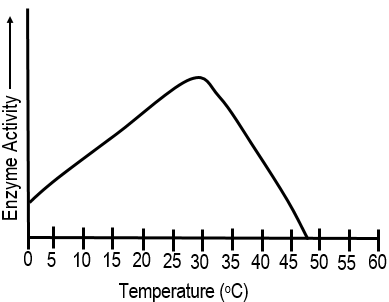
Based on the graph, what is the optimal temperature for this enzyme? 
a)
15oC
b)
40oC
c)
30oC
d)
35oC
50.

Which of the following correctly describes enzyme structure and function?

a)

The shape of an enzyme is responsible for its function.

b)

All enzymes can bind to all substrates.

c)

The substrate is responsible for the shape of the enzyme.

d)

The location of an enzyme determines its function.

51.

Which structure is not part of the endomembrane system?

a)

nuclear envelope

b)

chlorplast

c)

Golgi apparatus

d)

plasma membrane

52.

What is the most likely pathway taken by a newly synthesized protein that will be secreted by a cell?

a)

ER --> Golgi --> nucleus

b)

Golgi --> ER --> lysosome

c)

nucleus --> ER --> Golgi

d)

ER --> Golgi --> vesicles that fuse with the plasma membrane

53.

Which of the following eukaryotic organelles does not contain DNA?

a)

nucleus

b)

mitochondrion

c)

endoplasmic reticulum

d)

chloroplast

54.

Consider two cells with the same volume but very different surface areas due to their difference in shape. The cell with the larger surface area is most likely to:

a)

be involved in the rapid uptake of materials from the cell's environment

b)

have a very high metabolic rate

c)

be prokaryotic

d)

be buried deep in the interior of an organism

e)

be nearly spherical in shape

55.

Which type of cell should have the MOST mitochondria?

a)

photosynthetic cells in tree leaves

b)

nondividing cells in the skin of your finger

c)

muscle cells in the legs of a marathon runner

d)

bacterial cells that are growing on sugars

e)

inactive yeast cells stored in a bakery refrigerator
56.

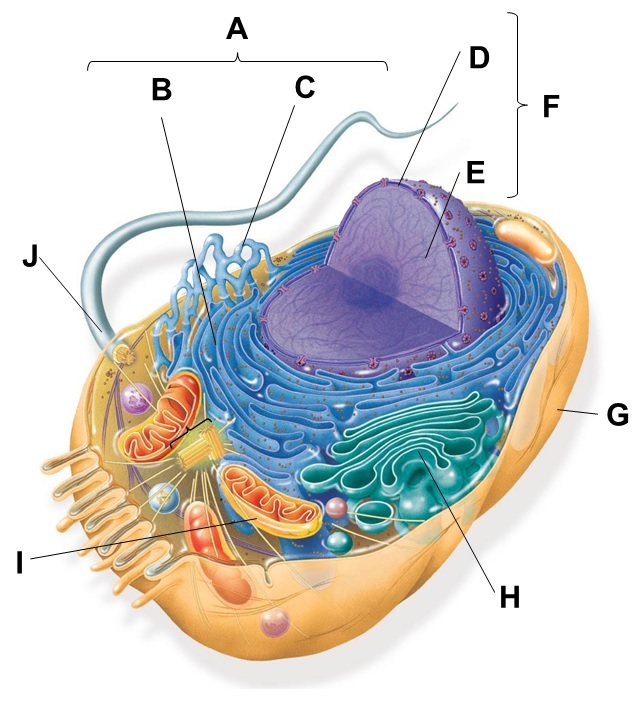
What structure is labeled by H?

a)

endoplasmic reticulum

b)

endomembrane system

c)

Golgi body

d)

mitochondria

57.

The Endosymbiotic Theory suggests that eukaryotic cells evolved when an ancient cell engulfed another, forming a permanent symbiotic relationship. Choose the evidence that best justifies this claim.

a)

Both mitochondria and chloroplasts perform energy functions

b)

Eukaryotic cells have many mitochondria

c)

Eukaryotic cells have traits in common with archaea

d)

Mitochondria and chloroplasts contain circular loops of unique DNA

58.

Cells tend to be small, with sizes ranging between 1 and 100 mm. These small sizes help to ensure that cells have a favorable surface-area-to-volume ratio. Choose the statement that explains why a favorable surface-area-to-volume ratio is advantageous.

a)

Higher surface-area-to-volume ratios improve the efficiency of transporting materials in and out of cells.

b)

Lower surface-area-to-volume ratios improve the efficiency of transporting materials in and our of cells.

c)

Higher surface-area-to-volume ratios speed up the flow of cytoplasm within cells.

d)

Higher surface-area-to-volume ratios slow down the flow of cytoplasm within cells.
59.
Large numbers of ribosomes are present in cells that specialize in producing which of the following molecules?
a)
glycogen
b)
cellulose
c)
proteins
d)
lipids
60.
Which four structures are found in all cells?
a)
DNA, ribosomes, cytosol, and a cell membrane
b)
nucleus, ribosomes, cytosol, and a cell membrane
c)
nucleus, ribosomes, cytosol, and mitochondria
d)
DNA, cell wall, cytosol, and a cell membrane
61.
The liver works to filter our blood of toxins.  What organelle would be most abundant in its cells?
a)
Lysosomes
b)
Smooth ER
c)
Golgi Body
d)
Vacuole
62.
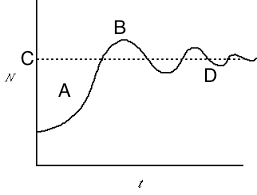
Which letter shows the the exponential growth of a population?
a)
A
b)
B
c)
C
d)
D
63.
This population pyramid shows that 
a)
the Ukraine population is in a rapid decline
b)
the Ukraine population is in a rapid increase 
c)
the Ukraine population is in a stable and steady state
d)
men outlive women in the Ukraine
64.
The illustrations below show the age and sex of the human populations in Country 1 & Country 2. The ages are grouped by -year classes, and the sexes are represented separately. The percentages in the different age classes are shown by the relative widths of successive horizontal bars.
In country 1, approximately what percentage of the individuals were younger than fifteen years of age?
a)
10%
b)
21%
c)
42%
d)
52%
65.
J-Shaped curves
a)
show a decline after an increase
b)
display populations that have reached carrying capacity
c)
represent exponential growth
d)
does not depend on the numbe rof resources
66.
Which of the following is an example of a density-independent limiting factor?
a)
A parasite
b)
A natural disaster
c)
A decrease in prey
d)
A food shortage
67.
Which kind of dispersion is #1?
a)
clumped
b)
random
c)
uniform
68.
Refer to the diagram of the survivorship curve.
Which curve best describes an organism that invests a lot of energy in parenting?
a)
A
b)
B
c)
C
d)
this is not a survivorship curve
69.

Upon chemical analysis, a particular polypeptide was found to contain 145 amino acids. How many peptide bonds are present in this protein?

a)

145

b)

143

c)

144

d)

146

70.

Polysaccharides, triglycerides, and proteins are similar in that they

a)

are synthesized from monomers by the process of hydrolysis

b)

are synthesized from monomers by dehydration synthesis

c)

are synthesized as a result of peptide bond formation between monomers

d)

are decomposed into their subunits by dehydration reactions