Wayground logo

Free Printable Worksheets

Font size

S
M
L
XL
Worksheets

Semester 1 Exam Review - Day 1

Total questions: 60

Worksheet time: 44mins

Name
Class
Date
1.
Any type of liquid or solid water that falls to earth's surface
a)
evaporation
b)
condensation
c)
precipitation
d)
runoff 
2.
Process of water vapor changing into a liquid
a)
evaporation
b)
condensation
c)
precipitation
d)
transpiration 
3.
Process of liquid water changing into a gas
a)
evaporation
b)
condenstaion
c)
precipitation
d)
transpiration 
4.
The energy source that allows the water cycle to occur
a)
batteries
b)
the sun
c)
solar panels 
d)
gasoline 
5.
What is it called when plants give off water vapor as a waste product?
a)
condensation
b)
evaporation
c)
sublimation
d)
transpiration
6.
What do we call water that flows over the ground surface rather than soaking in?
a)
runoff
b)
discharge
c)
recharge
d)
tributary
7.
What is C?
a)
Evaporation
b)
Condensation
c)
Precipitation
d)
Runoff
8.
What is B?
a)
Evaporation
b)
Condensation
c)
Precipitation
d)
Runoff
9.
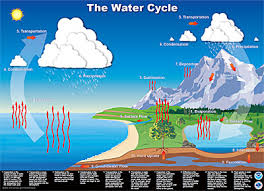
The arrows in the diagram below represent the movement of water in the water cycle.

Which arrow represents the process of transpiration?
a)
A
b)
B
c)
C
d)
D
10.
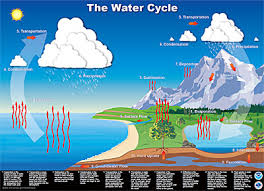
Base your answers to the following questions on the diagram of the water cycle below. Letter A represents a process in the water cycle. Points X and Y represent locations on Earth's surface.
 The process represented by A is
a)
precipitation
b)
transpiration
c)
condensation
d)
saturation
11.
What follows evaporation during the water cycle? How does this occur?
a)
Water evaporates into water vapor
b)
Water vapor condenses and forms a  cloud
c)
Water precipitates to the ground
d)
Water runs down into the hydrosphere
12.
What is      D?
a)
Evaporation
b)
Condensation
c)
Precipitation
d)
Runoff
13.

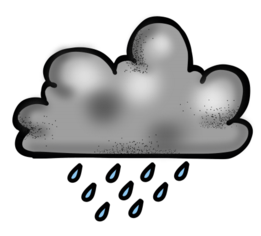
What part of the hydrological cycle does this picture show?

a)

condensation

b)

precipitation

c)

evaporation

14.

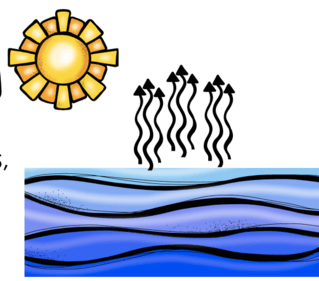
What part of the hydrological cycle does this picture show?

a)

condensation

b)

precipitation

c)

evaporation

15.

What part of the hydrological cycle does this picture show?

a)

condensation

b)

precipitation

c)

evaporation

16.
Which stages does liquid water from the ocean turn into water vapor?
a)
condesantion
b)
evaporation
c)
precipitation
d)
run off
17.
Which stage does ground water try to return to the ocean or soak into the ground?
a)
condensation
b)
evaporation
c)
precipitation
d)
run off
18.
What is the hydrosphere?
a)
Water on the earth's surface
b)
Oceans of the Earth
c)
Rivers, oceans and lakes of the Earth
d)
None of the above
19.

Most of Earth's water is ___________________?

a)

fresh water

b)

water vapor

c)

salt water

d)

solid

20.

What percentage of fresh water is available to us that is not frozen in glaciers?

a)

More than 45%

b)

Less than 1%

c)

100%

d)

More than 77%

21.

What is an aquifer?

a)

a land that is drilled deeply for underground

b)

an underground layer of rock or earth that holds groundwater

c)

a hole formed in a rock or mountain by the movement of glaciers

d)

water supplied by snow

22.

What do we call the water that fills the cracks and spaces in the underground soil and rock layers?

a)

groundwater

b)

precipitation

c)

salt water

d)

snow

23.

Where is most of the fresh water on Earth found?

a)

rivers

b)

swimming pools

c)

lakes

d)

glaciers

24.

Which item represents the distribution of water on Earth?

a)

20% available fresh water, 9% fresh water frozen in glaciers, 71% salt water

b)

71% available fresh water, 20% salt water, 9% salt water frozen in glaciers

c)

1% available fresh water, 2% fresh water frozen in glaciers, 97% salt water

d)

97% available fresh water, 1% salt water, 2% salt water frozen in glaciers

25.

Which source of fresh water is not easily available for human use?

a)

glaciers

b)

rivers

c)

oceans

d)

lakes

26.

Which kind of water do we use for daily purposes such as drinking, washing our clothes, brushing our teeth, and watering our gardens?

a)

salt water

b)

water from glaciers

c)

water from the ocean

d)

groundwater

27.
What percentage of Earth's water is fresh water?
a)
3%
b)

97%

c)
<1%
d)
70%
28.
What percentage of Earth's fresh water is available for human use?
a)
3%
b)
<1%
c)
70%
d)
97%
29.
Tides are caused mainly by what?
a)
Moon’s gravitational pull
b)
Sun’s gravitational pull
c)
Earth’s gravitational pull
30.
Most places on Earth experience about how many high and low tides in 24 hours?
a)
2 high and 2 low tides
b)
4 high and 4 low tides
c)
1 high and 1 low tides
31.
What type of tide occurs during a new and full moon?
a)
Neap tides
b)
Spring tides
c)
Normal tides
32.
What type of tide occurs during the first or third quarter moon?
a)
Neap tides
b)
Spring tides
c)
Normal tides
33.
If the Sun, Earth, and Moon are in perfect alignment, the Earth would have a _______ tide.
a)
Spring
b)
Neap
c)
Normal
34.
If the Sun, Earth, and Moon create a 90 degree angle, the Earth would have __________.
a)
Spring tides
b)
Neap tides
c)
Normal tides
35.
Differences in the moon's and sun's pull on different sides of the Earth cause _________.
a)
gravity
b)
lunar phases
c)
tides
d)
dabbing
36.
The bulge of water on the side of the Earth closest to the moon produces ___________.
a)
high tide
b)
low tide
c)
neap tide
d)
spring tide
37.
Tides are caused by
a)
strong winds that blow over ocean waters.
b)
the interaction of Earth, the moon and the sun.
c)
the shifting of the plates on the ocean floor.
d)
variations in the salinity of ocean water
38.
Which body has the greater effect on Earth's tides?
a)
Sun
b)
Saturn
c)
Moon 
d)
Venus
39.
How many low tides and high tides happen in a day?
a)
1 low tide, 1 high tide
b)
4 low tides, 4 high tides
c)
3 low tides, 3 high tides
d)
2 low tides, 2 high tides
40.
The Moon has a greater influence on Earth tides than the Sun because...
a)
it is smaller than the Sun
b)
it revolves around the Earth
c)
it is closer to the Earth
41.
Temperature in the stratosphere warms as altitude increases.
a)
True
b)
False
42.
Which layer of the atmosphere contains the greatest amount of water vapor?
a)
Thermosphere
b)
Troposphere
c)
Mesosphere
d)
Stratosphere
43.
In which layer of the atmosphere does weather occur?
a)
Mesosphere
b)
Thermosphere
c)
Stratosphere
d)
Troposphere
44.
What causes the temperature to increase in the stratosphere?
a)
Nitrogen
b)
Ozone
c)
Water Vapor
d)
carbon dioxide
45.
What decreases as you go up in the atmosphere?
a)
Altitude
b)
Atmosphere
c)
Meteors
d)
Air Pressure
46.
What is the lowest main layer of Earth's atmosphere?
a)
Thermosphere
b)
Troposphere
c)
Stratosphere
d)
Mesosphere
47.
What is the outer most main layer of Earth's atmosphere?
a)
Thermosphere
b)
Troposphere
c)
Stratosphere
d)
Mesosphere
48.
What is the second lowest main layer of Earth's atmosphere?
a)
Thermosphere
b)
Troposphere
c)
Stratosphere
d)
Mesosphere
49.
Which of the following is the correct order of the atmosphere layers from Earth to space?
a)
troposphere, stratosphere, mesosphere, thermosphere, exosphere
b)
troposphere, mesosphere, thermosphere, exosphere, stratosphere
c)
thermosphere, stratosphere, mesosphere, troposphere, exosphere
d)
troposphere, stratosphere, mesosphere, exosphere, thermosphere
50.
The ________ is between the mesosphere and troposphere.
a)
stratosphere
b)
thermosphere
c)
troposphere
d)
mesosphere
51.
Meteoroids begin to burn up in the...
a)
stratosphere
b)
thermosphere
c)
troposphere
d)
mesosphere
52.
Which is the uppermost layer of the atmosphere?
a)
stratosphere
b)
thermosphere
c)
troposphere
d)
mesosphere
53.
Which layer is the lowest layer of the atmosphere?
a)
stratosphere
b)
thermosphere
c)
troposphere
d)
mesosphere
54.
Space shuttles and International Space Station orbit in the...
a)
stratosphere
b)
thermosphere
c)
troposphere
d)
mesosphere
55.
Virtually all weather takes place in the...
a)
stratosphere
b)
thermosphere
c)
troposphere
d)
mesosphere
56.
Clouds are found at various levels within the...
a)
stratosphere
b)
thermosphere
c)
troposphere
d)
mesosphere
57.
The ________ is found between the thermosphere and stratosphere.
a)
stratosphere
b)
thermosphere
c)
troposphere
d)
mesosphere
58.
What is found in the stratosphere, forms when exhaust pollutants react with sunlight?
a)
ozone
b)
clouds
c)
meteroids
d)
airplanes
59.
Most of the air that makes up the atmosphere is found in the...
a)
stratosphere
b)
thermosphere
c)
troposphere
d)
mesosphere
60.
Groundwater is
a)
The water underground
b)
The water above ground
c)
The water in space