wayground logo

Free Printable Worksheets

Font size

S
M
L
XL
Worksheets

Forensic Science Final Review

Total questions: 215

Worksheet time: 4hrs 31mins

Name
Class
Date
1.
The arm and leg bones can be used to determine forensic height
a)
true
b)
false
2.
The pelvis of a female is _____ as compared to a male.
a)
wide and circular
b)
wide and heart-shaped
c)
narrow and circular
d)
narrow and heart-shaped
3.
Which is the most reliable bone to determine the sex of a skeleton? 
a)
Femur
b)
Skull
c)
Pelvic bone
d)
Collarbone
4.
One of the  ways to determine the race using bones is by examining the :
a)
the pelvis
b)
the leg bones
c)
skull
d)
the occipital bump
5.
If skeletal remains were determined to be from a white person, it is termed
a)
africoid
b)
mongoloid
c)
caucasoid
d)
aboriginal
6.
If skeletal remains were determined to be from an Asian person, it is termed
a)
caucasoid
b)
mongoloid
c)
africoid
d)
aboriginal
7.
How many bones do adult humans have?
a)
206
b)
306
c)
350
d)
450
8.
You notice a skull that has a rough and bumpy surface.  What sex this this characteristic typically associated with?
a)
Male
b)
Female
9.
What bones are used to measure height
a)
Femur
b)
Radius
c)
Humerus
d)
All of the above
10.
A forensic anthropologist may help to create a(n)  __________ to help with the identification of the victim. 
a)
dental profile
b)
DNA profile
c)
autopsy chart
d)
facial reconstruction
11.

What CANNOT be determined by examining bones?

a)

age

b)

race

c)

weight

d)

gender

12.
What bone is used to determine height from skeletal remains?
a)
skull
b)
pelvis
c)
fibula
d)
sacrum
13.
How do you convert cm to inches when determining height from bones?
a)
multiply by 12
b)
divide by 12
c)
divide by 2.54
d)
multiply by 2.54
14.
What bones are best to determine the sex of a skeleton?
a)
pelvis
b)
skull
c)
long bones
d)
mandible
15.
What is used to determine age of a skeleton?
a)
shape of skull
b)
sacrum curvature
c)
presence/absence of epiphyseal plates
d)
size of long bones
16.
When the head of a long bone has fused to its shaft, this is an indication of
a)
sex
b)
age
c)
height
d)
all of these
17.
The number of bones and their condition can tell an investigator about  a person's
a)
age
b)
health
c)
calcium intake
d)
all of these
18.
Where the skull plates meet is called
a)
gaps
b)
sutures
c)
cartilage
d)
epiphysis
19.
The ring of bones that connects the upper and lower body is
a)
skull
b)
pelvis
c)
humerus
d)
sutures
20.
Which choice below is not a suture in the skull?
a)
coronal
b)
sagittal
c)
lambdoid
d)
occipital
21.
Bone densities, sutures, and epiphyses of bones help determine which of the following?
a)
height
b)
sex
c)
age
d)
all of these
22.
If a skull is found and wisdom teeth are present, you can determine
a)
the person was under 17 when they died
b)
the person was over 17 when they died
c)
the skull belonged to male
d)
it does not determine any of these
23.
What structure is labeled in the picture?
a)
suture
b)
epiphyseal plate
c)
occipital protuberance
d)
subpubic angle
24.
Which skull plates are fused and which are not help determine
a)
sex
b)
age
c)
height
d)
all of these
25.
One of the  ways to determine the race using bones is by examining the :
a)
the pelvis
b)
the leg bones
c)
skull
d)
the occipital bump
26.
If skeletal remains were determined to be from a white person, it is termed
a)
africoid
b)
mongoloid
c)
caucasoid
d)
aboriginal
27.
If skeletal remains were determined to be from an Asian person, it is termed
a)
caucasoid
b)
mongoloid
c)
africoid
d)
aboriginal
28.
The study of human remains applied to a legal context is 
a)
forensic archaeology
b)
forensic anthropology
c)
cultural anthropology
d)
criminology
29.
You can tell the difference between male and female persons by the larger angle of 
a)
sciatic notch
b)
pubic arch
c)
pubic symphysis
d)
mastoid process
30.
When trying to find the age of an individual, anthropologists will give an exact age of the deceased
a)
true
b)
false
31.

What does PMI stand for?

a)

pre mortem interval

b)

post memory interval

c)

post murder interval

d)

post mortem interval

32.

What can entomologists know by studying the insects at a crime scene?

a)

who the victim is

b)

PMI

c)

who probably commited the crime

d)

the crime autopsy

33.

How does temperature have an effect on insect evidence?

a)

temp. does not effect insect evidence

b)

high temp. speeds up insect's life cycle

c)

low temp. speeds up insect's life cycle

34.

In general, the older the insects around the dead body are....

a)

the longer the body has been dead

b)

the less time the body has been dead

c)

the more blood the body lost

d)

the hotter the temp. around the body is

35.

Some species will get to the body first because they feed on the fresh corpse while others are attracted to one that has been dead for weeks

a)

true

b)

false

36.

The entomologist must be able to identify the ________ of blow fly because each ________ develops at a different rate.

a)

family

b)

genus

c)

order

d)

species

37.

Estimations of the postmortem interval (PMI) using entomological evidence must take into account ______________________.

a)

the species of insect present

b)

weather conditions

c)

geographical locations of the decedent's body

d)

all of these

38.

The two insect orders most commonly found on a corpse are... (choose 2)

a)

Arthropods

b)

Diptera

c)

Crustaceans

d)

Coleoptera

39.

What are the stages of metamorphosis in a fly's life cycle? (in order)

a)

Egg, pupa, larva, maggot, adult

b)

Larva, pupa, egg, adult

c)

Egg, larva, maggot, pupa, adult

d)

Egg, larva, pupa, adult

40.

What are the four basic steps in a DNA test?

a)

Insertion, Cutting, Splicing, and Analysis

b)

Investigation, Cutting, Sorting, Analysis

c)

Isolation, Cutting, Sorting, Analysis

d)

Isolation, Cutting, Splicing, and Analysis

41.

A scientist who needs a larger sample of DNA would use which test to make more?

a)

Gel Electrophoresis

b)

Capillary Electrophoresis

c)

Polymerase Chain Reaction

d)

Short Tandem Repeats

42.

What is CODIS?

a)

DNA test that compares suspects to crime scenes

b)

Database containing DNA sample results from the US and its territories

c)

Organization that uses DNA testing to catch criminals

d)

A special computer used by the FBI to match samples of DNA to people

43.

Choose the complimentary strand of CGTATCGA

a)

GCATAGCT

b)

ACGTACGT

c)

GCTATCGT

d)

GCTACGTA

44.
A forensic entomologist is...
a)
A person who studies insects to gain clues about a crime
b)
a person who studies bones to gain clues about a crime 
c)
a person who studies DNA to gain clues about a crime 
d)
a person who studies fire and arson 
45.
What does post mortem interval mean? 
a)
time that has past since the victim was at the scene 
b)
time that has past since the victim died
c)
time that has past since the suspect was at the scene
d)
time that has past since the insects arrived at the scene 
46.
Which of the following is not a common factor that could have an effect on insect evidence? 
a)
where the body was located 
b)
the weather conditions 
c)
age the person was when they died 
d)
drugs or poisons present 
47.
The major variable in the fly’s life cycle is ____________________.
a)
moisture
b)
pressure
c)
temperature
d)
barometer
48.
During this stage house flies begin to appear and deposit eggs 
a)
fresh stage
b)
post-decay stage
c)
bloated stage
d)
decay stage
49.
This stage occurs because of the activity bacteria which produces gases inside the body.
a)
post-decay stage
b)
decay stage
c)
fresh stage
d)
bloated stage
50.
During this stage/phase, the larvae stops feeding and travels several feet away from the corpse.
a)
initial decay
b)
migration phase
c)
fresh stage
d)
bloated stage
51.
During this stage, beetles begin to colonize the body and consume the dry, less nutrient-rich components. 
a)
decay stage
b)
bloated stage
c)
fresh stage
d)
post-decay stage
52.
During which stage does the body take on a compressed appearance and give off a powerful odor. 
a)
decay stage
b)
bloated stage
c)
fresh stage
d)
post-decay
53.
Forensic entomology is often used to help estimate the time of death.
a)
True
b)
False
54.

The post mortem Interval (PMI) can best be determined in the first 24 hours by

20 sec

a)

insect larvae present

b)

position of the body

c)

temperature of the body

d)

cause of death

55.

Livor Mortis refers to the ________ of a body.(

20 sec

a)

rigidity (stiffness)

b)

color

c)

temperature

d)

consistency

56.

During autolysis which of the following occurs?

a)

cells die

b)

the body temperature drops considerably

c)

the body becomes rigid

d)

insect life decreases sharply in a body

57.

A corpse in a pond loses temperature at a rate of

a)

0.8 oC per hour

b)

1.6 oC per hour

c)

0.4 oC per hour

d)

2.0 oC per hour

58.
All types of insect species arrive at the body almost immediatly after it dies 
a)
true
b)
false 
59.

the classification of things in an orderly way that indicates natural relationships

a)

dichotomous

b)

taxonomy

c)

arthropods

60.

animals characterized by jointed legs, a segmented body, and a hard, nonliving exoskeleton. the exoskeleton does not keep up with the growth of the insect, and so must be shed periodically

a)

dichotomous

b)

taxonomy

c)

arthropods

61.

the carcass of a dead and decaying animal

a)

carrion

b)

entomology

c)

arthropods

62.

feeding on carrion; from the greek word phagos, to each, and necro, meaning dead

a)

entomology

b)

necrophagous

c)

carrion

63.

biological process in the development of animals, usually involving conspicuous changes in the animal's form or structure

a)

metomorphosis

b)

malt

c)

instar

64.

a developmental stage of arthropods, generally referring to changes in the size of the larvae

a)

malt

b)

metomorphosis

c)

instar

65.

the depositing or laying of eggs.

a)

instar

b)

oviposition

c)

malt

66.

concerning the surrounding area or environment

a)

malt

b)

instar

c)

ambient

67.

emergence of an adult from its pupal case

a)

ambient

b)

mites

c)

eclosion

68.

a unit of measure of the energy absorbed by a biological system, causing growth

a)

degree-day

b)

mites

c)

eclosion

69.

cases formed by the hardening of the last larval skin in which the pupa is formed. color starts out white and turns brown with time.

a)

eclosion

b)

puparia

c)

mites

70.
What bloodstain pattern is created when an object moves through an existing stain, removing or altering its appearance?
a)
Swipe
b)
Walking Drip
c)
Wipe
d)
Contact
71.
What bloodstain pattern is created when blood is released or thrown from a blood-bearing object?
a)
Cast-Off
b)
Walking Drip
c)
Medium Velocity
d)
Void
72.
What type of blood spatter is typically created from a gunshot?
a)
Medium Velocity
b)
High Velocity
c)
Cast-Off
d)
Void
73.
The protrusions around and connected to the drops are called
a)
radial lines
b)
spines or spikes
c)
blood edges
d)
satellite spatters
74.
The drop shown above would have more than likely been dropped from an angle of 
a)
90
b)
50
c)
30
d)
10
75.
The lines in the picture are referred to as lines of ___.
a)
convergence
b)
agreement
c)
tangents
d)
credit
76.
What is another term for a Red Blood Cell?
a)
Antigen
b)
Erythrocyte
c)
Leukocyte
d)
Thrombocyte
77.
What is another term for White Blood Cells?
a)
Antigen
b)
Erythrocyte
c)
Leukocyte
d)
Thrombocyte
78.
The least common form of the ABO blood type is:
a)
Type A
b)
Type B
c)
Type AB
d)
Type O
79.
What blood type has both A and B antigen proteins?
a)
Type A
b)
Type B
c)
Type AB
d)
Type O
80.
What blood type has neither A nor B antigen proteins?
a)
Type A
b)
Type B
c)
Type AB
d)
Type O
81.
Which test is used to detect invisible blood stains?
a)
Kastle-Meyer
b)
Luminol
c)
Precipitin
d)
Huminal
82.
Who discovered the ABO and Rh blood groups?
a)
Oliver
b)
Decastello
c)
Landsteiner
d)
Balthazard
83.
Which type of blood cell fights disease as part of the immune system?
a)
Red Blood Cells
b)
White Blood Cells
c)
Platelets
d)
Plasma
84.
Which of the following is NOT true about blood typing?
a)
It is quicker and less expensive than DNA profiling
b)
It identifies the presence or absence of particular proteins embedded in the cell
c)
It can provide class evidence to a forensic investigator
d)
It can help determine the manner in which a victim died
85.
Blood platelets serve what function?
a)
They produce antibodies to kill bacteria and viruses
b)
They help clot blood and repair blood vessel damage
c)
They carry nutrients and wastes to the proper organs in the body
d)
They carry oxygen adn carbon dioxide to the proper organs in the body
86.
When blood falls, it maintains what shape and why?
a)
Blood falls in a teardrop shape because of adhesion
b)
Blood falls in a teardrop shape because of surface tension
c)
Blood falls in a round shape because of capillary action
d)
Blood falls in a round shape because of cohesion
87.
Small secondary droplets around the main blood spatter drop are called:
a)
Spikes
b)
Splats
c)
Satellites
d)
Gushes
88.
The Rh factor was discovered when studying which organism's blood?
a)
Human
b)
Chimpanzee
c)
Monkey
d)
Gorilla
89.

As the angle of impact gets smaller, what happens to the tail?

a)

Gets longer

b)

Gets shorter

c)

Stays the same

90.

what is blood stain pattern

a)

blood that leaves the body

b)

blood associated in crime

c)

physical, geometric image created by blood contacting a surface,

or by a surface contacting blood.

d)

image of blood by photograph

91.

The arrow is pointing to a

a)

satellite

b)

spline

c)

parent drop

92.

The arrow is pointing to a

a)

satellite

b)

spline

c)

parent drop

93.

When crime scene investigations trace all the angles back to one location, they refer to this as..

a)

the area of convergance

b)

the origin story

c)

diameter of the blood drops

94.

Blood dripping off a weapon would be considered

a)

Passive blood spatter

b)

Projected blood spatter

c)

Transfer blood

95.

Antibodies are:

a)

Y shaped proteins that attach to antigens

b)

foreign molecules or cells

c)

treated with antibiotics

d)

treated with vaccines

96.

The more unique blood proteins a person has, the _____________ likely they can be identified by police.

a)

more

b)

less

97.

A medium-velocity-sized blood splatter (1 to 4 mm) is caused by __________________________________.

a)

Gun Shot Wound

b)

Bloody Nose

c)

Beatings or Stabbings

d)

Laceration

98.

Today blood splatter evidence is used to explain events:

a)

at all death scenes

b)

at vehicular homicide scenes

c)

during crime-scene analysis

d)

None of these choices

99.

Which type of bloodstain pattern suggests that bloody hair was dragged across the floor?

a)

wipe

b)

arterial gush

c)

swipe

d)

transfer pattern

100.

What happens to the shape of a blood droplet as the angle of release changes from a 90-degree drop toward a 10-degree drop?

a)

It becomes more wider than long

b)

It becomes more circular

c)

It has more spines

d)

It becomes more longer than wide

101.

What term describes the clumping of red blood cells?

a)

agglutination

b)

antigens

c)

eosinophil

d)

lymphocyte

102.

Of the four main human blood types using the ABO system, the largest percentage of the U.S. population is made up of:

a)

Type A

b)

Type AB

c)

Type B

d)

Type O

103.

The presence or absence of particular proteins, found embedded within a cell or plasma membranes of red blood cells, determines a person’s:

a)

DNA

b)

RH factor

c)

Blood Type

d)

Surface Proteins

104.

Blood typing is less expensive and quicker for analyzing blood evidence than DNA profiling. Since many different people share the same type, this blood evidence is considered to be:

a)

Class evidence

b)

Individual evidence

c)

Trace evidence

d)

Biological evidence

105.

The three components of blood, red blood cells, white blood cells, and platelets, are carried throughout the body in:

a)

Antibodies

b)

Basophil

c)

Monocytes

d)

Plasma

106.

Red blood cells:

a)

carry respiratory gases, mainly oxygen and carbon dioxide

b)

fight disease and foreign invaders

c)

aid in blood clotting

d)

are involved in repairing damaged blood cells

107.
What is suspect 1's Blood Type?
a)
A+
b)
O+
c)
A-
d)
O-
108.
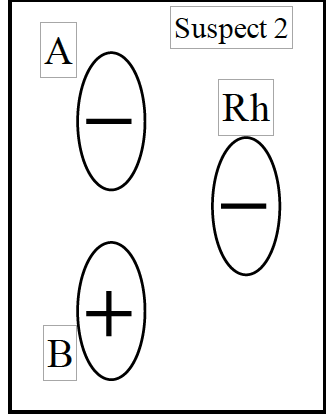
What is suspect 2's Blood Type?
a)
A-
b)
B-
c)
A+
d)
B+
109.
What is suspect 3's Blood Type?
a)
AB+
b)
AB-
c)
O+
d)
O-
110.
What is clumping of Red Blood Cells Called?
a)
Agglutination
b)
Antigen
c)
Antibody
d)
Thrombocyte
111.
What blood type has anti-B antibodies?
a)
Type A
b)
Type B
c)
Type AB
d)
Type O
112.
Which test is used to determine if a blood sample is human?
a)
Kastle-Meyer
b)
Luminol
c)
Precipitin
d)
Huminal
113.
What blood type has neither A nor B antigen proteins?
a)
Type A
b)
Type B
c)
Type AB
d)
Type O
114.
What blood type has anti-A antibodies?
a)
Type A
b)
Type B
c)
Type AB
d)
Type O
115.
What blood type has both A and B antigen proteins?
a)
Type A
b)
Type B
c)
Type AB
d)
Type O
116.
The least common form of the ABO blood type is:
a)
Type A
b)
Type B
c)
Type AB
d)
Type O
117.
Blood Typing is considered what type of evidence?
a)
Indiviual
b)
Class
c)
Trace
d)
Physical
118.
What type of surface did this blood most likely fall on?
a)
Semi-porous surface
b)
Smooth surface
c)
Carpet
d)
Rough surface
119.
What would cause low velocity blood spatter?
a)
Baseball bat
b)
Gun shot
c)
Hand grenade
d)
Gravity
120.

Which blood type is the universal donor?

a)

O+

b)

AB+

c)

AB-

d)

O-

121.
Which of the following does NOT affect blood stain shape?
a)
Texture of target surface
b)
Size of droplet
c)
Speed at which the blood left the original surface 
d)
Blood type
122.
_____ are found directly on the surface of red blood cells
a)
Antigens
b)
Antibodies
c)
Nothing
d)
Both Antigens & antibodies
123.
What does CODIS stand for?
a)
Criminal Offense DNA Index System
b)
Criminal Offensive DNA Index Securities
c)
Combined DNA Index Securities
d)
Combined DNA Index System 
124.
What does the CoDIS database contain?
a)
Mugshots
b)
DNA profiles
c)
Top-secret government information
d)
Facebook login information
125.
Which shows the correct complementary base pairing for DNA?
a)
C-A, T-G
b)
A-G, C-T
c)
C-G, U-A
d)
T-A, G-C
126.
What are the 4 nitrogen bases?
a)
adenine, thymine, cytoplasm, and guanine
b)
adenine, thymine cytosine, and guanine
c)
adenine, thymine, cytosine, and gylcerol
d)
adenine, thymine, cytosine, and glucose
127.
What does DNA stand for?
a)
Deoxyribonucleic acid
b)
Denitrogenous acid
c)
Deribonucleic acid
d)
Diribonucleic acid
128.
Why is DNA important?
a)
it is very small and very complicated
b)
it's in everything
c)
it serves as the blueprint for traits of all living things
d)
because we eat it every day for energy
129.
Section of a chromosome that determines traits. (small segments of DNA) 
a)
Characteristic
b)
phenotype
c)
gene
d)
karyotype
130.
Pattern of DNA fragments obtained by examining a person’s unique sequence of DNA base pairs
a)
Chromosome
b)
DNA Probe
c)
DNA Fingerprint
d)
Electrophoresis
131.
DNA is found in what two organelles  
a)
Nucleus and Ribosomes
b)
Ribosomes and Mitochondria 
c)
Nucleolus and Golgi Body
d)
Nucleus and Mitochondria
132.
Mitochondrial DNA is different from nuclear DNA because
a)
it is inherited only from the mother
b)
It is inherited only from the father
c)
It is double helix in shape
d)
It is not useful in forensic science
133.
The structure of DNA is a:
a)
triple helix
b)
double helix
c)
single helix
d)
what the heck is a helix
134.
The male determines the sex of the child
a)
True
b)
False
c)
sometimes
135.
True or False. The total amount of DNA in a cell is known as genome?
a)
True
b)
False
136.
The purpose of PCR
a)
cutting DNA
b)
creating RFLPs
c)
amplifying/copy DNA
d)
reversing the charge of DNA
137.
Who invented the process of DNA fingerprinting?
a)
Jeffreys
b)
Dawson
c)
Roseland
d)
Crick
138.
What enzyme is used during PCR to pair complementary bases to the template strand?
a)
Thermonuclease
b)
Helicase
c)
DNA Polymerase
d)
RNA Polymerase
139.
How do scientists cut DNA into smaller strands?
a)
restriction enzymes
b)
scissors
c)
ligase
d)
agarose
140.
Watson and Crick were the first to suggest that DNA is _____
a)
a short molecule
b)
the shape of a double helix
c)
a protein molecule
d)
the genetic material
141.
Where is DNA found in the body?
a)
Cells nucleus
b)
Heart
c)
Cartilage
d)
Muscle
142.
What is a special protein that targets a specific base sequence and cuts DNA into smaller fragments?
a)
Electrophoresis
b)
Polymerase Chain Reaction
c)
Restriction Enzyme
d)
Introns
143.
a forensic technique used to identify individuals by characteristics of their DNA.
a)
DNA Analysis
b)
Fibers
144.
DNA is______ that it is possible to distinguish one individual from another.
a)
the same
b)
different
145.

The application of science to civil and criminal laws in the criminal justice system is called _______________________.

a)

Biology

b)

Forensic Science

c)

Toxicology

d)

Law Enforcement

146.

In a forensic laboratory, the _______________________________ unit examines firearms, bullets, cartridge cases and shotgun shells. In addition, it will perform GSR (gunshot residue) analysis.

a)

Chemical Analysis

b)

Toxicology

c)

Firearms

d)

DNA

147.
Which of the following is a part of the 3 facets of guilt?
a)
Means
b)
Mode
c)
Opportunity
d)
All of these
148.
Alphonse Bertillion contributed....
a)
a process to identify fingerprints
b)
a way to detect poisons 
c)
anthropometry, a system to identify people
d)
analyze Gun Shot Residue 
149.
Alec Jefferys was the scientist who...
a)
developed a identification system for finger prints
b)
Discovered the A, B, and O blood types
c)
Applied Microscopic techniques to Forensics
d)
Devolped the first DNA profiling test
150.
Which forensics pioneer is known for founding the first ever crime lab and developing "The Exchange Principle"?
a)
Leone Lattes
b)
Walter McCrone
c)
Edmond Locard
d)
Alphonse Bertillon
151.
a person that may have committed a crime
a)
arson 
b)
fingerprints 
c)
primary 
d)
suspect
152.
What is meant by indirect evidence?
a)
carpet fibers on victims match type found in trunk of vehicle perpetrator drives
b)
common to a group of objects curly relies on statistics
Individual- to a single source
c)
Provides information for developing a hypothesis.
d)
Stands on own
153.
Where is physical evidence found and collected?
a)
from scene of crime and other involved locations
b)
your house
c)
labs 
d)
in your computer 
154.
Why is physical evidence important?
a)
prints and patterns have the potential of being individual vs. class.
b)
Provides information for developing a hypothesis.
c)
from scene of crime and other involved locations
d)
All of the above 
155.
Which process requires the most DNA?
a)
RFLP
b)
STR
c)
PCR
d)
Recombinant DNA
156.
What does PCR stand for?
a)
Poly-ambiguous chain reaction
b)
Pentahedral corrosion remnant
c)
Polymerase chain reaction
d)
Peroxide corrosion remnant
157.
Restriction enzymes are used to ___ DNA.
a)
glue together
b)
cut
c)
reconnect
d)
exchange
158.
The cartridges in a revolver are held in the...
a)
Cylinder
b)
Magazine
c)
Barrel
d)
Breech
159.
Which of the following parts of a cartridge is affected by the gun barrel?
a)
Bullet
b)
Cartridge casing
c)
Primer
d)
Propellant
160.
Which of the following revolver gun parts will leave distinct toolmarks on the cartridge casing?
a)
Magazine
b)
Firing pin
c)
Gun barrel
d)
Ejector
161.
Which of the following is used to match a test-fired bullet’s striations to those of a bullet recovered from a crime scene?
a)
Electron microscope
b)
Infrared microscope
c)
Comparison micoscope
d)
Gas chromatograph
162.
a case that holds a bullet, primer powder, and gunpowder
a)
cartridge
b)
caliber
163.
the inside diameter of a firearm barrel
a)
cartridge
b)
caliber
164.
the ridges found on the inside of a firearm's barrel that are created when the firearm is manufactured
a)
grooves
b)
lands
165.
the depressions found on the inside of a firearm's barrel that are created when the firearm is manufactured
a)
grooves
b)
lands
166.
What is left on the bullet after it exits the barrel?
a)
Rifling and Striation patterns
b)
Only Rifling 
c)
Only Striation Patterns
d)
None of these
167.
Forensic Scientists compare bullets from...
a)
A Crime Scene bullet only
b)
A test bullet only
c)
A test bullet and a crime scene bullet
d)
None of the
168.
Why was rifling added to the barrels of guns?
a)
To make bullets shoot straighter
b)
To make bullets traceable at crime scenes
c)
To make bullets go faster
d)
To cause bullets to separate from the cartridge
169.
What is the difference between a bullet and a cartridge?
a)
the bullet is the projectile, while the cartridge holds the bullet, powder, and primer
b)
the cartridge is the projectile, while the bullet holds the cartridge, powder, and primer
c)
they are the same thing
d)
a bullet is larger and used more frequently than a cartridge
170.
Where are extractor and ejector marks found?
a)
on the bullet
b)
on the cartridge
c)
 both of these places
d)
neither of these places
171.
What tool is used to compare striations of fired bullets?
a)
compound microscope
b)
comparison microscope
c)
scanning electron microscope
d)
transmission electron microscope
172.
Which of these databases is used by firearms investigators?
a)
IBIS
b)
AFIS
c)
CODIS
d)
NCIC
173.
What are the Griess test, lead residue test, and diphenylalamine test used for?
a)
GSR testing
b)
electrophotometry
c)
spectroscopy
d)
bullet trajectory tests
174.
the flight path of a projectile
a)
gunshot residue
b)
trajectory
175.
the projectile that is fired when a firearm is discharged
a)
breech
b)
bullet
176.
What is the primary determining factor of the caliber of a bullet?
a)
weight
b)
length
c)
diameter
d)
mass
177.
soot and particles of unburned gunpowder deposited on a person who discharges a firearm
a)
gunshot residue
b)
trajectory
178.
_____ is the study of the effects of being fired on a bullet, cartridge, and a gun.
a)
DNA Analysis 
b)
Gun Shot Residue
c)
Ballistics
d)
Blood Stain Analysis
179.
A Comparison must show _______ striations for a for a positive match
a)
Identical match of
b)
50% match of
c)
20% match of
d)
85% match of
180.
Tempered glass is used in
a)
Windshields in autos manufactured in the United States
b)
Crystal Stemware
c)
The side and rear windows of autos manufactured in the United States
d)
Both B & C
181.
When a bullet penetrates a panel of glass, it leaves a crater shaped hole that
a)
is wider on the entrance side
b)
is smaller on the entrance side
c)
Forms randomly
d)
Both B & C
182.
The fracture pattern of glass usually has
a)
Radial and concentric lines
b)
Concentric lines
c)
Radial lines
d)
Directional lines
183.
The most common glass, which is inexpensive, and easy to melt and shape
a)
Soda lime glass
b)
Leaded glass
c)
Tempered glass
d)
Laminated glass
184.
In reference to the diagram, what is the correct sequence of impact
a)
A first
b)
B first
c)
A and B simultaneously
d)
Sequence impossible to determine
185.
In reference to the diagram, line 1 is known as __________, and line 2 is known as ___________.
a)
Radial and concentric
b)
Radial and directional
c)
Concentric and directional
d)
Concentric and Radial
186.
Flotation is a method used by scientists to determine the _______ of a particle of glass.
a)
Weight
b)
Density
c)
Temperature
d)
Refractive Index
187.
The larger opening of a crater-shaped hole in glass made be the penetration of a projectile indicates
a)
The exit side of the glass
b)
The entrance side of the glass
c)
The projectile was traveling at a low velocity
d)
That a bullet made a openig
188.
Soil can be easily compared wet, moist, or dry.
a)
True 
b)
False
189.
Which of the following determine the type of soil?
a)
Climate
b)
Temperature
c)
Texture
d)
Humidity
190.
A crack in glass that moves outward from the point of impact like spokes on a wheel is called a:
a)
compound fracture
b)
concentric fracture
c)
spoke fracture
d)
radial fracture
191.
In the lab, a Pyrex/borosilicate piece of glass was dipped in vegetable oil and disappeared from view. What does this tell us?
a)
the piece disintegrated in the oil
b)
the oil and the glass had the same refractive index
c)
the oil and the glass chemically reacted
d)
the oil and the glass have different refractive indices
192.
Because glass is a solid with random arrangement of motionless atoms, it is called:
a)
plasma
b)
obtuse
c)
amorphous
d)
frozen
193.
Which type of fracture is shown by letter B?
a)
radial
b)
concentric
c)
birefrigent
d)
none of these
194.
Glass evidence is:
a)
class 
b)
individual 
c)
direct
d)
both class and individual
195.
The bright halo that appears near the border of a glass particle that is immersed in a liquid of a different refractive index is called the:
a)
border line
b)
refractive line
c)
Becke line
d)
immersion line
196.
Which glass break was made first?
a)
A
b)
B
197.
What will NOT be visible if a glass and a liquid has the same refractive index?
a)
Conchoidal Lines
b)
Becke Lines
c)
Fracture Lines
d)
Radial Lines
198.
Bending of light waves as they change velocity is called:
a)
reflection
b)
mirroring
c)
refraction
d)
transversing
199.
The ratio of velocity of light in a vacuum to that in another medium (like water) is called the:
a)
birefringence
b)
refractive index
c)
refractive quotient
d)
comparison index
200.
What is the main ingredient in ordinary glass?
a)
(a) soda
b)
(b) lime
c)
(c) metal oxides
d)
(d) sand
201.
A fracture in glass always terminates at an existing line of fracture
a)
True
b)
False
c)
Maybe
202.
A high-velocity projectile, such as a bullet, will often leave a round, crater-shaped hole that is surrounded by a nearly symmetrical pattern of radial and concentric cracks
a)
True
b)
False
c)
Maybe
203.
The collection process will usually start with the collection of the most fragile or most easily lost evidence.
a)
True
b)
False
c)
Maybe
204.
All glass at the crime scene should be
a)
thrown away
b)
collected
c)
crushed
d)
burnt
205.
Immersion Method is 
a)
used to determine a glass fragment's refractive index
b)
used to determine a glass fragment's density
c)
used to analyzed the radial and concentric fracture patterns in glass
206.
A property of matter that depends on both the mass of a substance and the effects of gravity on that mass.
a)
density
b)
mass
c)
weight
d)
force
207.
measurement of how much matter is in an object
a)
mass
b)
force
c)
weight
d)
density
208.
Glass is a source of trace evidence
a)
True
b)
False
209.
Soil formation begins with the weathering of_______.
a)
Humas
b)
Subsoil
c)
Litter
d)
Rock
210.
Decayed organic material in soil is called______.
a)
Litter
b)
Silt
c)
Humus
d)
Clay
211.
Which of the following is the largest particle in soil?
a)
sand
b)
silt
c)
humus
d)
clay
212.
Soil is made of
a)
weathered rocks and minerals
b)
dead plants and animals
c)
air and water
d)
all of the above
213.

The procedure that a criminal uses when committing a crime

a)

corpus delecti

b)

modus operandi

c)

Locard's exchange principle

d)

perception

214.

An individual whom the court determines possesses knowledge relevant to the trial

a)

expert witness

b)

eyewitness

c)

forensic scientist

d)

law enforcement officer

215.

In order to be a good observer, a forensic scientist must

a)

be able to make assumptions when collecting evidence

b)

observe, interpret, and report observations clearly

c)

filter out unnecessary information when observing a crime scene

d)

allow emotion t heighten their senses when observing a crime scene