wayground logo

Free Printable Worksheets

Font size

S
M
L
XL
Worksheets

Periodic Table

Total questions: 106

Worksheet time: 2hrs 32mins

Name
Class
Date
1.
How did Mendeleev arrange the elements?
a)
alphabetical 
b)
density
c)
melting point
d)
atomic mass
2.
The horizontal row on the periodic table is called a
a)
group
b)
family
c)
period
d)
atomic number
3.
A vertical column is called...
a)
group
b)
tower
c)
period
d)
crew
4.
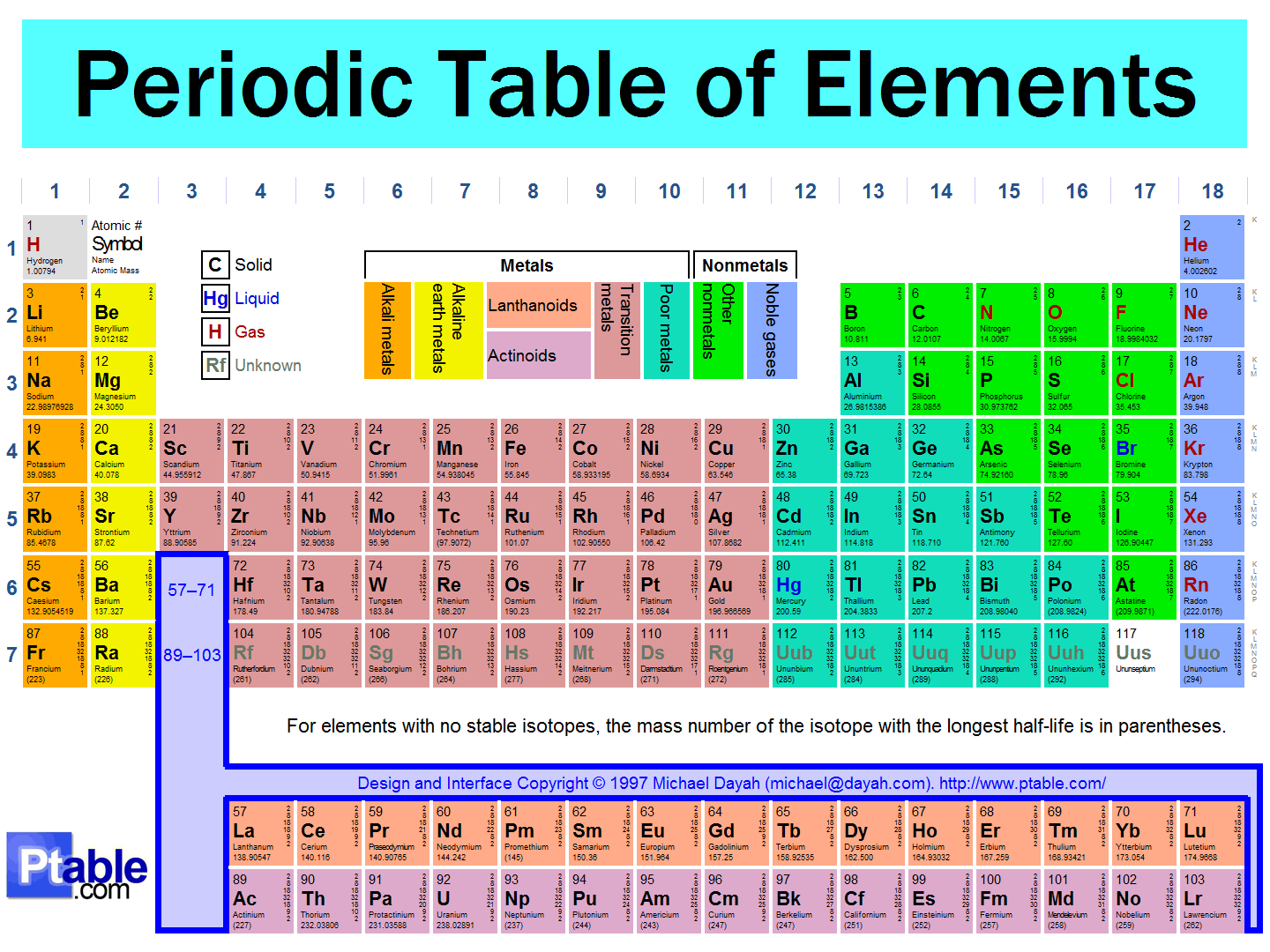
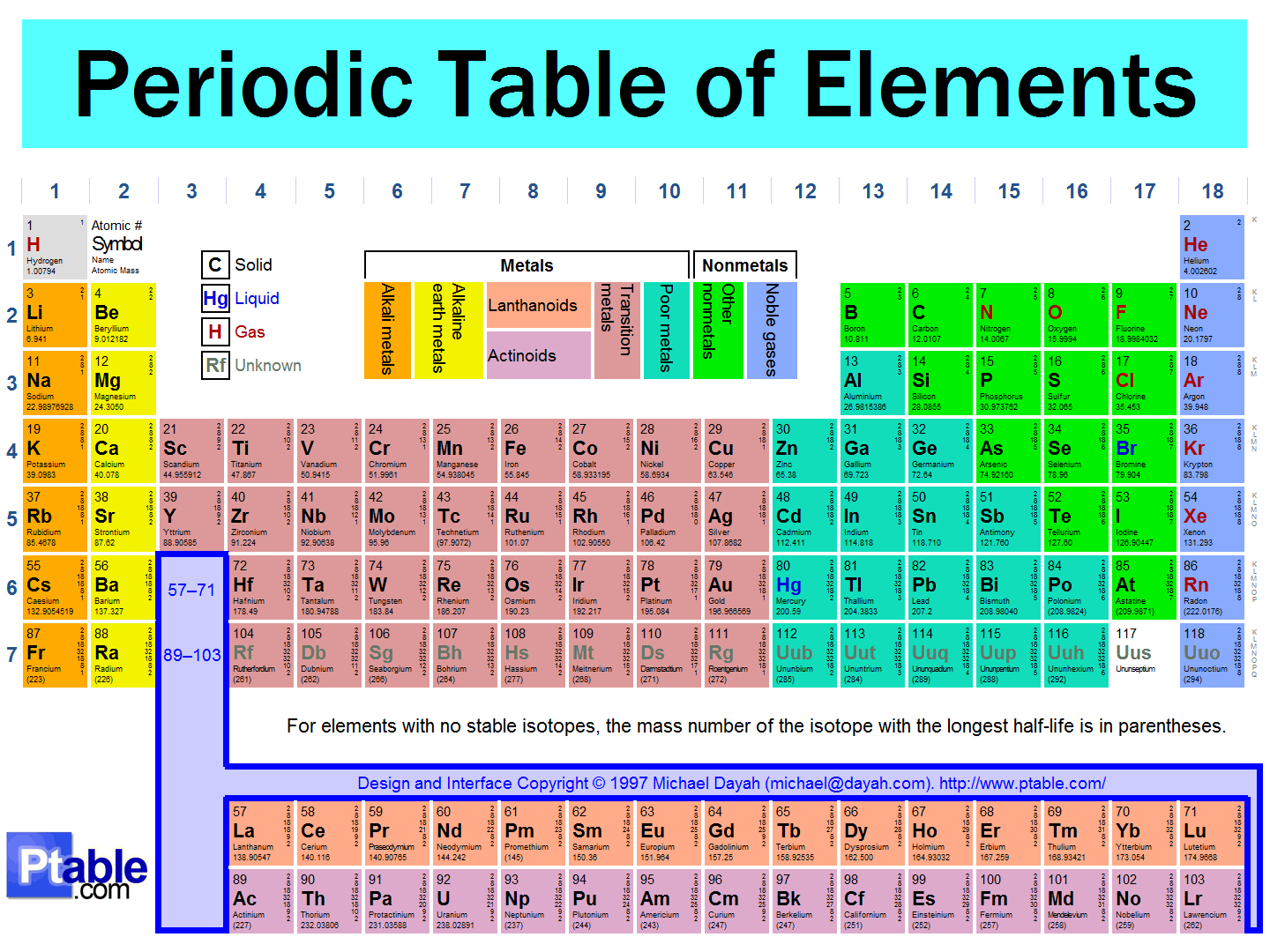
The number at the bottom of each square on the periodic table is the ...
a)
atomic number
b)
atomic mass
c)
chemical symbol
d)
element name
5.
The number at the top of each square on the periodic table is the ...
a)
atomic number
b)
atomic mass
c)
Chemical Symbol
d)
Element Name
6.
What is the chemical symbol for Lithium?
a)
H
b)
He
c)
Li
d)
N
7.
How many elements follow the periodic law?
a)
7
b)
98
c)
110
d)
All of them
8.
A rule that states that repeating chemical and physical properties of elements change periodically with the atomic number of the elements is the _________.
a)
periodic law
b)
alkaline-earth metals
c)
actinide
d)
group rule
9.
Pure forms of these elements are stored in oil so they won't react with oxygen and water in the air.
a)
Alkali Metals
b)
Alkaline-earth metals
c)
Halogens
d)
Noble Gases
10.
Most of the elements on the periodic table are classified as _____.
a)
Metals
b)
Nonmetals
c)
Metalloids
d)
Periods
11.
This class of elements are sometimes called "semiconductors."
a)
Metals
b)
Nonmetals
c)
Metalloids
d)
Groups
12.
Which group of the periodic table is composed of inert (not reactive)  gases?
a)
alkali metals
b)
alkaline earth metals
c)
halogens
d)
noble gases
13.
Elements which are shiny, conduct electricity and heat are called
a)
metal
b)
nonmetal
c)
metalloid
d)
nonexistent
14.
Which element is not a metal?
a)
H
b)
Re
c)
Al
d)
B
15.
Which is a halogen?
a)
Helium
b)
Chlorine
c)
Oxygen
d)
Neptune
16.
Which is an alkali metal?
a)
Magnesium
b)
Iron
c)
Sodium
d)
Europium
17.
Elements in a ..................have similar chemical properties.  
a)
period
b)
group
c)
row
18.
A proton is....
a)
A negatively charged subatomic particle
b)
A positively charged subatomic particle
c)
A neutrally charged subatomic particle
d)
The only subatomic particle located in the nucleus
19.
A neutron has a charge of
a)
+2
b)
No charge
c)
-1
d)
+1
20.
How many protons are in Beryllium?
a)
4
b)
9
c)
5
d)
2
21.
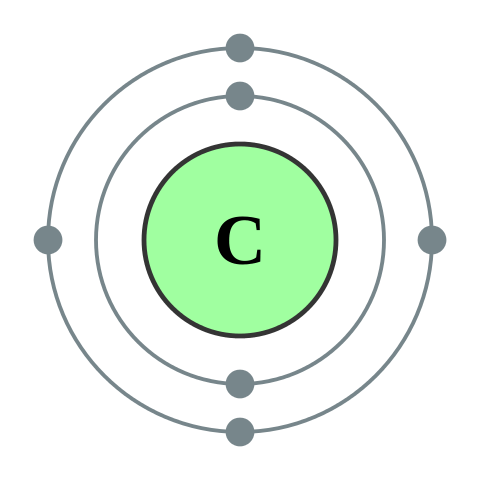
What element is represented in this Bohr Model? 
a)
Carbon
b)
Hydrogen
c)
Aluminum
d)
Lithium
22.
What's a valence electron?
a)
electrons in the second energy level
b)
electrons in the outermost energy level
c)
the atomic number
d)
electrons in the first level
23.
How many electrons do atoms need to be stable?
a)
1
b)
2
c)
6
d)
8
24.
Which of the following has a full valence shell?
a)
Oxygen
b)
Neon
c)
Barium
d)
Carbon
25.
The majority of an atom's mass exists where?
a)
In the nucleus
b)
In the electron cloud
c)
In the space between the nucleus and the electrons
d)
In the neutrons
26.
How many neutrons does the isotope of lithium have?
a)
8
b)
3
c)
4
d)
5
27.
How many electrons should Lithium have around its Lewis dot model?
a)
1
b)
2
c)
3
d)
4
28.
How many electrons should Beryllium have around its Lewis dot model?
a)
1
b)
2
c)
3
d)
4
29.
How many electrons should Nitrogen have around its Lewis dot model?
a)
1
b)
3
c)
4
d)
5
30.
How many electrons should Carbon have around its Lewis dot model?
a)
1
b)
3
c)
4
d)
5
31.
How many electrons should Neon have around its Lewis dot model?
a)
5
b)
6
c)
7
d)
8
32.
How many electrons should Sodium have around its Lewis dot model?
a)
1
b)
2
c)
3
d)
4
33.
Traveling across a period the atomic radii ______________.
a)
Increases
b)
Decreases
c)
Stays the same
34.
Traveling down a family the atomic radii ______________.
a)
Increases
b)
Decreases
c)
Stays the same
35.
The properties of an element can be predicted from...
a)
color
b)
location on Periodic Table
c)
educated guess
d)
atomic number
36.
Valence electrons are: 
a)
Electrons farthest away from the nucleus
b)
Electrons closest to the nucleus
c)
Electrons that just come and go - they don't stay with the atom
37.
Which has the greater EN: 
Cl or Al?
a)
Cl
b)
Al
38.
Which has the greater EN: 
N or C?
a)
C
b)
N
39.
Which has the greater EN: 
H or F?
a)
H
b)
F
40.
Which of the following will have a larger radius than Zinc?
a)
Gallium
b)
Aluminum
c)
Magnesium
d)
Strontium
41.
Which of the following will have a lower ionization energy than Scandium (Sc)?
a)
Helium (He)
b)
Titanium (Ti)
c)
Calcium (Ca)
d)
Magnesium (Mg)
42.
As atoms of elements in group 16 are considered in order from top to bottom, the electronegativity of each successive element....
a)
decreases
b)
increases
c)
remains the same
d)
none of the above
43.
Which atom has the largest atomic radius?
a)
potassium
b)
rubidium 
c)
francium
d)
cesium
44.
As you move down the periodic table atoms get bigger.  This is because ____________.
a)
The atoms have more mass.
b)
The atoms have more protons.
c)
The atoms have more energy levels
d)
The atoms have more nuetrons
45.
As you move across the periodic table atoms tend to get smaller because, ______________.
a)
the atoms have more mass.
b)
the atoms have less mass
c)
the atoms have more protons.
d)
the atoms have less electrons.
46.
Atoms that have a high electronegativity, _______________.
a)
give up their electrons more easily.
b)
hold on to their electrons more tightly.
c)
have more electron shells.
47.
Electronegativity is...
a)
how good an atom is at attracting electrons
b)
the ability of an atom to lose electrons
c)
the energy required to remove an electron from a specific atom
d)
how easy it is to make friends. 
48.
Ionization energy is...
a)
the energy required to add an electron to a specific atom
b)
how much energy it takes to remove an electron from an atom
c)
the energy required to shield the outer electrons from the nucleus
d)
a measure of the ability of an atom to attract electrons
49.
Metals are good conductors of heat and electricity.
a)
true
b)
false
50.
The atom with the largest atomic radius in Group 18 is - 
a)
Ar
b)
He
c)
Kr
d)
Rn
51.
Metals have the largest - 
a)
atomic radius and electronegativity
b)
electronegativity and ionization energy
c)
atomic radius only
d)
ionization energy and atomic radius
52.
Which statement correctly and completely identifies a trend?
a)
Atomic radius decreases across a period and increases down a group.
b)
Electronegativity decreases across a period and decreases down a group.
c)
Ionization energy increases across a period and increases down a group.
d)
Ionic radius increases across a period and increases down a group.
53.
The element with the largest electronegativity in the halogens is - 
a)
At
b)
F
c)
Cl
d)
Br
54.
The element with the lowest electronegativity in Period 3 is - 
a)
Na
b)
Cl
c)
Ar
d)
Mg
55.
The electronegativity of Cl is the highest in Period 2.  Why?
a)
Cl is the largest and has the greatest effective nuclear charge
b)
Cl is the smallest and has the lowest effective nuclear charge
c)
Cl is the largest and has the lowest effective nuclear charge
d)
Cl is the smallest and has the greatest effective nuclear charge
56.
Which periodic group has the smallest atomic radius?
a)
Alkali metals
b)
Halogens
c)
Noble Gases
d)
Transition metals
57.
Atomic radius generally increases as we move __________.  
a)
down a group and from right to left across a period 
b)
up a group and from left to right across a period 
c)
down a group and from left to right across a period 
d)
up a group and from right to left across a period 
58.
Electronegativity __________ from left to right within a period and __________ from top to bottom within a group.
a)
decreases, increases 
b)
increases, increases
c)
increases, decreases 
d)
stays the same, increases
59.
a)
2
b)
3
c)
5
60.
a)
16
b)
32
c)
6
d)
4
61.
Valence electrons are: 
a)
Electrons farthest away from the nucleus
b)
Electrons closest to the nucleus
c)
Electrons that just come and go - they don't stay with the atom
d)
Electrons in the second shell
62.
This could be the dot diagram of
a)
Be
b)
B
c)
C
d)
Ne
63.
How is helium different from the other noble gases?
a)
It will react with other elements.
b)
It has 10 valence electrons.
c)
It has 2 valence electrons.
d)
It is heavier than the other noble gases.
64.
Valence Electrons determine an element's _____________.
a)
Reactivity
b)
Location
c)
Identity
d)
Color
65.
What element in period 2 has 7 valence electrons?
a)
Beryllium
b)
Chlorine
c)
Magnesium
d)
Fluorine
66.
What element in period 2 has 7 valence electrons?
a)
Beryllium
b)
Chlorine
c)
Magnesium
d)
Fluorine
67.

This is a correct dot diagram for nitrogen (N)

a)

true

b)

false

68.
How many electrons can the 1st electron shell hold?
a)
2
b)
3
c)
8
d)
18
69.
How many electrons can the 2nd electron shell hold?
a)
2
b)
3
c)
8
d)
18
70.
How many electrons can the 3rd electron shell hold?
a)
2
b)
3
c)
8
d)
18
71.

How many valence electrons does carbon have?

a)

4

b)

5

c)

6

d)

7

72.
How many valence electrons do atoms in group 16 have?
a)
4
b)
5
c)
6
d)
7
73.

How many valence electrons do elements in Group 1 have?

a)

1

b)

2

c)

3

d)

4

74.

USE THE PERIODIC TABLE

How many valence electrons does magnesium have?

a)

1

b)

2

c)

12

d)

24

75.

USE THE PERIODIC TABLE

How many valence electrons does Phosphorus have?

a)

31

b)

5

c)

15

d)

4

76.

USE THE PERIODIC TABLE

How many valence electrons does Oxygen have?

a)

8

b)

2

c)

16

d)

6

77.

USE THE PERIODIC TABLE

Find the element that has 3 Valence Electrons and 2 energy levels.

a)

Magnesium - Mg

b)

Lithium - Li

c)

Aluminum - Al

d)

Boron - B

78.

USE THE PERIODIC TABLE

Find the element that has 5 Valence Electrons and 4 energy levels.

a)

Arsenic - As

b)

Selenium - Se

c)

Calcium - Ca

d)

Vanadium - V

79.
Elements in the same column of the periodic table always have the same # of _______ as one another.
a)
Protons
b)
Neutrons
c)
Electrons
d)
Valence Electrons
80.
What atom matches this electron configuration?
1s22s22p63s23p64s23d10
a)
Zinc
b)
Copper
c)
Nickel
d)
Germanium
81.
What atom matches this electron configuration?
1s22s22p63s2
a)
Neon
b)
Magnesium
c)
Aluminum
d)
Potassium
82.
What electron configuration matches an oxygen atom?
a)
1s22s22p63s2, 3p64s23d104p5
b)
1s22s22p4
c)
1s22s22p6
d)
1s22s22p63s23p64s23d1
83.
How many electrons does Si contain? (click to see image)
a)
14
b)
28
c)
2
d)
4
84.
There are 4 different types of subshells s,p,d,f
a)
true
b)
false
85.
Electrons occupy orbitals of lowest energy first is part of what electron configuration rule?
a)
Hund’s Rule
b)
Aufbau Principle
c)
Pauli Exclusion Principle
86.
Electron arrangement that uses arrows
a)
Electron configuration
b)
Shorthand configuration
c)
Lewis dot structure
d)
Orbital diagram
87.
What electron configuration matches an oxygen atom?
a)
1s22s22p63s2, 3p64s23d104p5
b)
1s22s22p4
c)
1s22s22p6
d)
1s22s22p63s23p64s23d1
88.
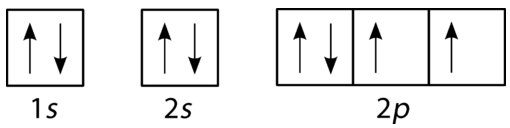
This orbital diagram represents:  
a)
C
b)
B
c)
N
d)
O
89.
What is incorrect about this orbital diagram?
a)
Both arrows in the 2p box should be pointing up
b)
There is nothing incorrect with this diagram
c)
In the there should only be 1 orbital in the first 2p box and one in the 2nd 2p box
d)
All the arrows should be pointing up.
90.
Which orbital shows a violation of Hund's Rule?
a)
A
b)
B
c)
C
d)
D
91.
Which orbital shows a violation of the Pauli Exclusion Principle?
a)
A
b)
B
c)
C
d)
D
92.
Which orbital shows a violation of the Aufbau Principle?
a)
A
b)
B
c)
C
d)
D
93.
What is the electron configuration for Ca+2?
a)
1s22s22p63s23p64s2
b)
1s22s22p63s23p64s23d2
c)
1s22s22p63s23p6
d)
1s22s22p63s23p8
94.
In an orbital diagram,  an arrow represents: 
a)
an electron
b)
an orbital
c)
an element
95.
The maximum number of electrons that can be placed in an f orbital.  
a)
2
b)
6
c)
10
d)
14
96.
The maximum number of electrons that can be placed in an p orbital.  
a)
2
b)
6
c)
10
d)
14
97.

Which of the following is true?

a)

An atomic orbital can only hold a maximum of 2 electrons, each with opposite spins

b)

An atomic orbital can hold a minimum of 6 electrons, each with opposite spins

c)

An atomic orbital can hold a maximum of 6 electrons, each with the same spin

d)

An atomic orbital can hold a minimum of 2 electrons, each with opposite spins

98.
What orbital is shown in the picture?
a)
s
b)
p
c)
d
d)
f
99.

The electron configuration of an atom is 1s22s22p63s23p2 The number of valence electrons in the atom is

a)

2

b)

4

c)

8

d)

10

100.
Which of the following is a p block element?
a)
Ca
b)
Ar
c)
Re
d)
Au
101.
How many unpaired electrons would lithium have?
a)
1
b)
2
c)
3
d)
0
102.
Order the following in increasing atomic radii: 
Ra, Be, Ca, Rb, H
a)
Ra, Be, Rb, H, Ca
b)
Rb, H, Ca, Be, Ra
c)
Ra, Rb, Ca, Be, H
d)
H, Be, Ca, Rb, Ra
103.
Which of the following sequences corresponds to a correct trend in ionization energy?
a)
Cl > S > P > Al
b)
Sr > Ca > Mg > Be
c)
Rb > K > Na > Li
d)
Rb > Sr > I > Xe
104.
Choose the set that goes from lowest to highest electronegativity?
a)
Cu, Mg, Sr, Ca
b)
F, Cl, Br, Si
c)
Cs, Rb, Ca, Mg
d)
Zn, Cd, Ag, Cu
105.

Which lists of 4 elements correctly aligns them left to right in order of decreasing atomic radius?

a)

O > P > K > Mg

b)

K > Mg > P > O

c)

Mg > K > P > O

106.
The early periodic table organized the elements in periods of increasing atomic mass. What information is currently used to organize the elements on the periodic table?
a)
number of valence electrons 
b)
number of energy levels 
c)
atomic number 
d)
ionic radius