wayground logo

Free Printable Worksheets

NEW

Font size

S
M
L
XL
Worksheets

Physics Electricity and Ohm's Law

Total questions: 64

Worksheet time: 16hrs 0mins

Name
Class
Date
1.
How many Volts would it take to push 1 Amp through a resistance of 1 Ohm
a)
10 volts
b)
1 volt
c)
48 volts
d)
5 volts
2.
If the battery produced 12.6 Volts and what would be the current flow be for a 6 Ohm resistor
a)
2.1 Amps
b)
2.4 Amps
c)
1.71 Amps
d)
15 Amps
3.
What is current measured in?
a)
Ω (Ohms)
b)
V (Volts)
c)
A (Amps)
d)
W (Watts)
4.
What is resistance measured in?
a)
Ω (Ohms)
b)
V (Volts)
c)
A (Amps)
d)
W (Watts)
5.
What is Resistance?
a)
The flow of electrons
b)
Electric potential difference
c)
A battery
d)
The ability to reduce the flow of electrons
6.
What types of charges attract?
a)
Positive and Positive
b)
Positive and Neutral
c)
Negative and Neutral
d)
Positive and Negative
7.
The mathematical relationship among Voltage, Current, and Resistance
a)
Faraday's Law
b)
Tesla's Law
c)
Edison's Law
d)
Ohm's Law
8.
If the Voltage is increased and the resistance stays the same, Current will
a)
Increase
b)
Decrease
c)
Stay the same
d)
X
9.

What are three good electrical conductors?

a)

Copper, Gold, Rubber

b)

Gold, Silver, Wood

c)

Gold, Silver, Copper

d)

Copper, Aluminum, Paper

10.
What size resistor would produce a 3 Amp current flow with a 12 Volt battery
a)
1 Ohm
b)
3 Ohms
c)
4 Ohms
d)
12 Ohms
11.
What is the Voltage of a circuit that has a resistance of 5 Ω and a current of 2 A?
a)
25 V
b)
10 V
c)
2.5 V
d)
0.4 V
12.
How many Volts would we need to produce a current flow of 8 Amps through a 6 Ohm resistor
a)
12 volts
b)
24 volts
c)
1.3333
d)
48 volts
13.
DC stands for ____ and is used in batteries.
a)
Distant Current
b)
Don't Current
c)
Direct Current
d)
Distributed current
14.
AC stands for ___.
a)
Alternating Current
b)
Attraction Connections
c)
Actual Current
d)
Action Curcuit
15.
Electricity that flows in a closed path is called a
a)
path
b)
current
c)
circuit
d)
light
16.
To complete a circuit the switch must be
a)
unattached
b)
open
c)
closed
d)
It depends
17.
In a parallel circuit the current
a)
makes one circle
b)
stays in one path
c)
splits and goes through two components
d)
does not move
18.
An example of a parallel circuit is
a)
the wiring in a house
b)
a flashlight
c)
a single circular path
d)
I really don't know
19.
Two types of circuits are
a)
parallel and magnetic
b)
electromagnetic and series
c)
series and parallel
d)
big and small
20.
This is an example of a ______ circuit
a)
Series
b)
Parallel
c)
Open
d)
Dihexihedral
21.
This is an example of a _______ circuit
a)
open
b)
series
c)
parallel
d)
square
22.
The type of current where charges flow in one direction
a)
Direct Current
b)
Alternating Current
c)
Electron Flow
d)
Voltage
23.
The type of current where charges shake back and forth in a circuit
a)
Alternating Current
b)
Direct Current
c)
Voltage 
d)
Switchback Current
24.
AC stands for ___.
a)
Alternating Current
b)
Attraction Connections
25.
DC stands for ____ and is used in batteries.
a)
Distant Current
b)
Don't Current
c)
Direct Current
26.
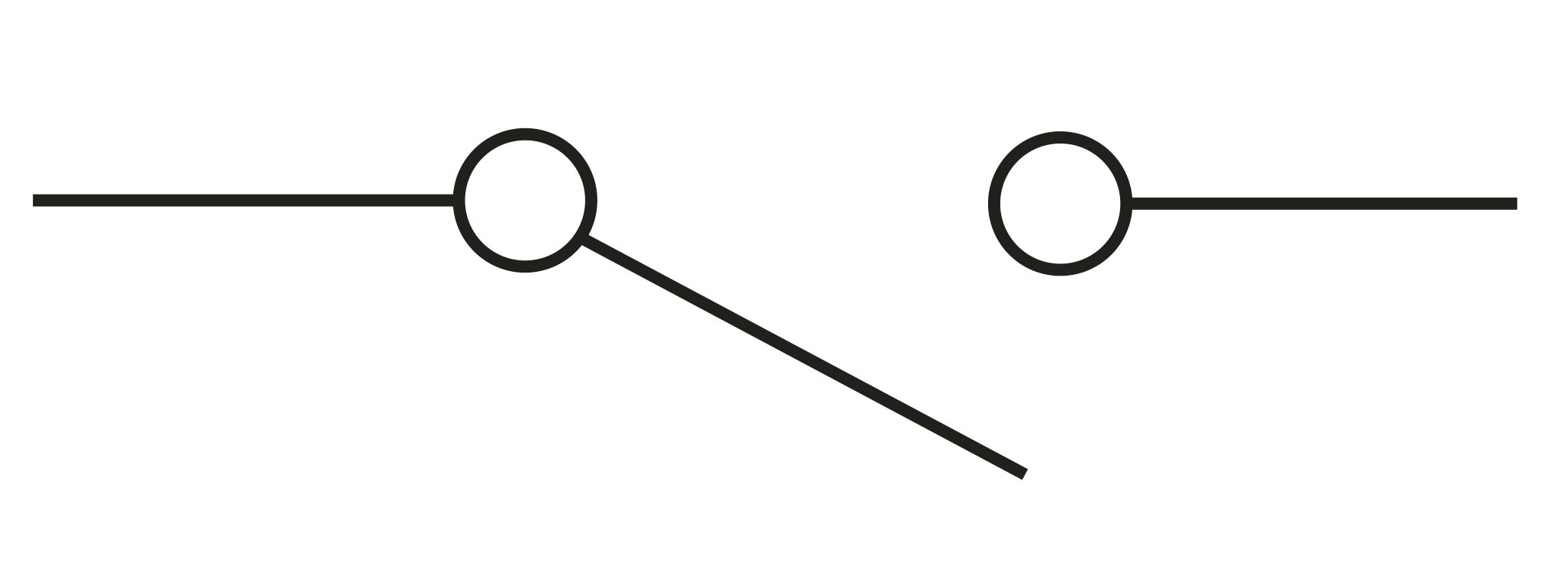
what is this symbol for?
a)
light bulb
b)
switch
c)
battery
d)
resistor
27.
In order for a circuit to work you need to have
a)
A voltage source
b)
A complete pathway with no breaks in the circuit
c)
A resistor
d)
A voltage source and a complete pathway with no breaks in the circuit
28.
This is the circuit symbol for ...
a)
an AC current source
b)
a DC current source
c)
an ammeter
d)
a voltmeter
29.
The current flowing in an electric circuit can be increased by:
a)
increasing voltage or decreasing resistance.
b)
decreasing voltage or increasing resistance.
c)
increasing voltage and increasing resistance.
d)
decreasing voltage and decreasing resistance.
30.

What is Electric Current

a)

flow of electric current through a conduction

b)

flow of electric charges through a conduction

c)

flow of electric charges through an insulator

d)

flow of electric current through an insulator

31.

Is it possible for the AC electrons to change their flow?

a)

No, its not possible.

b)

Yes, its possible.

32.

What is this symbol?

a)

Ammeter

b)

Resistor

c)

Battery

d)

Voltage

33.

A kilowatt-hour is equivalent to

a)

1000 W.

b)

3600 J.

c)

3,600,000 J/s.

d)

3,600,000 J.

34.

A 200-W light bulb is connected across a 100-V dc power supply. What current will flow through this bulb?

a)

0.90 A

b)

0.36 A

c)

0.60 A

d)

2.0 A

35.

A light bulb operating at a dc voltage of 100 V has a resistance of 200 Ω. How much power is dissipated in this bulb?

a)

100 W

b)

60 W

c)

50 W

d)

200 W

36.

When 5.00 A is flowing through an 10.0-Ω device, how much power is being dissipated in the device?

a)

50.0 W

b)

250 W

c)

500 W

d)

2.50 kW

37.

Calculate the power generated as a 20 A current flows through a 10Ω resistor?

a)

2 W

b)

200 W

c)

4000 W

d)

400 W

38.

What is the resistance of a 75 W bulb with 5 A of current flowing through it?

a)

3 Ω

b)

15 Ω

c)

375 Ω

d)

Resistance is futile!

39.
What is the power of a 20V bulb with 5A through it?
a)
100W
b)
100V
c)
6.3W
d)
6.3A
40.
In a parallel circuit if one of the light bulbs burns out the rest _________.
a)
stop the flow of electricity
b)
 can still light up
c)
 will go out
d)
of the light bulbs burn out also
41.
A series circuit has how many pathways for the electrons to flow?
a)
Two
b)
One
c)
Many
d)
Zero
42.
What kind of circuit is this?
a)
Series
b)
Consecutive
c)
Parallel
d)
Training
43.
What kind of circuit is this?
a)
Series
b)
Consecutive
c)
Parallel
d)
Training
44.
this is the symbol for a _____?
a)
switch
b)
light 
c)
battery
d)
wires
45.
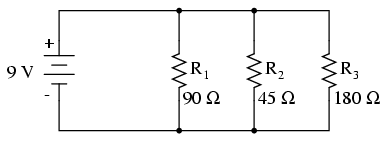
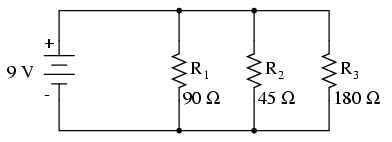
Find the total resistance, total current and total voltage for the following circuit
a)
VT = 9 V
T = 3
RT = 14
b)
VT = 9
T = 0.64
RT = 14
c)
VT = 9 
T = 6.3
RT = 1.4
d)
VT = 9
T = 0.64
RT = 1.4
46.
The current going through the 180 ohm resistor is 
a)
0.05 amps
b)
0.2 amps
c)
0.1 amps
d)
20 amps
47.
The current going through the 45 ohm resistor is 
a)
0.05 amps
b)
0.2 amps
c)
0.1 amps
d)
5 amps
48.

The current going through the 90 ohm resistor is

a)

10 amps

b)

0.1 amps

c)

0.2 amps

d)

.001 amps

49.
The total resistance of this circuit is 
a)
25.7 ohms
b)
315 ohms
c)
324 ohms
d)
90 ohms
50.
The total current going through the circuit is
a)
0.35 amps
b)
0.0286 amps
c)
0 amps
d)
9 amps
51.

What is the total resistance of this circuit?

a)

155 Ω

b)

21.63Ω

c)

40.90

d)

31.94 Ω

52.

In the circuit below, what is the voltage across R1?

a)

12 V

b)

6 V

c)

8 V

d)

4 V

53.

What is the current through R1?

a)

10 A

b)

5 A

c)

7 A

d)

2 A

54.

(Hint: Sketch first) 3 resistors are connected to a 9 V battery in a series circuit, the first resistor uses 6 V, the second uses 2 V. How much voltage does the third resistor use?

a)

1 V

b)

2 V

c)

3 V

d)

9 V

55.

What is the Total Resistance for this circuit?

a)

200

b)

330

c)

460

d)

560

56.
This is the symbol for a ...
a)
Wire
b)
Battery
c)
Buzzer
d)
Fuse
57.

wood is a(n) _____?

a)

conductor

b)

insulator

58.
A material in which electrons are able to move easily
a)
Circuit
b)
Insulator 
c)
Resistance 
d)
Conductor 
59.

What kind of circuit is this?

a)

Series

b)

parallel

c)

World Series

60.

What kind of circuit is this

a)

Series

b)

Parallel

c)

World Series

61.

The voltage supplied to a circuit is 18 V and the current running through is 20 A. What is the power generated?

a)

170 W

b)

170 A

c)

1.7 V

d)

1.7 W

62.

A light bulb operating at a dc voltage of 100 V has a resistance of 200 Ω. How much power is dissipated in this bulb?

a)

100 W

b)

60 W

c)

50 W

d)

200 W

63.
The voltage supplied to a circuit is 17 V and the current running through is 10 A. What is the power generated?
a)
170 W
b)
170 A
c)
1.7 V
d)
1.7 W
64.
If an oven has a power of 2000 W and the voltage is 230 V what fuse is required?
a)
3A
b)
5A
c)
13A