wayground logo

Free Printable Worksheets

Font size

S
M
L
XL
Worksheets

Unit 2 Atomic Theory and Structure

Total questions: 104

Worksheet time: 1hrs 29mins

Name
Class
Date
1.
What subatomic particles would you find in the nucleus of an atom?
a)
Protons only
b)
Protons and Neutrons
c)
Neutrons and Electrons
d)
Protons and Electrons 
2.
Which subatomic particles contribute the most to the mass of an atom?
a)
Protons, Neutrons, Electrons
b)
Protons only
c)
Protons and Electrons
d)
Protons and Neutrons
3.
What is the number of protons that the element in this image contain?
a)
14
b)
7
c)
15
d)
18
4.
Protons and Electrons balance the charge of an atom.
a)
True
b)
False
5.
If an atom has 12 positively charged subatomic particles, which of the following must it also have to be considered a neutral atom?
a)
12 neutrons
b)
12 electrons
c)
12 protons
d)
24 protons and neutrons
6.
An atom has 10 protons, 15 neutrons and 10 electrons what is its mass number.
a)
20
b)
10
c)
5
d)
25
7.
An element with a mass number of 11 and an atomic number of 5 has how many neutrons?
a)
11
b)
5
c)
6
d)
16
8.
The mass of one proton is greater than the mass of one...
a)
neutron
b)
electron
9.
What is the atomic mass of the atom pictured? 
a)
9
b)
10
c)
18
d)
19
10.
What is the atomic number of the atom pictured? 
a)
9
b)
10
c)
18
d)
19
11.
What is the element name of the atom pictured? 
a)
Fluorine
b)
Neon
c)
Argon
d)
Potassium
12.
Which scientist conducted experiments using alpha particles and thin gold foil, which later helped him develop his model for the atom? 
a)
Ernest Rutherford
b)
Kneels Bore
c)
Niels Bohr
d)
Earnest Rutherfraud
13.
Which scientist discovered the electron, which helped him develop a model of the atom?
a)
Niels Bohr
b)
John Dalton
c)
Ernst Rutherford
d)
J.J Thompson
14.
What is an atom mostly made up of?
a)
protons
b)
electrons
c)
empty space
d)
neutrons
15.
An isotope has three forms.  30% have a mass of 4 amu, 20% have a mass of 5 amu and 50% have a mass of 3 amu.  Average atomic mass will be closest to
a)
2 amu
b)
3 amu
c)
4 amu
d)
5 amu
16.
How many electron shells/levels does this atom have?
a)
1
b)
2
c)
3
d)
4
17.
What is the difference between the atomic mass and the mass number?
a)
the atomic mass is always a whole number
b)
the atomic mass equals the atomic #
c)
mass number is the rounded atomic mass - always a whole number
d)
electrons
18.
An atom has 13 protons, 15 neutrons and ___ electrons what is its mass number?
a)
13
b)
26
c)
28
d)
15
19.
Elements on the periodic table increase by...
a)
atomic mass
b)
size
c)
mass number
d)
atomic #
20.
Matter that cannot be broken down into a simpler substance – building blocks of life.
a)
neutron
b)
atom
c)
electron
d)
quarks
21.
An atom has 10 protons, 15 neutrons and 10 electrons what is its mass number.
a)
20
b)
10
c)
5
d)
25
22.
An element with a mass number of 11 and an atomic number of 5 has how many neutrons?
a)
11
b)
5
c)
6
d)
16
23.
What charge does the nucleus have and why?
a)
positive - the neutrons do not have a charge
b)
positive - the neutrons and protons are positively charged particles
c)
neutral - the neutral charge dominates the positive charge
d)
neutral - electrons cancel out the positive charge of the atom
24.
The subatomic particle that determines the identity of an element.
a)
neutron
b)
proton
c)
electron
d)
outer shell
25.
What are valence electrons?
a)
electrons on the first orbital always
b)
nucleus
c)
the outermost shell
d)
the number of electrons on the outermost orbital
26.
What are the maximum number of electrons that go on the first 3 energy levels?
a)
2,4,16
b)
2,8,18
c)
4,8,12
d)
3,4,6
27.
Describe an Electron Cloud?
a)
the mist outside of an atom
b)
home of the protons
c)
where electrons are located
d)
nucleus
28.
Has a mass of 1/200th the mass of a proton.
a)
electron
b)
neutron
c)
nucleus
d)
electron cloud
29.
This causes the mass of the nucleus to increase.
a)
adding an electron
b)
adding a neutron
c)
more orbitals
d)
adding negatively charged particles
30.
Who first thought of and invented the word "Atom"
a)
Democritus
b)
J.J. Thompson
c)
Antoine Lavoisier 
d)
Ernest Rutherford
31.
The alpha particle is a
a)
helium-4 isotope
b)
an electron
c)
pure energy
32.
I have 10 g of radon-222 and it has a half-life of 7 days. I let it sit for 2 weeks. How many grams will I have after the 2 weeks?
a)
2.5 g 
b)
0.039 g
c)
0.88 g
33.
Who created the gold foil experiment that disproved the Plum Pudding model?
a)
J.J. Thompson
b)
Ernest Rutherford
c)
Democritus
d)
Antoine Lavoisier 
34.
Who developed the five postulates of the atom?
a)
J.J. Thompson
b)
John Dalton
c)
Democritus
d)
Antoine Lavoisier 
35.
Which model is shown?
a)
Bohr Model
b)
Plum Pudding Model
c)
Quantum Mechanical Model
d)
Spicy Soup Model
36.
How many neutrons in this species?
a)
146
b)
238
c)
92
d)
148
37.
What is the electronic shell configuration of argon?
a)
2,8,8
b)
2,4,6,6
c)
2,8,10,2
d)
2,8,18,8,4
38.
How many electrons can the first energy level hold?
a)
1
b)
2
c)
8
d)
0
39.
Element X has an electronic configuration of 2,8,4. It is most likely to be..
a)
In Group 4
b)
In Period 4
c)
Have 4 nucleons
d)
have 4 protons
40.

How many electrons can the third shell have?

a)

Two

b)

Eight

c)

Five

d)

Three

41.

What is the electronic configuration of Lithium?

a)

2.8.8

b)

2.2.2

c)

2.8.5

d)

2.1

42.

How many electrons per shell does sodium have?

a)

2,8

b)

2,8,2

c)

2,8,1

d)

2,2,8

43.
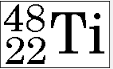
How many protons does this isotope of titanium have?
a)
48
b)
22
c)
26
d)
70
44.
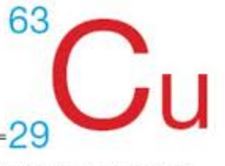
How many electrons does a Copper atom have?
a)
63
b)
29
c)
92
d)
34
45.
In the Bohr model of the atom, what is the maximum number of electrons in the second orbital?
a)
8
b)
2
c)
1
d)
18
46.

What is an isotope?

a)

an atom with the same number of protons but a different number of neutrons

b)

an atom with the same number of protons but a different number of electrons

c)

an atom with the same number of neutrons but a different number of protons

d)

an atom with the same number of neutrons but a different number of electrons

47.
The scientist responsible for the oil drop experiment was:
a)
Democritis
b)
Dalton
c)
Millikin
d)
De Broglie
48.
John Dalton stated:
a)
elements are made of atoms
b)
atoms of a given element are identical
c)
atoms cannot be subdivided, created, nor destroyed
d)
all of the above
49.
Bohr coined the term "valence electrons" which gave birth to:
a)
quantum chemistry
b)
theory of relativity
c)
plum pudding model
d)
time travel
50.
The impossibility to know simultaneously the exact position and momentum of a particle is called the:
a)
Einstein Uncertainty Principle
b)
Moseley Uncertainty Principle
c)
Heisenburg Uncertainty Principle
d)
Bohr Uncertainty Principle
51.
The nucleus of an atom can be described as:
a)
spacious and negatively charged
b)
dense and positively charged
c)
spacious and positively charged
d)
dense and negatively charged
52.
The Bohr model of an atom is concerned with ____ electrons, whereas the Lewis dot diagram is concerned with _______ electrons
a)
valence; all
b)
all; valence
c)
outer; inner
d)
inner; outer
53.
Electrons are not factored into atomic mass because:
a)
They are so small their mass is negligible
b)
They're not in the nucleus
c)
They're too big
d)
They move so quickly their mass is zero
54.
Place the following scientists in order, from earliest to latest: 
A) Ernest Rutherford
B) J.J. Thomson
C) John Dalton
a)
B,C,A
b)
C,A,B
c)
A,C,B
d)
C,B,A
55.
J.J. Thomson provided evidence that an atom...
a)
is the smallest particle of matter
b)
contains negatively charged particles
c)
has an overall negative charge
d)
has an overall positive charge
56.
Discovered the neutron
a)
Ernest Rutherford
b)
James Chadwick
c)
Joseph Thomson
d)
John Dalton
57.
Believed matter was continuous and discredited Democritus' theory
a)
Plato
b)
Galileo
c)
Aristotle
d)
Democritus
58.
Discovered the proton in 1920
a)
James Chadwick
b)
Ernest Rutherford
c)
John Dalton
d)
Niels Bohr
59.
His atomic model was depicted similar to a planetary/solar system
a)
Niels Bohr
b)
Joseph Thomson
c)
Ernest Rutherford
60.
Takes two small nuclei and combines them into a larger nucleus
a)
fission
b)
fusion
61.
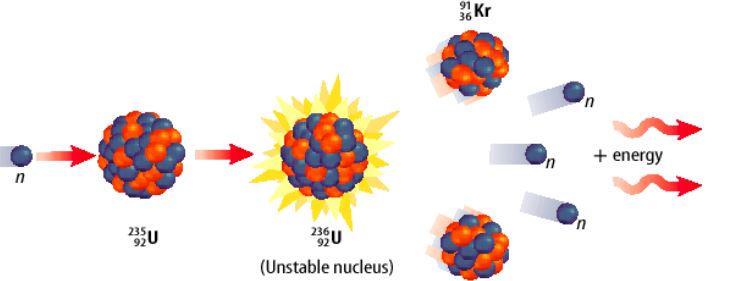
The splitting of a nucleus into smaller nuclei is
a)
fusion
b)
fission
c)
half-life
d)
gamma radiation
62.
How do nuclear power-plants work?
a)
Fusion
b)
Half-life
c)
Fission
d)
Fusion or fission
63.
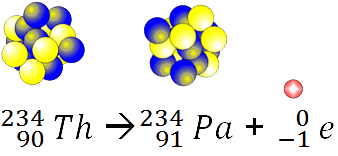
Complete the nuclear equation and determine the type of decay that is occurring in this reaction. 
a)
alpha
b)
beta
c)
gamma
d)
none
64.
Alpha particles have a _____ charge.
a)
+2
b)
0
c)
+4
d)
-1
65.
The beta particle has a charge of ...........
a)
+1
b)
-1
c)
0
d)
+2
66.
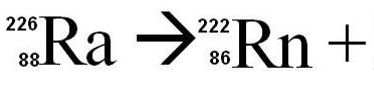
Which type of radioactive decay is occurring in this equation? 
a)
Alpha decay
b)
beta decay
c)
gamma decay
d)
positron emission
67.
This is an example of...
a)
Fission  reaction
b)
Fusion reaction
c)
Decomposition reaction
d)
Decay
68.
Where does fusion occur naturally?
a)
Underwater
b)
All around us
c)
In the radioactive waste
d)
On the sun
69.
Which atoms combine together during fusion reaction on the sun?
a)
Helium and Hydrogen atoms
b)
Hydrogen atoms
c)
Hydrogen and Lithium atoms
d)
Hydrogen and Carbon atoms
70.
In order of most to least penetrating radiation we have
a)
Alpha , Beta,  Gamma
b)
Beta , Gamma , Alpha
c)
Gamma, Beta, Alpha
d)
Gamma, Alpha, Beta
71.
The process of nuclear change in an atom of radioactive material is called... 
a)
nuclear decay
b)
nuclear mass
c)
isotopes
d)
radon
72.
During beta decay, a nucleus .... 
a)
gives up two protons and two neutrons.
b)
  maintains the same number of protons and neutrons.
c)
  loses a proton and gains a neutron.
d)
gains a proton and loses a neutron. 
73.
Radioactive materials have unstable...
a)
electrons
b)
protons
c)
nuclei
d)
neutrons
74.
Negatively charged particles emitted from a nucleus at a high speed are ____.  
a)
alpha particle
b)
gamma rays
c)
beta particles
d)
X rays
75.
The process by which nuclei having low masses are united to form nuclei with larger masses is ____.  
a)
a chain reaction 
b)
fission
c)
a chemical reaction 
d)
fusion 
76.
During ________________, unstable elements are transformed into more stable elements.
a)
mutation
b)
germination
c)
pollination
d)
radioactive decay
77.
This radioactive particle is also known as an electron and has a charge of -1
a)
alpha
b)
beta
c)
gamma
d)
kryptonite
78.
With respect to penetrating power, a gamma particle is considered the _________________ form of radiation and lead or concrete incompletely block this type of radiation.
a)
weakest
b)
strongest
c)
somewhat strongest
d)
all radioactive particles are equally powerful
79.
What type of radioactive decay increases the atomic number of a radioactive atom?    
a)
 gamma emission
b)
 beta emission
c)
 alpha emission 
d)
 fusion
80.
 For the following nuclear reaction, what was the starting substance (X)?
      X     86Rn222 + 2He
a)
Radium-222
b)
Radon-222
c)
Radon-226
d)
Radium-226
81.
Complete the following reaction and choose the type of decay.

54Xe
118 → X + 55Cs118
a)
alpha emission
b)
neutron activation
c)
beta emission
d)
gamma emission
82.

What is it called when electrons absorb energy and move to an orbital with higher energy.

a)

Ground state

b)

Excited state

c)

Absorption rate

d)

Quantum

83.

States that single electrons with the same spin must occupy each equal energy orbital before additional electrons with opposite spins can occupy the same orbital.

a)

Pauli’s Exclusion Principle

b)

Hund’s rule

c)

Aufbau Principle

84.

states that at most each orbital can only contain two electrons.

a)

Pauli’s Exclusion Principle

b)

Hunds Rule

c)

Aufbau Principle

85.

States that each electron occupies the lowest energy orbital available

a)

Pauli’s Exclusion Principle

b)

Hunds Rule

c)

Aufbau Principle

86.

What is the lowest available energy state of an atom?

a)

Ground state

b)

Excited state

c)

Absorption rate

d)

Quantum

87.

What are the regions where there is a high probability of finding an electron called?

a)

Clouds

b)

Rings

c)

Orbitals

d)

Configuration

88.

What is the minimum amount of energy that can be gained or lost by an atom called?

a)

Light

b)

Electron

c)

Photon

d)

Quantum

89.

The arrangement of electrons in the orbitals of an atom is called an electron configuration

a)

True

b)

False

90.

What is represented by “n” and is considered the energy level of the electron

a)

Principal Quantum Number

b)

Secondary Energy Number

c)

Electron sublevel

d)

Electron State

91.
24.1% of all the isotopes of a an element have a mass of 75.23 amu, 48.7% have a mass of 74.61 amu, and 27.2% have a mass of 75.20 amu.
What is the average mass of this element?
a)
74.92 amu
b)
24.97 amu
c)
75.01 amu
d)
74.51 amu
92.
An element has two naturally occurring isotopes. One is 10.013 amu and is 19.9% abundant. The other is 11.01 amu and is 80.1% abundant. What is the average atomic mass? What element is it?
a)
9.012, Beryllium
b)
12.011, Carbon
c)
6.941, Lithium
d)
10.812, Boron
93.
Atom 1 has Mass=12  Protons=6
Atom 2 has Mass= 14 Electrons=6
Are these atoms isotopes of each other or different elements?

a)
Different Elements - Mg & Si
b)
Different Elements - Ar & Ca
c)
Isotopes of Carbon
d)
Isotopes of Magnesium
94.
Energy of motion is which type of energy?
a)
Potential
b)
Kinetic
c)
Sound
d)
Gravitational
95.
What type of energy is in this picture?
a)
Kinetic
b)
Potential
c)
Chemical
d)
Sound
96.
When plants convert the sun's energy into food, which type of energy is it?
a)
kinetic
b)
chemical
c)
thermal
d)
radiant
97.
What kind of energy is represented in this picture?
a)
Thermal
b)
Potential
c)
Nuclear
d)
Mechanical
98.
How many valence electrons are there?
a)
1
b)
2
c)
8
d)
79
99.
What is the highest occupied energy level?
a)
1
b)
2
c)
3
d)
4
100.
There are 4 different types of subshells s,p,d,f
a)
true
b)
false
101.
four numbers that describe the location of an electron in an atom
a)
Quantum number
b)
Aufbau principle
c)
Hund’s rule
d)
Isotope
102.

Who used theoretical calculations and experimental results to devise and solve a mathematical equation describing the behavior of the electron in a hydrogen atom?

a)

JJ Thomson

b)

Niels Bohr

c)

Erwin Schrodinger

d)

James Chadwick

103.

What is the difference in a 1s orbital and a 2s orbital?

a)

The shape of the orbital

b)

The size of the orbital

c)

The number of electrons it can hold

d)

None of the above

104.

When atoms _____________ energy, their electrons move to higher energy levels. These electrons _____________ energy by emitting light when they return to lower energy levels.

a)

lose, absorb

b)

absorb, lose

c)

lose, lose

d)

absorb, absorb