
 Worksheets
First Semester Final Review
Total questions: 120
Worksheet time: 1hrs 18mins


The Truman Doctrine's main goal was to:
Contain communism
Provide weapons to democratic countries
Help south Korea
Provide collective security

Which of the following describes a response by France and Great Britain to the German aggression shown on this map?
disarmament
appeasement
Nuremberg Trials
economic sanctions


In Korematsu v US, the Supreme Court ruled that
the Fourteenth Amendment was absolute
the Japanese were permitted to own property within internment camps
in times of war, Constitutional rights could be limited
habeas corpus rights were universally guaranteed
How did the United States react to aggression by Germany and Japan in the 1930's?
It adopted isolationist policies that avoided involvement.
It formed military alliances with Britain and France.
It adopted a policy of appeasement.
It declared war on Germany.
How did American civilians show their support for the huge
economic cost of the war?
They held scrap drives.
They rationed food and supplies.
They purchased war bonds.
They planted victory gardens.
What characterizes the economy during World War II?
high unemployment to due low production demand
shortages of goods such as gasoline, nylon, and tires
low manufacturing levels in northern cities
a decrease in the availability of industrial jobs
The Neutrality Acts of 1935 and 1937 were enacted by Congress to
help the United States recover from the Great Depression
stop Nazi Germany from conquering Europe
aid the Americans who fought in the Spanish Civil War
prevent the U.S. from being drawn into another world war
The Lend-Lease Act of 1941 significantly changed United States policy toward nations involved in World War II because it
supplied war materials to allied nations without a declaration of war
imposed a trade boycott on Germany and Japan
authorized the seizure of British assets in the United States
approved the appeasement policies of the French and British governments
FDR sent destroyers to Britain in exchange for
cash and manufactured goods
a promise to pay at the war's end.
the use of British bases in the Atlantic
a new agreement on trade
The Pittsburgh Courier argued that African Americans should join the war effort in order to achieve victory over Hitler’s racism and racism at home, in a campaign called
Double V
Tuskegee Airmen
Fight for Right
Victory Suit
Liberty ships could be produced quickly because they were
Made of steel rather than iron
Made with thick hulls
Riveted rather than welded
Assembled from pre-made parts
The cost-plus system sped up war production by
imposing penalties on companies that did not meet production quotas.
Providing larger profits for companies that worked fast and produced a lot.
Allowing previously competing companies to work together.
Providing bonuses for superior workmanship in war production.
Migrant farm workers became an important part of the Southwest’s agricultural system as the result of
The planting of victory gardens
FDR's Executive Order 8802
The Bracero Program
The Great Migration

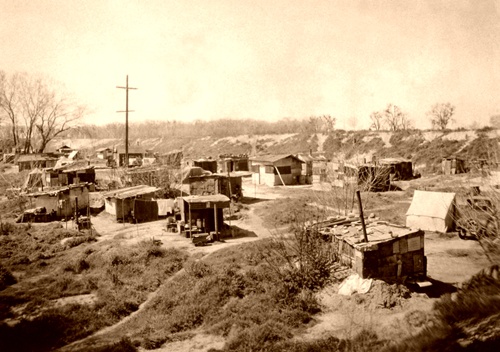
_____________ invested in stocks, betting that the market would continue to climb so that they could make a quick profit.
Bailiffs
Okies
Stock Brokers
Speculators
Stocks were rising steadily during the 1920s. We would call this a _________ market?
Bear
Moose
Bull
Lion
Thousands of World War I veterans came to Washington, D.C. in 1932 to lobby Congress to
Provide bonus payments to war veterans and their families
Provide military jobs for family members of veterans
Provide public works jobs for unemployed veterans
Pass legislation giving veterans their promised bonuses early
Which of the following was NOT a cause of the Great Depression?
Overproduction
Loss of Export Sales
High Tariffs
Low Tariffs
Of the following programs, which one put young men to work and built state parks and bridges?
Agricultural Adjustment Act
Civilian Conservation Corps
Securities and Exchange Comission
Social Security Act
Hoover attempts to give the banks and private businesses large sums of money in the hopes that that money will eventually reach the hands of the masses. This economic practice is called?
Socialism
Supply-side economics
Microeconomics
Keynesianism
The _________________ was established to build dams and power plants to a region covering seven southern states.
National Labor Relations Board
Hooverville Association
National Youth Administration
Tennessee Valley Authority
The ________________ provided pensions for the elderly, unemployed, and people with disabilities.
Smoot-Hawley Tariff
Social Security Act
Welfare Administration
Civilian Conservation Corps
How did FDR and the New Deal affect the power of the Federal Government?
It decreased the influence of the federal government
It increased the influence and the power of the federal government
FDR did not impact the balance of state and federal power
The state governments increased their influence.
In the 1930s, the enactment of New Deal programs demonstrated a belief that
Corporations were best left to operate without government interference
State government should give up control over commerce inside their states
The Federal Government must concern itself with the people’s economic well-being
The US Constitution was not relevant to 20th century life
A major criticism of President Franklin D. Roosevelt’s programs to combat the Great Depression was that these programs
Reduced the power of the Federal government
Ignored the plight of homeowners with mortgages
Provided too much protection for big business
Made people dependent on the Federal Government

What name was given to the great achievements in art and learning by African Americans during the 1920s?
The Roaring 20s
The Best of Times
Harlem Renaissance

The movement describing Christians whose beliefs were based on a literal translation of the Bible and who condemned radicals, changing attitudes of women, and Darwinism were known as:
Fundamentalists
Ku Klux Klan
Flappers
Suffragettes
group of writers such as F. Scott Fitzgerald, Ernest Hemingway, Sinclair Lewis who rejected the idea of material wealth and moved to Paris
Lost Generation
Beat Generation
Millennial Generation
Generation X

This Jazz musician would become the most popular jazz musician of his time.
Paul Lawrence Dunbar
Eugene O'Neill
Louis Armstrong
Ernest Hemingway
Music created in Harlem Renaissance
Jazz
Rock
Hip Hop
Swing
How did life change for American women in the 1920s?
Many women felt freer to experiment with bolder styles and manners.
Married women found it much easier to balance careers and family life.
Most women grew long hair and stopped using makeup.
Women began to dominate the work force, often taking leadership positions.
In the 1920s fundamentalists gained attention for their belief in
the repeal of Prohibition.
the theory of evolution.
a literal interpretation of the Bible.
a larger role for technology in everyday life.
The rise of films, radio broadcasting, and the news media all helped to bring about
organized crime
mass media
the Garvey movement
the Ku Klux Klan
Henry Ford was able to cut daily work hours and increase wages due to the success of
the airline industry
public transportation
mass production
negotiating with unions
Harding won the presidency by appealing to Americans' desire to
Reform society
Return to life before the war
Repeal Prohibition
Become a world power
The golden age of Hollywood began in 1927 with the release of "The Jazz Singer," the first
animated film
feature-length film
full-length motion picture
"talking" motion picture
The Cotton Club was a
Chicago speakeasy where gangsters, artists, and politicians congregated.
Fictitious nightclub featured in "The Jazz Singer"
Harlem nightspot where many African American entertainers got their start.
Hollywood nightspot frequented by the stars of the silver screen.
Most Americans of the 1920s wanted to avoid future wars by
banning Japan from the League of Nations.
dividing Germany among the Allies.
avoiding involvement in world affairs.
forbidding Germany to rebuild its armed forces.
The Dawes Plan
required the U.S. to pay back loans.
kept the U.S. out of world affairs.
had U.S. banks make loans to Germany to help with reparations.
limited the amount of weapons the U.S. could have.

