
 Worksheets
Which Catagory is it?
Total questions: 46
Worksheet time: 39mins
Name
Class
Date
1.
Sodium chloride NaCl
a)
Acid
b)
Base
c)
Alkali
d)
Salt
2.
Aluminium hydroxide AlOH
a)
Acid
b)
Base
c)
Alkali
d)
Salt
3.
Which level on a pH scale does acid belongs in?
a)
0-6
b)
8-14
4.
Which is a property of a base?
a)
metal and a hydroxide (OH)
b)
slippery
c)
bitter base
d)
All of the above
5.
Which level on a pH scale does bases belongs in ?
a)
0-7
b)
7-14
6.
HCl
a)
Acid
b)
Base
c)
Salt
7.
Acid, Base, Salt: H2S
a)
Acid
b)
Base
c)
Salt
8.
When you neutralize acid with a base you create
a)
a Salt and water
b)
You can not neutralize acid with a base
c)
You create carbon dioxide
d)
A moderate sized explosion
9.
Ice melting
a)
Chemical Change
b)
Physical Change
10.
Water freezing
a)
Chemical Change
b)
Physical Change
11.
Wood burned in a fireplace
a)
Chemical Change
b)
Physical Change
12.
Cake batter baked in an oven
a)
Chemical Change
b)
Physical Change
13.
Baking soda and vinegar combine to make carbon dioxide
a)
Chemical Change
b)
Physical Change
14.
Glass bottle that is shattered
a)
Chemical Change
b)
Physical Change
15.
Rust on an iron fence
a)
Chemical Change
b)
Physical Change
16.
Boiling water
a)
Chemical Change
b)
Physical Change
17.
Burning coal
a)
Chemical Change
b)
Physical Change
18.
Which one of these is a chemical property?
a)
melting point
b)
boiling point
c)
color
d)
flammability
19.

What is reactability?
a)
the ability of a substance to undergo a chemical reaction, either by itself or with other materials
b)
the ability of a substance to undergo a physical change either by itself or with other materials
20.
Which is an example of a physical property?
a)
ability to react with acid
b)
state of matter
c)
flammability
d)
ability to react with oxygen
21.
Which is NOT a physical property?
a)
odor
b)
reacts with acid
c)
ability to conduct electric current
d)
hardness
22.
Which of the following is a chemical property of water?
a)
Reacts with pure sodium
b)
Boils at 100 oC
c)
Is liquid at room temperature
d)
Has a density of 1 gm/mL
23.
sodium chloride: NaCl
a)
ionic
b)
covalent
24.
carbon dioxide
a)
ionic
b)
covalent
25.
O2
a)
ionic
b)
covalent
26.
silver oxide AuO
a)
ionic
b)
covalent
27.
Electrons are shared
a)
ionic
b)
covalent
28.
electrons are lost or gained
a)
ionic
b)
covalent
29.
Made of a metal part and a non metal part
a)
ionic
b)
covalent
30.
Takes two small nuclei and combines them into a larger nucleus
a)
fission
b)
fusion
31.
The splitting of a nucleus into smaller nuclei is
a)
fusion
b)
fission
c)
half-life
d)
gamma radiation
32.
How do nuclear power-plants work?
a)
Fusion
b)
Half-life
c)
Fission
d)
Fusion or fission
33.
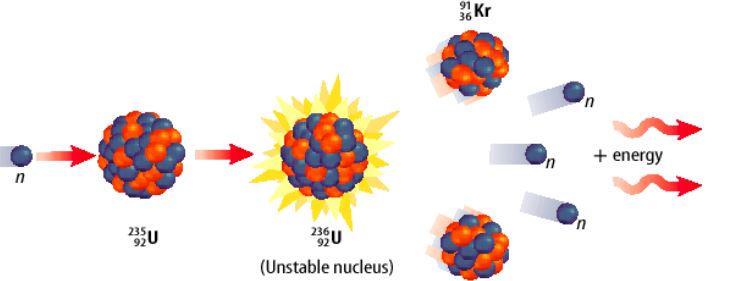
This is an example of...
a)
Fission reaction
b)
Fusion reaction
c)
Decomposition reaction
d)
Decay
34.
Where does fusion occur naturally?
a)
Underwater
b)
All around us
c)
In the radioactive waste
d)
On the sun
35.
What does it mean that fusion is a "chain reaction?"
a)
many steps or mini-reactions in the process
b)
long chains of elements form in a row
36.
Which of these statements correctly describes how the chain reaction occurs in nuclear fission.
a)
Uranium releases electrons to create electricity
b)
When a nuclear fission reaction occurs, the electrons emitted can strike other nuclei in the sample, and cause them to split
c)
When a nuclear fission reaction occurs, the neutrons emitted can strike other nuclei in the sample, and cause them to split
d)
Protons and neutrons change to electrons because the nuclei are so big
37.
The major drawback to nuclear fission reactors is the difficulty of achieving safe disposal of radioactive waste products.
a)
true
b)
false
38.
Very high temperature and pressure is required for:
a)
Fission
b)
Fusion
c)
Radioactive Decay
39.
Which of the following is true about nuclear fusion?
a)
It is easy to implement.
b)
It produces less energy than nuclear fission.
c)
It produces more energy than nuclear fission.
d)
It has the ability to occur easily in everyday life.
40.
In an endothermic reaction, heat is ,,,
a)
taken in
b)
given out
41.
In an exothermic reaction, heat is ...
a)
taken in
b)
given out
42.
If a chemical reaction is EXOTHERMIC, the temperature would....
a)
Stay the same
b)
Increase
c)
Decrease
43.
A chemical reaction that requires energy is a
a)
exothermic reaction
b)
endothermic reaction
c)
over reaction
44.

'Have you ever eaten sherbet sweets? They fizz in your mouth and your tongue feels cold. Why do you think that is?'
a)
Because it is an Endothermic reaction
b)
Because it is an Exothermic reaction
c)
It is made of ice
d)
It is dissolving in your mouth
45.
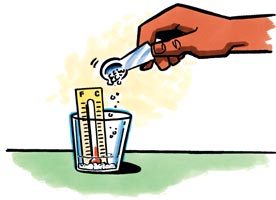
In an endothermic reaction, heat is ...
a)
taken in or absorbed
b)
given out or released
46.
Organic or inorganic: C5H12
a)
organic
b)
inorganic
100 %

