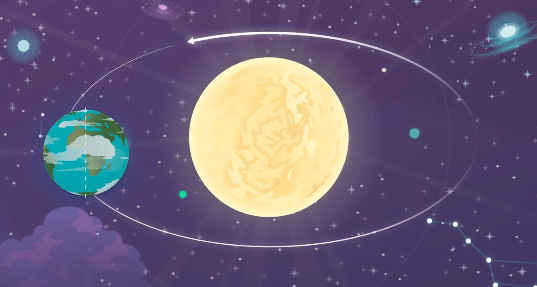
wayground logo

Free Printable Worksheets

Font size

S
M
L
XL
Worksheets

Low TEK review

Total questions: 136

Worksheet time: 2hrs 29mins

Name
Class
Date
1.
The water is ______ dense than the boat
a)
more
b)
less
2.
The blue ball has ________ mass than the red one.
a)
less
b)
more
3.
If you poured 3 liquids that do not mix how could you tell which one is the most dense?
a)
The liquid on top
b)
The liquid in the middle
c)
The liquid at the bottom
4.
The ability of a substance to dissolve is called...
a)
malleability
b)
ductility
c)
solubility
5.
Which tool helps us to measure mass?
a)
scale
b)
triple beam
c)
ruler
d)
magnifying glass
6.

What is anything that has mass and takes up space?

a)

gravity

b)

pounds

c)

matter

d)

objects

7.
If you poured 3 liquids that do not mix how could you tell which one is the most dense?
a)
The liquid on top
b)
The liquid in the middle
c)
The liquid at the bottom
8.
A ________________ allows heat and electricity to travel through the material easily. 
a)
conductor
b)
insulator
c)
rubber eraser
d)
solubility
9.

A substance that does not allow electrical and/or heat energy to pass through.

a)

Conductor

b)

Insulator

c)

liquid

d)

gas

10.
To change a solid to a liquid, what do you do?
a)
add heat
b)
remove heat
c)
add cold
d)
mass
11.

True or false: An object's magnetism is a physical property.

a)

True

b)

False

12.

A combination of 2 or more substances that cannot be easily separated is called-

a)

a mixture

b)

a solution

c)

a solute

d)

a solvent

13.
A combination of two or more substances that cannot easily be separated--
a)
mixture
b)
solution
c)
solute
d)
solvent
14.
If I added 27 grams of salt to water and separated the solution with a hot plate, what amount of salt would be left behind?
a)
20 grams
b)
0 grams
c)
27 grams
d)
10 grams
15.
To separate a mixture of salt and water what separation tool/method is used?
a)
Filter
b)
Screen
c)
Magnet
d)
Evaporation
16.
If you spilled nails in a sandbox, what separation tool/method could you use to clean out the sandbox so it would be safe for children to play in?
a)
Filter
b)
Screen
c)
Magnet
d)
Evaporation
17.
What is work?
a)
a job
b)
using a force to move an object a distance 
c)
a machine that functions
d)
a task 
18.
The resistance that one surface or object encounters when moving over another is...
a)
force
b)
friction
c)
work
d)
energy
19.
A pulling force between to objects is
a)
strength
b)
gravity
c)
Inertia
d)
work
20.
An object that has stored energy is...
a)
Kinetic energy
b)
Potential energy
c)
Chemical energy
d)
Mechanical energy
21.
A push or pull on an object is...
a)
a force
b)
a machine
c)
tug of war
d)
friction
22.
An example of an conductor is...
a)
plastic
b)
dry air
c)
a person who directs an orchestra
d)
metal
23.
Does electricity travel in a closed path and create an electrical circuit?
a)
true
b)
false
24.
Energy produced by vibrations
a)
Sound Energy
b)
Heat Energy
25.
Energy that allows us to see objects.
a)
Light energy
b)
Sound energy
26.
Energy that warms objects.
a)
Heat Energy
b)
Decrease
27.
What is a force that works AGAINST MOTION?
a)
Force
b)
Motion
c)
Gravity
d)
Friction
28.
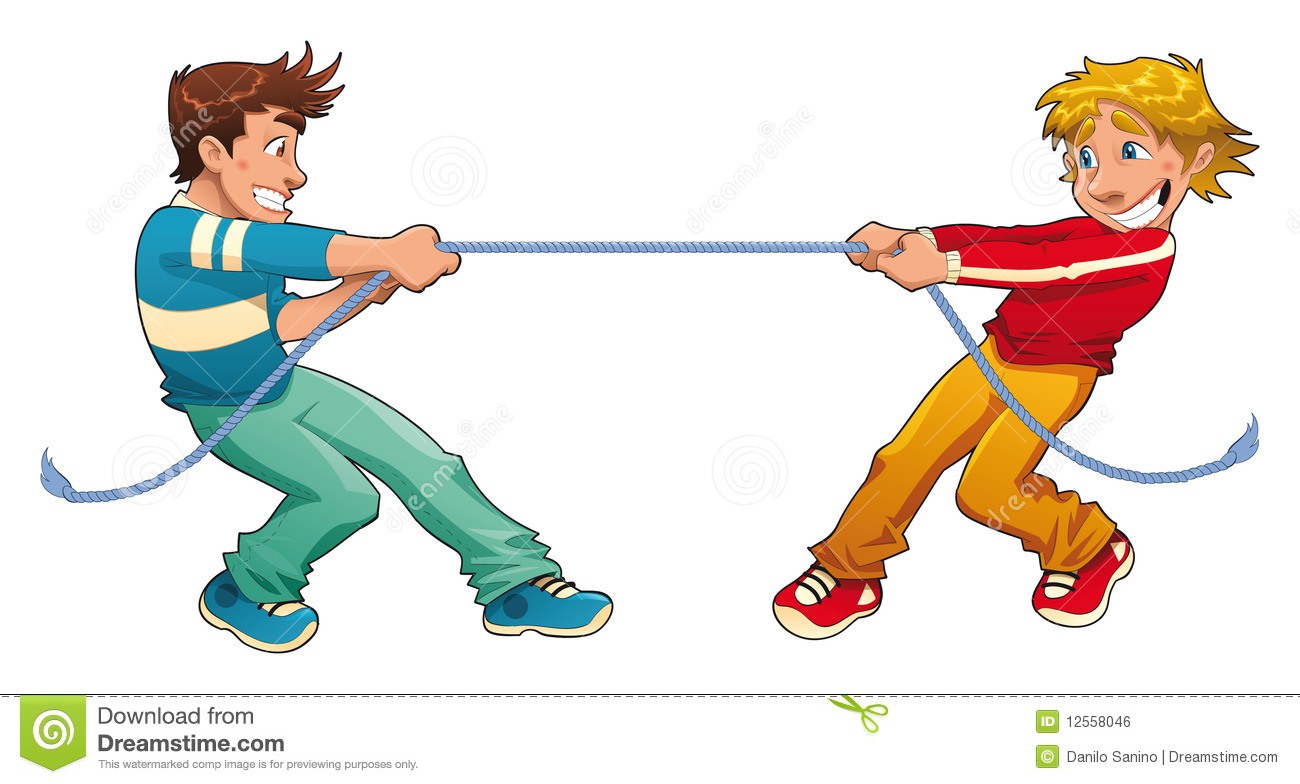
If these boys are pulling with the same amount of force.  What will happen?
a)
The boy in blue will win.
b)
They will not move at all.
c)
The boy in red will win.
d)
Both will fall down.
29.
Levi is wanting to light a bulb.  What does he need to get the bulb to light?
a)
A battery and a paper clip
b)
A battery and a wire
c)
A paper clip and a wire
d)
A switch and a wire
30.
A series circuit has ____ path(s) that the electric current can take. 
a)
One
b)
Two 
c)
Three 
d)
Four
31.
In a parallel circuit, if one connection is broken, all of the connections stop working.
a)
True
b)
False
32.
Which of these objects is an insulator?
a)
Copper Wire
b)
Paper Clip
c)
Steel Pole
d)
Rubber Gloves
33.
Which statement is true?
a)
The light bulb will light up because the  circuit is complete.
b)
The light bulb will light up because the  circuit is broken.
c)
The light bulb will not light up because the  circuit is complete.
d)
The light bulb will not light up because the  circuit is broken.
34.
What kind of circuit is this?
a)
series
b)
parallel
35.
What kind of circuit is this?
a)
Series
b)
Consecutive
c)
Parallel
d)
Training
36.
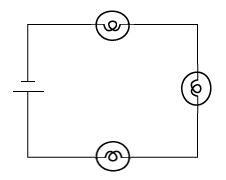
The picture shows an electrical circuit. This circuit is a series circuit because: 
a)
It has 3 light bulbs.
b)
The same current flows through all three light bulbs.
c)
It uses a single battery.
d)
The electrical current has more than one path to flow through
37.
What is a Parallel circuit? 
a)
Has only one path 
b)
Has more than one path 
c)
Allows energy to travel through easily 
d)
Has only one light bulb
38.
An incomplete circuit is shown.
To complete the circuit, a wire should be placed from —
a)
Point D to Point C
b)
Point B to Point C
c)
Point A to Point D
d)
Point B to Point D
39.
This circuit has a battery, buzzer, and switch.
When the switch is closed the buzzer will sound because -
a)
the switch gives energy to the battery
b)
the buzzer is made of special plastic
c)
the wires are cooled by the surrounding air
d)
electricity can flow in a complete path
40.
Which statement is true about the picture?
a)
The metal pan causes the water to boil. 
b)
The metal pan is a poor conductor of heat.
c)
The wooden handle is a good heat insulator. 
d)
The wooden handle is a good heat conductor.
41.
A girl turned the light off and went to bed.  She remembered she had accidentally left her glass of ice water on the counter.  When she got up the next morning, the ice had melted. What form of energy caused the ice to melt?
a)
Sound energy
b)
Light energy
c)
Thermal energy
d)
Mechanical energy
42.
A student created an electrical circuit, shown.

Which of the following statements is true about the circuit?

 
a)
The electrical circuit is working.
b)
The electrical circuit is open.
c)
The electrical circuit is complete.
d)
The electrical circuit is closed.
43.
Which form of energy is produced when a guitar string vibrates?
a)
Sound energy
b)
Electrical energy
c)
Chemical energy
d)
Light energy
44.
A student wanted to see how his toy car would roll on different types of flooring.  Jack decided to roll the car on a tile floor, a wood floor, and a carpeted floor.  Jack's experiment was designed to test the effects of which of the following forces.
  I. Gravity
  II. Friction
  III. Magnetism
 
a)
Gravity
b)
Gravity and magnetism
c)
Magnetism and friction
d)
Friction
45.
Which of the following is NOT mechanical energy?
a)
Pedaling a bike
b)
Rowing a boat
c)
Turning on a light bulb
d)
Running up a hill
46.
Sound is caused by? 
a)
force
b)
vibrations
c)
instruments
d)
air
47.
What machine changes electrical energy into light and sound energy
a)
battery
b)
lightbulb
c)
alarm clock
d)
apple
48.
The pictures shows what a student observed when he looked through a hand lens at a penny.
What happens to light passing through a hand lens that makes the image of the penny appear larger? The light is-
a)
absorbed
b)
reflected
c)
refracted
d)
stopped
49.
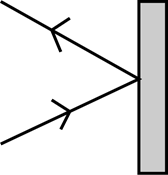
The illustration shows a light ray striking an object.
In the illustration, the light ray striking the object is-
a)
absorbed
b)
stopped
c)
reflected
d)
refracted
50.
A student placed a pencil in a cup of water.  The pencil appears broken because light-
a)
always travels in a straight line
b)
bends when it passes through water
c)
makes the water in the glass evaporate
d)
reflects the pencil on the water's surface
51.
The bouncing off of light rays from the surface of an object such as a mirror or other shiny surface is called:
a)
mirror
b)
laser
c)
reflection
d)
refraction
52.
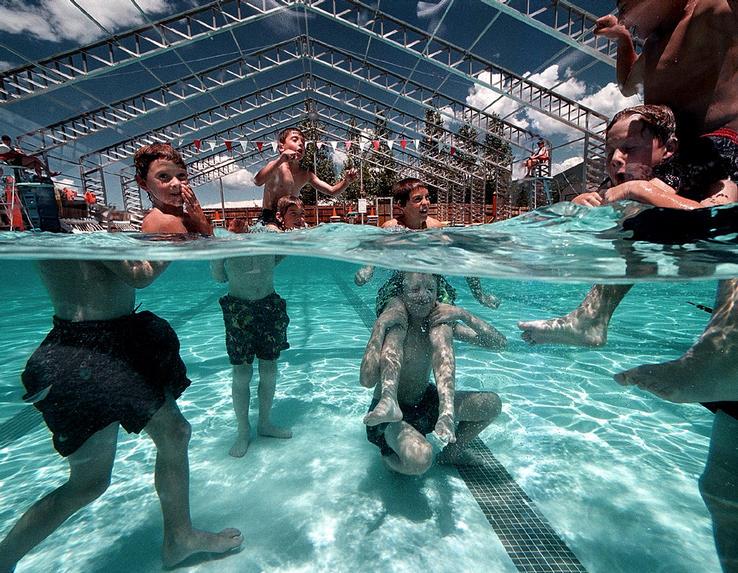
Why does the lower part of the child appear so much different in size from the upper part?
a)
The light rays that travel through water and then into air are refracted.
b)
The light rays that travel through water and then into air are enlarged.
c)
The light rays that travel through air and then into water are reflected.
d)
The light rays that travel through air and then into water are reduced.
53.
a)
Reflection
b)
Refraction
54.
a)
Reflection
b)
Refraction
55.
a)
Reflection
b)
Refraction
56.
a)
Reflection
b)
Refraction
57.
True or False: This diagram shows the correct position of the mirrors so that the light hits the target
a)
True
b)
False
58.
What do we call this tool that separates white light into the colors of the Visible Spectrum?
a)
tuning fork
b)
prism
c)
microscope
d)
graduated cylinder
59.
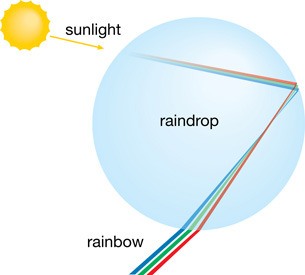
Light bending as it passes through a rain drop is an example of...
a)
Refraction
b)
Reflection
60.
What force holds the planets in motion around the sun?
a)
Magnetic
b)
Electrical
c)
Gravitational
d)
Air Resistance
61.
A material or substance that a matter wave travels through is  ________
a)
a block
b)
a wall
c)
a medium
d)
an electromagnetic spectrum
62.
When light bends it is ______
a)
Reflection
b)
Absorption
c)
refraction 
d)
optical density
63.
When light bounces back it is _____
a)
Reflected
b)
Refracted
c)
Absorbed
d)
Optical Density
64.

A force is a push or pull upon an object, resulting from the object's interaction with another object. Whenever there is an interaction between two objects, there is a force exerted upon each of the objects. A force can cause an object to accelerate, slow down, remain in place, or change shape.


What can a force do to an object?

a)

cause it to slow down

b)

cause it to accelerate

c)

cause it to remain in place or change shape

d)

ALL of the above

65.
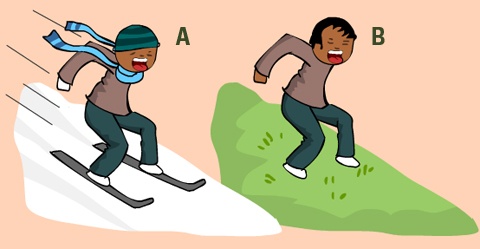
Why is it harder for the boy in Image B to get down the hill?
a)
Motion
b)
Friction
c)
Work
d)
Displacement
66.
Which force produces a change in motion?
a)
unbalanced force
b)
balanced force
c)
gravitational force
d)
frictional force
67.
Which of the following statements is true? 
a)
Balanced forces cause a change in motion. 
b)
Unbalanced forces cause a change in motion. 
c)
Forces do not effect the change in motion. 
68.
A measure of how much matter an object has is--
a)
weight
b)
gravity
c)
mass
d)
volume
69.
What is the definition of "weight"?
a)
measure of the force of gravity on your body
b)
the time it takes to get on a ride 
c)
the amount of matter in an object
d)
the size of an object
70.
When you stretch a rubber band, you are storing __________ energy. 
a)
kinetic 
b)
potential
c)
none of the above
d)
all of the above 
71.
The list of items needed for an experiment are the ______________.
a)
conclusion
b)
materials
c)
variables
d)
hypothesis
72.
Scientists record ___________ during an experiment.
a)
data
b)
materials
c)
model
d)
conclusion
73.
A scientist does multiple __________ of an experiment to make sure they get valid results.
a)
models
b)
qualitative
c)
conclusions
d)
trials
74.
The _________________ is the procedure that scientists follow when they try to solve scientific problems.
a)
manipulated variable
b)
scientific method
c)
data
d)
conclusion
75.
The summary at the end of an experiment that explains results is called the ______________.
a)
qualitative
b)
conclusion
c)
variable
d)
materials
76.
The _________________ is the educated guess a scientist makes about a question.
a)
material
b)
manipulated variable
c)
variable
d)
hypothesis
77.
A scientist will use a ______________ when they can't directly investigate the actual item for their experiment.
a)
hypothesis
b)
model
c)
variable
d)
conclusion
78.
All of the variables that are kept the same in an experiment are the ________________ variables.
a)
manipulated
b)
controlled
c)
responding
d)
quantitative
79.
What are the 3 main fossil fuels?
a)
Coal, Oil, and Gasoline
b)
Coal, Oil, and Natural Gas
c)
Electricity, Gasoline, Petroleum
d)
Coal, Oil, Non-renewable Resources
80.
Fossil Fuels formed over long periods of time after particles in water settled to the sea floor and formed marine mud.  What kinds of particles needed to be present in the marine mud in order for fossil fuels to form.
a)
Mostly sand and a few small bits of wood
b)
Mostly decaying organisms
c)
Mostly lava and a few sedimentary rocks
d)
Mostly metal minerals
81.
Oil and natural gas were formed from ___________________
a)
marine organisms
b)
dead plants
c)
trees
82.
Petroleum and natural gas form from...
a)
strong winds
b)
cooled magma
c)
radioactive materials
d)
remains of plants and animals 
83.
Which of the following is a fossil fuel?
a)
Wind
b)
Coal
c)
Solar
d)
Biomass
84.
What type of fossil fuel is mined from the ground?
a)
wind
b)
coal
c)
biomass
d)
air
85.
Fossil fuels are classified as nonrenewable because they.......
a)
require expensive equipment
b)
take millions of years to replace
c)
can be found all over 
d)
provide all the energy we use
86.

Which fossil fuel is used to produce electricity

a)

oil

b)

gas

c)

coal

d)

petroleum

87.

Which of these fossil fuel is solid

a)

natural gas

b)

coal

c)

petroleum

d)

methane

88.

Fossil fuels are renewable resources

a)

true

b)

false

89.
When sediments stick together its called . . . 
a)
cementation
b)
compaction
c)
deposition
d)
erosion
90.
How do we know a rock is sedimentary?
a)
its orange
b)
its small
c)
its broken down
d)
it has layers
91.
Both land and water cover the Earth. Which one covers more of the Earth?
a)
water
b)
air
92.
Large body of water surrounded by land on all sides.
a)
Sea
b)
River
c)
Lake
93.
A piece of land that is surrounded by water on 3 sides. 
a)
Tributary
b)
Peninsula
c)
Island
94.
What is a shape or feature on the Earth's surface?
a)
landform
b)
geography
c)
natural resources
d)
environment
95.

Which of the following is NOT a component of soil?

a)

Water

b)

Animal

c)

Plastic

d)

Air

96.

Which of the following is NOT a commonly studied property of soil?

a)

Color

b)

Texture

c)

Water Retention

d)

Taste

97.

Which property of soil can be described with the words, "smooth," and "rough"?

a)

Shape

b)

Texture

c)

Size

d)

Color

98.

Which vocabulary word means: To hold water

a)

particle

b)

retain

c)

physical property

d)

texture

99.
What is the remains of something that was once alive?
a)
inorganic matter
b)
organic matter
100.
What is a mixture of weathered rock, decayed organic matter, mineral fragments, water, and air called?
a)
soil
b)
organic matter
c)
decomposed matter
101.
What is the average weather of an area called?
a)
temperature
b)
topography
c)
climate
102.
Which of these is an example of precipitation?
a)
snow
b)
air
c)
clouds
d)
vapor
103.
Which is the opposite of condensation?
a)
runoff
b)
evaporation
c)
precipitation
d)
transpiration
104.
Snow, sleet, hail, and rain are all examples of  ________________. 
a)
evaporation
b)
condensation
c)
accumulation
d)
precipitation
105.
What is the water cycle?
a)
the 3 forms of water
b)
the movement of water on, above, or below the surface of the Earth
c)
when water melts
d)
when clouds form
106.
What does this illustration show?
a)
Sunrise
b)
The Water Cycle
c)
Sunset
d)
the recycling of snow
107.
This is what heats up the water to start the  water cycle. 
a)
sun
b)
moon
c)
stars
d)
Mars
108.
The Sun’s heat energy causes evaporation. Most of the evaporation on the Earth happens to water found in -
a)
oceans
b)
lakes
c)
rivers
d)
underground
109.
The spinning of the Earth on its axis that causes night and day.
a)
Rotate
b)
Revolve
110.
The imaginary line running through the center of Earth.
a)
axis
b)
moon
c)
constellation
d)
orbit
111.
The star at the center of our solar system.
a)
Sun
b)
moon
c)
orbit
d)
axis
112.
The rotation of Earth on its axis causes the pattern of _____.
a)
night and day
b)
constellations
c)
Earth's seasons
d)
the phases of the moon
113.
It takes Earth _________ to make one complete rotation on its axis.
a)
24 hours
b)
365 days
c)
28 days
d)
24 days
114.

what are the two poles?

a)

south and west

b)

north and east

c)

north and south

d)

east and west

115.

how long does it takes earth to travel once around the sun?

a)

325 days

b)

452 days

c)

2 days

d)

365 days

116.

when the earth is facing away from the sun it is?

a)

night

b)

day

c)

noon

d)

12pm

117.

if the earth is facing towards the sun its?

a)

day

b)

night

c)

sleep time

d)

early

118.
How long does it take for the Earth to make one full orbit around the Sun?
a)
one day
b)
one week
c)
one month
d)
one year
119.
Which of these is an example of precipitation?
a)
snow
b)
air
c)
clouds
d)
vapor
120.
What is the weather conditions in an area over a long period of time?
a)
climate
b)
temperature
c)
elevation
d)
precipitation
121.
Winters in Maine can reach temperatures below zero.
a)
Climate
b)
Weather
122.
Changes from minute-to-minute, hour-to-hour, day-to-day
a)
Climate
b)
Weather
123.
A tornado warning was issued for Kansas City this morning.
a)
Climate
b)
Weather
124.
It snowed for three days last week.
a)
Climate
b)
Weather
125.
Meteorologists forecast this.
a)
Climate
b)
Weather
126.
Which weather tool measures temperature?
a)
thermometer
b)
barometer
c)
psychrometer
d)
anememeter
127.

Weather and climate mean the same.

a)

True

b)

False

128.

What is the big difference between climate and weather?

a)

Weather can only happen on certain occasions and climate can happen anytime anywhere

b)

Weather is how if feels outside for one day and climate is how it feels for periods of time

c)

There is no difference between them

d)

Weather is real and climate is fake

129.

What is the source of heat and light in our solar system?

a)

The North star

b)

the moon

c)

the sun

130.

The Sun, Earth and moon all rotate on an axis.

a)

True

b)

False

131.

A line, real or imaginary, around which something spins is called

a)

gravity.

b)

axis.

c)

equator.

132.

The gravity that pulls us to the ground comes from the sun.

a)

True

b)

False

133.

How long does it take the Earth to revolve around the sun?

a)

365 days

b)

24 hours

c)

30 days

134.

How long does it take the Earth to rotate once on it's axis?

a)

365 days

b)

24 hours

c)

30 days

135.
a natural force that causes two objects to pull toward each other on their mass and the distance between them.
a)
gravity
b)
orbit
c)
atmosphere
d)
axis
136.
a natural satellite that orbits a planet. 
a)
sun
b)
atmosphere
c)
moon
d)
craters