wayground logo

Free Printable Worksheets

Font size

S
M
L
XL
Worksheets

S1 Review

Total questions: 82

Worksheet time: 1hrs 1mins

Name
Class
Date
1.
Hot coffee is stirred with a spoon; the spoon gets hot due to
a)
conduction
b)
convection
c)
radiation
2.
A chair is several feet from a fireplace. The side of the chair facing the fireplace gets warm due to
a)
conduction
b)
convection
c)
radiation
3.
"Lava lamps" contain colored liquids. These liquids form globs that rise to the top due to
a)
conduction
b)
convection
c)
radiation
4.
Near the ceiling of a room the air is warmer; the warm air rises because of
a)
conduction
b)
convection
c)
radiation
5.
Some cook pans have cooper on the bottom to heat evenly.
Copper transfers heat to the pan by
a)
conduction
b)
convection
c)
radiation
6.
In a swimming pool, water near the surface is slightly warmer. The warm water rises because of
a)
conduction
b)
convection
c)
radiation
7.
The metal skewer gets so hot that you drop your marshmallow into the campfire because of
a)
conduction
b)
convection
c)
radiation
8.
A house burns down. The vinyl siding of the house next door warps due to
a)
conduction
b)
convection
c)
radiation
9.
Warm air over the beach rises while cooler, dense air from the ocean rushes in due to
a)
conduction
b)
convection
c)
radiation
10.
A huge rock at the state park gets hot during the day. The rock was warmed from the Sun by
a)
conduction
b)
convection
c)
radiation
11.

What type of rocks are made from erosion and deposition?

a)

sedimentary

b)

igneous

c)

metamorphic

12.

What type of rocks are made from lava?

a)

sedimentary rocks

b)

igenous rocks

c)

metamorphic rocks

13.

What type of rock is made from pressure and heat?

a)

igenous

b)

sedimentary

c)

metamorphic

14.
This sphere includes the continents, the ocean floor, all the rocks on the surface, and all of the sand in the deserts. 
a)
Hydrosphere 
b)
Biosphere 
c)
Atmosphere 
d)
Geosphere 
15.
Composed of all the water on or near the earth
a)
Hydrosphere 
b)
Biosphere 
c)
Atmosphere 
d)
Geosphere 
16.
This sphere is composed of all the living things 
a)
Hydrosphere 
b)
Biosphere 
c)
Atmosphere 
d)
Geosphere 
17.
Body of air surrounding our planet. 
a)
Hydrosphere 
b)
Biosphere 
c)
Atmosphere 
d)
Geosphere 
18.
Water evaporating from the surface of a lake moves from the...
a)
Atmosphere to the geosphere 
b)
Geosphere to the hydrosphere 
c)
Hydrosphere to the atmosphere 
d)
Atmosphere to the hydrosphere 
19.
When living things breathe, they interact with which of Earth's spheres? 
a)
Geosphere 
b)
Hydrosphere 
c)
Atmosphere 
d)
Biosphere 
20.
Oceans, rivers, lakes, and the moisture in the air are all part of which of Earth's spheres? 
a)
Hydrosphere 
b)
Biosphere 
c)
Atmosphere 
d)
Geosphere 
21.
When a plants takes carbon dioxide from the air which two spheres are interacting? 
a)
Biosphere and atmosphere 
b)
Geosphere and atmosphere 
c)
Hydrosphere and atmosphere 
d)
Atmosphere and atmosphere 
22.
When plants draw nutrients from the soil, the interaction is between which two spheres? 
a)
The atmosphere and the geosphere 
b)
The geosphere and the hydrosphere 
c)
The hydrosphere and atmosphere 
d)
The biosphere and the geosphere 
23.

The hydrosphere includes

a)

water

b)

air

c)

dogs

24.
The hydrosphere interacts with the biosphere by providing __________ to life.
a)
nutrients
b)
water
c)
soil
d)
lightning
25.
All of the following are examples of the biosphere except
a)
plants
b)
animals
c)
bacteria
d)
air
26.
Fire would most affect the
a)
geosphere
b)
atmosphere
c)
cryosphere
d)
hydroshpere
27.

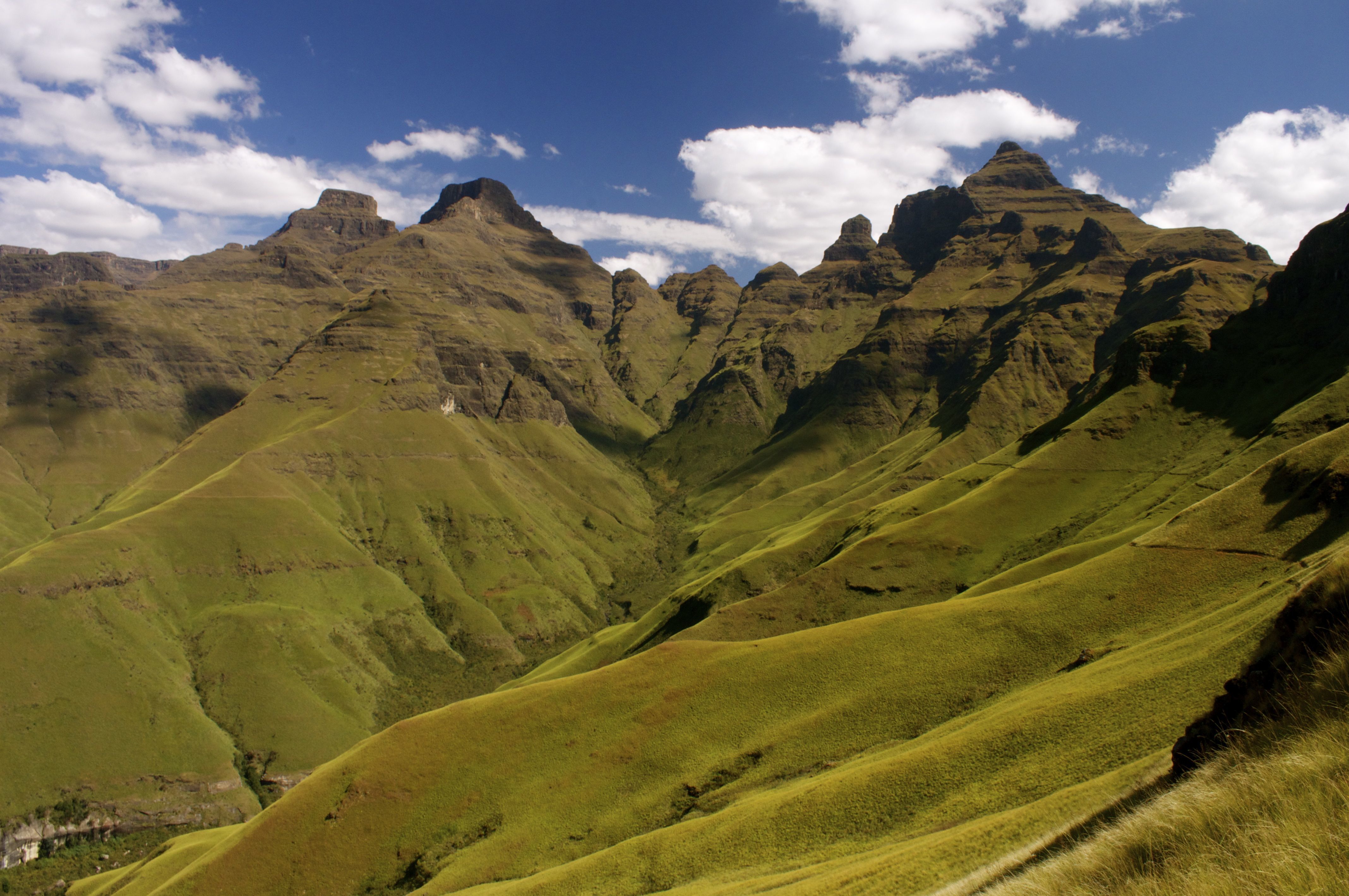
This is part of the....

a)

Geosphere

b)

Hydrosphere

c)

Biosphere

28.
What sphere does a volcano belong too?
a)
Atmosphere
b)
Cryosphere
c)
Geosphere
d)
Hydrosphere
29.
What sphere does the earths core belong too?
a)
Hydrosphere
b)
Biosphere
c)
Geosphere
d)
Atmosphere
30.
Which of these answers describes Earth’s atmosphere?
a)
all living and once-living things
b)
the mixture of gases that surrounds Earth
c)
a mixture of nickel and iron below the mantle
d)
all the salt and fresh liquid water on Earth’s surface
31.
Which of followings is an example of the Biosphere? 
a)
Desks
b)
Clouds
c)
River water 
d)
Grass
32.
Which of followings is NOT an example of Hydrosphere?
a)
Ocean water
b)
Clouds
c)
Underground water
d)
None of the above
33.
About how much of Earth's water is fresh water?
a)
97%
b)
15%
c)
3%
d)
75%
34.
Where is most of Earth's water found?
a)
rivers
b)
oceans
c)
glaciers
d)
groundwater
35.
What part of the water cycle does this picture show?
a)
condensation
b)
precipitation
c)
evaporation
36.
Which of these is an example of precipitation?
a)
snow
b)
air
c)
clouds
d)
vapor
37.
Which is the opposite of condensation?
a)
runoff
b)
evaporation
c)
precipitation
d)
transpiration
38.
Snow, sleet, hail, and rain are all examples of  ________________. 
a)
evaporation
b)
condensation
c)
accumulation
d)
precipitation
39.
What is it called when water changes from a liquid to a gas?
a)
EVAPORATION
b)
PRECIPITATION
c)
TRANSPIRATION
40.
What is it called when plants give off water vapor as a waste product?
a)
condensation
b)
evaporation
c)
sublimation
d)
transpiration
41.
When water _________, dew forms.
a)
Melts
b)
Evaporates
c)
Condenses
d)
Precipitates
42.
What is the water cycle?
a)
the 3 forms of water
b)
the movement of water on, above, or below the surface of the Earth
c)
when water melts
d)
when clouds form
43.
During which stage do clouds form?
a)
condensation
b)
evaporation
c)
precipitation
44.
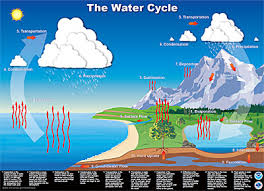
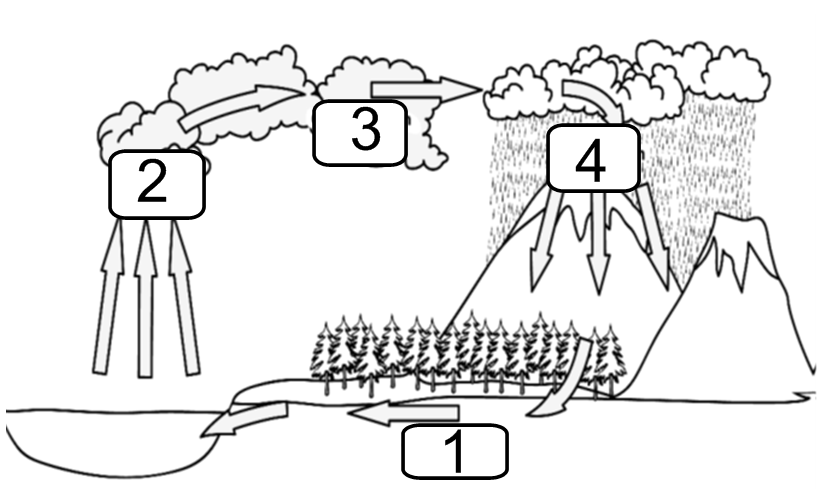
Which stage does the #2 show in the diagram?
a)
condensation
b)
evaporation
c)
precipitation
d)
run off
45.
Which stage does the #3 show in the diagram?
a)
condensation
b)
evaporation
c)
precipitation
d)
run off
46.
what does the #4 show in the diagram?
a)
condensation
b)
evaporation
c)
precipitation
d)
run off
47.
what does this tool measure?
a)
wind direction
b)
wind speed
c)
air temperature
d)
humidity
48.
What is the process during which water cools and turns from a gas to a liquid?
a)
Codensation
b)
Runoff
c)
Precipitation
d)
Evaporation
49.
Any type of liquid or solid water that falls to earth's surface
a)
evaporation
b)
condensation
c)
precipitation
d)
runoff 
50.
The ________ is the driving force of the earth's surface.
a)
sun
b)
moon 
c)
stars
51.
The water cycle has no start or end
a)
true
b)
false
52.
Precipitation occurs because 
a)
the droplets evaporate in the air
b)
the droplets are too light for the air to hold
c)
the droplets are too heavy for the air to hold
53.
The type of plate boundary where two plates come together is a .....
a)
Convergent Boundary
b)
Divergent Boundary
c)
Transform Boundary
d)
Plate Boundary
54.
Which of the following causes Earth's tectonic plates to move?
a)
Energy from the Sun
b)
Magnetic Pole Reversal
c)
Convection currents in the mantle
d)
Faults in Mountain Ranges
55.
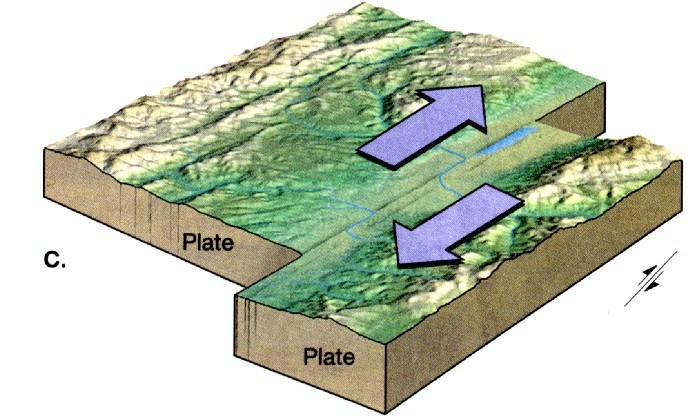
What type of plate boundary is this?
a)
Plate
b)
Divergent
c)
Convergent
d)
Transform
56.
What type of event will occur at this boundary?
a)
Earthquake
b)
Volcano Eruption
c)
Tornado
d)
Mountain Building
57.
A divergent boundary occurs when plates ....
a)
Pull apart
b)
Come together
c)
Slide past each other
d)
subducting
58.
Which of the following is the name of the ancient supercontinent formed 28 Million Years ago.
a)
Pangea
b)
Gondwanda
c)
Laurasia
d)
Neverland
59.
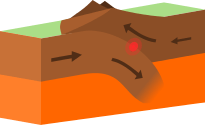
What type of plate boundary is this?
a)
Transform
b)
Convergent
c)
Divergent
d)
Plate
60.
Oceanic Trenches are formed by _______ plate boundaries
a)
Convergent
b)
Transform
c)
Plate
d)
Divergent
61.
The theory that says Earth's continents once made up an ancient supercontinent, and have been drifting apart ever since, is called the theory of...
a)
Pangea
b)
Plate Tectonics
c)
Natural Selection
d)
Gravity
62.
A fault is formed by the movement of a __________ plate boundary
a)
Transform
b)
Convergent
c)
Divergent
63.
How is it possible for new crust to be formed without increasing the surface area of the Earth?
a)
Crust is destroyed at the same time it is created
b)
New crust is underwater where it sinks
c)
New crust breaks more easily than old crust
64.
Mountains are created when....
a)
Two continental plates collide
b)
Two oceanic plates pull apart
c)
An Oceanic plate subducts under a Continental Plate
d)
Two continental plates pull apart
65.

the general terms for the movement of sediment by wind, water, glaciers

a)

weathering

b)

erosion

c)

deposition

66.

the breakdown of rock into smaller pieces of the same rock without any change in its composition

a)

weathering

b)

deposition

c)

erosion

67.
the breakdown or decomposition of rock that takes place when minerals change through chemical processes
a)
chemical weathering
b)
mechanical weathering
c)
erosion
d)
deposition
68.

the process in which sediment particles are picked up and moved from one place to another

a)

weathering

b)

deposition

c)

erosion

69.

the part of the erosion process in which sediment travels to a new location and is laid down or dropped off

a)

weathering

b)

erosion

c)

deposition

70.

Roots grow into cracks of a rock and pry them apart

a)

mechanical weathering

b)

deposition

c)

erosion

71.

rock is broken by the freezing and thawing of ice

a)

deposition

b)

weathering

c)

erosion

72.

rock particles wear away rock

a)

weathering

b)

deposition

c)

erosion

73.

animals break up the ground by burrowing

a)

weathering

b)

deposition

c)

erosion

74.

Fossils are found in ____________________________ rock

a)

Igneous

b)

Metamorphic

c)

Sedimentary

d)

Granite

75.

The preserved remains of an organism from long ago is called a ___________

a)

stratum

b)

clast

c)

fossil

d)

relative age

76.

The series of processes that change rocks from one form into another is called ___________

a)

Fossil Record

b)

Stratum

c)

Clast

d)

Rock Cycle

77.

The theory that undisturbed layers of rock have the oldest layers on the bottom and the youngest on the top is called ______

a)

fossil record

b)

rock cycle

c)

law of superposition

d)

stratum

78.

An estimation of a age made by comparing position of two objects is called:

a)

rock cycle

b)

fossil record

c)

relative age

d)

clast record

79.

A rock that forms from melted material, such as from volcanic activity is called:

a)

Igneous

b)

Metamorphic

c)

Sedimentary

d)

Fossil

80.

Fossil #1 is found 700ft under ground and fossil #2 is found 300ft under ground, which is newer?

a)

Fossil #1

b)

Fossil #2

c)

Neither fossil is newer

d)

Both Fossils are the same age

81.

A rock that is formed underneath the Earth by heat and pressure is called:

a)

igneous

b)

metamorphic

c)

sedimentary

d)

fossil

82.

A rock that is formed by erosion and weathering is called:

a)

igneous

b)

sedimentary

c)

metamorphic

d)

fossils