
 Worksheets
Anat. & Phys. Semester 1 Final
Total questions: 174
Worksheet time: 2hrs 37mins
Physiology is generally studied:
in terms of chemical and physical events in living systems
to learn about the about the function of the body
in conjunction with anatomy for best understanding
all of the above
The structural and functional unit of life is:
a cell
an organ
the organism
a molecule
Which of the following is the proper order from small to large?
molecules, cells, tissues, organs, organisms
cells, molecules, organs, tissues, organ systems
cells, molecules, tissues, organs
molecules, tissues, cells, organisms
Homeostasis in the human body is controlled primarily by which two organ systems?
cardiovascular and integumentary
skeletal and endocrine
nervous and endocrine
cardiovascular and respiratory
Which of the following organ systems is matched most accurately to the "life function" it provides?
integumentary system -- movement
nervous system -- excretion
muscular system -- maintaining boundaries
nervous system -- responsiveness
Negative feedback systems:
regulate blood clotting and the birth process
operate in such a way that the initial stimulus is enhanced and grows
operate in such a way that the initial stimulus is shut off or reduced
always inhibit a process as reflected in their naming as "negative"
If you were to assume the anatomical position, you would:
lie face down
lie flat on your back with the palms of your hands flat on the floor
stand erect with the palms of your hands facing forward
stand erect with the palms of your hands cupped toward your thighs
stand on your head
The term "sagittal section of the brain" means that the brain was cut:
across horizontally
into anterior and posterior parts
into right and left parts
on the diagonal
Which type of section could be used to separate the thoracic cavity from the abdominopelvic cavity?
frontal
sagittal
dorsal
transverse
ventral
Which ventral cavity subdivision has no bony protection?
thoracic
pelvic
abdominal
cranial
Match the following organ with the correct body cavity location: stomach
cranial
abdominopelvic
thoracic
spinal
none of these
Match the following organ with the correct body cavity location: urinary bladder
cranial
abdominopelvic
thoracic
spinal
none of these
Match the following organ with the correct body cavity location: heart
cranial
abdominopelvic
thoracic
spinal
none of these
Match the following organ with the correct body cavity location: lungs
cranial
abdominopelvic
thoracic
spinal
none of these
Match the following organ with the correct body cavity location: liver
cranial
abdominopelvic
thoracic
spinal
none of these
Match the following organ with the correct body cavity location: eyes
cranial
abdominopelvic
thoracic
spinal
none of these
Match the following organ with the correct body cavity location: brain
cranial
abdominopelvic
thoracic
spinal
none of these
The horizontal plane divides the body into
right and left portions
anterior and posterior portions
superior and inferior portions
none of the above
An organ is
the smallest unit of life
a group of systems
two or more different tissues that combine to perform a general function
a group of similar cells that combine to perform a common function
The smallest unit capable of life by itself is:
an organ
an organelle
tissue
a cell
a nucleus
Osmosis involves:
a differentially permeable membrane
a difference in water concentration
diffusion
all of the above
The process in which fairly large particles are engulfed and brought into the cell is:
pinocytosis
phagocytosis
electrical forces in the membrane
shape and position changes of carrier molecules in the plasma membrane
Match the description with the correct stage of mitosis:
Centrioles reach the opposite ends of the cell and the chromosomes attach to the spindle
anaphase
metaphase
prophase
telophase
Match the description with the correct stage of mitosis:
Two nuclear membranes are formed
anaphase
metaphase
prophase
telophase
Match the description with the correct stage of mitosis:
The centromeres divide and the chromosomes begin to move apart
anaphase
metaphase
prophase
telophase
Match the description with the correct stage of mitosis:
The chromosomes are precisely lines up on the spindle equator
anaphase
metaphase
prophase
telophase
If DNA is a sequence of AAA, then a segment of messenger RNA synthesized on it will have a base sequence of:
TTT
GGG
CCC
UUU
AAA
Organized groups of cells with similar structures and a common purpose form a(n):
organ
tissue
organism
organ system
Match the tissue description with the type of tissue:
Filtration, secretion, and absorption are important functions of this tissue
connective tissue
epithelium
muscle
nervous tissue
Match the tissue description with the type of tissue:
Composed largely of nonliving extracellular matrix; important in protection and support
connective tissue
epithelium
muscle
nervous tissue
Match the tissue description with the type of tissue:
Enables us to be aware of the external environment and to react to it; specialized for communication
connective tissue
epithelium
muscle
nervous tissue
Match the tissue description with the type of tissue:
Lines body cavities and covers surfaces; commonly has one surface attached and the other free
connective tissue
epithelium
muscle
nervous tissue
Match the tissue description with the type of tissue:
Responsible for essentially all examples of body movements
connective tissue
epithelium
muscle
nervous tissue
Select the most accurate match below between tissue type and general funtion:
epithelial -- connects body parts
muscle -- secretory or glandular
connective -- contract and shorten
nervous -- conduction of electrochemical impulses
The muscle type forming the muscular heart is:
skeletal muscle
smooth muscle
cardiac muscle
voluntary muscle
The movement of molecules from a region of a higher concentration to a region of lower concentration is
diffusion
osmosis
filtration
active transport
The transport of substances against a concentration gradient across a selectively permeable membrane is
diffusion
osmosis
filtration
active transport
Which is not a fiber type found in connective tissue?
reticular
collagen
elastic
interstitial
The type of cartilage that functions as a shock absorber between vertebrae is
hyaline cartilage
elastic cartilage
fibrocartilage
perichondrium
The type of cartilages at the ends of long bones is
elastic cartilage
fibrocartilage
hyaline cartilage
none of the above
____ connect bone to bone
ligaments
tendons
matrix
collagen
The three types of muscle tissue are
skeletal, smooth and cardiac
dense, loose and striated
squamous, cuboidal and columnar
skeletal, smooth and connective
Intercalated discs are
discs between vertebrae
junctions between smooth muscle cells
junctions between cardiac muscle cells
junctions between skeletal muscle cells
The membrane that lines the thoracic cavity and surrounds each lung
cutaneous
peritoneum
pleural
visceral
The membrane that surrounds the heart
pericardium
peritoneum
pleural
visceral
The dermis of the skin is composed of
epithelium
fat
connective tissue
muscle
The hypodermis is _______ to the dermis
superficial
proximal
deep
distal
The axial skeleton is made up of which bones?
limbs, thoracic cage, shoulder and hip girdle
skull, vertebral column, thoracic cage
shoulder and hip girdle, limbs, vertebral column
none of the above
The youngest cells of the epidermis, the only ones capable of mitosis are found in the
stratum basale
stratum spinosum
stratum corneum
stratum granulosum
The dermis of the skin is composed primarily of what tissue?
connective tissue
stratified squamous epithelium
keratin
cuboidal epithelium
The manufacture of keratin in the epidermis of the skin functions to
give the skin its color
increase sensitivity to touch
prevent underlying structures from drying out
increase hair follicle development
Which of the following layers of the skin consist of dead cells?
stratum basale
stratum spinsoum
stratum granulosum
stratum corneum
Dermal papillae form at the junction between
epidermis and hypodermis
dermis and hypodermis
epidermis and dermis
none of the above
The arrector pili muscle functions
to keep the skin moist
to straighten the hair
as a site of nutrient exchange
to prevent baldness
Skin color is determined by:
the amount of carotene in the stratum corneum and subcutaneous tissue
pigments in the epidermis (melanin)
the degree of oxygenation of the blood
all of the above
Which of the following is a function of the skin?
body temperature control via sweating and heat radiation
production of vitamin D
protection from bacterial invasion
all of the above
When the body temperature rises, which of the following takes place?
eccrine glands become active
arrector pili muscles contract
Pacinian corpuscles are stimulated
blood is prevented from reaching skin capillary beds
all of the above
Sebaceous glands are important for:
production of keratin
keeping skin and hair soft and flexible
production of sweat
heat regulation of the body
Joe just burned himself on a hot pot. A blister forms and the burn is painful. Joe's burn is most likely a:
first-degree burn
second-degree burn
third-degree burn
The apocrine sweat glands are:
most responsible for odor in humans
found primarily in the axillary and anogenital areas
more often than not associated with hair follicles
become active during puberty
all of the above
The "tanning" effect (darkening of the skin) that occurs when a person is exposed to the sun is somewhat protective due to:
increased production of melanin that helps to block ultraviolet light
an increased concentration of keratin that "toughens" the skin
added layers of epidermis that thicken the skin
an increased blood supply that carries the heat of the sun away
The rule of nines is helpful clinically in:
diagnosing skin cancer
estimating the extent of a burn
preventing acne
none of the above
Which is a function of the skeletal system?
support
provides levers for muscle activity
storage
all of the above
A bone that has essentially the same width, length, and height is most likely:
a long bone
a short bone
a flat bone
an irregular bone
The shaft of a long bone is properly called the:
epiphysis
periosteum
diaphysis
compact bone
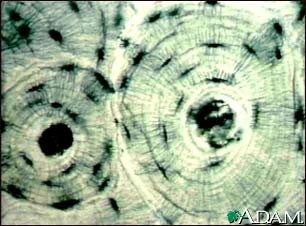
The osteon exhibits:
a central Haversian canal carrying a blood vessel
concentric lamellae of matrix
osteocytes in lacunae
canaliculi that connect lacunae the Haversian canal
In adult long bones, hyaline cartilage is found:
in the medullary cavity
between trabeculae
on articular surfaces
in the epiphyseal line
in the diaphysis
The spinal cord passes through a large opening in the occipital bone. This opening is an example of a:
foramen
sinus
ramus
facet
tubercle
Which of the following bones is not part of the knee joint?
femur
tibia
fibula
patella
Anatomical characteristics of a synovial joint include:
articular cartilage
a joint cavity
an articular capsule
all of the above
Multiaxial joints of the body include:
the knee and elbow
the ankle and wrist
the hip and shoulder
intercarpal and intertarsal joints
The diaphysis of long bones contains the medullary cavity which is filled with
red bone marrow
yellow bone marrow
compact bone
periosteum
The cells which are trapped in the matrix of bone are called
osteoblasts
osteoclasts
osteocytes
hydroxyapatite
An example of flat bones those found in the
legs
vertebrae
ankles
cranium
The connective tissue sheet that envelops bone and is attached to its outer surface is called
periosteum
endosteum
spongy bone
compact bone
The bone cell that wanders through bone and dissolves matrix are called
osteocytes
osteoclasts
osteoblasts
none of the above
The axial skeleton is made up of which bones
scapula and clavicle
vertebrae and sternum
cranial and facial bones
vertebrae, sternum, cranial and facial bones
There are ________ pairs of ribs in the thoracic cage
5
8
12
10
The ____ is the concave, lateral surface of the scapula which articulates with the head of the humerus.
subscapular fossa
coracoid process
glenoid cavity
supraspinous fossa
What part of the hip do we sit on?
the greater sciatic notch
the inferior ramus of the pubis
the ramus of the ischium
the ischial tuberosity
The bony ridge you feel on the inside of your ankle is the ___ of the tibia
lateral condyle
medial condyle
medial malleolus
lateral malleolus



[The eyes are _______ to the brain].


The topmost layer of the skin
Dermis
Epidermis
Subcutaneous fats
muscles
Layer of skin that contains sweat glands and hair follicles
Muscles
Subcutaneous fats
Epidermis
Dermis
Where can you expect to find apocrine glands?
Your armpits
Your hands
Your feet
Your forehead
Where can you expect to find eccrine glands?
Your forehead
Your armpits
Your groin
Your fingerprints and toe prints are produced by folds in your _________________ called _________________.
epidermis; papillae
dermis; papillae
hypodermis; papilomas
dermis; papilomas
The site of new nail growth occurs at the __________________.
Lunula
Papillae
Keratinocytes
Melanocytes
Which is an example of a hinge joint?
shoulder
wrist
elbow
neck
The bones of a joint are held together by
tendons
bursas
epipheses
ligaments
About how many bones are in the adult human body?
108
206
300
509

