
 Worksheets
World Mid Year Review
Total questions: 121
Worksheet time: 1hrs 5mins

What is the name of this iconic temple and where is it located?
The Pantheon, Rome
The Temple of Zeus, Carthage
The Parthenon, Greece
Constantinople, it no longer exists.
What is the Socratic method?
A method used to enhance realism in classical art.
A teaching method using questions designed to lead pupils to find answers.
A political system that evolved from early Greek dictatorships.
A simple note taking method.
The ancient Greeks were polytheistic meaning they believed...
in one supreme god.
in multiple gods.
in no gods at all.
we are reborn many times until we reached Nirvana.

The famous blind poet from ancient Greece who wrote the Iliad and the Odyssey was...
Homer.
Plato.
Leonidas.
Aristophanes.

The Greek city-state which favored democracy and a well-rounded education.
Sparta
Athens
Delphi
Corinth


After the defeat of the Persians, which leader took Athens into the "Golden Age" of prosperity and achievement?
Pericles
Leonidas
Themistocles
Socrates

A militaristic city-state in Greece where boys were trained from age 7 to fight.
Athens
Delphi
Corinth
Sparta
Which social class in ancient Rome consisted of farmers, merchants, etc.
Patricians
Nobles
Plebians
Middle class
Rome's Polytheistic gods were borrowed from which other classical culture
The Egyptians
The Greeks
The Mesopotamians
The Persians
How did Caesar die?
He was stabbed 23 times by members of the Senate and his friend Brutus.
He was assassinated in his sleep by a jealous girlfriend
He killed himself for having failed the Roman people.
He was bitten by a mosquito in Egypt that carried an unknown virus (probably West Nile)
The purpose of the "Bread and Circus" was to
The " Bread and Circus" was a Roman myth
Entertain and feed the poor in times of trouble
give jobs to bakers
Keep the armies from revolting

Why was communication difficult between communities in Ancient Greece?
They did not speak to same language
Mountains and Water made travel difficult
communication was easy
Greece is a very large country
What language did the Romans speak
french
italian
latin
english

When the Roman Empire was divided into eastern and western halves, the eastern portion became know as...
the Mughal Empire
the Kingdom of Eastern Europe
the Eastern Caliphate.
the Byzantine Empire
The religion Romans turn to towards the end of the empire? (hint: Constantine was the first emperor to embrace it)
Hinduism
Lutheranism
Judaism
Christianity

Which letter represents Athens?
B
D
F
A


What Greek city-state developed democracy?
Sparta
Corinth
Ionia
Athens

A marathon is a foot race that covers ____ miles.
50
26.2
13.1
22.2
______________ controlled and dominated the Delian League.
Athens
Sparta
Persia
Macedonia
The Odyssey begins at the end of
The Trojan War
The Punic Wars
The Peloponnesian Wars
The Ionian Revolt

What does the word "Democracy" mean?
"rule by the government"
"rule by tyrant"
"rule by the wealthy"
"rule by the people"
The following information describes which battle of the Persian wars: Narrow mountain pass where Persians faced king Leonidas who gave his life. along with his me, to buy time for the Greeks to mount a defense against Xerxes.
Thermopylae
Salamis
Plataea
Marathon
What best describes the result/effect of the Battle of Marathon?
Greek victory inspires confidence & unity, Persians return home & plot future invasions
Greek victory inspires confidence & unity, Persians return home & never invade Greece again
Persians win and proceed on to attack other city-states on the Greek mainland
Persians win, the Persian Wars are over, puppet leaders are installed across Greece
The type of democracy the United States in which laws and governance are done on behalf of the citizens?
Indirect
Direct
Representative
Unlimited
What was the name of the Greek marketplace where people meet and debated?
agora
acropolis
polis
ephor
What is the olive branch a symbol of?
peace
prosperity
victory
sympathy
Home of the Minoan civilization
Persia
Crete
mainland Greece
Italy
Theater was dedicated to the Greek god...
Zeus
Athena
Aphrodite
Dionysus
Extended families that controlled small farming
villages in ancient Japan and were called...
Clans
Shinto
Kami
Shogun
Traditional religion of Japan
Shinto
Zen budism
Samurai
Bushido
samurai code of honor
Bushido
Zen Buddhism
Court
Shogun
Wrote the tale of Genji
Lady Murasaki Shikibu
Oda Nobunaga
kami
Samurai
Why was it so easy for the Japanese feudal system to develop and have more power than the emperor?
The emperor had little interest in ruling the people
Shoguns became more powerful as each province was left to provide their own armies
Emperors became more powerful as they forced peasants into military service
The royal family was sickly and could not hold power.
Which statement is true about emperors in ancient feudal Japan?
They were figureheads with no real power
They held all of the power
They relied on foreign support to control the shogun
They feared China's army

Which two countries had the most influence on Japan?
Korea, Mongolia
Mongolia, China
China, Vietnam
China, Korea
In the Japanese social pyramid during the age of the Shogunate, who did the samurai take orders from?
They didn't take orders from anyone
The Emperor
The Shogun
The Daimyo
Who became the first Emperor of China by uniting the "Warring Kingdoms"?
Wudi
Shi Huangdi
Confucius
Han
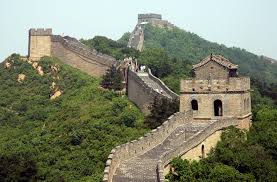
What is the purpose of the structure pictured here?
It is a temple
Protection on China's northern border
Protection of China's Southern border
To protect China from Persian invaders
____ is fine, windblown fertile yellow soil of northern China.
Loess
Clan
Oracle Bone
Yangzi


How was Chinese civilization affected by mountains and deserts?
They became wealthy.
They were isolated from other civilizations.
They made it easier to travel.
They made China vulnerable to attack.
What were the four main dynasties of Ancient China?
Shang, Zhou, Qin, Han
Zhang, Ming, Hee, Yangtze
Shoe, Chin, Mee, Woo
Hirohito, Honshu, Nara, Ming
What are the seasonal winds that blow cold, dry air in the winter and warm, wet air and pouring rains in the summer?
Monsoons
Tornadoes
Typhoons
Earthquakes
After being nomadic cattle herders, what economic activity did the Aryans begin to do?
Shipbuilding
Fighting in wars
farming
killing cows for food
Why do the Hindu people of India choose not to challenge the caste system?
It is embedded in their religious beliefs.
It is part of their economic system.
The caste system no longer exists.
They liked the social class they were born into.
Reincarnation is...
a state of perfect happiness and peace
the idea of passing through many lives to be united with Brahman
the consequences of how a person lives
divine law that requires people to perform the duties of their caste
Nirvana is...
a state of perfect happiness and peace
the idea of passing through many lives to be united with Brahman
the consequences of how a person lives
divine law that requires people to perform the duties of their caste
Karma is...
a state of perfect happiness and peace
the idea of passing through many lives to be united with Brahman
the consequences of how a person lives
divine law that requires people to perform the duties of their caste
Dharma is...
a state of perfect happiness and peace
the idea of passing through many lives to be united with Brahman
the consequences of how a person lives
divine law that requires people to perform the duties of their caste
Buddhists follow the guidance of which two sets of rules?
Torah & the Bible
The Four Noble Truths and the Eightfold Path
Book of the Living & Book of the Dead
Mahabharata and the Ramayana
How did Hinduism originate?
It came from Shintoism.
It developed from Buddhism.
It developed from the Aryan's faith and became mixed with Indian beliefs.
It came from Judaism.
Who founded Buddhism?
Siddhartha Gautama
The Brahman
Ramayana
Mahabharata the Wise One

Which social hierarchy is illustrated in the diagram?
manorialism
caste
apartheid
Ecomienda
How did the caste system affect the lifestyle of the people of ancient India?
Religiously, people follow their duty and hope for a better status in the next life
Politically, priests and warriors keep their power over the common people.
Socially, people's caste determine their jobs, marriage, and friends.
All of the above.
The collection of Aryan religious works that include poems, hymns, and rituals are called
the Vedas
the Varnas
the Mahayana
the Jati
What is a guru?
A type of food that people in India eat
A teacher in the Indian culture
A god in Hinduism
A religious building
What are the four noble truths?
Four rules to follow in your life
Four answers to life's most important questions
A set of ideas in Buddhism that center around how suffering is created
Four gods of Buddhism
Ahimsa is the core belief in Jainism which means...
Getting rid of all material possessions
Practicing nonviolence towards all living things
Following your Dharma
Doing your job in the Social Structure

Where in the Social Hierarchy were Skilled Laborers located?
Brahmins
Kshatriyas
Vaisyas
Sudras
Why were priests higher than rulers in the Indian Caste System?
The Caste System in linked to religion and priests have more knowledge about how to reach Moksha than leaders.
Priests have been reincarnated more times than rulers
Priests were elected to rule India by the leaders
Leaders only hold a symbolic position in Indian government
Which of these things is NOT true about Hinduism?
There is no known founder
People's status in life is determined by their karma
Each soul goes through reincarnation
A person can reach enlightenment from any social class

What is A?
North America
South America
Europe
Asia
Antarctica

What is B?
North America
South America
Europe
Asia

What is C?
Pacific Ocean
Atlantic Ocean
Indian Ocean
Arctic Ocean

What is F?
Tropic of Capricorn
Tropic of Cancer
Prime Meridian
Equator

What is H?
Equator
Tropic of Cancer
Prime Meridian
Tropic of Capricorn

What is J?
Europe
Africa
Asia
North America

What is L?
Europe
North America
Australia
Asia

What is N?
Pacific Ocean
Atlantic Ocean
Indian Ocean
Arctic Ocean

