wayground logo

Free Printable Worksheets

Font size

S
M
L
XL
Worksheets

AP Macroeconomics Midterm Exam Review (Units 1-3)

Total questions: 115

Worksheet time: 1hrs 14mins

Name
Class
Date
1.
An economist would probably state that in a market economy, prices are generally determined by the interaction between 
a)
buyers and sellers
b)
wholesalers and retailers
c)
producers and labor unions
d)
consumers and government officials
2.
Which of the following is likely to increase the demand for peanut butter?
a)
Fewer children in the population
b)
News that insects have destroyed much of the peanut crop and that there will be less peanut butter on the shelves in three months.
c)
A big increase in the price of jelly.
d)
A report from the Surgeon General of the United States that eating peanut butter makes people nutty.
3.
In economics, a shortage of a product occurs when
a)
the product's price falls below its market-clearing level
b)
the product's market-clearing level reduces overall demand
c)
the people who buy the product consume more than they need
d)
the businesses producing the product become less efficient
4.
The US can produce 200 airplanes or 400 trucks. Japan can produce 300 trucks or 100 airplanes. 
Which country has the comparative advantage in producing trucks and what is their opportunity cost? 
a)
Japan, 1/3 airplane per truck
b)
US, 1/2 airplane per truck
c)
US, 2 airplanes per truck
d)
Japan, 3 airplanes per truck
5.
The US can produce 200 airplanes or 400 trucks. Japan can produce 300 trucks or 100 airplanes. 
Which country has the comparative advantage in producing airplanes and what is their opportunity cost? 
a)
Japan, 1/3 trucks per airplane
b)
US, 1/2 trucks per airplane
c)
US, 2 trucks per airplane
d)
Japan, 3 trucks per airplane
6.

Suppliers often reduce prices because they

a)

have a shortage of products

b)

have a surplus of products to sell

c)

want decrease consumer demand

d)

want to increase the product supply

7.
What does the Production Possibilities Frontier represent? 
a)
A.  A catalog of all possible production options, represented as percentages.
b)
B. The tradeoffs between possible production levels for two goods.
c)
C. The amount that a society could produce if it devoted all its resources to producing one good.
d)
D. The possible gains from international trade in two or more goods.
8.
The resource that includes equipment, machinery, buildings, and tools.
a)
Land
b)
Labor
c)
Capital 
d)
Entrepreneur
9.
The major types of resources used to make a product are called  
a)
natural resources
b)
factors of reduction
c)
factors of production
d)
capital resources
10.

In economics, the pleasure, happiness, or satisfaction received from a product is called:

a)

status fulfillment

b)

marginal cost

c)

rational outcome

d)

utility

11.

Which of the following will not produce an outward shift of the production possibilities curve?

a)

an upgrading of the quality of a nation's human resources

b)

the reduction of unemployment

c)

an increase in the quantity of a society's labor force

d)

the improvement of a society's technological knowledge

12.

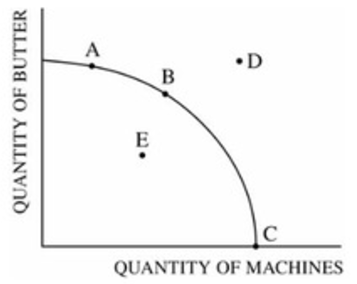
Refer to the above diagram. This economy will experience cyclical unemployment if it produces at point:

a)

A

b)

B

c)

C

d)

D

13.

Refer to the above diagram. At which point will this economy NOT be able to produce, it is currently unattainable?

a)

A

b)

B

c)

C

d)

E

14.

Which of the following might shift a nation's production possibilities curve inward?

a)

improved technology.

b)

devastation by war.

c)

improved health care.

d)

a business downturn in which unemployment temporarily rises.

15.

When the price of a product rises, consumers shift their purchases to other products whose prices are now relatively lower. This statement describes:

a)

an inferior good.

b)

the rationing function of prices.

c)

the substitution effect.

d)

the income effect.

16.

An increase in demand means that:

a)

given supply, the price of the product will decline.

b)

the demand curve has shifted to the right.

c)

price has declined and consumers therefore want to purchase more of the product.

d)

the demand curve has shifted to the left.

17.

Refer to the above diagram, in which S1 and D1 represent the original supply and demand curves and S2 and D2 the new curves. In this market the indicated shift in supply may have been caused by:

a)

an increase in the wages paid to workers producing this good.

b)

the development of more efficient machinery for producing this commodity.

c)

this product becoming less fashionable.

d)

an increase in consumer incomes.

18.

Which of the following is a fundamental characteristic of the market system?

a)

property rights

b)

central planning by government

c)

unselfish behavior

d)

government-set wages and prices

19.

Which of the following is not a characteristic of the market system?

a)

private property

b)

freedom of enterprise

c)

government ownership of the major industries

d)

competition in product and resource markets

20.
The thing you give up to pursue the next best alternative is
a)
capital
b)
product allocation
c)
opportunity cost
d)
relative distribution
21.
Labor Hours to Produce:  
COUNTRY   Wheat  Cloth
France             5         10
England          20        60
Which statement is true?
a)
France has AA in wheat but not cloth
b)
France has neither AA or CA
c)
England has AA in both
d)
England has AA in neither
22.
The "Invisible Hand" is the term Economist Adam Smith used to describe:
a)
comparative advantage
b)
effect of self interest on markets
c)
diminishing marginal utility
d)
how some countries utilize resources better
23.
The Wealth of Nations is ______________'s most famous work.
a)
David Ricardo
b)
Adam Smith
c)
F.A. Hayek
d)
Friedrich Neitsze
24.
According to comparative advantage, a good should be produced at the point where
a)
its explicit costs are least.
b)
its opportunity costs are least
c)
the cost of real resources used is least.
d)
production can occur with the greatest impact on employment
25.
Inferior goods react ___________ to income shifts.
a)
directly
b)
sometimes
c)
constantly
d)
inverse
26.
The Law of Demand says that price and quantity have a(n)
a)
direct relationship
b)
inverse relationship
c)
PPC focus
d)
Diminishing Motility
27.

Related goods impacts Demand because its relationship to what determinant of Demand?

a)

Increasing Marginal Cost

b)

Diminishing Marginal Utility

c)

Scarcity

d)

Substitution Effect

28.
The diagram shows the production possibilities curve for Country Y. Which of the following statements is true?
a)
If Country Y is producing at point C, it is using all its resources efficiently
b)
The opportunity cost of producing more machines is constant
c)
Country Y cannot produce at point E
d)
The most efficient point of production is point D
29.
Two alternative production possibility frontiers for apples and wheat are shown in the figures. As more wheat is produced, how will the opportunity cost of producing wheat, as represented in Figures 1 and 2, be affected? 
a)
Figure 1: Decrease / Figure 2: Increase
b)
Figure 1: Increase / Figure 2: Decrease
c)
Figure 1: No Change / Figure 2: Increase
d)
Figure 1: No Change / Figure 2: Decrease
30.
The Country of North Korea has a dictator that makes all of the economic decisions. What type of economy is this?
a)
Traditional 
b)
Market 
c)
Command 
d)
Centrally Planned 
31.

The economic problem is that

a)

resources are limited and wants are limited.

b)

resources are unlimited and wants are limited.

c)

resources are limited and wants are unlimited.

d)

resources are unlimited and wants are unlimited.

32.
What is the difference between a shortage and scarcity? 
a)
A shortage is temporary but scarcity always exists 
b)
A shortage results from rising prices; scarcity results from falling prices 
c)
A shortage is lack of all goods and services; scarcity concerns a single item 
d)
There is no real difference between a shortage and scarcity
33.
 An example of investment spending would be:
a)
purchase of a bond.         
b)
purchase of a loaf of bread.
c)
purchase of a new productive machine.         
d)
purchase of a rival company.
34.
An example of an intermediate good will be
a)
wages paid to an employee
b)
steel purchased by the aircraft manufacturers
c)
vegetables purchased for your dinner
d)
electric bills for the office
35.
Which of the following would NOT be a part of GDP
a)
used car sales
b)
new residential construction
c)
a new truck purchased by a building contractor
d)
telephone service purchased for a home
36.
 Real GDP is the same as
a)
current dollar GDP
b)
interest rate adjusted GDP
c)
inflation adjusted GDP
d)
value added GDP
37.
Recessions are periods when
a)
output rises
b)
the aggregate price level rises
c)
the unemployment rate is falling
d)
output and employment are falling
38.
The official unemployment rate reported by the government may tend to understate the amount of unemployment by
a)
including discouraged workers in the calculations
b)
excluding discouraged workers who are not actively seeking employment
c)
including employed people over 65 in the calculations
d)
excluding teenagers from the calculations
39.
Inflation adversely affects some people because
a)
nominal income falls during inflation
b)
purchasing power tends to increase during inflation
c)
budget deficits increase during inflation
d)
inflation causes money to lose its value over time
40.
1.  An example of frictional unemployment is a(n):
a)
autoworker who is temporarily laid off from an automobile company due to a decline in salesA)     
b)
geologist who is permanently laid off from an oil company due to a new technological advance.
c)
 real estate agent who leaves a job in Texas and searches for a similar, higher paying job in California.
d)
autoworker who is not working because he is currently on strike from his job at the production factory
41.
1.  Goods that are produced in a particular period but NOT sold in that period:
a)
 go into inventories and are called consumption.
b)
end up in inventories and are included in investment.
c)
are finally included in depreciation when they are sold.
d)
are classified as intermediate goods.
42.

You read in the newspaper that the CPI in 2008 was 120, you will conclude that a typical market basket in 2008 would have cost

a)

20 percent more than the same market basket purchased in 2007.

b)

120 percent more than the same market basket purchased in 2007.

c)

20 percent more than the same market basket purchased in the base year.

d)

20 percent less than the same market basket purchased in the base year.

43.
What type of inflation occurs when a rise in oil prices cause the prices of other goods to increase? 
a)
Cost-push inflation
b)
Demand-pull inflation
c)
Nominal inflation
d)
Real inflation
44.
What type of unemployment did people experience during the Great Depression?
a)
Seasonal
b)
Structural/Technological
c)
Cyclical
d)
Frictional
45.

An industry historically used employees with specific skills. If this industry experiences technological advances that require new skills, there will most likely be

a)

cyclical unemployment

b)

frictional unemployment

c)

seasonal unemployment

d)

structural unemployment

e)

no change in unemployment

46.

Which of the following individuals is classified as unemployed?

a)

A fifteen-year-old high school student who is looking for a babysitting job

b)

a laid-off computer programmer who has given up looking for a new job

c)

a parent who works in an after-school day care center for 15 hours a week

d)

a recent college graduate who is looking for her first job

e)

a mayor who lost an election and retired

47.

Based on the economic figures in the table above, what is the value of gross domestic product, in billions of dollars?

a)

$4,500

b)

$4,700

c)

$4,900

d)

$5,150

e)

$5,950

48.

The table above shows the consumer price index for selected years. On the basis of these data, how much did it cost in 1995 to buy the same goods and services that cost $50 in 1929?

a)

$25

b)

$100

c)

$125

d)

$250

e)

$300

49.

A country’s real gross domestic product is the annual value of all final goods and services that are

a)

purchased in that country, adjusted for changes in the price level

b)

produced in that country, expressed in current prices

c)

produced in that country, less exports

d)

produced in that country, less depreciation

e)

produced in that country, adjusted for changes in the price level

50.

A short-run increase in national income could be caused by a decrease in which of the following?

a)

Consumption

b)

Investment

c)

Imports

d)

Government spending

e)

Exports

51.

Suppose that in a particular country, nominal gross domestic product (GDP) grew by 8 percent, and the GDP deflator increased by 10 percent. The country’s growth rate of real GDP would be approximately equal to

a)

-2%

b)

-0.8%

c)

0.8%

d)

2%

e)

18%

52.

Which of the following best describes an economy at full employment?

a)

The rate of unemployment is zero.

b)

There is only structural and cyclical unemployment.

c)

There is only cyclical unemployment.

d)

There is cyclical, but not structural, unemployment.

e)

There is frictional, but not cyclical, unemployment.

53.
What type of GDP is calculated with the current year's prices?
a)
Nominal GDP
b)
Real GDP
c)
GDP per capita
d)
Base Year GDP
54.
Each individual on food stamps in Delaware can receive up to $194 a month.  Is this included in government spending?
a)
Yes - Government spending
b)
Yes - Consumer Spending
c)
No - Intermediate Goods
d)
No - Tranfer Payment
55.
A Chik-fil-A milkshake today costs $2.75.  The Camden location sold 5,000,000 this year.  In 1961, it cost $0.80 and they sold 2,000,000.  How do I find the nominal GDP for Chik-fil-A milkshakes in 1961?
a)
2.75 x 5,000,000
b)
.80 x 2,000,000
c)
.80 x 5,000,000
d)
2.75 x 2,000,000
56.
Who is most likely to be hurt by inflation?
a)
someone who borrowed money
b)
a retiree on a fixed income
c)
a business owner
d)
the U.S. government
57.
The unemployment rate does not account for which two types of people?
a)
discouraged workers (hidden unemployed) and those employed
b)
full time carers and those in school
c)
retirees and those in prison
d)
discouraged workers (hidden unemployed)  and underemployed
58.
Which of the following would not affect the size of real GDP?
a)
Consumer purchase of a new car for personal use.
b)
Government purchase of a new car for the military
c)
Consumer purchase of a rare renaissance painting. 
d)
Business purchase of a new car for a delivery vehicle.
59.

In a typical circular flow model describing the interaction of businesses and households, which of the following is/are true?

I. Households buy factors of production and goods

II. Firms buy factors of production and goods

III. Households buy factors of production

IV. Firms buy factors of production

V. Firms buy goods

VI. Households buy goods

a)

I only

b)

II only

c)

III and IV only

d)

IV and VI only

60.
Which of the following will most likely occur during the expansionary phase of the business cycle? 
a)
Real GDP rises and unemployment falls.
b)
Real GDP rises and unemployment rises. 
c)
Real GDP declines and inflation rises.
d)
Interest rates rise and the number of business failures rise. 
61.
Frictional unemployment 
a)
would be eliminated if the economy were operating at full employment levels of GDP.
b)
is zero when we have achieved the Natural rate of unemployment.
c)
is present even when labor markets are working well.
d)
is the result of worker skills not matching the jobs available
62.
If real GDP=$300 billion and the price index is 200. Nominal GDP is
a)
$30 billion
b)
$600 billion
c)
$300 billion
d)
$15 billion
63.
A shoe lace produced in 2013 and added to a shoe produced in 2014.
a)
Included in 2014 GDP
b)
Included in 2013 GDP
c)
Included in 2012 GDP
64.
A shoe produced in South Korea and sold in the U.S.
a)
Included in U.S. GDP
b)
Included in South Korea GDP
c)
Included in Canadian GDP
65.
What year is the base year?
a)
2008
b)
2009
c)
2012
d)
2013
66.
If Real GDP is $300 million and the population is 10 million, what is the Real GDP per capita?
a)
$3,000 
b)
$300 
c)
$30 
d)
$5 
67.
When a company buys new computers for their business, what part of the GDP equation does this count as? 
a)
Consumption
b)
Investments
c)
Imports
d)
Exports
68.

A series of economic expansion and compression (markets getting bigger or smaller)
a)
 business cycle
b)
 credit
c)
 market
d)
 supply
69.
GDP that is NOT adjusted for inflation
a)
real GDP
b)
nominal GDP
c)
price level
d)
net national product
70.
Which is an example of a final good or service
a)
Coffee Beans at Starbucks
b)
T-Shirt at Polo Store
c)
Lumber at furniture store
d)
Wheat at a bakery
71.
Which is an example of an intermediate good
a)
Coffee Beans at Starbucks
b)
T-Shirt at Polo Store
c)
Alarm Clock at Walmart
d)
A car at Ford Dealership
72.
____________always decreases purchasing power
a)
fiscal policies
b)
inflation
c)
monopoly
d)
trade barriers
73.
__________ are common products that consumers buy in a month.(used for CPI)
a)
market basket
b)
inflation
c)
fiscal policies
d)
monetary policy
74.
Drug dealing is not reflected in GDP because
a)
GDP does not measure the underground economy
b)
GDP does not measure nonmarket activities
c)
one of the "goods" not reported in GDP
d)
one of the "bads" not reported in GDP
75.
A vehicle produced in the summer of 2009 and sold in December 2012 would be counted in which year's GDP
a)
2009
b)
2010
c)
2011
d)
2012
76.
Where on the business cycle are we most likely to see the highest inflation?
a)
A
b)
B
c)
C
d)
D
77.
Where on the business cycle would you find the lowest unemployment?
a)
A
b)
B
c)
C
d)
D
78.
Where on the business cycle would you find the highest unemployment?
a)
A
b)
B
c)
C
d)
D
79.
High levels of GDP per capita indicate...
a)
Higher levels of happiness 
b)
Higher standard of living
c)
Equal levels of wealth 
d)
Self-sufficient communities
80.

The formula for GDP is

a)

C+X+G+Y

b)

C-I-G-Xn

c)

C+I+G+Xn

d)

I+G-Xn-Xi

81.

The nominal GDP in year 1 would be

a)

$1.50

b)

$5

c)

$10

d)

$15

e)

$.50

82.

Using year 1 as the base year, what is the real GDP in year 3

a)

$50

b)

$25

c)

$30

d)

$75

e)

$45

83.

The nominal GDP for 2015 would be

a)

$400,000

b)

$600,000

c)

$300,000

d)

$200,000

e)

$500,000

84.

The long run aggregate supply curve is also known as

a)

The natural rate of unemployment

b)

Full-employment

c)

The natural rate of employment

d)

Cyclical unemployment

85.
In an effort to avoid recession, the government implements a tax rebate program, effectively cutting taxes for households. We would expect this to: 
a)
affect neither aggregate supply nor aggregate demand.
b)
increase aggregate demand.
c)
reduce aggregate demand.
d)
reduce aggregate supply.
86.
An example of expansionary fiscal policy would be
a)
cutting taxes.
b)
cutting government spending.
c)
cutting production of consumer goods.
d)
cutting prices of consumer goods.
87.
To solve recession gap implement ___________ discretionary fiscal policy and to solve inflation gap implement ___________ discretionary fiscal policy.
a)
contractionary ; contractionary
b)
expansionary ; contractionary
c)
contractionary ; expansionary
d)
expansionary; expansionary
88.
During a recession, which of the following is likely to occur?
a)
an increase in real wages
b)
an increase in production
c)
and increase in the GDP growth rate
d)
an increase in the unemployment rate
89.

A fiscal policy action that could be taken to return this economy to full employment would be to

a)

increase the reserve requirement.

b)

lower the discount rate.

c)

increase government spending.

d)

increase taxes.

e)

buy securities or bonds.

90.

How much does GDP Change:


↑ G = $1,000; MPC = .5

a)

$1,000 increase

b)

$500 decrease

c)

$2,000 increase

d)

$800 decrease

e)

$0

91.

How much does GDP Change:


↓ T = $2,000; MPC = .75

a)

$1,000 decrease

b)

$5,000 increase

c)

$4,000 decrease

d)

$6,000 increase

e)

$8,000 increase

92.
Prices and wages tend to be: 
a)
flexible both upward and downward.
b)
inflexible both upward and downward.
c)
flexible downward, but inflexible upward.
d)
flexible upward, but inflexible downward.
93.
What is it called when prices rise and output falls
a)
Inflation
b)
Deflation
c)
Recession
d)
Stagflation
94.

The movements on each graph could be caused by

a)

a decrease in wages.

b)

an increase in the discount rate.

c)

an increase in government spending.

d)

a decrease in taxes.

e)

a major loss of innovation or ideas such as the burning of the library at Alexandria.

95.

This economy is experiencing a(n)

a)

inflationary gap.

b)

full employment.

c)

recessionary gap.

d)

economic boom.

e)

economic recovery.

96.

This economy is experiencing a(n)

a)

inflationary gap.

b)

full employment.

c)

recessionary gap.

d)

economic boom.

e)

economic recovery.

97.

A movement from a to c could be caused by

a)

an increase in the Federal Funds Rate.

b)

an open market sale of securities.

c)

a drastic decrease in government regulations on businesses.

d)

an increase in taxes on businesses.

e)

a massive increase in energy prices, a major input for businesses.

98.

A shift from point A to B is commonly called a

a)

demand side theory

b)

supply shock.

c)

demand pull inflation.

d)

supply side theory

99.

A shift from point A to B results in

a)

stagflation

b)

depression.

c)

disinflation.

d)

supply side theory

100.

Which of the following fiscal policies could cause the shift in the graph?

a)

lowering the reserve requirement.

b)

lowering the discount rate.

c)

decreasing government spending.

d)

decreasing taxes.

e)

the Fed buying bonds.

101.

The fiscal policy action that could return this economy to full employment would be to

a)

sell bonds.

b)

raise the discount rate.

c)

increase government spending.

d)

cut taxes.

e)

decrease government spending.

102.

The economy is at point c. The government raises income taxes. It will now be at point

a)

a

b)

b

c)

c

d)

d

103.

What fiscal policy action could have caused the shift in the graph?

a)

an increase in taxes

b)

an increase in the discount rate

c)

a decrease in the federal funds rate

d)

a decrease in the reserve requirement

e)

an increase in government spending

104.
Supporters of Keynesian economics believe that
a)
government should be used as a tool to increase demand for goods.
b)
demand for goods increases when prices rise.
c)
taxes have a strong negative influence on economic output.
d)
the government should have a limited role in regulating the economy.
105.
What is a recessionary gap?
a)
when ouput falls below potential
b)
when output exceeds potentional
c)
when output increases
d)
when unemployment decreases
106.
The aggregate supply curve (short-run) slopes upward and to the right because: 
a)
changes in wages and other resource prices completely offset changes in the price level.
b)
the price level is flexible upward but inflexible downward.
c)
supply creates its own demand.
d)
wages and other resource prices adjust only slowly to changes in the price level.
107.

The US dollar appreciates:

a)

AS increases

b)

AD decreases

c)

AD and AS increase

108.
What does the vertical axis represent on the aggregate demand curve?
a)
Total Input
b)
Total Output
c)
Price Level
d)
Both A&B
109.
What term best describes the total demand for final goods and services at a range of price levels during a stated period of time?
a)
Aggregate Supply
b)
Total Supply
c)
Total Demand
d)
Aggregate Demand
110.
What will generally happen to the aggregate demand curve when consumer confidence is too low?
a)
Curve shifts left
b)
No change in curve
c)
Curve slopes up
d)
curve shifts right
111.
The wealth effect states that higher prices ______ the purchasing power or the real value of the nation's households' wealth and savings.
a)
increase
b)
stagnate
c)
reduce
d)
double
112.
The MPC is .75.  Congress increase government spending by $100 billion and increases taxes by $100 billion.  The GDP
a)
increases by $800 billion
b)
decreases by $800 billion
c)
remains the same
d)
increases by $100 billion
113.

If the economy starts at B and there is a fall in aggregate demand, the economy moves

a)

back to A in the long run.

b)

to B in the long run.

c)

to C in the long run.

d)

to D in the long run.

e)

to either A or C in the long run.

114.

If the government increases taxes by more than is needed to close an inflationary gap. Which of the following would most likely be the end result?

a)

Equilibrium real GDP will be more than anticipated.

b)

The economy could move into a recession.

c)

The economy will generate a larger inflationary gap than anticipated.

d)

This will not have any adverse effects on the economy, since inflation has been abated.

e)

The unemployment rate will continue to decline.

115.

If the MPC in an economy is .75, government could shift the aggregate demand curve leftward by $60 billion by:

a)

reducing government expenditures by $12 billion.

b)

reducing government expenditures by $60 billion.

c)

increasing taxes by $15 billion.

d)

increasing taxes by $20 billion.