wayground logo

Free Printable Worksheets

NEW

Font size

S
M
L
XL
Worksheets

Midterm Review

Total questions: 60

Worksheet time: 1hrs 14mins

Name
Class
Date
1.

In an atom, an orbital represents

a)

the most probably location of a proton

b)

the most probable location of an electron

c)

the least probably location of a neutron

d)

photons emitted as electrons move to lower energy levels

2.

Which particle has a mass so small, it is considered to be 0 amu?

a)

proton

b)

hydrogen nucleus

c)

neutron

d)

electron

3.

During a flame test, sodium chloride produces an intense yellow flame. This yellow color is produced when electrons in excited atoms

a)

are gained by the atoms

b)

are lost by the atoms

c)

move to higher energy states within the atoms

d)

move to lower energy states within the atoms

4.

What quantity is the same among atoms of the same element?

a)

mass number

b)

atomic number

c)

number of neutrons

d)

number of nucleons

5.

An atom that has 8 protons and 10 neutrons is an isotope of the element

a)

nitrogen

b)

oxygen

c)

fluorine

d)

neon

6.

Which elements have the most similar chemical properties?

a)

Ge, As, and Sb

b)

Mn, Fe, and Co

c)

S, Se, and Te

d)

P, S, and Cl

7.

In a bond between an atom of hydrogen and an atom of chlorine, the hydrogen atom has a

a)

weaker attraction for electrons

b)

stronger attraction for electrons

c)

smaller number of first-shell atoms

d)

larger number of first-shell atoms

8.

Which atom has the lowest electronegativity?

a)

Nitrogen

b)

Oxygen

c)

Fluorine

d)

Neon

9.

What is the overall charge of an ion that has 9 protons, 11 neutrons, and 10 electrons?

a)

+1

b)

-1

c)

+2

d)

-2

10.

Which electron configuration represents the atoms of a bromine atom in the excited state?

a)

2-8-18-7

b)

2-8-18-8

c)

2-8-17-8

d)

2-8-18-7-1

11.

Which formula represents a polar molecule?

a)

Cl2

b)

CH4

c)

HCl

d)

CO2

12.

Which compound has both ionic and covalent bonds?

a)

CH4

b)

CO

c)

CaCl2

d)

MgSO4

13.

As the elements in Group 2 in the periodic table are considered in order of increasing atomic number, there is a general increase in

a)

stability

b)

atomic radius

c)

electronegativity

d)

first ionization energy

14.

How many electron pairs are shared between the atoms in an N2 molecule?

a)

1

b)

2

c)

3

d)

4

15.

How would you classify NaCl?

a)

element

b)

compound

c)

heterogeneous mixture

d)

homogeneous mixture

16.

Which pair of atoms will form ionic bonds?

a)

S and F

b)

Mg and O

c)

F and Cl

d)

H and Ne

17.
 The mass of a proton is approximately equal to...
a)
 1 atomic mass unit.
b)
12 atomic mass units.
c)
the mass of 1 mole of carbon atoms.
d)
the mass of 12 moles of electron.
18.
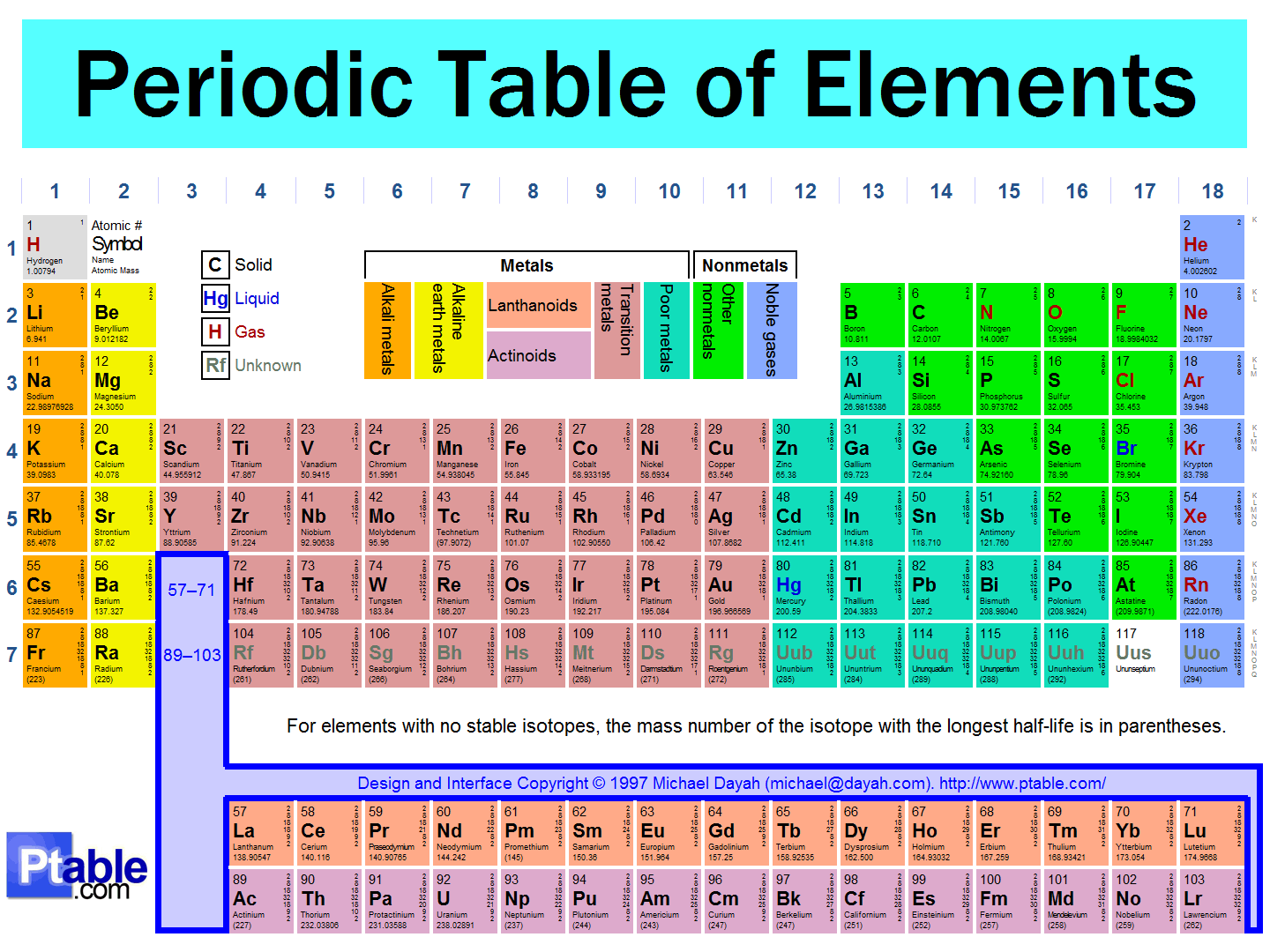
The atoms along the staircase are called 
a)
metals
b)
nonmetals
c)
metalloids
d)
noble gases
19.
Which group of the periodic table is composed of inert (not reactive)  gases?
a)
alkali metals
b)
alkaline earth metals
c)
halogens
d)
noble gases
20.
A vertical column is called...
a)
group
b)
tower
c)
period
d)
crew
21.
How many neutrons does an atom of argon-41 contain? (elemental symbol: Ar)
a)
18
b)
41
c)
23
d)
39
22.
Who discovered the electron?
a)
J.J. Thomson
b)
Ernest Rutherford
c)
John Dalton
d)
Niels Bohr
23.
If a substance is ________ , it can be pounded into shapes. This is a property of a metal.
a)
ductile
b)
malleable
c)
magnetic
d)
reactive
24.
Which atom has the largest atomic radius?
a)
potassium
b)
rubidium
c)
francium
d)
cesium
25.
Which change results in the formation of different substances?
a)
burning of propane
b)
melting of NaCl(s)
c)
deposition of CO2(g)
d)
solidification of water
26.
Round 1047.78 to three sig figs
a)
104
b)
105
c)
1050
d)
1050.00
27.
How many significant figures does the following number have: 0.002040
a)
6
b)
4
c)
3
d)
2
28.
the formula of this atom when it becomes an ion would be
a)
N-2
b)
N+3
c)
N-3
d)
N+2
29.
Atoms that gain electrons become...
a)
negatively charged (anions)
b)
positively charged (cations)
c)
remain neutrally charged
d)
21
30.
METALS are more likely to LOSE electrons, so they tend to form ...
a)
anions
b)
cations
c)
neutral atoms
d)
negative ions
31.
Ionization Energy is defined as.....
a)
The smallest amount of energy possible to excite an electron to a higher energy level
b)
The amount of energy given off when an electron returns to a ground state
c)
The amount of energy in one photon
d)
The energy required to remove one electron from a neutral atom
32.
This could be the dot diagram of
a)
P
b)
Ar
c)
Na
d)
B
33.
the electron configuration of calcium ion is
a)
2,8,8,2
b)
2,8,8
c)
2,2,8
d)
2,8
34.
Nonmetals form ____ by ____ electrons.
a)
Cations, gaining
b)
Cations, losing
c)
Anions, gaining
d)
Anions, losing
35.
How many electrons should Oxygen have around its Lewis dot model?
a)
5
b)
6
c)
7
d)
8
36.
Which formula represents a nonpolar molecule?
a)
HBr
b)
H2S
c)
CBr4
d)
PCl3
37.
Which of the following is a polar molecule?
a)
CH4
b)
Xe
c)
H2O
d)
CO2
38.
Draw the Lewis dot structure of OF2 and determine the number of lone pairs on the central atom
a)
None
b)
1
c)
2
d)
it's ionic
39.
What explains the very high melting and boiling point of water
a)
Strong dipole-dipole bonds between water molecules
b)
Strong hydrogen bonds between water molecules
c)
Dispersion forces which are present in all molecules
d)
Asymmetrical shape of the polar bonds.
40.
Intermolecular force present in HCl?
a)
dipole dipole
b)
dispersion
c)
H-bond
d)
ionic
41.

1. Which of the following molecules is the most polar?

a)

H − Cl

b)

H − Br

c)

H − I

d)

H − F

42.

Which of the following correctly lists the molecule and its type of bond?

a)

CaO Ionic bond

b)

Br2 Polar covalent bond

c)

CH4 Polar covalent bond

d)

NaI Coordinate covalent bond

43.
J.J. Thomson provided evidence that an atom...
a)
is the smallest particle of matter
b)
contains negatively charged particles
c)
has an overall negative charge
d)
has an overall positive charge
44.
Traveling down a family the atomic radii ______________.
a)
Increases
b)
Decreases
c)
Stays the same
45.
Traveling across a period the atomic radii ______________.
a)
Increases
b)
Decreases
c)
Stays the same
46.
How does ionization energy change as I go across a period ?
a)
It doesn't
b)
It increases
c)
It decreases
47.
Each element wants to gain or lose electrons so that it can have the same electron configuration as......
a)
a Nobel gas
b)
other elements in its family
c)
other elements in its period
d)
it used to have before reacting
48.
A anion will be a ____ ion.
a)
negative
b)
positive
49.
A cation is a ____ ion.
a)
negative
b)
positive
50.
As you move down the periodic table atoms get bigger.  This is because ____________.
a)
The atoms have more mass.
b)
The atoms have more protons.
c)
The atoms have more energy levels
d)
The atoms have more nuetrons
51.
As you move across the periodic table atoms tend to get smaller because, ______________.
a)
the atoms have more mass.
b)
the atoms have less mass
c)
the atoms have more protons.
d)
the atoms have less electrons.
52.
Atomic radius generally increases as we move __________.  
a)
down a group and from right to left across a period 
b)
up a group and from left to right across a period 
c)
down a group and from left to right across a period 
d)
up a group and from right to left across a period 
53.
Electronegativity __________ from left to right within a period and __________ from top to bottom within a group.
a)
decreases, increases 
b)
increases, increases
c)
increases, decreases 
d)
stays the same, increases
54.

If two atoms are isotopes of the same element, the atoms must have

a)

the same number of protons and the same number of neutrons

b)

the same number of protons and the different number of neutrons

c)

the different number of protons and the same number of neutrons

d)

the different number of protons and the different number of neutrons

55.

The nuclides I-131 and I-133 are classified as

a)

isomers of the same element

b)

isomers of Xe-131 and Cs-133

c)

Isotopes of the same element

d)

isotopes of Xe-131 and Cs-133

56.

Ink can be separated by a method of -----------------------------------------------

a)

distillation

b)

filtration

c)

chromatography

d)

sedimentation

57.

Which quantities must be conserved in a chemical reaction? (THINK: "ChEM")

a)

mass, charge, density

b)

mass, charge, energy

c)

charge, volume, density

d)

charge, volume, energy

58.

A classification of matter that can vary in its proportion of components is a.....

a)

Compound

b)

Element

c)

Mixture

d)

Atoms

59.
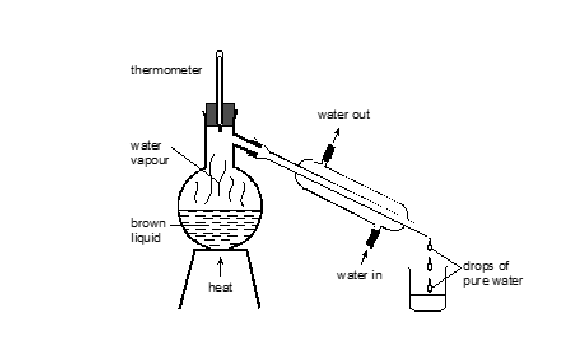
Which separation technique uses the apparatus shown in the diagram?
a)
filtration 
b)
 crystallisation
c)
distillation
d)
chromatography
60.
a)
helium and hydrogen
b)
helium and calcium
c)
hydrogen and calcium
d)
hydrogen and helium