wayground logo

Free Printable Worksheets

Font size

S
M
L
XL
Worksheets

6th Grade Final Exam

Total questions: 65

Worksheet time: 1hrs 8mins

Name
Class
Date
1.
Steve wanted to see if the type of fertilizer made sunflowers grow larger. What is the independent variable 
a)
Type of fertilizer
b)
Size of sunflower
c)
type of sun flower
2.
Steve wanted to see if the type of fertilizer made sunflowers grow larger. What is the dependent variable 
a)
Type of fertilizer
b)
Size of sunflower
c)
Type of sunflower
3.
Molly investigated if the age of students caused them to be better drivers. What is the independent variable?
a)
Type of car
b)
Skill of driving
c)
Age of student
4.
Molly investigated if the age of students caused them to be better drivers. What is the dependent variable?
a)
Type of car
b)
Skill of driving
c)
Age of student
5.
Robert wanted to know if the type of phone you used gave you better or worse service. What is the independent variable. 
a)
Location of phone call
b)
Type of phone
c)
How good the service was
6.
Robert wanted to know if the type of phone you used gave you better or worse service. What is the dependent variable. 
a)
Location of phone call
b)
Type of phone
c)
How good or bad the service was
7.
How many more students like Science than History?
a)
80 more students
b)
120 more students
c)
40 more students
d)
30 more students
8.
How many students have blue for a favorite color?
a)
11
b)
12
c)
14
d)
17
9.
How many more people have purple for a favorite color than red?
a)
3
b)
5
c)
7
d)
9
10.
At which age do the least amount of teens have a cell phone?
a)
18
b)
14
c)
13
d)
15
11.
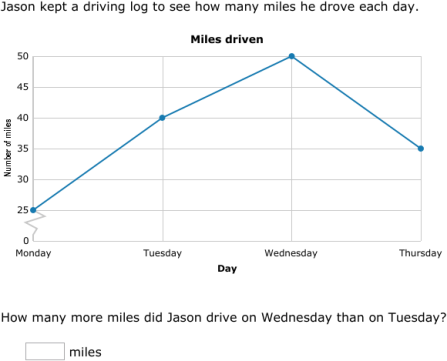
How many more miles did Jason drive on Wednesday than on Tuesday?
a)
40 miles
b)
10 miles
c)
5 miles
d)
50 miles
12.
What is the difference between Jill's 12th grade math score and her 7th grade math score?
a)
72
b)
91
c)
21
d)
19
13.

24 students were surveyed. The results are shown in the graph. If 72 students were asked the same question, predict how many students would own less than 5 games.

a)

9

b)

10

c)

18

d)

28

14.
What is the correct value?
a)
5 ml
b)
15 ml
c)
20 ml
d)
25 ml
15.
What is the volume of the liquid in this graduated cylinder?
a)
19 mL 
b)
35 mL 
c)
24 mL 
d)
1.9 mL
16.
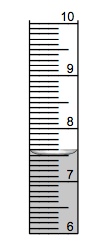
What is the volume of the liquid in this graduated cylinder?
a)
8.5 mL 
b)
7.5 mL 
c)
8 mL 
d)
.1 mL
17.
What is the volume of the liquid in this graduated cylinder?
a)
43 mL 
b)
30.7 mL 
c)
37 mL 
d)
38 mL
18.

The boundary around a watershed is called the

a)

watershed.

b)

divide.

c)

sub-watershed.

d)

transpiration.

19.

What is a body of water that combines freshwater from rivers and lakes with saltwater from the ocean?

a)

Estuary

b)

Floodplain

c)

Wetland

d)

Tributary

20.

What is a land area that can be covered with water at various points throughout the year?

a)

Estuary

b)

Floodplain

c)

Wetland

d)

Tributary

21.

What three bodies of water do Virginia's watersheds lead to

a)

Chesapeake Bay

b)

Gulf of Mexico

c)

North Carolina Sounds

d)

Atlantic Ocean

22.
Why does ice float?
a)
As water freezes, it expands and its density decreases.
b)
As water freezes, it takes up more hydrogen from the atmosphere, causing it to have a greater buoyancy.
c)
As water freezes, air becomes trapped between the hydrogen bonds of water molecules.
d)
As water freezes, it takes up more oxygen from the atmosphere, causing it to have a greater buoyancy.
23.
Water is polar because...
a)
The unequal sharing of electrons gives the water molecule a slight negative charge near its oxygen atom and a slight positive charge near its hydrogen atoms.
b)
The molecule has two poles, at which the it is colder than other regions of the molecule.
c)
The unequal sharing of electrons gives the water molecule a slight negative charge near its hydrogen atoms and a slight positive charge near its oxygen atom.
d)
The water molecule is neutral.
24.
Water is referred as the? 
a)
Specific Heat 
b)
Heat Source 
c)
Universal Solvent
d)
Oxygen 
25.
What is the chemical symbol for the element hydrogen
a)
H
b)
He
c)
h
d)
he
26.
What is the chemical symbol for the element Carbon
a)
ca
b)
co2
c)
C
d)
Cd
27.
What is the chemical symbol for the element Nitrogen
a)
Ni
b)
N
c)
No
d)
Nb
28.

Where are Protons and Neutrons located?

a)

The Neucleus

b)

the outside

c)

The inside

d)

On earth

29.
an atom with atomic number 6 would have how many protons 
a)
6
b)
12
c)
3
d)
cannot be determined 
30.
Particles in an atom that are neutral and have no charge are 
a)
negatrons 
b)
electrons 
c)
neutrons 
d)
protons 
31.
True or False? Neutrons have a negative charge
a)
True
b)
False
32.
What are the 3 main fossil fuels?
a)
Coal, Oil, and Gasoline
b)
Coal, Oil, and Natural Gas
c)
Electricity, Gasoline, Petroleum
d)
Coal, Oil, Non-renewable Resources
33.
Non-Renewable resources are also known as what?
a)
Fossil Fuels
b)
Renewable
c)
Solar Energy
d)
Hydroelectric Energy
34.
what is a non renewable resource?
a)
water
b)
wind
c)
coal
d)
biomass
35.
what is a fossil fuel
a)
oil
b)
biomass
c)
wind 
d)
hydro
36.
Where does most of earth`s energy come from?
a)
The sun
b)
Mars
c)
Wind
d)
Water
37.
Electrical Energy is transferred to _____ Energy.
a)
Thermal
b)
Solar
c)
Electrical
d)
None
38.
The roller coaster cart has the most gravitational potential energy at position-
a)
W
b)
X
c)
Y
d)
Z
39.
Which items would have this energy transformation: chemical energy -> mechanical energy?
a)
person running
b)
candle burning
c)
windmill turning
d)
playing a violin
40.
A hairdryer converts -- 
a)
electrical energy into chemical
b)
electrical energy into thermal
c)
chemical energy into mechanical
d)
thermal energy into mechanical
41.
Clouds are made up of tiny drops of ______ or ice. The moisture in the cloud affects the weather.
a)
dust
b)
water
c)
cloud particles
d)
precipitation
42.
They are highest clouds in the sky. They look curly, white and feathery. Usually mean good weather.
a)
Cumulus
b)
Cumulonimbus
c)
Cirrus
d)
Stratus
43.
This is sometimes called a thunderhead cloud. It looks very tall like mountains and heavy rain comes from it. 
a)
Cumulus
b)
Cirrus
c)
Stratus
d)
Cumulonimbus
44.
They are low in the sky and look soft and fluffy. 
a)
Cirrus
b)
Cumulonimbus
c)
Cumulus 
d)
Stratus
45.
These clouds are the closest to the ground. Their name means layer- or sheet like. They bring rain or snow and cover most of the sky. 
a)
Cirrus
b)
Stratus
c)
Cumulonimbus
d)
Cumulus
46.
Which gas in our atmosphere is most abundant?
a)
Argon
b)
Oxygen
c)
Nitrogen
d)
Carbon Dioxide
47.
In which layer of the atmosphere does weather occur?
a)
Mesosphere
b)
Thermosphere
c)
Stratosphere
d)
Troposphere
48.
a)
Low Clouds
b)
Low Temperatures
c)
Light Wind
d)
Low Air Pressure
49.
Which tool measures humidity or the amount of moisture in the air?
a)
wind vane
b)
barometer
c)
anemometer
d)
hygrometer
50.
Which is the second closest planet to the sun?
a)
Earth
b)
Saturn
c)
Venus
d)
Mercury
51.
A spinning motion on an axis
a)
rotation
b)
revolution
52.

The Earth completes one of these every 365.25 days

a)

rotation

b)

revolution

53.
This is the reason we experience day and night
a)
rotation
b)
revolution
54.
The gravitational pull of the Sun on the Earth causes this
a)
rotation
b)
revolution
55.
The motion of one object around another object
a)
rotation
b)
revolution
56.
Takes about 24 hours to complete one
a)
rotation
b)
revolution
57.
Tides are caused by
a)
strong winds that blow over ocean waters.
b)
the interaction of Earth, the moon and the sun.
c)
the shifting of the plates on the ocean floor.
d)
variations in the salinity of ocean water
58.
A student saw water in his desk.  After a few hours, it disappeared.  What happened?
a)
it froze
b)
a fairy licked it all up
c)
it evaporated 
d)
condensation
59.
Maria noticed little drops around her cup.  Which of these words describes where the drops likely came from?
a)
evaporation
b)
condensation
c)
rain
60.
To change a solid into a liquid you need to
a)
decrease the heat
b)
increase the heat
c)
scream "LIQUIFY!!!!"
61.
To change a liquid into a solid, you need to 
a)
increase the heat
b)
decrease the heat
62.
The process of a liquid turning to a solid is called 
a)
evaporation
b)
melting
c)
freezing
d)
boiling point
63.
The process of a solid turning into a liquid is called
a)
melting
b)
evaporation
c)
freezing
64.
A living or once-living organisms in an ecosystem is a
a)
population
b)
biotic factor
c)
abiotic factor
d)
community
65.
A nonliving element in an ecosystem is an 
a)
animal
b)
abiotic factor
c)
biotic factor
d)
organism