wayground logo

Free Printable Worksheets

Font size

S
M
L
XL
Worksheets

chem mid term

Total questions: 141

Worksheet time: 2hrs 27mins
Name
Class
Date
1.
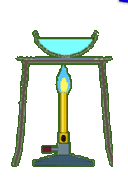
When should you tie back long hair or baggy clothing?
a)
When working with chemicals
b)
When working with a Bunsen burner
c)
When doing dissections.
d)
Any time you are working in the lab.
2.
When is it OK to eat or drink in the lab?
a)
Always
b)
Never
3.
If you break glassware in the lab, you should...
a)
Tell the teacher
b)
Clean it up quickly before the teacher notices
c)
Scream at the top of your lungs
4.
When in the lab...
a)
long sleeves and loose clothing should be rolled up
b)
closed toe shoes should be worn
c)
long hair should be pulled back
d)
all of the above
5.
Before leaving the lab you should always wash your hands.
a)
True 
b)
False
6.
It's fine to smell chemicals directly from their containers.
a)
True
b)
False
7.
If you get something in your eyes, how long do you need to use the eyewash station?
a)
15 - 20 seconds
b)
5 minutes
c)
15 - 20 minutes
d)
Don't use the eyewash.
8.
 If you do not understand a direction or part of a lab procedure, you should 
a)
skip it and go on to the next part.
b)
ask the instructor before proceeding
c)
try several methods until something works
d)
figure it out as you do the lab
9.
 After completing an experiment, all chemical wastes should be
a)
taken home
b)
dumped in the sink
c)
disposed of according to your instructor’s directions
d)
left at your lab station for the next class
10.
You have been injured in the laboratory (cut, burn, etc.). First you should
a)
apply first aid yourself
b)
tell the science instructor at once
c)
see a doctor after school
d)
visit the school nurse after class
11.
 The following footwear is best in the laboratory. 
a)
shoes appropriate for the weather
b)
open-toed shoes
c)
closed-toed shoes
d)
sandals
12.
Hot glass looks the same as cold glass.
a)
True
b)
False
13.
Chipped or cracked glassware is okay to use.
a)
True
b)
False
14.
Never remove chemicals or other equipment from the laboratory.
a)
True
b)
False
15.
Read all procedures thoroughly before entering the laboratory
a)
True
b)
False
16.
It’s okay to pick up broken glass with your bare hands as long as the glass is placed in the trash.
a)
True
b)
False
17.
If a laboratory fire erupts, immediately
a)
notify your instructor
b)
 run for the fire extinguisher
c)
throw water on the fire
d)
 open the windows
18.
Approved eye protection devices (such as goggles) are worn in the laboratory
a)
 to avoid eye strain
b)
to improve your vision
c)
only if you don’t have corrective glasses
d)
 any time chemicals, heat or glassware are used
19.
If you wear contact lenses in the school laboratory
a)
take them out before starting the lab
b)
you do not have to wear protective goggles
c)
 advise your science instructor that you wear contact lenses
d)
 keep the information to yourself
20.
You are heating a substance in a test tube. Always point the open end of the tube 
a)
away from all people
b)
toward another classmate
c)
toward your lab partner
d)
toward yourself
21.
You have been injured in the laboratory (cut, burn, etc.). First you should
a)
apply first aid yourself
b)
tell the science instructor at once
c)
see a doctor after school
d)
visit the school nurse after class
22.
what does MSDS stand for 
a)
Mechanical safety data worksheets
b)
Material safety data worksheets 
23.
Safety Data Sheets provide some basic health information in addition to information about chemicals.
a)
True
b)
False
24.
A pictogram of a _________ is used to mark flammable materials.
a)
Exclamation Point
b)
Bomb
c)
Flame
d)
Skull and Crossbones
25.
A chemical's product label typically provides more information than what is found on the SDS.
a)
True 
b)
False
26.
What safety symbol is this?
a)
Clothing Protection
b)
Hand Protection
c)
Eye Protection
d)
Sharp Object Hazard
27.
What does this symbol indicate? 
a)
Extreme temperatures
b)
Corrosive materials
c)
Sharp surfaces
d)
Electrical hazard
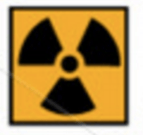
28.
What safety symbol is this? 
a)
corrosive
b)
toxic
c)
radiation
d)
biohazard
29.
What does this symbol indicate? 
a)
Fumes are present; ventilation required.
b)
Fumes are present; inhale deeply.
c)
Moisture is condensing; use a test tube to collect. 
d)
Spill safety.
30.
What safety symbol is this? 
a)
biohazard
b)
radiation
c)
toxic
d)
corrosive
31.
What does this symbol indicate?
a)
Items cannot be disposed of in the trashcan.
b)
Items should be disposed of in the trashcan.
32.

What symbol is this?

a)

Clothing Protection

b)

Eye Safety

c)

Fume

d)

Sharp Object

33.

What symbol is this?

a)

Fume

b)

Extreme Temperature

c)

Toxic

d)

Open Flame

34.

What symbol is this?

a)

Irritant

b)

Chemical

c)

Electrical

d)

Flammable

35.
Identify the Image 
a)
Indicates Radioactivity 
b)
Indicates fire safety
c)
Indicates biological hazard
d)
Indicates glass safety
36.
Dispose the broken glassware in a special container provided by the teacher.
a)
True 
b)
False
37.
Chemicals can be disposed in the regular sink or wash basin.
a)
True 
b)
False 
38.

Glassware used to measure liquid volume. A very accurate tool. Graduated in mL (milliliters).

a)

beaker

b)

cup

c)

graduated cylinder

d)

Erlenmeyer flask

39.

Glassware used to stir, heat , and measure liquid volume in mL (rough estimate).

a)

graduated cylinder

b)

beaker

c)

cup

d)

erlenmeyer flask

40.

An electrical device used to heat things up in a science lab.

a)

electric cord

b)

heated blanket

c)

stirrer

d)

hot plate

41.

Used to handle hot beakers.

a)

crucible tongs

b)

pot holders

c)

test tube tongs

d)

gloves

42.

Used to hold hot test tubes and found in a science lab.

a)

plastic bins

b)

test tube holders

c)

zip lock bags

d)

crucible tongs

43.

Used to measure temperature in degrees Celsius or Fahrenheit.

a)

digital scale

b)

tape measure

c)

measuring stick

d)

thermometer

44.

A slender tube attached to a bulb and used for transferring or measuring small amounts of liquids.

a)

pipette

b)

graduated cylinder

c)

beaker

d)

pipe

45.
Mass is the space that an object occupies.
a)
AlwaysTrue
b)
 Sometimes True
c)
Never True
46.
Volume can be calculated by multiplying length times width times height.
a)
Always True
b)
Sometimes True
c)
Never True
47.
Density is the relationship of mass divided by volume.
a)
Always True
b)
Sometimes True
c)
Never True
48.
Put the liquids in order from most dense to least dense?
a)
4, 3, 2, 1
b)
1, 2, 3, 4
c)
3, 4, 2, 1, 
d)
4, 3, 1, 2
49.
Jack has a rock. The rock has a mass of 14g and a volume of 2cm3. What is the density of the rock?
a)
7 mL
b)
7 g/cm3
c)
28 g/cm3
d)
1/7 g/cm3
50.
Which units of measurement are used for volume?
a)
grams
b)
centimeters
c)
grams/milliliter
d)
milliliter
51.
Which lab tool might you use to measure the volume of a liquid?
a)
electric scale
b)
bunsen burner
c)
test tube
d)
graduated cylinder
52.
What is the volume of Object X?
a)
10.0 cm3
b)
15.0 cm3
c)
20.0 cm3
d)
25.0 cm3
53.
I have two objects with the same volume but different masses.  Which object will be more dense?
a)
The object with less weight.
b)
The object with more weight.
c)
The object with more mass.
d)
The object with less mass.
54.
Frank has a paper clip. It has a mass of 9g and a volume of 3cm3. What is its density?
a)
3 g/cm3
b)
1/3 g/cm3
c)
27 g/cm3
d)
39 g/cm3
55.
Calculate the density of the cube.
a)
2 g/cm3
b)
4 g/cm3
c)
6 g/cm3
d)
8 g/cm3
56.
Calculate the density of the cube.
a)
.33 g/cm3
b)
.4 g/cm3
c)
.6 g/cm3
d)
.5 g/cm3
57.
Which of the following is an ELEMENT?
a)
carbon
b)
sugar
c)
water
d)
salt
58.
A combination of substances that are not chemically combined is called a(n)____________. 
a)
mixture
b)
compound
c)
physical
59.
The positive particles of an atom are 
a)
electrons 
b)
positrons 
c)
neutrons 
d)
protons 
60.
How many different elements are in this chemical formula: C2H2ClK3
a)
6
b)
8
c)
2
d)
4
61.
Which of the following chemical formulas represents a compound? 
a)
C3
b)
O2
c)
CH3CHO
d)
H2
62.
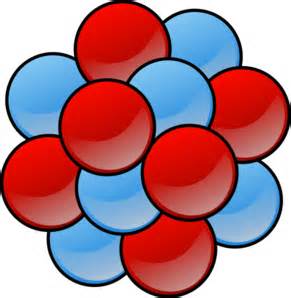
What is the picture displayed?
a)
atom
b)
element
c)
molecule
d)
compound
63.
How many elements are in C6H12O6?
a)
1
b)
2
c)
3
d)
4
64.

The ability of salt to dissolve into water is what type of property?

a)

Physical

b)

Chemical

65.

Ice cream melts when it gets too hot. This is an example of a:

a)

Physical Property

b)

Chemical Property

66.

When water is heated to 212° F, it begins to boil. This is an example of a

a)

Physical Property

b)

Chemical Property

67.

Gasoline is flammable, meaning it has the ability to catch fire. This is an example of a

a)

Physical Property

b)

Chemical Property

68.
apples can react with oxygen and turn brown
a)
physical properties
b)
chemical properties
69.

Which of the following is the correct separation technique in the picture below?

a)

distillation

b)

Sieving

c)

Evaporation

d)

Decantation

70.

Which technique is shown in the diagram below?

a)

Sieving

b)

Filtration

c)

Decantaton

d)

Crystallization

71.

Sand can be separated from iron filings by using a _________ .

a)

a bar magnet

b)

filter paper

c)

distillation apparatus

d)

chromatography paper

72.
How many Hydrogen are in 4H2O?
a)
6
b)
8
c)
2
d)
4
73.
2H2 + O2 ----> 2H2O What is the product?
a)
------>
b)
2H2O
c)
2H2+ O2
74.
2H2 + O--------> 2H2O What  are the reactants?
a)
----->
b)
2H2O
c)
2H2 +O2
75.
How many Magnesium are in 10MgCl2?
a)
10
b)
5
c)
20
76.
Number of N in (NH₄)₂CrO₄
a)
1
b)
2
c)
8
d)
16
77.
How many Sodium (Na) are in 6NaCl?
a)
1
b)
12
c)
6
78.
What is the approximate mass of an alpha particle?
a)
4amu
b)
2amu
c)
1.00amu
d)
9.11 x 10⁻²⁸ amu
79.
The least penetrating form of radiation is _____.
a)
alpha
b)
beta
c)
gamma
d)
UV
80.
The most penetrating form of radiation is _____.
a)
alpha
b)
beta
c)
gamma
d)
UV
81.
What is the product of the alpha decay of Gold-175?
a)
Ir-171
b)
Tl-179
c)
Au179
d)
Au171
82.
What happens to the atomic number during alpha decay?
a)
The atomic number decreases by 4
b)
The atomic number increases by 1
c)
The atomic number decreases by 2.
d)
The atomic number stays the same.
83.
Arrange in order of increasing ability to penetrate matter.
a)
Beta, gamma, alpha
b)
Alpha, gamma, beta
c)
Gamma, beta, alpha
d)
Alpha, beta, gamma
84.
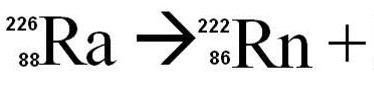
Complete the nuclear equation and determine the type of decay that is occurring in this reaction. 
a)
alpha
b)
beta
c)
gamma
d)
none
85.
Which type of nuclear radiation is being emitted here?
a)
Alpha
b)
Beta
c)
Gamma 
d)
none
86.
The technetium-99 isotope has a half-life of 6.0 hours. If 100.0 mg were injected into a patient how much remains after 18 hours?
a)
33.0 mg
b)
12.5 mg
c)
.33 mg
d)
15.8 mg
87.

In the symbol 167N what the 7 stand for?

a)

Mass number

b)

Atomic number

c)

Atomic mass

d)

Number of neutrons

88.
Barium-122 has a half-life of 2 minutes. A fresh sample weighing 80 g was obtained. If it takes 10 minutes to set up an experiment using barium-122, how much barium-122 will be left when the experiment begins?
a)
0.25g
b)
2.5g
c)
25g
d)
80g
89.

What is the half-life of an isotope if after 20.0 days you have 4.0 grams remaining of a 64.0 grams sample?

a)

1.25 days

b)

5.0 days

c)

80 days

d)

4.25 days

90.
This particle is found in the nucleus and has no charge
a)
Neutron
b)
Proton
c)
Electron
91.
This particle is found in the nucleus and has a positive charge
a)
Electron
b)
Proton
c)
Neutron
92.
This is a negatively charged particle found outside the nucleus
a)
Electron
b)
Proton
c)
Neutron
93.
This contains most of the mass of an atom
a)
Electron Cloud
b)
Nucleus
c)
Electron
94.
The first person to ever talk about an atom was
a)
Democritus
b)
Rutherford
c)
Dalton
95.
How did Rutherford discover the proton?
a)
Cathode tube ray experiment
b)
Gold Foil Experiment
c)
Planetary Model
d)
Plum Pudding Model
96.
Who stated that all atoms of the same element are excacty alike?
a)
Democritus
b)
Dalton
c)
Thomson
d)
Borh
97.
What scientist is best known for his "Plum Pudding" model of the atom?
a)
J.J. Tomson
b)
Ernest Rutherford
c)
John Dalton
d)
Democritus
98.
What contribution did John Dalton make to atomic theory? 
a)
He discovered that every atom was positively charged. 
b)
He discovered that every element consisted of one type of atom.  
c)
He discovered that atoms had nuclei. 
d)
He discovered that atoms could be divided into smaller parts. 
99.
J.J. Thomson provided evidence that an atom...
a)
is the smallest particle of matter
b)
contains negatively charged particles
c)
has an overall negative charge
d)
has an overall positive charge
100.
Rutherford's gold foil experiment provided evidence that...
a)
negative and positive charges are spread evenly throughout the atom.
b)
alpha particles have a positive charge.
c)
gold is not a dense as previously thought.
d)
there is a dense positively charged nucleus at the center of an atom.
101.
What does the nucleus of an atom contain?
a)
Electrons and neutrons
b)
Protons and neutrons
c)
Neutrinos and positrons
d)
DNA and RN
102.
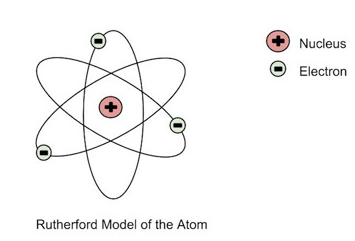
Who came up with this model of an atom?
a)
J.J. Thompson
b)
Ernest Rutherford
c)
Neils Bohr
d)
James Chadwick
103.

What is the molar mass of AgF?

a)

514.9 g/mol

b)

99.7 g/mol

c)

126.87 g/mol

d)

198.8 g/mol

104.

What is the mass of 1 mole of calcium carbonate, CaCO3?

a)

99.01 g

b)

100.09 g

c)

216.87 g

d)

84.09 g

105.

What is the molar mass of ammonium sulfide - (NH4)2S?

a)

68.17 g/mol

b)

40.02 g/mol

c)

114.12 g/mol

d)

82.91 g/mol

106.

What are the units for molar mass?

a)

grams

b)

AMU

c)

g/mol

d)

mole

107.

What is the percent composition by mass of sulfur (S) in the compound MgSO4?

a)

20.22%

b)

19.85%

c)

26.64%

d)

28.64%

108.

What is the molar mass of Zn(C2H3O2)2

a)

183.46g/mol

b)

169.89L

c)

120.65g/mol

d)

236.54M

109.

What percent of Zn3(PO4)2 is zinc?

a)

33.15%

b)

16.04%

c)

50.80%

d)

19.68%

110.

Number of H in 3(NH4)2CrO4

a)

4

b)

8

c)

24

d)

2

111.

What element is this?

a)

Helium

b)

Hydrogen

c)

Argon

d)

Silver

112.

How many electrons does Si contain? (click to see image)

a)

14

b)

28

c)

2

d)

None of these

113.

How many electrons does potassium K contain? (click to see image)

a)

19

b)

39

c)

20

d)

40

114.

What element is represented in this Bohr Model?

a)

Carbon

b)

Hydrogen

c)

Aluminum

d)

Lithium

115.

An isotope has 8 protons, 10 neutrons, and 8 electrons. Which element is this?

a)

Neon

b)

Fluorine

c)

Oxygen

d)
116.

The isotope of Bromine, bromine-67, has how many neutrons?

a)

34

b)

33

c)

32

d)

31

117.

What is an isotope?

a)

An element with the same number of neutrons and different number of protons

b)

An element with the same number of protons and different number of neutrons

c)

An element with the same number of protons and different number of electrons

d)

An element with the same number of neutrons and different number of electrons

118.

What is the charge and mass of a proton?

a)

+1 charge, 1 amu

b)

0 charge, 1 amu

c)

0 charge, 0 amu

d)

-1 charge, 0 amu

119.

What is the charge and mass of a neutron?

a)

+1 charge, 1 amu

b)

0 charge, 1 amu

c)

0 charge, 0 amu

d)

-1 charge, 0 amu

120.

What is the charge and mass of a electron?

a)

+1 charge, 1 amu

b)

0 charge, 1 amu

c)

0 charge, 0 amu

d)

-1 charge, 0 amu

121.

How many electrons are in the 3rd energy level of Carbon?

a)

2

b)

1

c)

0

d)

4

122.

The correct electron configuration for Chlorine is

a)

1s22s22p5

b)

1s22s22p63s2

c)

1s22s22p63s23p4

d)

1s22s22p63s23p5

123.

How many valence electrons are in Chlorine

a)

4

b)

5

c)

6

d)

7

124.

What is the correct aufbau diagram for Nitrogen (N)?

a)
b)
c)
d)
125.
What atom matches this electron configuration?
1s22s22p63s23p64s23d10
a)
Zinc
b)
Copper
c)
Nickel
d)
Germanium
126.
What atom matches this electron configuration?
1s22s22p63s2
a)
Neon
b)
Magnesium
c)
Aluminum
d)
Potassium
127.
What electron configuration matches an oxygen atom?
a)
1s22s22p63s2, 3p64s23d104p5
b)
1s22s22p4
c)
1s22s22p6
d)
1s22s22p63s23p64s23d1
128.
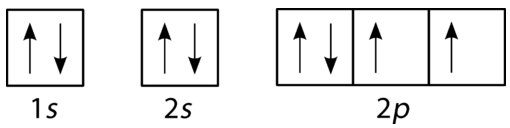
This orbital diagram represents:  
a)
C
b)
B
c)
N
d)
O
129.

Which rule is being broken this orbital diagram?

a)

Aufbau Principle

b)

Pauli Exclusion Principle

c)

Hund's Rule

d)

The diagram is correct.

130.
Which element is pictured?
a)
neon
b)
fluorine
c)
magnesium
d)
argon
131.
How many electrons can the d sublevel hold?
a)
14
b)
10
c)
2
d)
6
132.
The maximum number of electrons that can be placed in an f orbital.  
a)
2
b)
6
c)
10
d)
14
133.
Which orbital shows a violation of the Pauli Exclusion Principle?
a)
A
b)
B
c)
C
d)
D
134.
How many electrons can the s sublevel hold?
a)
14
b)
10
c)
2
d)
6
135.
Each orbital will hold ____ electrons
a)
5
b)
4
c)
8
d)
2
136.
What atom matches this electron configuration?
1s22s22p63s23p64s23d10
a)
Zinc
b)
Copper
c)
Nickel
d)
Germanium
137.
What electron configuration matches an oxygen atom?
a)
1s22s22p63s2, 3p64s23d104p5
b)
1s22s22p4
c)
1s22s22p6
d)
1s22s22p63s23p64s23d1
138.
The electron configuration of an atom is 1s22s22p6.  The number of electrons in the atom is 
a)
3
b)
6
c)
8
d)
10
139.
Which electron configuration belongs to Chlorine (Cl)?
a)
1s2s2p3s3p5
b)
1s2s2p3s3p6
c)
1s2s2p3s3p7
140.
This orbital diagram represents:  
a)
C
b)
B
c)
N
d)
O
141.
What is incorrect about this orbital diagram?
a)
Both arrows in the 2p box should be pointing up
b)
There is nothing incorrect with this diagram
c)
In the there should only be 1 orbital in the first 2p box and one in the 2nd 2p box
d)
All the arrows should be pointing up.