wayground logo

Free Printable Worksheets

NEW

Font size

S
M
L
XL
Worksheets

Genetics and Natural Selection Review

Total questions: 57

Worksheet time: 41mins

Name
Class
Date
1.
The man who studied genetics and came up with genetics is
a)
Watson
b)
Crick
c)
Mendel
d)
Darwin
2.
Genotype refers to the ...
a)
physical expression of the genes
b)
the possible combination of alleles in a gene
c)
whether an allele is dominant or recessive
d)
how an organism will appear
3.
Squidward has light blue skin, and his genotype for this trait is Bb. Would Squidward be considered a purebred or hybrid for light blue skin?
a)
Purebred
b)
Hybrid
4.
Which of the following is a phenotype?
a)
BB
b)
Bb
c)
bb
d)
Blue eyes
5.
What is a phenotype
a)
The genetic make up (code)
b)
The physical trait
6.
the passing of genetic traits from parent to offspring.
a)
heredity
b)
trait
c)
gene
d)
allele
7.
having two of the same genes for the trait (sometimes called purebred).
a)
homozygous
b)
hetrozygous
c)
protein
d)
chromosome
8.
having two different genes for a trait (sometimes called hybrid).
a)
protein
b)
homozygous
c)
heterozygous
d)
genotype
9.
Magda is a tall, 11 year old drummer. She has a scar on her right cheek. She is good at swimming. Which of her traits did Magda most likely inherit?
a)
height
b)
the scar
c)
ability to swim
d)
ability to play drums
10.
G = green, g = yellow
The genotype for a yellow plant is...
a)
GG
b)
Gg
c)
gg
d)
all of the choices result in yellow
11.
An allele whose trait only shows up when no dominant allele is present.
a)
hidden allele
b)
dominant allele
c)
recessive allele
d)
present allele
12.
Two heterozygous (Tt) tall pea plants are crossed. Which describes their offspring?
a)
50% tall and 50% short
b)
75%tall and 25% short
c)
100%short
13.
Which of the following genotypes is a purebred?
a)
Bb
b)
Gg
c)
bb
d)
Dd
14.
One form of a gene is called_______________
a)
a DNA
b)
a Phenotype
c)
a trait
d)
an allele
15.
Where, in the eukaryotic cell, is DNA located?
a)
ribosomes
b)
nucleus
c)
E.R.
d)
cytoplasm
16.
A human usually has _____ total chromosomes.
a)
6
b)
22
c)
4
d)
46
17.
How many alleles (letters) do each person carry for a trait?
a)
1
b)
2
c)
3
d)
4
18.
How many alleles (letters) does a child get from each parent for each trait?
a)
1
b)
2
c)
3
d)
4
19.
Dominant alleles are represented by a:
a)
Male gene
b)
lowercase letter
c)
recessive trait
d)
capital letter
20.
Aa, DD, bB, yy are all examples of
a)
genotypes
b)
phenotypes
21.
What you see, or the physical appearance.
a)
Genotype
b)
Phenotype
c)
Homozygous
d)
Heterozygous
22.
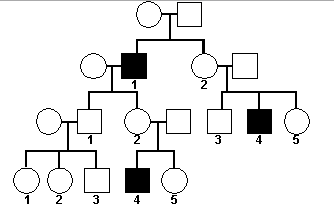
In a pedigree, what shape represents a male?
a)
circle
b)
square
c)
triangle
d)
diamond
23.
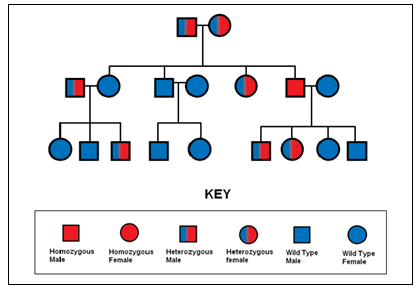
What type of heredity is shown in the pedigree?
(hint: check your notes - "modes of inheritance")
a)
Sex-Linked Dominant
b)
Sex-Linked Recessive
c)
Autosomal Dominant
d)
Autosomal Recessive 
24.
What gender has an X and a Y chromosome?
a)
male
b)
female
c)
transgender 
d)
all of the above
25.
In the second generation-how many people are carriers of the trait?
a)
2
b)
3
c)
5
d)
6
26.
How many individuals are there in the 3rd generation?
a)
2
b)
3
c)
4
d)
6
27.
What do we use pedigrees for?
a)
To look at families
b)
To make determinations about the offspring
c)
To track traits in families
d)
Nothing
28.
Why do all the daughters in Generation II carry the colorblind gene?
a)
Because mom passed on the gene.
b)
Because dad passed on the X chromosome.
c)
Because their brother has it.
d)
Because their brother gave it to them.
29.
Which individual in the first generation is a carrier?
a)
The male
b)
The female
c)
individual 1
d)
None of the above
30.
Survival of the Fittest and Evolution were proposed by what scientist?
a)
Charles Darwin
b)
Albert Einstein
c)
Steven Hawking
d)
Isaac Newton
31.
Behavioral changes of individuals of a species that allow for better survival. (Acquired traits)
a)
Variation
b)
Adaptation
c)
Behavior
d)
Environment
32.
When every organism of a species has died.
a)
Evolution
b)
Natural Selection
c)
Extinction
d)
Artificial Selection
33.
The theory of evolution by natural selection means that what is changing over time?
a)
The inherited traits of a population.
b)
The acquired traits of a population.
c)
Hair color and eye color
d)
Attractive features.
34.
Why are advantageous traits more likely to be passed onto offspring?
a)
Because they are more likely to survive and reproduce.
b)
Because they come from dominant alleles.
c)
Because they come from recessive alleles.
d)
Because the trait is an acquired phenotype.
35.
The purpose of selective breeding is to 
a)
Get bigger animals
b)
get smaller animals
c)
create animals with desirable traits
d)
create animals with bad traits
36.
A farmer has bred his pineapple plants from the sweetest pineapples from his last harvest to get even sweeter pineapple plants. What is this an example of?
a)
Selective breeding
b)
Natural selection
c)
Extinction
d)
Mutagenesis
37.
Organisms within a population have genetic differences in their traits called.
a)
Genotypes
b)
Variation
c)
Natural Selection
d)
Heterozygous
38.

Problems with selective breeding include

a)

Better animals

b)

More Meat

c)

Animals can have health problems

d)

more diversity

39.

What is the advantage of Sexual Reproduction?

a)

More genetic variation

b)

reproduces quickly

c)

more competition

d)

takes longer to reproduce

40.

How does sexual reproduction create more diverse offspring?

a)

Has fewer combinations of genes possible

b)

Has more combinations of genes possible

c)

Has genes that do not combine

d)

Has genes from one parent only

41.

How many parents are involved in asexual reproduction?

a)

4

b)

3

c)

2

d)

1

42.

What type of offspring are reproduced in asexual reproduction?

a)

Different types

b)

Diverse

c)

Uniform

d)

Random genetic possibilities

43.

How many parents are involved in sexual reproduction?

a)

1

b)

3

c)

2

d)

8

44.

Which type of reproduction is more suitable for an environment that changes frequently?

a)

sexual reproduction

b)

asexual reproduction

c)

cloning

d)

genetic modification

45.

Why is sexual reproduction better than asexual reproduction in a changing environment

a)

Less genetic variety means they can adapt better

b)

no genetic difference in the population means it can adapt better

c)

More genetic variety means they can adapt better

d)

more genetic variety means it can not adapt

46.

When your 2 cats had a baby, they had traits of...

a)

both parents

b)

one parent

c)

none from either parent

d)

their great grand parents only

47.

Where are chromosomes located?

a)

ribosomes of cells

b)

your stomach

c)

nucleus of cells

d)

vacuoles of cells

48.

what part of the cell do we find the gene for hair color?

a)

vacuole

b)

ribosome

c)

cell wall

d)

the nucleus

49.

A strand of DNA that contains genetic information is called a

a)

Chromatoid

b)

chromosome

c)

Chloroplast

d)

Chlorophyll

50.

In the nucleus of a cell you will find...

a)

genes

b)

chromosomes

c)

DNA ( genetic material )

d)

all of the above

51.

What is the job of chromosomes?

a)

break down wastes

b)

store genetic instructions

c)

transport protein

d)

make energy

52.

When a sperm cell fertilizes an egg cell, the genes in both cells:

a)

combine

b)

replicate

c)

divide

d)

change

53.

Which of these organisms reproduces through binary fission?

a)

starfish

b)

bacteria

c)

hydra

d)

coral

54.

The offspring of a budding organism starts as a(n):

a)

growth on the parent's body

b)

colony of clones

c)

cutting from the parent

d)

unfertilized egg cell

55.

Which example of regeneration is also considered reproduction?

a)

a starfish regrows a missing arm

b)

a worm cut in half grows into two separate worms

c)

a deer grows a new antler to replace a broken one

d)

a lizard's tail falls off and a new one grows back
56.
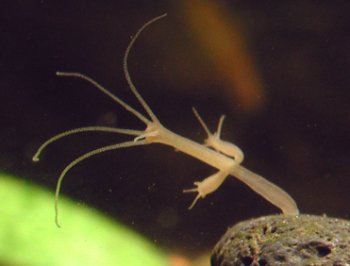
This is when a new organism grows by cell division on the body of its parent. The bud, or offspring is identical to the parent. The bud, when large enough, can break off of the parent and live on its own.  Examples of this include yeast, hydra and potatoes.
 
a)
Regeneration
b)
Vegetative propagation
c)
Fission
d)
Budding
57.
 This is when uniform offspring grow from a part of a parent plant. Parent plants sends out runners. Where the runner touches the ground, roots can grow. A new plant is produced even if the runner is broken apart Each new plant is uniform and identical to the parent.
a)
Vegetative propagation
b)
Regeneration
c)
Budding
d)
Fission