
NEW
Font size
 Worksheets
Weather and Water Cycle Unit Test Reviw
Total questions: 38
Worksheet time: 19mins
What is a fluid?
a phase change from a liquid to a gas
particles that are compact and close together
anything that has particles that flow and move freely
ONLY water
What happens to particles when they cool off?
the particles spread apart, become less dense and rise
the particles compact together, become more dense and sink
What happens to particles when they warm up?
the particles spread apart, become less dense and rise
the particles compact together, become more dense and sink
What is one way to reduce damage to your home when a tornado is coming?
lay in a ditch
drive away
put your house on stilts
board up your windows
How does air move?
from low to high pressure
from high to low pressure
up and down
side to side
What is conduction?
the movement of heat in a circular motion
the movement of wind in a counter clockwise motion
the transfer of heat energy between two objects touching
the transfer of wind energy by the air
liquid to a gas
condensation
evaporation
precipitation
transpiration
gas to a liquid (forms a cloud)
evaporation
condensation
precipitation
groundwater
rain, hail, sleet, snow
condensation
infiltration
precipitation
evaporation
water evaporating from plant leaves
ground water
infiltration
condensation
transpiration
water soaking into the ground
condensation
infiltration
ground water
precipitation
water moving downhill on the Earth's surface back into bodies of water
precipitation
infiltration
evaporation
run off
water stored underneath Earth's surface
ground water
transpiration
run off
precipitation
What does a cold front symbol look like?
red with half circles on one side
blue with triangles on one side
purple with triangles and half circles on one side
red half circles on one side and blue triangles on the other side
what doe a warm front symbol look like?
red with half circles on one side
blue with triangles on one side
purple with triangles and half circles on one side
red half circles on one side and blue triangles on the other
What does a stationary front symbol look like?
red half circles on one side
blue triangles on one side
purple triangles and half circles one one side
red half circles on one side and blue triangles on the other side
what does an occluded front symbol look like?
red with half circles on one side
blue with triangles on one side
purple with triangles and half circles on one side
red half circles on one side and blue triangles on the other side
what does a high pressure symbol look like
red H
blue H
red L
blue L
What does a low pressure symbol look like?
red H
blue H
red L
blue L
what kind of weather does a stationary front bring?
heavy rain and thunderstorms
tornadoes
warm weather and high winds
several days of light, steady rain
what kind of weather does a cold front bring?
warmer weather with light rain
steady rain for several days
cooler temperatures with heavy rains/thunderstorms
tornadoes
What weather does an occluded front bring?
sunny skies
light rain
thunderstorms
freezing temperatures
What weather does a warm front bring?
continuous heavy rain
steady light rain over many days
no rain
sunny skies
If an air mass comes from a cold region of earth and over water, it is called a_______________ air mass.
martime polar
martime tropical
continental polar
continental tropical
If an air mass comes from a warm region of earth and over land, it is called a_______________ air mass.
maritime polar
maritime tropical
continental polar
continental tropical
In areas of _____________ air is sinking and dry leading to clear skies.
low pressure
high pressure
warm front
cold front
In areas of _________, air is rising and moist leading to cloudy skies.
high pressure
low pressure
warm front
cold front

In which general direction is the cold front near Florida moving?
north
south
east
west
Most weather occurs in which layer of the atmosphere?
troposphere
stratosphere
mesosphere
thermosphere

Clear skies=high-pressure. Cloudy skies=low pressure. Which city likely has clouds but will be clear soon?
Omaha
Los Angeles
Atlanta
Cleveland
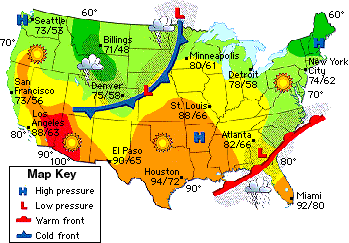

Which cities are probably experiencing stormy or rainy weather?
Los Angeles and Charleston
Seattle and Chicago
Chicago and Little Rock

What kind of weather is New York City most probably having?
Hot and humid
Clear, sunny skies with light wind
Rainy and possible storms
What percentage of Earth is covered by water?
20%
90%
60%
70%
The amount of water collected in a space
condensation
accumulation
transpiration
evapotranspiration
What two things drive the water cycle?
gravity and geothermal energy
the sun and precipitation
the sun and gravity
gravity and evapotranspiration

