wayground logo

Free Printable Worksheets

Font size

S
M
L
XL
Worksheets

SCI 8 - Earth's Interior Exam Review 2021

Total questions: 50

Worksheet time: 29mins

Name
Class
Date
1.

Which layer of the earth is made of LIQUID iron and nickel?

a)

Inner core

b)

Outer core

c)

Manthe

d)

Crust

2.
What are the two types of crust
a)
continental and oceanic
b)
ocean and upper
c)
lower and upper
d)
pizza and subway
3.

What is the correct order of Earth's Layers, starting from the surface, going toward the center?

a)

crust, outer core, inner core, mantle

b)

mantle, outer core, inner core, crust

c)

crust, mantle, outer core, inner core

d)

outer core, inner core, crust, mantle

4.
How do geologists observe Earth’s interior?
a)
by studying constructive forces 
b)
by directly looking under many layers 
c)
by recording and studying seismic waves
5.

S-waves cannot travel through the

a)

mantle

b)

outer core

c)

inner core

d)

crust

6.

All continents were once joined together as a supercontinent called

a)

Pangaea

b)

Cocos

7.

Evidence that the continents were once joined together

a)

South America and Africa fit together like puzzle pieces

b)

South America and Africa share fossils of Mesosaurus and Glossopteris

c)

South America and Africa both have rocks of the same age

d)

all of the above

8.

Evidence of crustal movement =

a)

faulting

b)

folding

c)

tilting

9.
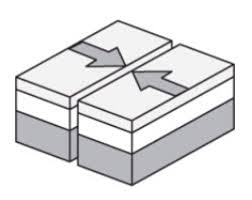
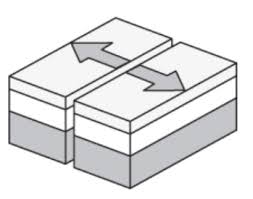
Name the boundary
a)
convergent boundary
b)
divergent boundary
c)
transform boundary
d)
sergent boundary
10.
Name the boundary
a)
convergent boundary
b)
divergent boundary
c)
transform boundary
d)
sergent boundary
11.
Name the boundary
a)
convergent boundary
b)
divergent boundary
c)
transform boundary
d)
sergent boundary
12.
Mountains form from ...
a)
plates sliding past one another
b)
collision of plates
c)
plates moving away from each other
13.
In the image, which type of boundary is shown? Hint: its located in the state of California. 
a)
divergent
b)
convergent
c)
transform fault
14.

Evidence of crustal movement =

a)

faulting

b)

folding

c)

tilting

15.

Earthquakes and volcanoes are found

a)

at plate boundaries

b)

in water

c)

on land

d)

in the sky

16.

A ________________ is a break in Earth's crust

a)

intrusion

b)

fault

c)

extrusion

d)

igneous rock

17.

Which layer has convection currents?

a)

Stiffer Mantle

b)

Outer Core

c)

Asthenosphere

d)

Crust

18.

Oceanic crust is ____________ and ____________ than continental crust

a)

thinner, less dense

b)

thinner, more dense

c)

thicker, less dense

d)

thicker, more dense

19.

Which part of Earth's crust is thicker, continental or oceanic?

a)

Oceanic

b)

Continental

20.

Scientists think that convection currents that move the plates flow in Earth's

a)

Continental crust

b)

Oceanic crust

c)

Mantle/Asthenosphere

d)

Lithosphere

21.
Plate movement is caused by ______________.
a)
the rotation of the Earth
b)
ocean tides
c)
convection currents in the mantle
d)
the moon's gravity
22.
Which layer is MOST dense?
a)
Mantle
b)
Crust
c)
Outer Core
d)
Inner Core
23.
P waves move through____
a)
Solids only
b)
Liquids only
c)
Solids and Liquids
d)
None of these
24.
S waves move through
a)
Solids only
b)
Liquids only
c)
Solids and liquids
d)
None of these
25.
Which layer of the Earth is the only liquid layer?
a)
Outer Core
b)
Inner Core
c)
Mantle
d)
Lithosphere
26.
Which of Earth's layers is made of SOLID iron and nickel?
a)
crust 
b)
mantle
c)
outer core
d)
inner core
27.

Which of the following increases as depth increases into the Earth? (choose all that apply)

a)

time

b)

Pressure

c)

temperature

d)

density

28.
Identify C
a)
Crust
b)
Mantle
c)
Outer Core
d)
Inner Core
29.
How do scientist know about the structure of the interior of the earth?
a)
By Drilling many holes
b)
Sound Waves
c)
Seismic Waves
d)
Ocean Waves
30.
Identify A
a)
Crust
b)
Mantle
c)
Outer Core
d)
Inner Core
31.
Identify D
a)
Crust
b)
Mantle
c)
Outer Core
d)
Inner Core
32.
Identify B
a)
Crust
b)
Mantle
c)
Outer Core
d)
Inner Core
33.
What is an instrument that detects and records waves produced by earthquakes? (This piece of equipment can measure the magnitude of an earthquake.)
a)
Epicenter
b)
Fault
c)
Seismogram
d)
Seismograph
34.
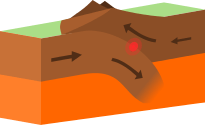
What type of plate boundary is this?
a)
Plate
b)
Divergent
c)
Convergent
d)
Transform
35.
Mountains are created when....
a)
Two continental plates collide
b)
Two oceanic plates pull apart
c)
An Oceanic plate subducts under a Continental Plate
d)
Two continental plates pull apart
36.
Earthquakes and volcanoes are most likely found in which locations?
a)
At plate boundaries
b)
in oceans
c)
in the middle of continents
d)
in the middle of plates
37.
Subduction happens at . . .
a)
When one plate SINKs or GOES UNDER
b)
ALL Divergent Plates
c)
ALL transform
d)
ALL Convergent
38.
What kind of plate boundary is shown here?
a)
divergent
b)
convergent
c)
transform
d)
strike slip
39.
A boundary where two plates move away from each other.
a)
convergent boundary
b)
divergent boundary
c)
transform boundary
d)
sergent boundary
40.
A boundary where two plates slide past each other.
a)
convergent boundary
b)
convergent boundary
c)
transform boundary
d)
sergent boundary
41.
A boundary where two plates collide into  each other.
a)
convergent boundary
b)
divergent boundary
c)
transform boundary
d)
sergent boundary
42.
What type of boundary creates new seafloor?
a)
convergent ocean ocean
b)
convergent ocean continental
c)
convergent continental continental
d)
divergent
43.

Tsunamis are caused by

a)

underwater disturbances such as earthquakes, landslides, and volcanoes.

b)

wind and the gravitational pull of the moon.

44.

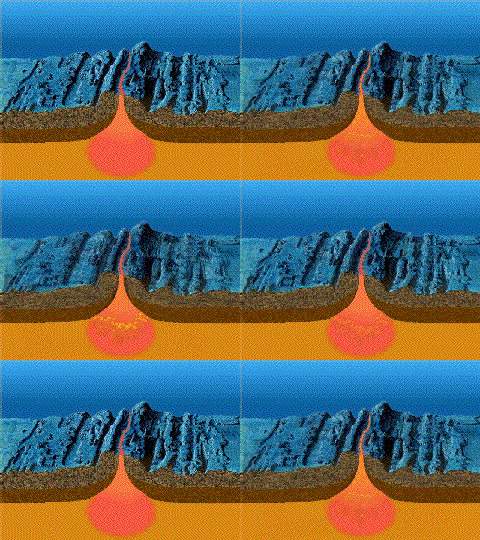
Which diagram correctly models the relative plate motion on each side of a mid-ocean ridge?

a)
b)
c)
d)
45.

What plate boundary feature is also shown?

a)

A ridge formed by a convergent boundary

b)

A valley forming at an divergent boundary

c)

A fault forming at a transform boundary

d)

A volcano formed by a convergent boundary

46.

Evidence of continental drift =

· matching _______ & _______on continents now separated by oceans

· South America and _______ fit together like puzzle pieces

a)

rocks only, Africa

b)

rocks & fossils, Asia

c)

rocks & fossils, Africa

d)

rocks & fossils, Asia & Africa

47.

Rock layers are deposited _____________

a)

vertically

b)

horizontally

c)

vertically & horizontally

48.

What is thinner, oceanic crust or continental crust?

a)

oceanic crust

b)

continental crust

49.
Where is the point on the Earth’s surface directly above the focus of an earthquake?
a)
Epicenter
b)
Fault
c)
Hypocenter
d)
Tremor
50.

Tsunamis warning given = move to _____________ ground

a)

higher

b)

lower