wayground logo

Free Printable Worksheets

Font size

S
M
L
XL
Worksheets

Unit 6: States of Matter

Total questions: 45

Worksheet time: 34mins

Name
Class
Date
1.

Which state of matter does NOT have a definite volume?

a)

solid

b)

liquid

c)

gas

d)

none

2.

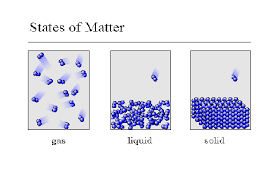
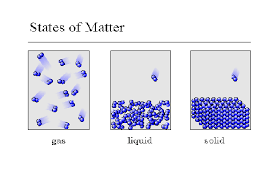
This model represents which state of matter?

a)

solid

b)

liquid

c)

gas

3.

Why does your hand feel cold when you hold an ice cube?

a)

The ice transfers cold to your hand

b)

Your hand transfers heat to the ice

4.

Temperature is a measure of the average...

a)

kinetic energy

b)

potential energy

c)

thermal energy

5.

The particles in a _______ slide past each other.

a)

solid

b)

liquid

c)

gas

6.

Which substance would have the lowest viscosity?

a)

honey

b)

a milkshake

c)

water

d)

ketchup

7.

What phase change occurs when a mirror fogs up when you take a shower?

a)

evaporation

b)

boiling

c)

condensation

d)

melting

8.

Adding thermal energy can cause which phase change(s)?

a)

freezing

b)

melting

c)

boiling

d)

condensation

9.

Which particles would be moving the fastest?

a)

water at 20 degrees C

b)

ice at 0 degrees C

c)

water at 40 degrees C

d)

water at 100 degrees C

10.

The weakest attractive forces exist between particles of a:

a)

solid

b)

liquid

c)

gas

11.

When a solid changes to a liquid it is:

a)

freezing

b)

boiling

c)

vaporizing

d)

melting

12.
A gas
a)
has a definite shape but no definite volume
b)
has a definite volume but no definite shape
c)
has fast-moving particles
13.
What term describes a solid changing to a gas?
a)
Deposition
b)
Sublimation
c)
Evaporation
d)
Freezing
14.
The speed of the molecules determines the _____.
a)
volume
b)
density
c)
pressure
d)
temperature
15.
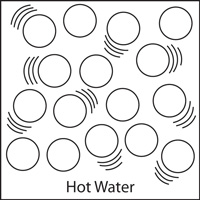
Which state of matter has particles arranged like this?
a)
solid
b)
liquid
c)
gas
16.
What happens to the particles when I add heat?
a)
The particles get bigger
b)
The particles get smaller
c)
The particles get slower
d)
The particles get faster
17.
What happens when my glass of water is sitting in the sun and disappears into a gas?
a)
evaporation
b)
burning
c)
melting
d)
freezing
18.
My glass of ice water is sitting in the sun and has droplets of water on the outside of the glass. What is happening?
a)
condensation
b)
evaporation
c)
melting
d)
freezing
19.
Which form of matter does not take the shape of its container?
a)
liquid
b)
gas
c)
solid
d)
air
20.

When a substance is placed at a temperature BELOW its freezing point, it will exist as a:

a)

solid

b)

liquid

c)

gas

21.
The phase change from water vapor to liquid water is known as...
a)
evaporation
b)
precipitation
c)
condensation
d)
sublimation
22.
What happens to particles when they are heated?
a)
They speed up and spread out
b)
They slow down and compress
c)
They stop moving
d)
They move closer together and speed up
23.
How are solids different from liquids?
a)
particles in solids are moving freely around each other.
b)
particles in solids have no motion.
c)
particles in solids are vibrating in place.
d)
particles in solids have more motion than in liquids
24.
What is sublimation?
a)
phase change between solid and liquid
b)
pahse change from gas to solid
c)
phase change from solid to gas
d)
phase change from solid to solid
25.
What is deposition?
a)
Phase change from gas to solid
b)
phase change from liquid to solid
c)
Phase change from solid to gas
d)
Phase change from liquid to gas
26.

What happens when the speed of particles decreases?

a)

Their temperature decreases

b)

Their temperature increases

c)

Their mass decreases

d)

Their mass increases

27.

When ice sits out on a counter and melts, it is because the ice has...

a)

gained mass

b)

gained energy

c)

lost mass

d)

lost energy

28.
What happens when my glass of water is sitting in the sun and disappears into a gas?
a)
evaporation
b)
burning
c)
melting
d)
freezing
29.
Which form of matter does not take the shape of its container?
a)
liquid
b)
gas
c)
solid
d)
air
30.
How is a gas defined?
a)
Indefinite shape, indefinite volume
b)
Definite shape, definite volume
c)
Found in stars
d)
Definite volume, indefinite shape
31.

What state of matter does the picture below represent?

a)

solid

b)

liquid

c)

gas

d)

plasma

32.
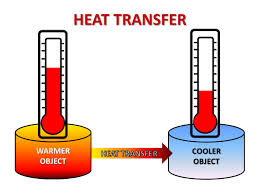
Heat transfers from an area of ____temperature to an area of ___ temperature.
a)
high to low
b)
low to high
c)
high to high
d)
It can travel high to low and low to high. 
33.

Temperature of a material depends upon the average —————— of its particles

a)

Kinetic energy

b)

Thermal energy

c)

Heat energy

d)

Particle energy

34.

The average kinetic energy of the particles in iced tea is —————than the average kinetic energy of the particles in hot tea.

a)

louder

b)

Prettier

c)

Higher

d)

Lower

35.

Molecules with more kinetic energy move ———- than molecules with less kinetic energy

a)

Lower

b)

Faster

c)

Higher

d)

Slower

36.
7. All phase changes (changing states) requires energy to be added or taken away.
a)
True
b)
False
37.
Vaporization includes _____________ and  _____________.
a)
melting and boiling
b)
condensation and boiling
c)
sublimation and freezing
d)
evaporation and boiling
38.
What is the change from a Solid to a Gas due to the gaining of energy?
a)
Condensation
b)
Vaporization
c)
Sublimation
d)
Deposition
39.
At higher temperatures
a)
particles in an object have less energy
b)
particles in an object move faster
c)
a gas contracts
40.
How are solids different from liquids?
a)
particles in solids are moving freely around each other.
b)
particles in solids have no motion.
c)
particles in solids are vibrating in place.
d)
particles in solids have more motion than in liquids
41.
Change from gas to liquid...
a)
condensation
b)
evaporation
c)
expansion
d)
movement
42.

Dew often forms on grass in the early morning as water vapor in the air turns into a liquid. What do we call the phase change that causes dew to form?

a)

condensation

b)

evaporation

c)

deposition

d)

sublimation

43.

Use the graph below to answer this question. At which point is the substance a solid?

a)

A

b)

C

c)

E

d)

F

44.

Use the graph below to answer this question. What state of matter would the substance be at point F?

a)

solid

b)

liquid

c)

gas

45.
Molecules are far apart and are in constant motion.
a)
Solid
b)
Liquid
c)
Gas