wayground logo

Free Printable Worksheets

Font size

S
M
L
XL
Worksheets

No Bones About It

Total questions: 77

Worksheet time: 55mins

Name
Class
Date
1.

What bone is highlighted?

a)

Skull (Cranium)

b)

Mandible

c)

Clavicle

d)

Scapula

2.

What bone is highlighted?

a)

Skull (Cranium)

b)

Mandible

c)

Scapula

d)

Clavicle

3.

What bone is highlighted?

a)

Skull (Cranium)

b)

Scapula

c)

Clavicle

d)

Mandible

4.

What bone is highlighted?

a)

Skull (Mandible)

b)

Clavicle

c)

Mandible

d)

Scapula

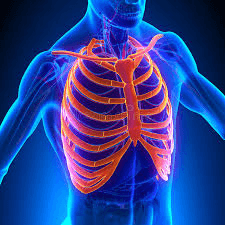
5.

What bone is highlighted?

a)

Ribs

b)

Vertebrae

c)

Clavicle

d)

Femur

6.

What bone is highlighted?

a)

Radius

b)

Ulna

c)

Humerus

d)

Carpals

7.

What bone is highlighted?

a)

Vertebrae

b)

Radius

c)

Pelvis

d)

Ribs

8.

What bone is highlighted?

a)

Radius

b)

Ulna

c)

Humerus

d)

Carpals

9.

What bone is highlighted?

a)

Radius

b)

Ulna

c)

Humerus

d)

Carpals

10.

What bone is highlighted?

a)

Femur

b)

Tibia

c)

Fibula

d)

Humerus

11.

What bone is highlighted?

a)

Patella

b)

Pelvis

c)

Clavicle

d)

Femur

12.

What bone is highlighted?

a)

Patella

b)

Pelvis

c)

Clavicle

d)

Mandible

13.

What bone is highlighted?

a)

Tibia

b)

Fibula

c)

Femur

d)

Humerus

14.

What bone is highlighted?

a)

Tibia

b)

Fibula

c)

Radius

d)

Ulna

15.

From wrist to fingertip, what is the order of bones?

a)

Carpals, metacarpals, phalanges

b)

Phalanges, metacarpals, carpals

c)

Carpals, phalanges, metacarpals

d)

Metacarpals, carpals, phalanges

16.

From ankle to toe, what is the order of bones?

a)

Tarsals, metatarsals, phalanges

b)

Phalanges, metatarsals, tarsals

c)

Metatarsals, phalanges, tarsals

d)

Tarsals, phalanges, metatarsals

17.
What is the place where two bones meet?
a)
hinge
b)
bone
c)
spot
d)
joint
18.
What is the name for the connector that attaches muscle to bone?
a)
ligament
b)
tendon
c)
patella
d)
string
19.
What is the name for the connector that attaches bone to bone?
a)
ligament
b)
tendon
c)
patella
d)
string
20.

Which of the following is not a function of bones?

a)

Protection

b)

Blood cell formation

c)

Storage

d)

Absorption

21.
Bone formed by needlelike pieces of bone and lots of space are called
a)
Spongey bone
b)
Cartilage
c)
Compact bone
22.
The adult skeletal system is composed of how many bones?
a)
216
b)
371
c)
206
d)
199
23.
The _________________ gives the body its shape and supports and protects the internal organs.
a)
urinary system
b)
skeletal system
c)
lympthatic/immune system
d)
endocrine system
24.
The shaft of the bone
a)
diaphysis
b)
epiphysis
c)
medullary cavity
d)
matrix
25.
Which term best describes the joints at the top of your skull?
a)
motionless
b)
flexible
c)
rubbery
d)
elastic
26.
Which type of joint give you the largest range of motion?
a)
pivot
b)
ball-and-socket
c)
hinge
d)
gliding
27.
The joints in your knees and elbows are most similar to:
a)
a clock
b)
a screw
c)
a wheel
d)
a door hinge
28.

The Skeletal System also produces

a)

Organs

b)

Rigidity

c)

Red and White Cells

d)

Muscle

29.

Bones are made of two main types of bone tissue:

a)

Spongy

b)

Medular

c)

Compact

d)

Fibrous

30.

The hard, outer portions of bones made of...

a)

Spongy Bone Tissue

b)

Calcium

c)

Compact Bone Tissue

d)

Sodium

31.

There are two types of Bone Marrow...

a)

Red

b)

White

c)

Yellow

d)

Brown

32.

It is located in the epiphysis and stores the growth cartilage...

a)

Bone Marrow

b)

Compact Bone Tissue

c)

Epiphyseal Line

d)

Spongy Bone Tissue

33.
A mature bone cell is called a _________.
a)
osteon
b)
osteocyte
c)
osteoclast
d)
osteoblast
34.
An osteocyte "lives" in __.
a)
lacunae
b)
lamellae
c)
Haversian canals
d)
Volkmann's canals
35.
Which type of bone cells are responsible for dissolving old bone matrix?
a)
Osteoblasts
b)
Osteoclasts
c)
Osteocytes
d)
Osteons
36.
The medullary cavity of a long bone is lined with a thin layer of connective tissue called the _________________.
a)
diaphysis
b)
endosteum
c)
periosteum
d)
epiphysis
37.
In newborns, certain cranial bones are NOT completely formed and instead are joined by membranous regions called ________.
a)
sinuses
b)
chitin
c)
fontanels
d)
osteons
38.
The bone building process is called?
a)
collagen
b)
ossification
c)
hypertrophy
d)
getting stronger
39.
Bone forming cells are called...
a)
osteoblasts
b)
osteocytes
c)
osteoclasts
d)
osteons
40.
Most bones of the skeleton are formed by...
a)
endochondral ossification
b)
gender specific ossification
c)
intramembranous ossification
d)
hyaline ossification
41.
Identify number 5. 
a)
Medullary cavity
b)
Compact bone
c)
Periosteum
d)
Diaphysis
42.
Tough and fibrous tissue that forms the outermost covering of bone.
a)
periosteum
b)
compact bone
c)
spongy bone
d)
endsteum
43.
Large bone; makes up the roof of the orbital and nasal cavities; "forehead". 
a)
frontal 
b)
sphenoid 
c)
parietal 
d)
ethmoid 
44.
What is this structure called?
a)
Mastoid Process
b)
Styloid Process
c)
Zygomatic Process
d)
External Acoustic Meatus
45.
What bone is this?
a)
Ethmoid
b)
Sphenoid
c)
Temporal
d)
Frontal
46.
What feature is this?
a)
Optic Canal
b)
Carotid Canal
c)
Foramen Magnum
d)
Jugular Foramen
47.
Which of the following is the function of the STYLOID and MASTOID Processes?
a)
Allow for muscle attachment
b)
Allow nerves to pass
c)
Allow blood vessels to pass
d)
Attach to facial bones
48.
a)
Zygomatic
b)
Frontal
c)
Parietal
d)
Lacrimal
49.
a)
Zygomatic
b)
Temporal
c)
Parietal
d)
Lacrimal
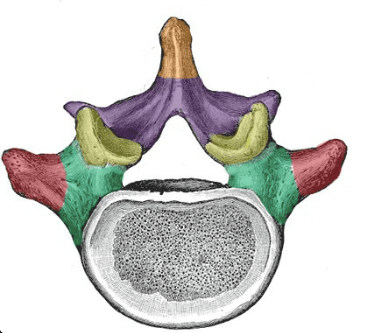
50.
The brown represents 
a)
transverse process
b)
spinous process
c)
foramen 
d)
body 
51.
The pink represents
a)
transverse process
b)
spinous process
c)
body 
d)
foramen 
52.
The bone indicated by #2 is the 
a)
parietal bone
b)
temporal bone
c)
ethmoid bone
d)
occipital bone
53.
forms sides and roof of skull; Curved bones; joined together at the sagittal suture
a)
temporal 
b)
parietal 
c)
occipital 
d)
frontal 
54.
thin, flat bones that form the back of the nasal septum 
a)
ethmoid 
b)
lacrimal 
c)
inferior nasal conchae 
d)
vomer
55.
a)
Frontal
b)
Sphenoid
c)
Zygomatic
d)
Maxilla
56.
_____ is found at letter C?
a)
Sagital Suture
b)
Coronal Suture
c)
Occipital Suture
d)
Lamboidal Suture
57.
The bone indicated by #1 is the 
a)
parietal bone
b)
temporal bone
c)
ethmoid bone
d)
occipital bone
58.
How many cervical vertebrae exist in the spine? 
a)
7
b)
12
c)
5
d)
4
59.
There are __________ lumbar vertebrae. 
a)
12
b)
5
c)
7
d)
6
60.
How many thoracic vertebra exist in the spinal column? 
a)
15
b)
5
c)
12
d)
7
61.
The section of spine directly below the cervical region is called the
a)
Lumbar
b)
Thoracic
c)
Sacral
d)
Coccyx
62.
The fused portion of the spine located in the pelvic region is called the
a)
lumbar
b)
sacral
c)
cervical
d)
thoracic
63.
Inferior portion of the sternum; made of cartilage; cone shaped
a)
coracoid process
b)
acromion process
c)
xiphoid process
d)
scapula
64.
How many pairs of true ribs are there? 
a)
12
b)
2
c)
5
d)
7
65.
Which bone does the sternal end of the clavicle attach to?
a)
Body
b)
Manubrium
c)
Xiphoid Process
d)
Vertebral Rib 1
66.
What two bones make up the shoulder girdle?
a)
Scapula and Clavicle
b)
Scapula and Humerus
c)
Humerus and Clavicle
d)
Sternum and Clavicle
67.
How many floating ribs are there? 
a)
12
b)
2
c)
4
68.
Breastbone; flat, elongated bone that protects the heart and lungs
a)
clavicle
b)
sternum 
c)
scapula
d)
rib
69.
These are immovable joints that hold the skull bones together
a)
Facial
b)
Sutures
c)
Squamous
d)
Vomer
70.
Which marking is this?
a)
Iliac crest
b)
Pubis
c)
Ilium
d)
ischium
71.
Which marking is this?
a)
Iliac crest
b)
Pubis
c)
Ilium
d)
Ischium
72.
Which marking is this?
a)
Iliac crest
b)
Pubis
c)
Ilium
d)
Ischium
73.
How many bones make up the toes? 
a)
10
b)
12
c)
14
d)
16
74.
What is another name for the tailbone? 
a)
Sacrum
b)
Pubis
c)
Coccyx
d)
Talus
75.
How many pairs of floating ribs are there? 
a)
12
b)
2
c)
4
d)
7
76.
a)
calcaneus
b)
talus
c)
cuneiform
d)
navicular
77.

The majority of joints in the body are

a)

fibrous joints

b)

synovial joints

c)

cartilaginous joints

d)

joint capsules