wayground logo

Free Printable Worksheets

Font size

S
M
L
XL
Worksheets

Everything DNA Review Quizziz

Total questions: 75

Worksheet time: 1hrs 2mins

Name
Class
Date
1.
What are the nucleotides made of?
a)
Sugar, Phosphate, nitrogen base
b)
Phosphate, Adenine, nitrogen base
c)
Thymine, Adenine, Cytomine
d)
Phosphate, Nitrogen, Adenine
2.
Which of the following best describes a DNA molecule?
a)
double helix
b)
contains ribose
c)
made of amino acids
d)
contains Uracil
3.
Which of the following units are repeatedly joined together to form a strand of DNA? (This is the MONOMER of DNA.) 
a)
amino acids
b)
nucleotides
c)
fatty acids
d)
polysaccharides
4.
Adenine bonds with ______________.
a)
Guanine
b)
Thymine
c)
Cytosine
d)
Adenine
5.
Guanine bonds with ______________.
a)
Adenine
b)
Guanine
c)
Cytosine
d)
Thymine
6.
Why is DNA important?
a)
it is very small and very complicated
b)
it's in everything
c)
it serves as the blueprint for traits of all living things
d)
because we eat it every day for energy
7.
What are the 4 nitrogen bases?
a)
adenine, thymine, cytoplasm, and guanine
b)
adenine, thymine cytosine, and guanine
c)
adenine, thymine, cytosine, and gylcerol
d)
adenine, thymine, cytosine, and glucose
8.
Which 2 molecules forms the sides (backbone) of the DNA ladder?
a)
deoxyribose and adenine
b)
deoxyribose and a hydrogen bond
c)
sugar and the nucleus
d)
deoxyribose (sugar) and phosphate
9.
Which organelle is DNA usually found in?
a)
cell membrane
b)
vacuole
c)
chloroplast
d)
nucleus
10.
Which sequence of DNA bases would pair with this partial strand
ATG TGA CAG
a)
ATG TGA CAG
b)
TAC ACT GTC
c)
GTA AGT GAC
d)
CAT TCA CTG
11.
Has a deoxyribose sugar
a)
DNA
b)
RNA
12.
The sides of the double helix
a)
sugar phosphate
b)
nucleotides
c)
nitrogen bases
13.
A five-carbon sugar found in DNA.
a)
ribose
b)
guanine
c)
deoxyribose
d)
helicase
14.
DNA codes for...
a)
cholesterol
b)
proteins
c)
fatty acids
d)
carbohydrates
15.
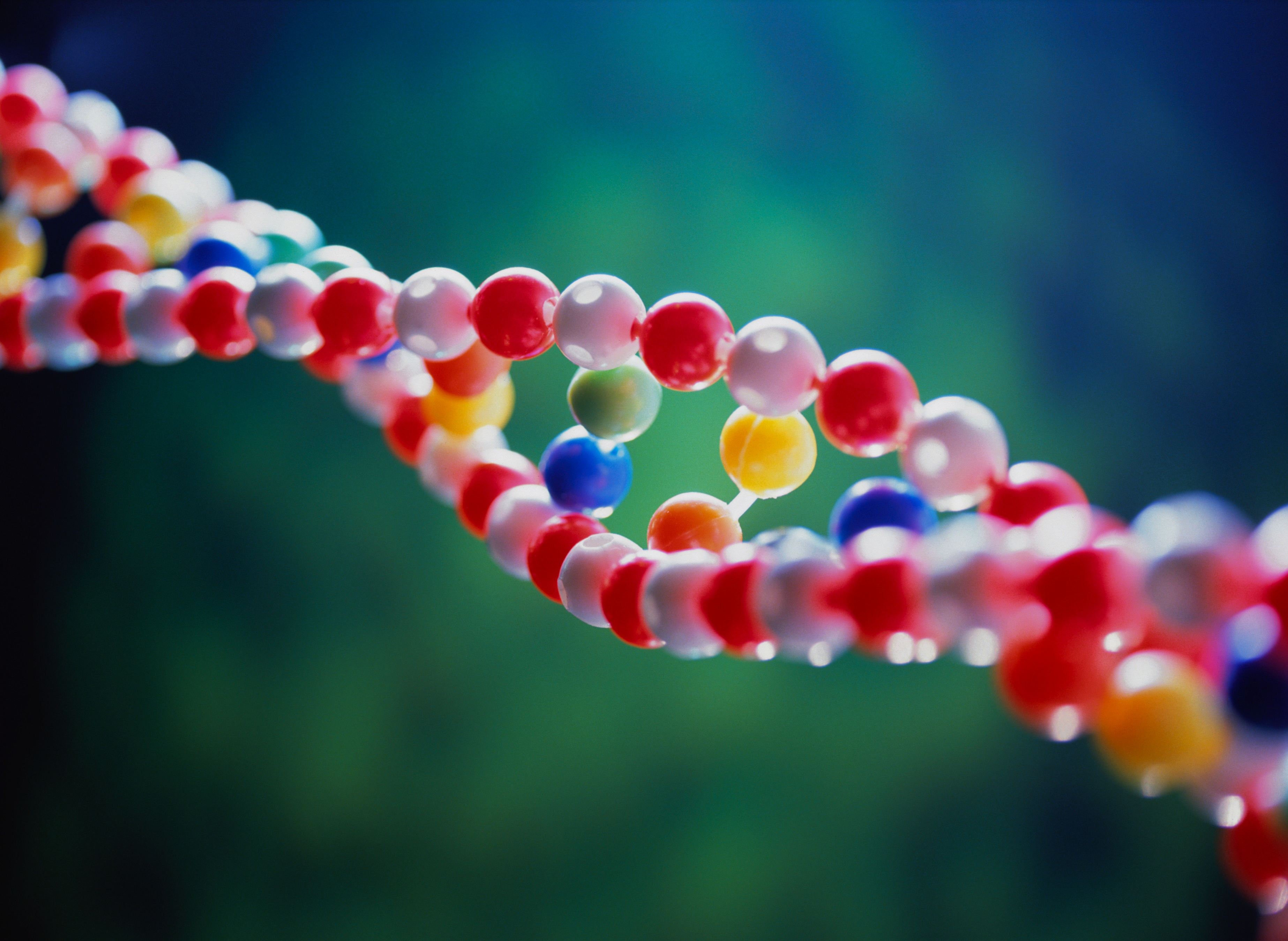
Name this structure
a)
double helix
b)
nucelotide
c)
twisted ladder
d)
hydrogen bond
16.
Which shows the correct complementary base pairing for DNA?
a)
C-A, T-G
b)
A-G, C-T
c)
C-G, U-A
d)
T-A, G-C
17.
What does DNA stand for?
a)
Deoxyribonucleic acid
b)
Denitrogenous acid
c)
Deribonucleic acid
d)
Diribonucleic acid
18.
What is the correct complementary strand for the following DNA?ATCGAG
a)
TACGAG
b)
ATCGAG
c)
TAGCTG
d)
TAGCTC
19.
What determines the code, or information, of a DNA molecule?
a)
the shape (structure) of the nitrogen bases
b)
the order (sequence) of the nitrogen bases
c)
the color of the nitrogen bases
d)
the frequency (number) of nitrogen bases
20.
In a molecule of double-stranded DNA, the amount of Adenine present is always equal to the amount of
a)
cytosine
b)
guanine
c)
thymine
d)
uracil
21.

What enzyme unwinds and separates the DNA?

a)

Primase

b)

Polymerase

c)

Ligase

d)

Helicase

22.

This enzyme adds nucleotide after the RNA Primer is attached.

a)

Polymerase

b)

Endonuclease

c)

GTPase

d)

Endoribonuclease

23.

Why is DNA semiconservative?

a)

Because the new DNA molecule consist of 1 parental and 1 new DNA strand

b)

Because the new DNA molecule consist of 2 parental and 2 new DNA strands

c)

Because the new DNA molecule consist of reassembled parental and new strands

d)

Because the new DNA molecule fiscally conservative and socially progressive

24.

Why does DNA need to replicate?

a)

to fix errors

b)

for copies of DNA to be in every new cell

c)

to make new humans

d)

Ms McGuire and Mrs Burke said so

25.

Which substance creates a flag or starting point for DNA replication?

a)

Helicase

b)

Polymerase

c)

Primase

d)

Ligase

26.
DNA replication results in two DNA molecules,
a)
each one with two original strands
b)
each one with two new strands
c)
each one with one new strand and one original strand
d)
one with two new strands and the other with two original strands
27.
Are all mutations bad?
a)
Yes
b)
No
28.
Original DNA: CAT GAT
New DNA: CAT AT
What mutation occurred?
a)
deletion
b)
substitution 
c)
tranverse
d)
insertion
29.
Gene: ABCDEF
Mutation: ACEFCD
What mutation?
a)
deletion
b)
substitution
c)
inversion
d)
insertion
30.
DNA molecule segment is : TTACGCAAG
The mutated DNA segment is TTCGCAAG. This is an example of ___ mutation.
a)
Substitution
b)
Deletion
c)
Insertion
d)
Inversion
31.
What do hurtful mutations do? 
a)
Decrease chances of survival 
b)
Increases changes of survival 
c)
Decreases likelihood of developing cancer
d)
Increases likelihood of developing cancer
32.
Which of the following is an example of a hurtful mutation? 
a)
Developing cancer
b)
Makes the organism faster
c)
Makes the organism a predator 
d)
Develops sharp claws
33.
What do helpful mutations do? 
a)
Increases chances of survival 
b)
Decreases changes of survival 
c)
Increases chances of developing cancer
d)
Decreases skills
34.
Which of the following is an example of a helpful mutation? 
a)
Develops speed 
b)
Decreases speed
c)
Increases weight gain 
d)
Develops no camflauge 
35.
What is the definition of DNA mutation? 
a)
The original DNA strand
b)
The strand with four pairs 
c)
A change in the DNA strand
d)
The strand in a double helix 
36.

Which type of mutation is like pulling books off a bookshelf?

a)

insertion

b)

deletion

c)

missense

d)

nonsense

e)

duplication

37.

Which type of mutation is like putting multiple copies of a book on a bookshelf?

a)

insertion

b)

deletion

c)

missense

d)

nonsense

e)

duplication

38.

Which types of mutation add DNA to the nucleus?

a)

duplication

b)

deletion

c)

missense

d)

nonsense

39.

Which types of mutations take DNA away from the nucleus?

a)

insertion

b)

deletion

c)

missense

d)

nonsense

e)

duplication

40.

Mutations can benefit humans because they can:

a)

Cause illness

b)

Make an organism more suited to live in its environment.

c)

Make organisms live shorter lives

d)

Cause organisms to grow extra limbs.

41.

Mutations can be negative because

a)

They can cause cancer

b)

They can cause birth defects

c)

They can help an organism thrive in its environment.

d)

They can effect offspring.

42.

A mutation is defined as:

a)

A change in the cell's structure

b)

Anything that changes in an embryo

c)

Any change in the physical features of a human

d)

A change in the DNA sequence

43.
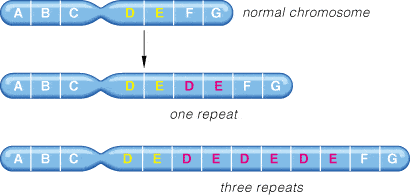
What type of chromosomal mutation is this?
a)
Inversion
b)
Translocation
c)
Deletion
d)
Duplication
44.

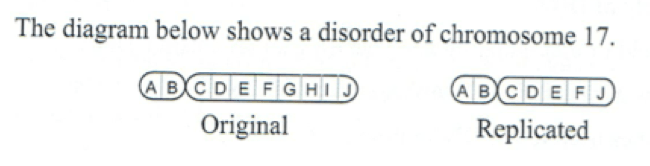
The chromosome mutation in this picture is known as _________.

a)

inversion

b)

deletion

c)

insertion

d)

duplication

45.
Identify the mutation in the picture.
a)
Inversion
b)
Deletion
c)
Duplication
d)
Translocation
46.
Identify the mutation in the picture.
a)
Inversion
b)
Duplication
c)
Deletion
d)
Translocation
47.
Identify the mutation in the picture.
a)
Deletion
b)
Inversion
c)
Duplication
d)
Translocation
48.
What type of chromosomal mutation has occurred?
a)
substitution
b)
insertion
c)
deletion
d)
nondisjunction
49.

The structure that holds two sister chromatids together until they separate for cell division is called a...

a)

chromosome

b)

chromatin

c)

centromere

d)

centriole

50.

The structures labeled B are

a)

centrioles

b)

sister chromatids

c)

centromeres

d)

chromatin

51.

In the following structure, the circled item is a

a)

chromosome

b)

chromatid

c)

centromere

d)

chromatin

52.
When DNA is in its less coiled, "relaxed," state, between cell divisions, it is called
a)
autosomes
b)
chromatid
c)
chromatin
d)
centromere
53.

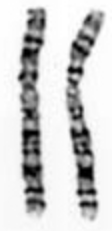
the molecule in the figure is?

a)

chromoatin

b)

chromatid

c)

chromosome

d)

sister chromatid

54.
How many DNA molecules make up a chromosome?
a)
1
b)
2
c)
23
d)
46
55.
Which of these organisms has more chromosomes than humans?
a)
chimpanzees
b)
potatoes
c)
plums
d)
all of these -- the number of chromosomes does not determine complexity of the organism
56.
The number of nucleotides in a human cell is about
a)
3000
b)
300,000
c)
3 million
d)
3 billion
57.

Looks like spaghetti or unraveled yarn that appears when the cell is not doing anything.

a)

Chromosomes

b)

Chromatin

c)

Double Helix

58.

Looks like an X that appears when the cell is doing something (replication, division)

a)

Double Helix

b)

Chromatin

c)

Chromosome

59.

This is made up of DNA and found in the nucleus of cells

a)

Chromosome

b)

Chromatin

c)

Canada

60.

This is the more condensed and organized form of DNA that occurs in pairs and has centromere and chromatids

a)

Chromatin

b)

Chromosome

c)

Double helix

61.
Which structure is labeled as A in the diagram?
a)
Centromere
b)
Chromosome
c)
Sister chromatids
62.
Nondisjunction can result in 
a)
trisomy conditions
b)
monosomy conditions
c)
additional sex chromosomes
d)
all of these
63.
A pair of identical chromosomes shown in a karyotype, one inherited from mom, and one inherited from dad are called
a)
sister chromotids
b)
centromeres
c)
homologous chromosomes
d)
autosomes
64.
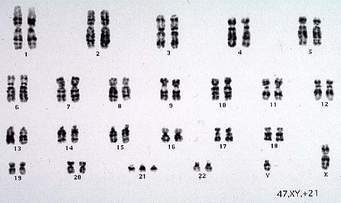
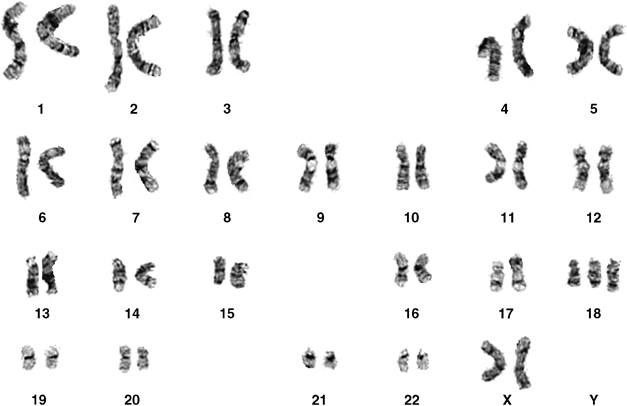
What makes this individual's karyotype not normal?
a)
An extra sex chromosome
b)
An extra autosome
c)
A missing sex chromosome
d)
A missing autosome
65.
What is the sex of this individual?
a)
female
b)
male
66.
What is the sex of this individual?
a)
female
b)
male
67.
Chromosome pairs 1-22 are referred to as
a)
sex chromosomes
b)
sister chromatids
c)
a karyotype
d)
autsomes
68.
Determine the sex of the individual whose karyotype is displayed in the image.
a)
female
b)
male
69.
Which sex chromosomes would indicate a typical human male?
a)
XX
b)
X
c)
XY
d)
XXY
70.

A normal human zygote should have _____ chromosomes inside.

a)

46

b)

23

c)

92

d)

64

71.
Is this Karyotype human?
a)
Yes
b)
No
c)
Impossible to Determine
72.
Based on the Karyotype shown, at which chromosome pair can we identify a genetic disorder? 
a)
Chromosome pair 5
b)
sex chromosomes
c)
Chromosome pair 21
d)
There are no chromosomal disorders
73.
What is the chromosomal condition of the individual whose karyotype is seen in the image?
a)
Monosomy X (Turner's Syndrome)
b)
Trisomy 21 (Down's Syndrome)
c)
Trisomy 13 (Patau Syndrome)
d)
Trisomy 18 (Edwards's Syndrome)
74.

How many chromosomes do human cells have?

a)

46

b)

23

c)

2

d)

44

75.

This is an example of a _______.

a)

karyotype

b)

autosome

c)

haploid

d)

centromere