Wayground logo

Free Printable Worksheets

Font size

S
M
L
XL
Worksheets

AP Bio Evolution Review

Total questions: 41

Worksheet time: 2hrs 37mins
Name
Class
Date
1.
What is the advantage of having different shaped beaks?
a)
To look different from other species.
b)
To be able to eat the food readily available in the environment.
c)
To protect itself against predators.
d)
To protect itself against prey.
2.
Remains of ancient organisms are called
a)
Extinctions
b)
Fossils
c)
Mutations
d)
Variations
3.
A well-tested concept that explains a wide range of observations is called a(an):
a)
hypothesis
b)
experiment
c)
cause and effect
d)
scientific theory
4.
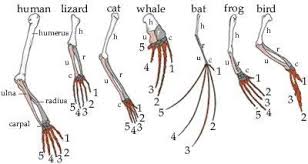
What is this an example of?
a)
vestigial structures
b)
embryology
c)
homologous structures
d)
fossil record
5.
Which of the following is a term for a group of similar organisms that can reproduce fertile offspring?
a)
individual
b)
population
c)
species
d)
fossil
6.
a measure of how commonly a particular allele occurs in a population is known as the 
a)
gene pool
b)
allele frequency
c)
mutation rate
d)
phenotype
7.
An inherited characteristic that increases an organism's ability to survive and reproduce in its specific environment is called (n)
a)
vestigial structure
b)
adaptation
c)
speciation
d)
analagous structure
8.
Which of the following would an animal breeder use to increase the number of cows that give the most milk?
a)
overproduction
b)
genetic isolation
c)
acquired characteristics
d)
artificial selection
9.
Genetic variation can arise from a random change in the DNA of a gene.  The change is called a(n)
a)
mutation
b)
gene flow
c)
gene pool
d)
allele
10.
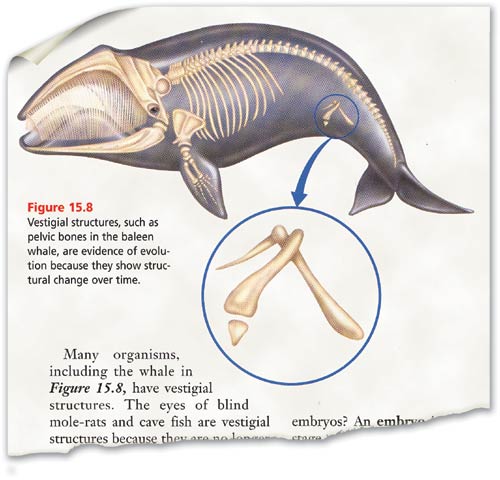
Which of the following is an example of a vestigial structure?
a)
the wings of a red-tailed hawk
b)
the hind limbs of a house cat
c)
the fins of sharks
d)
the tailbone of a human
11.
What type of speciation involves geographic isolation?
a)
Allopatric
b)
Sympatric
c)
Both
12.
What is genetic drift?
a)
The movement of genes in/out of a population
b)
A small, random change in the DNA
c)
Any change in the allelic frequencies in a population that is due to chance
d)
›The process in which humans select for or against particular features in organisms
13.
What type of selection is this?
a)
Directional Selection
b)
Stabilizing Selection
c)
Disruptive Selection
d)
Natural Selection
14.
What type of selection is this?
a)
Directional Selection
b)
Stabilizing Selection
c)
Disruptive Selection
d)
Natural Selection
15.
What type of selection is this?
a)
Directional Selection
b)
Stabilizing Selection
c)
Disruptive Selection
d)
Natural Selection
16.
Different mating times
a)
temporal
b)
behavioral
c)
geographic
d)
other
17.
Reproductive isolating mechanism (RIM) that acts after fertilization of egg by sperm.
a)
Prezygotic
b)
Postzygotic
c)
Premating
d)
Postmating
18.
Reproductive isolating mechanism (RIM) that acts to prevent fertilization of egg by sperm.
a)
Prezygotic
b)
Postzygotic
c)
Premating
d)
Postmating
19.
A reproductive barrier that occurs before the sperm fertilizes the egg is a...
a)
Prezygotic barrier
b)
Postzygotic barrier
c)
Allopatric
d)
Sympatric
20.
Fruit flies are beginning to live & mate on different types of fruit on the floor of the Amazon. Bigger fruit flies prefer rotting mangos, while smaller fruit flies prefer rotting bananas. What type of reproductive barrier is this?
a)
habitat isolation
b)
temporal isolation 
c)
gametic isolation
d)
mechanical isolation 
21.

Which free-living cells were the earliest contributors to the formation of Earth's oxidizing atmosphere?

a)

chloroplasts

b)

cyanobacteria

c)

mitochondria

d)

seaweeds

e)

endosymbionts

22.

Two species of fish belonging to the same genus occasionally mate, but the offspring fail to develop and hatch. What is the mechanism for keeping the two fish species separate?

a)

adaptation

b)

the postzygotic barrier called hybrid breakdown

c)

the postzygotic barrier called hybrid inviability

d)

the prezygotic barrier called hybrid sterility

e)

gamete isolation

23.

Occurs when environmental conditions fluctuate between two opposite extreme values.

a)

Artificial selection

b)

Distruptive selection

c)

Directional selection

d)

Stabilizing selection

24.
In the Hardy-Weinberg Equation, q2 is the frequency of what?
a)
The recessive allele 
b)
the dominant allele
c)
the recessive genotype
d)
the dominant genotype
25.
The Hardy-Weinberg Model is?
a)
Available at local hobby stores and retailers throughout the Greater Cleveland area.
b)
A mathematical tool that biologists can use to predict allele frequencies and determine whether or not evolution is occurring within a population.
c)
Always occurring within populations of organisms in nature.
d)
Only useful in the lab and cannot be practically applied to real-world populations of organisms.  
26.
In the early 2000s, White Nose fungus caused a mass die-off of native American bat species. Those bats that survived will continue the population with their own allele frequencies.  What type of genetic drift is this?
a)
Founder Effect
b)
Bottlenose Effect
c)
Bottleneck Effect
d)
Migration Effect
27.
A migratory bird unknowingly accumulates a few seeds of the hwagha plant in her feathers and drops them in an area where those plants did not live before.  This is an example of
a)
Founder Effect
b)
Predation
c)
Bottleneck Effect
d)
Migration
28.
The wing of a bat and a humans' arm have different functions and appear very different.  Yet, the underlying anatomy is basically the same.  therefore, these structures are examples of
a)
geographic isolation
b)
analogous structures
c)
homology
d)
reproductive isolation
29.
What does the variable q represent?
a)
Frequency of the heterozygote genotype
b)
Frequency of the homozygous recessive genotype
c)
The frequency of the recessive allele
d)
The frequency of the dominant allele 
30.

In H-W Equilibrium, what is p?

a)

hilarious genotype

b)

heterozygous genotype

c)

the homozygous recessive genotype

d)

the dominant allele frequency

31.

In H-W Equilibrium, what is 2pq?

a)

hilarious genotype

b)

heterozygous genotype

c)

the homozygous recessive genotype

d)

the homozygous dominant genotype

32.
Which Hardy-Weinberg equation represents the genotype frequencies in a population?
a)
p + q = 1
b)
p2 + 2pq + q2 = 1
c)
p2 + pq2 + q2 = 1
d)
p + 2pq + q3 = 1
33.

In Stanley Miller's and Harold Urey's experiment what chemical was intentionally left out?

a)

oxygen

b)

hydrogen

c)

methane

d)

ammonia

34.

In what way are protocells similar to living cells?

a)

They have a semipermeable membrane and can grow and divide

b)

They contain genetic material

c)

They have a phospholipid bilayer

d)

They contain true proteins similar to the ones found in living cells

35.

According to the theory of endosymbiosis, how did cells acquire mitochondria?

a)

A eukaryotic cell engulfed a virus

b)

A large aerobic cell engulfed a chloroplast

c)

A large anaerobic cell engulfed a small aerobic bacterium

d)

A large anaerobic cell engulfed a photosynthetic bacterium

36.

According to theory of endosymbiosis, how did plant cells evolve

a)

An anaerobic cell engulfed a chloroplast

b)

An aerobic, eukaryotic cell engulfed a photosynthetic bacterium

c)

An anaerobic cell engulfed a small aerobic bacterium

d)

A large anaerobic cell engulfed a photosynthetic bacterium

37.

The idea that Earth's early oceans had organic molecules that became the first life is called the..

a)

Primordial soup hypothesis

b)

Bubble hypothesis

c)

Miller-Urey Experiment

d)

Radioactive dating theory

38.

Which scientist(s) tested the primordial soup model by using an electrical spark to produced amino acids from the molecules believed to be present on early Earth?

a)

Oparin-Haldane

b)

Miller-Urey

c)

Pasteur

d)

Spallanzani

39.

How are mitochondria and chloroplasts like bacteria cells?

a)

They divide by meiosis

b)

They can make their own food

c)

They have the same membrane-bound organelles

d)

They contain their own DNA

40.
Which of the following does not support the RNA world hypothesis, which states that RNA functioned as the first genetic material in early protobionts?
a)
Many of the most critical elements of cells are composed mostly or entirely of RNA.
b)
RNA has been demonstrated to act as a catalyst in modern cells.
c)
Modern cells use an RNA template when synthesizing proteins.
d)
In modern cells, RNA provides the template on which DNA nucleotides are assembled.
41.

In H-W Equilibrium, what is p?

a)

the homozygous dominant genotype

b)

heterozygous genotype

c)

the homozygous recessive genotype

d)

the dominant allele frequency