wayground logo

Free Printable Worksheets

Font size

S
M
L
XL
Worksheets

PRIBADI DEPOK PARTICLE PHYSICS PART 02

Total questions: 40

Worksheet time: 28mins

Name
Class
Date
1.

Particles that are affected by strong nuclear force is in belong to which family?

a)

Hadron

b)

Lepton

2.

Particle that are not affected by strong nuclear force belong to which family?

a)

Baryon

b)

Lepton

3.

Hadron are made by smaller particle that is called?

a)

Quarks

b)

Meson

4.

How many quarks does baryon is made of?

a)

1

b)

2

c)

3

5.

How many quarks does meson is made of?

a)

1

b)

2

c)

3

6.

Below are the member of baryon except!

a)

proton

b)

neutron

c)

electron

7.
The word "atom" means what?
a)
"indivisible"
b)
"Adam"
c)
"extremely small"
d)
"indestructible"
8.
Almost all of the mass of an atom is found in what part?
a)
The electron cloud
b)
The nucleus
c)
The protons
d)
The charge
9.

How is alpha radiation used non-medically?

a)

In smoke alarms

b)

In thickness gauges

c)

In medical tracers

d)

In detecting leaks in pipes

10.
In a correctly written symbol what would be located in the "A" position?
a)
number of neutrons
b)
atomic number
c)
number of electrons 
d)
mass number
11.

Which of the following accurately describe isotopes?

a)

Isotopes are elements that are beside each other in the periodic table.

b)

Isotopes are atoms that has the same number of protons but different number of electrons.

c)

Isotopes have similar physical properties but different chemical properties.

d)

Isotopes are atoms that has the same number of protons but different number of neutrons.

12.
A particle that is not made out of any smaller component constituent parts is called?
a)
a. the elementary particle
b)
b. the primary particle
c)
c. the electron neutrino 
d)
d. the anti-neutrino
13.
Name given for the particles that have the same mass but all other properties are opposite.
a)
a. anti-matter 
b)
b. anti-particles 
c)
c. annihilate 
d)
d. dark matte
14.
Which particle is not involved in β+ decay? 
a)
 a.  electron 
b)
b. positron 
c)
c. proton 
d)
d. neutrino
15.
Which particle is not involved in β- decay?
a)
a.  electron 
b)
b. positron 
c)
c. proton 
d)
 d. anti-neutrino
16.
A particle that is made out of quarks is?
a)
a. hadron 
b)
b. lepton 
c)
c. boson 
d)
d. meson
17.
What is the name of a particle/hadron where three quarks combine?
a)
a. baryon 
b)
b. lepton 
c)
c. boson 
d)
d. meson
18.
What is the name of a particle/hadron where three anti - quarks combine?
a)
a. anti-baryon 
b)
b. anti-lepton 
c)
c. anti-boson 
d)
d. anti-meson
19.
What is the name of a particle/hadron where a quark combines with an anti-quark?
a)
a. quark 
b)
b. lepton 
c)
c. boson 
d)
d. meson
20.
A baryon made out of two u quarks and one d quark (uud).
a)
a. proton 
b)
b. neutron 
c)
c. boson 
d)
d. meson
21.
A baryon made out of two d quarks and one u quark (udd).
a)
a. proton 
b)
b. neutron 
c)
c. boson 
d)
d. meson
22.
What is the electric charge of the proton?
a)
a. + 1 
b)
b. 0 
c)
c. - 1 
d)
d. can’t tell
23.
Which of the following interactions do leptons not experience?
a)
a. strong interaction
b)
b. weak interaction 
c)
c. electromagnetic interaction
d)
d. gravitational interaction
24.
In the standard model, the particle considered to be an elementary particle is a(n)
a)
proton
b)
neutron
c)
electron
d)
alpha particle
25.
All atoms consist of mostly empty space.
a)
True
b)
False
26.
All of the following are quarks except 
a)
strange
b)
bottom
c)
charmed
d)
fundamental
27.
 The three types of nuclear radiation in increasing order of penetrating power are ____.
a)
gamma, beta, alpha
b)
alpha, gamma, beta
c)
alpha, beta, gamma
d)
beta, gamma, alpha
28.
An alpha particle consists of 
a)
two protons, two neutrons, and two electrons.
b)
two neutrons and two electrons.
c)
two protons and two neutrons.
d)
two protons and two electrons.
29.
When uranium (92 protons) ejects an alpha particle, the nucleus left behind has 
a)
92 protons.
b)
91 protons.
c)
90 protons.
d)
89 protons.
30.
When thorium (90 protons) ejects a beta particle, the resulting nucleus has 
a)
88 protons.
b)
89 protons.
c)
90 protons.
d)
91 protons.
31.
Solve this equation for alpha decay.
85209At = ___ + 24He
a)
83205Bi
b)
86209Rn
c)
81207Tl
d)
85208At
32.
Solve this equation for beta decay.
614C = ___ + -10e
a)
410Be
b)
714N
c)
210He
d)
613C
33.

If Uranium 238 decays, emitting an alpha particle, it will become;

a)

Uranium 234

b)

Thorium 238

c)

Thorium 234

d)

None of these are correct

34.
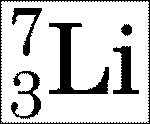
How many protons are in this atom?
a)
3
b)
4
c)
6
d)
10
35.
What sort of shield will block gamma rays?
a)
skin
b)
paper
c)
aluminum
d)
thick lead
36.
What do carbon-12 and carbon-14 have in common? 
a)
They have the same number of protons
b)
They have the same number of neutrons
c)
 They have the same atomic mass
d)
They have the same atomic weight
37.
What particle completes this reaction?
a)
alpha particle
b)
beta particle
c)
gamma particle
d)
neutron
38.
The charge on a gamma particle is...
a)
-1
b)
0
c)
+1
d)
+2
39.
Which type of radiation has the greatest penetrating power?
a)
Alpha
b)
Beta
c)
Gamma 
d)
Microwaves
40.

What is the approximate size of an atom?

a)

1 x 10⁻¹ m

b)

1 x 10¹⁰ m

c)

1 x 10⁻¹⁰ m

d)

1 x 10 -100m