wayground logo

Free Printable Worksheets

NEW

Font size

S
M
L
XL
Worksheets

Earth's Structures_Unit Test Review

Total questions: 56

Worksheet time: 43mins
Name
Class
Date
1.
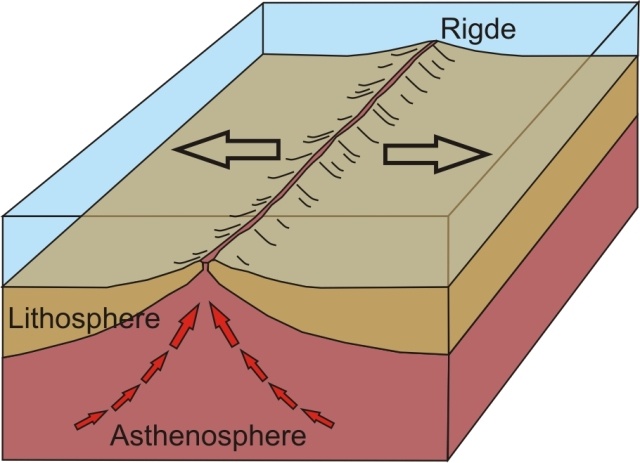
What kind of plate boundary is shown here?
a)
divergent
b)
convergent
c)
transform
d)
subducting
2.
What kind of plate boundary is shown here?
a)
divergent
b)
convergent
c)
transform
d)
submergent
3.
What is the best explanation for why oceanic crust is subducted by continental crust?
a)
The oceanic crust is cooler than continental crust.
b)
Continental crust is denser than oceanic crust.
c)
Oceanic crust is denser than continental crust.
d)
The oceanic crust is hotter than continental crust.
4.
Which of the following is associated with transform boundary?
a)
volcanoes
b)
mountains
c)
trenches
d)
earthquakes and fault line
5.
The volcanoes on the Hawaiian Islands form due to which of the following?
a)
Divergent Boundary
b)
Hot Spot
c)
Subduction Boundary
d)
Transform Boundary
6.
What is Magma when it reaches the surface of Earth?
a)
Lava
b)
Mafic Magma
c)
Felsic Magma
d)
None of these
7.
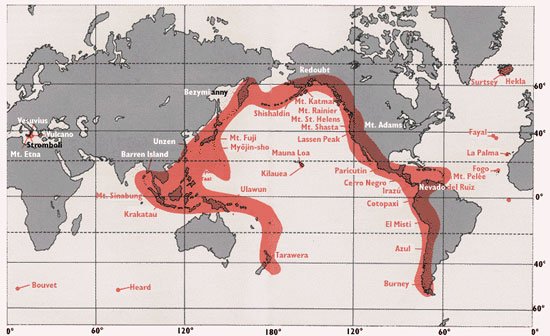
This is the name for the chain of volcanos around the edge of the Pacific Plate.
a)
Circle of Fire
b)
Ring of Lava
c)
Ring of Fire
d)
Circle of Magma
8.
What is molten rock that has formed deep within the Earth?
a)
Hot Spot
b)
Magma
c)
Lava
d)
Volcano
9.
The thinnest layer of the Earth is the ___________.
a)
mantle
b)
crust
c)
core
10.
What is the thickest layer of the Earth?
a)
the crust
b)
the mantle
c)
the outer core
d)
the inner core
11.
What describes the outer core?
a)
solid
b)
liquid
c)
viscous
d)
gas
12.
Why is the inner core solid?
a)
its unknown
b)
what it's made of
c)
the pressure
d)
it is colder than the outer core
13.

What layer is a semisolid and acts like a plastic?

a)

Lithosphere

b)

inner core

c)

Asthenosphere

d)

crust

14.

The oceanic crust is composed of_____.

a)

Granite

b)

Basalt

c)

Cookies

d)

Water

15.

The continental crust is mainly composed of ______.

a)

Flowers and grass

b)

Basalt

c)

Granite

d)

Crust

16.
What happens to pressure as we move from the crust to the inner core?
a)
Pressure Decreases
b)
Pressure Increases
c)
Nothing
17.
Which layer of Earth has the GREATEST density?
a)
crust
b)
mantle
c)
outer core
d)
inner core
18.
Which layer of Earth is made up of tectonic plates?
a)
outer core
b)
inner core
c)
asthenosphere
d)
lithosphere
19.

Sea-floor spreading begins at a

a)

Deep ocean trench

b)

Mid-ocean ridge

c)

Continent's edge

20.

The process that forms deep-ocean trenches is called...

a)

sea-floor spreading

b)

adding material to the ocean floor

c)

subduction

21.
The land feature that happens when there is subduction is called a...
a)
mid-ocean ridge
b)
deep-ocean trench
c)
asthenosphere
22.

Where is new crust formed?

a)

mid-ocean ridge

b)

deep-ocean trench

c)

asthenosphere

23.
Which of the following causes Earth's tectonic plates to move?
a)
Energy from the Sun
b)
Magnetic Pole Reversal
c)
Convection currents in the mantle
d)
Faults in Mountain Ranges
24.
What geologic feature/event would you most likely to find at a convergent boundary between two pieces of continental crust?
a)
Volcano
b)
Mountain
c)
Rift
d)
Island Arc
25.

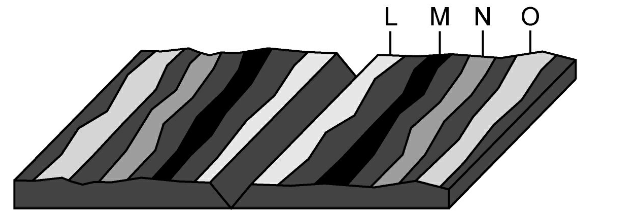
Where would the oldest rock be found at the mid-ocean ridge pictured above?

a)

L

b)

M

c)

N

d)

O

26.
Which type of rock results from melting and cooling of magma?
a)
Igneous
b)
Metamorphic
c)
Sedimentary
d)
Extrusive
27.
Which type of rock forms from extreme heat and pressure?
a)
Igneous
b)
Sedimentary
c)
Organic
d)
Metamorphic
28.
A metamorphic rock changes into an igneous rock by what two processes?
a)
Melting and cooling
b)
Extreme heat and pressure
c)
Compaction and cementation
d)
Weathering and erosion
29.
Wind, water, and ice breaking down rock is called
a)
Erosion
b)
Deposition
c)
Compaction
d)
Weathering
30.
What is the MAIN way rocks are classified?
a)
Their color and shapes
b)
How they form
c)
Mineral bands
d)
Where they form
31.
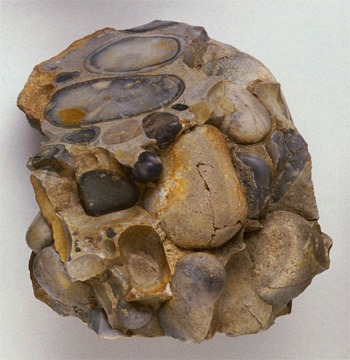
This rock was formed by smaller pieces of rock that settled at the bottom of a lake millions of years ago. What type of rock is this?
a)
Sedimentary
b)
Igneous
c)
Metamorphic
32.
Two ways to describe types of igneous rocks are _____
a)
Extrusive and Intrusive
b)
Foliated and Non-Foliated
c)
Clastic and Biochemical
d)
Black and Gray
33.
How do Intrusive Igneous rocks cool?
a)
quickly
b)
slowly
c)
really fast
34.
Wind, water, ice and gravity carry sediments away
a)
weathering
b)
deposition
c)
erosion
d)
cementation
35.
Sediment that is left behind in rivers lakes and oceans
a)
weathering
b)
erosion
c)
cementation
d)
deposition
36.
When the weight of new  sediment layers is deposited on top of older layers
a)
erosion
b)
compaction
c)
pressure
d)
weathering
37.
The color of a mineral in powder form is called the mineral's 
a)
hardness
b)
specific gravity
c)
luster
d)
streak
38.
How light reflects off of a mineral is called the mineral's 
a)
luster
b)
streak
c)
cleavage
d)
fracture
39.
A rock which contains a useful mineral is call a/an
a)
gem
b)
quarry
c)
ore
d)
alloy
40.
Dull, silky, waxy, pearly, and earthy are terms that best describe which property of minerals?
a)
luster
b)
color
c)
streak
d)
cleavage
41.
What are the 3 main fossil fuels?
a)
Coal, Oil, and Gasoline
b)
Coal, Oil, and Natural Gas
c)
Electricity, Gasoline, Petroleum
d)
Coal, Oil, Non-renewable Resources
42.
Fossil fuels are classified as nonrenewable because they.......
a)
require expensive equipment
b)
take millions of years to replace
c)
can be found all over 
d)
provide all the energy we use
43.
The Appalachian Mountains used to be pointed like the Rockies. What process lead to the roundedness of their peaks?
a)
Weathering
b)
Deposition
c)
Lightning Strikes
d)
Mining of the rock
44.
What is coal made of?
a)
decomposed animal and plant remains
b)
water
c)
electricity
d)
all of the above
45.

What type of fault is the San Andreas in California?

a)

Convergent

b)

Transform

c)

Optimus Prime

d)

Divergent

46.

All of the following are reasons some buildings are damaged more than others during an earthquake EXCEPT....

a)

The strength of the building materials.

b)

How close the building was to the earthquake's epicenter.

c)

What type of soil the building sat on.

d)

The people living inside of the building.

e)

The design of the building.

47.

Which of the following creates new crust?

a)
b)
c)
48.
Earthquakes and volcanoes are most likely found in which locations? 
a)
at plate boundaries
b)
in oceans
c)
in the middle of continents
d)
in the middle of plates
49.
Most geologists rejected Alfred Wegener's idea of continental drift because...
a)
it did not agree with their current theory
b)
Wegener was interested in what Earth was like millions of years ago
c)
Wegener used several different types of evidence to support his hypothesis
d)
Wegener could not identify the force that moved the continents
50.

According to the continental drift hypothesis, the presence of similar fossils in South America and Africa supports which scientific idea?

a)

Animals easily and frequently travel from Africa to South America.

b)

Species of animals probably traveled between continents on natural rafts (such as trees destroyed in tsunamis).

c)

Land bridges once existed that connected the continents.

d)

South America and Africa were once connected together.

51.
How does evidence of glaciation in Africa support the Theory of Continental Drift?
a)
It shows that the continents must have been in a different location.
b)
It doesn't. 
c)
I shows that it was colder at the equator in the past.
d)
It shows that it was warmer at the equator in the past.
52.

What causes an earthquake?

a)

Sudden release of energy

b)

Sudden release of magma

c)

Sudden release of shaking

d)

Sudden release of heat

53.

Hotspots are volcanoes that form...

a)

at convergent plate boundaries.

b)

at divergent plate boundaries.

c)

at transform plate boundaries.

d)

in the middle of a tectonic plate.

54.

Which two landforms are caused by convergent boundaries?

a)

a trench and a mid-oceanic ridge

b)

mountains and an oceanic trench

c)

a ridge and a rift valley

d)

a Rift Valley and an oceanic trench

55.
During chemical weathering, what can happen to the type of rock that has undergone chemical weathering?
a)
a new rock is produced that is larger than the original rock
b)
a new rock is produced that is the same as the original rock
c)
a new rock is produced that is different from the original rock 
d)
no new rock is created - it is just smaller in size
56.

Sand dunes are example of

a)

dryness

b)

wind

c)

weathering

d)

deposition