wayground logo

Free Printable Worksheets

Font size

S
M
L
XL
Worksheets

Unit 3 Waves and Earth

Total questions: 89

Worksheet time: 1hrs 24mins

Name
Class
Date
1.
a)

Reflection

b)

Refraction

c)

Diffraction

d)

Interference

e)

Absorption

2.

When a wave strikes an object and bounces off of it

a)

Absorption

b)

Diffraction

c)

Refraction

d)

Reflection

3.
a)

absorption

b)

diffraction

c)

reflection

d)

refraction

e)

transmission

4.
a)

absorption

b)

diffraction

c)

reflection

d)

refraction

e)

interference

5.
What is a medium?
a)
something between a small and a large?
b)
the substance through which a wave can travel
c)
a pattern of vibration that simulates when a wave is standing still
d)
the distance from any point on a wave to an identical point on the next wave
6.
You can see this text, your desk, and the person in front of you because light is being _______.
a)
absorbed
b)
refracted
c)
diffracted
d)
reflected
7.
When a wave passes from one medium to another, the ________ may change.
a)
speed
b)
frequency
c)
wavelength
d)
speed, frequency, and wavelength
8.
The Law of Reflection:
The angle of incidence is _________ the angle of reflection
a)
bigger than
b)
the same as
c)
smaller than
9.

The orca uses this behavior of waves to locate food.

a)

Refraction

b)

Reflection

c)

Absorption

d)

Diffraction

e)

Interference

10.
A student placed a pencil in a cup of water.  The pencil appears broken because light-
a)
always travels in a straight line
b)
bends when it passes through water
c)
makes the water in the glass evaporate
d)
reflects the pencil on the water's surface
11.

A rainbow forms when white light separates into different colors during?

a)

Absorption

b)

Scattering

c)

Refraction

d)

Diffraction

12.
According to the Law of reflection, a light ray striking a mirror
a)
continues moving through the mirror in the same direction
b)
moves into the mirror at a slightly different angle
c)
bounces off the mirror toward the direction it came from
d)
bounces off the mirror at the same angle it hits.
13.
According to the Law of reflection, a light ray striking a mirror
a)
continues moving through the mirror in the same direction
b)
moves into the mirror at a slightly different angle
c)
bounces off the mirror toward the direction it came from
d)
bounces off the mirror at the same angle it hits.
14.

When the car moves AWAY from you, its horn seems...

a)

Low pitched

b)

High pitched

c)

Normal

15.

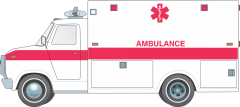
When an ambulance move TOWARD you it sounds ________ pitched.

a)

high

b)

low

c)

normal

16.
When two waves combine to form a new wave with a smaller amplitude, it is called 
a)
Refraction
b)
Constructive Interference
c)
Resonance
d)
Destructive Interference
17.
This wave has the second highest frequency on the spectrum. 
a)
microwaves
b)
visible light
c)
x-rays
d)
gamma ray
18.
Wavelengths on the right side of the Electromagnetic spectrum are ______________.
a)
short
b)
long
c)
average
19.
When the crest of one wave passes through the trough of another wave, ______ takes place.
a)
resonance
b)
diffraction
c)
destructive interference
d)
constructive interference
20.
A tuning fork starts to vibrate when a certain note is played on the piano, This is an example of _______.
a)
resonance
b)
refraction
c)
diffraction
d)
reflection
21.
In ________ interference, the energy of the combined wave is greater than the energy of each of the two waves.
a)
destructive
b)
rarefaction
c)
resonance
d)
constructive
22.
When 2 waves meet and there amplitude increases it is known as what?
a)
Constructive Interference
b)
Amplitude Addition
c)
Positive Interference
d)
Destructive Interference
23.
The bouncing back of a ray of light, sound, or heat when the ray hits a surface that it does not penetrate
a)
A. refraction
b)
B. reflection
c)
C. resonance
d)
D. standing wave
24.
What colors are in the rainbow?
a)
Red,orange,yellow,green,blue,indigo,purple
b)
Red,orange,yellow,green,blue,purple
c)
red,orange,orange,yellow,blue,purple
d)
red,orange,yellow,green,blue,blue,purple
25.
How far does the rainbow go?
a)
25 miles
b)
everywhere
c)
Nobody knows
d)
35 miles
26.
Rainbows are often seen
a)
after a rainstorm
b)
before a rainstorm
c)
after the sun sets at night
d)
before a storm
27.
What color is NOT in a rainbow
a)
yellow
b)
indigo
c)
orange
d)
pink
28.
Rainbows are produced when
a)
light exits many raindrops at different angles
b)
the sun causes a rainstorm
c)
the spectrum causes a rainstorm
d)
the sun comes out after a storm
29.
Rainbows are produced when
a)
light exits many raindrops at different angles
b)
the sun causes a rainstorm
c)
the spectrum causes a rainstorm
d)
the sun comes out after a storm
30.
What best describes the doppler effect?
a)
An apparent change in frequency of a wave due to the relative motion between a wave source and an observer
b)
When sound changes pitch
c)
When light changes color
d)
An apparent change in the amplitude of a wave due to the relative motion between a wave source and an observer.
31.

You stand on the sidewalk next to the street. A fire truck is moving towards you. The frequency of the siren on the fire truck is 600 Hz.


What should you hear?

a)

Frequency higher than 600 Hz

b)

Frequency lower than 600 Hz

c)

Exactly 600 Hz

d)

No sound, silence.

32.

You stand on the sidewalk next to the street. A fire truck is away from you. The frequency of the siren on the fire truck is 600 Hz.


What should you hear?

a)

A higher pitch of sound.

b)

A lower pitch of sound.

c)

A changing sound (up and down)

d)

No sound, silence.

33.
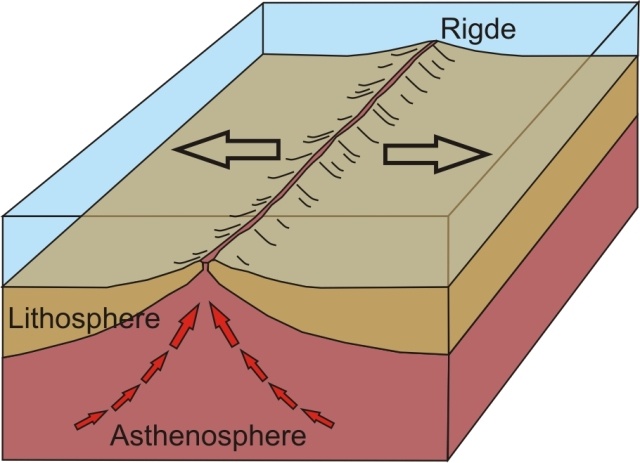
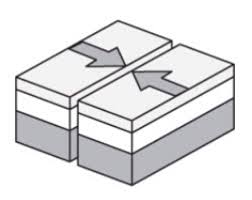
What kind of plate boundary is shown here?
a)
divergent
b)
convergent
c)
transform
d)
subducting
34.
What kind of plate boundary is shown here?
a)
divergent
b)
convergent
c)
transform
d)
submergent
35.
What kind of plate boundary is shown here?
a)
divergent
b)
convergent
c)
transform
d)
strike slip
36.
What geologic feature/event you be most likely to find at a transform boundary?
a)
Earthquakes
b)
Volcanoes
c)
Mountains
d)
Rift Valleys
37.
What geologic feature/event would you most likely to find at a divergent boundary between two pieces of oceanic crust?
a)
Rift Valley
b)
Mid-Ocean Ridge
c)
Island Arc
d)
Flat land
38.
What geologic feature/event would you most likely to find at a divergent boundary between two pieces of continental crust?
a)
Mid-Ocean Ridge
b)
Mountain
c)
Rift Valley
d)
Island Arc
39.
What geologic feature/event would you most likely to find at a convergent boundary between two pieces of continental crust?
a)
Volcano
b)
Mountain
c)
Rift
d)
Island Arc
40.
A subduction zone is formed...
a)
when one tectonic plate sinks below another
b)
at every type of convergent plate boundary
c)
at every type of divergent plate boundary
d)
at transform boundaries
41.
Name the boundary
a)
convergent boundary
b)
divergent boundary
c)
transform boundary
d)
sergent boundary
42.
Name the boundary
a)
convergent boundary
b)
divergent boundary
c)
transform boundary
d)
sergent boundary
43.
In which type of boundary do the plates move away from each other?
a)
convergent
b)
normal
c)
divergent
d)
transform
44.
The area where two or more plates meet is called a __________________.
a)
fault
b)
plate boundary
c)
plate edge
d)
ring of fire
45.
Plates slide past one another at ____________ boundaries.
a)
divergent
b)
convergent
c)
transform
d)
submergent
46.
Plates move towards one another at ______________ boundaries.
a)
divergent
b)
convergent
c)
transform
d)
detergent
47.
A giant landmass that existed 200 million years ago
a)
Wegener
b)
Pangaea
c)
Archyopteryx
d)
Ammonite
48.
The Theory of Continental Drift states that Pangaea broke apart and the continents "drifted" away from each other
a)
True
b)
False
49.
What is this a picture of?
a)
plate tectonics
b)
continental drift
c)
pangea
d)
glacier scaring
50.
What does the theory of continental drift state?
a)
The continents were once joined in a super-continent and have moved over time
b)
Continents are stationary and do not move
c)
The Earth is broken into lithospheric plates that move due to convection currents
d)
none of the above
51.
What two specific continents fit together most noticeably?
a)
Africa and North America
b)
South America and Europe
c)
South America and Africa
d)
Antartica and Africa
52.
The Theory of Continental Drift states that the continents drifted together to form Pangaea
a)
True
b)
False
53.
Which piece of evidence did Wegener use to prove continental drift?
a)
The shape of the continents
b)
Similar fossils found on separate continents
c)
Tree fossils found in odd places
d)
All of the above
54.
Name the boundary
a)
convergent boundary
b)
divergent boundary
c)
transform boundary
d)
sergent boundary
55.
Which type of event often occurs along transform fault boundaries? 
a)
volcanoes
b)
earthquakes
c)
sea-floor spreading
d)
mountain building
56.
A collision between two pieces of continental crust at a converging boundary produces a
a)
mid ocean ridge
b)
deep ocean trench
c)
rift valley
d)
mountain range
57.
What are the two types of crust
a)
continental and oceanic
b)
ocean and upper
c)
lower and upper
d)
pizza and subway
58.
which one is hotter?
a)
the crust
b)
mantle 
c)
Inner core
59.
High frequency waves have _________ wavelengths.
a)
varying
b)
long
c)
the same
d)
short
60.

If long wavelength is equal to low frequency, and red has the LONGEST wavelength of all the colors,

a)

then RED has a high frequency.

b)

then RED has a low frequency.

61.

If short wavelength is equal to high frequency, and VIOLET has the shortest wavelength of all the colors,

a)

then VIOLET has a high frequency.

b)

then VIOLET has a low frequency.

62.
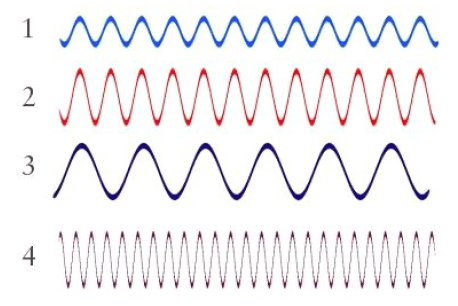
Which wave in the diagram has the greatest wavelength?
a)
1
b)
2
c)
3
d)
4
63.
The number of wavelengths that pass a point each per second is:
a)
frequency
b)
period
c)
longitudinal 
d)
transverse wave 
64.
_____________________ is the distance between a point on one wave and the identical point of the next wave.
a)
Amplitude
b)
Wavelength
c)
Frequency
d)
Crest
65.

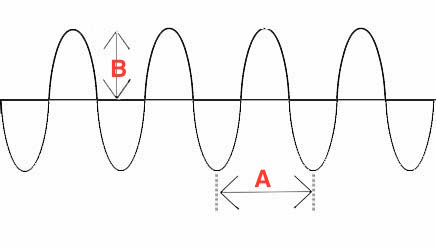
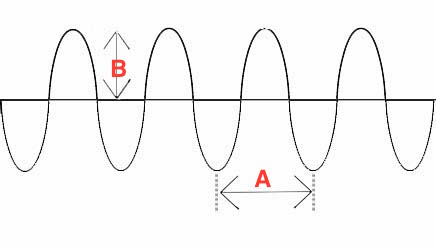
What property of this wave is represented by the letter "A"

a)

amplitude

b)

crest

c)

trough

d)

wavelength

66.
What property of the wave is represented by the letter "B"?
a)
amplitude
b)
crest
c)
trough
d)
wavelength
67.
The highest point on a wave is:
a)
the crest
b)
the trough
c)
the top
d)
the coast 
68.
crest to crest or trough to trough
a)
crest
b)
trough
c)
amplitude
d)
wavelength
69.
The number of wavelengths that pass a point each per second is:
a)
frequency
b)
period
c)
longitudinal 
d)
transverse wave 
70.
All waves carry ________ as they travel from one place to another.
a)
matter
b)
space
c)
energy
d)
water
71.
One end of the rope is vibrated to produce a wave with a wavelength of .25 m.  The Frequency of the wave is 3.0 Hz.  What is the speed of the wave?
a)
3.00 m/s
b)
2.50 m/s
c)
.75 m/s
d)
1.25 m/s
72.
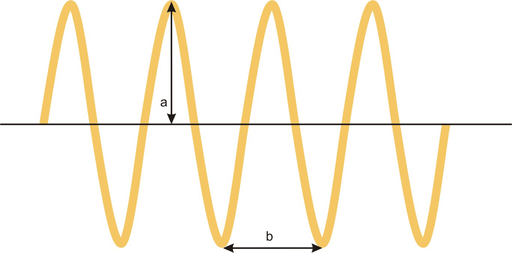
How many waves are in this wave chain?
a)
6
b)
3
c)
4
d)
5
73.
 A wave has frequency of 50 Hz and a wavelength of 10 m. What is the speed of the wave?
a)
500 m/s
b)
50 m/s
c)
5 m/s
d)
0.5 m/s
74.
A wave has wavelength of 10 m and a speed of 340 m/s. What is the frequency of the wave?
a)
34 m/s
b)
3400 Hz
c)
3400 m/s
d)
34 Hz
75.
One end of the rope is vibrated to produce a wave with a wavelength of .25 m.  The Frequency of the wave is 3.0 Hz.  What is the speed of the wave?
a)
3.00 m/s
b)
2.50 m/s
c)
.75 m/s
d)
1.25 m/s
76.
Where is the epicenter located?
a)
A
b)
B
c)
C
d)
There is no epicenter
77.
Where is the focus located?
a)
A
b)
B
c)
C
d)
There is no focus
78.
What is the name of the waves given off by an earthquake? 
a)
Seismic waves
b)
Radiation waves
c)
Sound waves
d)
Compaction waves
79.
Which of these places is likely to have an earthquake? 
a)
California because of the San Andreas fault
b)
Iowa because of the corn fault
c)
New York because of the Empire Fault
d)
No places are more likely to have earthquakes than others
80.
What type of fault is the San Andreas?
a)
Convergent
b)
Transform
c)
Optimus Prime
d)
Divergent
81.
An instrument that detects and measures earthquakes is a 
a)
seismogram
b)
focus seismic map
c)
focus
d)
seismograph 
82.
The point on Earth's surface directly above an earthquake's starting point or focus. 
a)
Hot spot
b)
Focus
c)
Moho point
d)
Epicenter
83.
Which color has the highest frequency?
a)
red
b)
orange
c)
green
d)
blue
84.
Which color has the least amount of energy?
a)
red
b)
orange
c)
green
d)
blue
85.

Richter scales are used to measure

a)

the size of a volcanic eruptions

b)

the strength of a tornado

c)

the magnitude of an earthquake

d)

the power of flood waters flowing over land

86.
A mountain that forms as molten rock flows through a crack into Earth’s surface.
a)
Volcano
b)
Earthquake
c)
Hill
d)
Sand Dune
87.

are destructive and constructive the same

a)

no

b)

yes

88.
Constructive interference will cause the wave to 
a)
Increase its displacement
b)
Decrease its displacement 
c)
Make its displacement stay the same
89.
Destructive interference is 
a)
When the two waves affect  each other in a negative way 
b)
The two waves add together and produce a single wave of greater amplitude
c)
Are in phase