wayground logo

Free Printable Worksheets

Font size

S
M
L
XL
Worksheets

Cell Biology

Total questions: 120

Worksheet time: 2hrs 50mins

Name
Class
Date
1.
The cells produced via meiosis are called:
a)
sex cells
b)
somatic cells
c)
body cells
d)
skin cells
2.
Unlike mitosis, meiosis in male mammals results in the formation of
a)
one haploid gamete
b)
three diploid gametes
c)
four diploid gametes
d)
four haploid gametes
3.
If the Diploid number of Carrots is 18, the haploid number is
a)
18
b)
9
c)
27
d)
36
4.
If a body cell in a butterfly contains 24 chromosomes, a butterfly egg would contain
a)
3
b)
6
c)
12
d)
24
5.
The chromosomes that pair up during meiosis, are called __________ chromosomes.  
a)
homozygous 
b)
asexual
c)
homologous
d)
genes
6.
Identify the phase.
a)
Metaphase I
b)
Metaphase II
c)
Prophase I
d)
Anaphase II
7.
How many daughter cells are produced from meiosis ?
a)
10
b)
6
c)
4
d)
2
8.
Name the growth phase of the cell cycle for both Mitosis and Meiosis.
a)
metaphase
b)
telophase
c)
interphase
d)
anaophase
9.
How many cells are produced during telophase I ?
a)
4
b)
8
c)
2
d)
0
10.
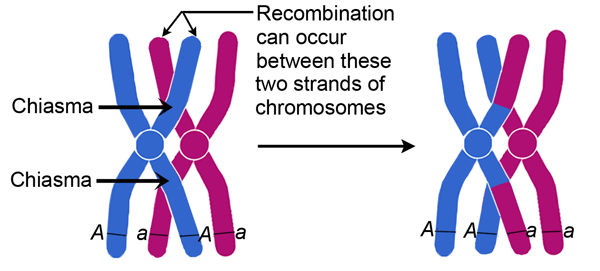
This image shows chromosomes during Prophase 1. Which of the following correctly describes the process shown?
a)
segregation of sister chromatids
b)
condensation and segregation of alleles
c)
mutationin which the DNA content of the gene is altered
d)
crossing - over in which alleles are exchanged
11.
Why do we need meiosis?
a)
To double the number of chromosomes going into sex cells
b)
To halve the number of chromosomes going into sex cells
c)
To triple the number of chromosomes going into sex cells
d)
To not change the number of chromosomes going into sex cells
12.
A human zygote should have _____ chromosomes inside.
a)
46
b)
23
c)
92
d)
64
13.
When an area of a chromatid is exchanged with the matching area on a chromatid of its homologous chromosome, _________________ occurs
a)
crossing over
b)
mutagenesis
c)
hybridization
d)
fertilization
14.

At the end of mitosis you have _____ cells

a)

identical

b)

different

c)

identical twins

d)

variety

15.
products of meiosis are genetically
a)
different
b)
identical
16.
This picture shows which process? 
a)
mitosis
b)
meiosis
c)
the cell cycle
17.
This picture shows which process?
a)
mitosis
b)
meiosis
c)
the cell cycle
18.
Human eggs and sperm are _____, and each has ____ chromosomes.
a)
diploid, 23
b)
diploid, 46
c)
haploid, 23
d)
haploid, 46
19.
How are your chromosomes inherited?
a)
most of your chromosomes from your mother
b)
most of your chromosomes from your father
c)
a random number of chromosomes from each parent
d)
half your chromosomes from your mother and half from your father.
20.
Name the phase of Mitosis:
a)
Prophase
b)
Metaphase
c)
Anaphase
d)
Telophase
21.

What kind of cells are made in MEIOSIS?

a)

Haploid Gametes

b)

Diploid Somatic Cells

c)

Skin Cells

d)

Liver Cells

22.
The result of meiosis is:
a)
two diploid cells
b)
two haploid cells
c)
four diploid cells
d)
four haploid cells
23.
What causes genetic variation in meiosis?
a)
chromosomes lining up
b)
crossing over of chromosomes
c)
separation of chromosomes
d)
chromosomes pulling apart
24.

The chromosomes that pair up during meiosis, are called __________ chromosomes.

a)

heterozygous

b)

asexual

c)

homologous pairs

d)

genes

25.
Which of the following is NOT a gamete (sex cell)?
a)
egg
b)
sperm
c)
skin cell
d)
all of the above are gametes
26.
What phase is represented?
a)
metaphase 1
b)
metaphase 2
c)
anaphase 1
d)
anaphase 2
27.
What phase is represented?
a)
metaphase 1
b)
metaphase 2
c)
anaphase 1
d)
anaphase 2
28.
What process, and which type of resulting cells are represented?
a)
mitosis, gametes
b)
mitosis, body cells
c)
meiosis, gametes
d)
meiosis, body cells
29.
Meiosis makes sperm and egg cells. In humans, sperm and egg cells each have _____ chromosomes. Therefore a fertilized human egg cell (sperm and egg cell combined) would create a cell with _____ chromosomes.
a)
23, 46
b)
46, 23
c)
2, 4
d)
50, 100
30.
What is one of the advantages, why is it better to reproduce sexually versus asexually?
a)
survival of the fittest
b)
overproduction
c)
genetic variation
d)
cloning
31.
According to the chromosome theory of inheritance, what are carried from parents to their offspring on chromosomes?
a)
Genes
b)
Spindle Fibers
c)
Centrioles
d)
Cytoplasm
32.

Which of the following will only show if two alleles are present?

a)

a dominant trait

b)

heterozygous

c)

a recessive trait

d)

hybrid

33.
A dog has 78 chromosomes in its body cells.  What is the diploid number?
a)
78
b)
39
c)
1
d)
100
34.
A Goat has 60 chromosomes in its body cells.  What is the haploid number?
a)
60
b)
30
c)
100
d)
120
35.
A human has 46 chromosomes in their body cells.  What is the haploid number?
a)
46
b)
92
c)
23
d)
12
36.
Mitosis produces cells with haploid or diploid number of chromosomes?
a)
Haploid
b)
Diploid
37.
Meiosis produces cells with a haploid or diploid number of chromosomes?
a)
Haploid
b)
Diploid
38.
Gametes have haploid or diploid number of chromosomes?
a)
Haploid
b)
Diploid
39.
What occurs during interphase?
a)
Two cells are formed
b)
The nucleus disappears
c)
Chromosomes line up in the middle of the cell
d)
DNA synthesized and cell grows
40.
What happens in Meiosis that causes the cells produced to be unique?
a)
Metaphase 2
b)
Interphase
c)
Splitting of Cytoplasm
d)
Crossing Over
41.

2N chromosome number

a)

diploid

b)

haploid

42.

mature egg and sperm

a)

diploid

b)

haploid

43.

number of chromosome in skin, muscle, and nerve cells

a)

diploid

b)

haploid

44.

one set of chromosomes

a)

haploid

b)

diploid

45.

N (1N) number of chromosomes

a)

diploid

b)

haploid

46.

produced at the end of fertilization

a)

haploid

b)

diploid

47.

If a fruit fly has 8 chromosomes in the cells of their wing, the diploid number is

a)

4

b)

8

c)

16

d)

64

48.

A chimp has a chromosome number of 48. The cells that make up the testes would have ____ chromosomes.

a)

24

b)

48

c)

96

d)

2304

49.

A chimp has a haploid number of 24, how many cells would be in the cells that make their ears?

a)

12

b)

24

c)

48

d)

96

50.

The diploid number is 12. How many chromosomes in a nerve cell?

a)

6

b)

12

c)

24

d)

144

51.

The haploid number is 14. The number of chromosomes in the muscle cells of the organisms would be

a)

7

b)

14

c)

28

d)

196

52.

The diploid number is 80. The haploid would be ___

a)

40

b)

80

c)

160

d)

20

53.
Which of the following best describes a DNA molecule?
a)
double helix
b)
contains ribose
c)
made of amino acids
d)
contains Uracil
54.
Adenine bonds with ______________.
a)
Guanine
b)
Thymine
c)
Cytosine
d)
Adenine
55.
Guanine bonds with ______________.
a)
Adenine
b)
Guanine
c)
Cytosine
d)
Thymine
56.
Which organelle is DNA usually found in?
a)
cell membrane
b)
vacuole
c)
chloroplast
d)
nucleus
57.

The word DNA is abbreviated for is ________________________.

a)

Disconuggets Acid

b)

Dioramanucleous Acid

c)

Deoxyribonucleic Acid

d)

Detoxifynubs Acid

58.

Sometimes mistakes occur curing cell division when DNA is being copied. What scientific word is used to describe the permanent changes in DNA?

a)

mutations

b)

alterations

c)

transformations

d)

mutilitions

59.

Genes are short segments of DNA and are located on the ______ in a cell.

a)

vaculoes

b)

chromosomes

c)

ribosomes

d)

lysosmes

60.

Which sequence of DNA bases would pair with this part of a strand

ATG TGA

a)

ATG TGA

b)

TAC ACT

c)

GTA AGT

d)

CAT TCA

61.

Somatic cells make up what?

a)

sperm or egg cell

b)

body cells

c)

brain cells

d)

chromosomes

62.

Meiosis

a)

divides a diploid cell into a haploid cell.

b)

creates a daughter cell.

c)

is the mating of two organisms.

d)

is creation of body cells.

63.

Chromosomes that contain genes for characteristics not directly related to the sex of an organism.

a)

autosomes

b)

chromosomes

c)

sperm

d)

egg

64.

The structure that holds two sister chromatids together until they separate for cell division is called a...

a)

chromosome

b)

chromatin

c)

centromere

d)

centriole

65.

The structures labeled B are

a)

centrioles

b)

sister chromatids

c)

centromeres

d)

chromatin

66.

Which of the following cells is NOT a type of somatic cell?

a)
b)
c)
d)
67.

What is the gender of the individual whose karyotype is seen in the image?

a)
b)
68.

A kangaroo has 14 chromosomes in its somatic cells. Which statement is correct?

a)

It's diploid sex cells have 7 chromosomes

b)

It's diploid skin cells have 28 chromosomes

c)

It's haploid sex cells have 7 chromosomes

d)

It's haploid eye cells have 14 chromosomes

69.

In a human karyotype the 'X' and 'Y' chromosomes determine the sex of the offspring. Which of the following two statements are true?

a)

Girls are XX

b)

Boys are YY

c)

Girls are YY

d)

Boys are XY

e)

Girls are XY

70.
Which of the following is NOT a somatic cell?
a)
sperm
b)
skin cell
c)
blood cell
d)
bone cell
71.

In the following structure, the circled item is a

a)

chromosome

b)

chromatid

c)

centromere

d)

chromatin

72.
What occurs during interphase?
a)
Two cells are formed
b)
The nucleus disappears
c)
Chromosomes line up in the middle of the cell
d)
DNA synthesized and cell grows
73.
Name this phase of meiosis. 
a)
Prophase 1
b)
Metaphase 1
c)
Anaphase 2
d)
Telophase 1
74.
Name this phase of meiosis.
a)
Metaphase 2
b)
Prophase 1
c)
Anaphase 1
d)
Metaphase 1
75.
Name this phase of meiosis.
a)
Prophase 1
b)
Metaphase 2
c)
Metaphase 1
d)
Anaphase 1
76.
Name this phase of meiosis.
a)
Metaphase 2
b)
Prophase 1
c)
Anaphase 1
d)
Metaphase 1
77.
Name this phase of meiosis. 
a)
Prophase 1
b)
Prophase 2
c)
Anaphase 1
d)
Telophase 1
78.
Name this phase of meiosis.
a)
Telophase 2
b)
Prophase 2
c)
Telophase 1
d)
Metaphase 1
79.
Name this phase of meiosis.
a)
Telophase 2
b)
Telophase 1
c)
Metaphase 1
d)
Anaphase 2
80.

What phase of meiosis is labeled G?

a)

Anaphase II

b)

Prophase II

c)

Metaphase II

d)

Telophase II

e)

Telophase I

81.

What phase of meiosis is labeled B?

a)

Anaphase I

b)

Prophase I

c)

Metaphase I

d)

Telophase II

e)

Telophase I

82.

What is the last phase of the 1st division of meiosis? This is the stage where the cell membrane pinches in and two cells start to form from the one original cell.

a)

Anaphase II

b)

Prophase II

c)

Metaphase II

d)

Telophase II

e)

Telophase I

83.

What phase of meiosis is labeled C?

a)

Anaphase I

b)

Prophase I

c)

Metaphase I

d)

Telophase II

e)

Telophase I

84.

In what phase of meiosis does the following occur?

Chromosomes are condensed, such that they are visible in the cell. Synapsis (crossing over) occurs; homologous chromosomes pair up. The nuclear membrane dissolves.

a)

Prophase I

b)

Anaphase I

c)

Metaphase I

d)

Telophase I

e)

Prophase II

85.

In what phase of meiosis does the following occur?

Chromosomes become attached to spindle fibers. Each cell contains one chromosome(sister chromatid) of each type; there are no homologous pairs. 1st phase of Meiosis II

a)

Prophase I

b)

Anaphase I

c)

Metaphase I

d)

Telophase I

e)

Prophase II

86.
The process illustrated in the diagram occurs during meiosis so that ---
a)
genetic variation will increase.
b)
genetic variation will decrease.
c)
homologous chromosomes can undergo crossing over.
d)
DNA can be faithfully replicated.
87.
How many DNA molecules make up a chromosome?
a)
1
b)
2
c)
23
d)
46
88.
Which of the following units are repeatedly joined together to form a strand of DNA?
a)
amino acids
b)
nucleotides
c)
fatty acids
d)
polysaccharides
89.
In a molecule of double-stranded DNA, the amount of Adenine present is always equal to the amount of
a)
cytosine
b)
guanine
c)
thymine
d)
uracil
90.
A segment of DNA that codes for a protein is called a...
a)
Enzyme
b)
Mutation
c)
Gene
d)
Complimentary
91.
Nucleotides are made up of a sugar, phosphate, and..?
a)
nitrogenous base
b)
nucleic acid
c)
cholesterol
d)
fatty acid
92.
Which of the following bases is NOT found in RNA?
a)
Thymine
b)
Adenine
c)
Guanine
d)
Cytosine
93.
Which of the following is a correct difference between RNA and DNA?
a)
RNA is single stranded and DNA is double stranded
b)
RNA is double stranded and DNA is single stranded
c)
DNA uses Uracil and RNA uses Thymine
d)
RNA has deoxyribose and DNA has ribose
94.
Adenine bonds with ______________.
a)
Guanine
b)
Thymine
c)
Cytosine
d)
Adenine
95.
Guanine bonds with ______________.
a)
Adenine
b)
Guanine
c)
Cytosine
d)
Thymine
96.
The five carbon sugar found in DNA
a)
Ribose
b)
Deoxyribose
c)
Glucose
97.
I am arranged as a double helix or "twisted ladder".
a)
DNA
b)
RNA
98.
I travel outside of the nucleus.
a)
DNA
b)
RNA
99.
I include the bases Guanine, Cytosine, Adenine and Uracil .
a)
DNA
b)
RNA
100.
Which sequence of DNA bases would pair with this partial strand
ATG TGA CAG
a)
ATG TGA CAG
b)
TAC ACT GTC
c)
GTA AGT GAC
d)
CAT TCA CTG
101.

What is Thymine replaced with in RNA?

a)

Uracil

b)

Guanine

c)

Adenine

d)

Cytosine

102.
How many nucleotides make a codon?
a)
1
b)
2
c)
3
d)
6
103.

The Process of creating RNA from DNA

a)

Transcription

b)

Translation

c)

Replication

104.

In RNA the base T is replaced with

a)

U

b)

G

c)

C

d)

A

105.

What combines together to make a protein?

a)

Amino Acid

b)

RNA

c)

Ribosome

d)

DNA

106.

A segment of DNA has one strand with the following order of bases:

AGCGCATAGCAA

What would be the order of the bases of the copied strand of mRNA?

a)

UCGCGUAUCGUU

b)

TCGCGTATCGTT

c)

CTATACGCTACC

107.
Bond formed between two amino acids that results in a water molecule being released
a)
peptide bond
b)
complete protein
c)
dipeptide
d)
casein
108.

A defect or mutation in an individual's genes can result in a

a)

genetic disease/disorder

b)

death of organism

c)

the organism is not affected by it

109.

The process of making a copy of DNA to make another DNA molecule?

a)

DNA Replication

b)

Transcription

c)

Translation

110.

The process of making a protein from RNA is called....

a)

Transcription

b)

DNA Replication

c)

Translation

111.

Transcription is the process of making.......

a)

DNA without the use of nitrogen bases

b)

an exact copy of the DNA to end up with two DNA strands

c)

mRNA from DNA

112.

TRUE or FALSE

the combination of a nitrogen base, a sugar, and a phosphate is called a gene

a)

TRUE

b)

FALSE

113.

the production of proteins involves two main steps called....

a)

Translation and Replication

b)

Transcription and Replication

c)

Transcription and Translation

114.

What are the three types of RNA?

a)

mRNA, tRNA, rRNA

b)

mRNA, tRNA, oRNA

c)

tRNA, rRNA, pRNA

115.

Which RNA takes genetic information out of the nucleus and into the cytoplasm?

a)

tRNA

b)

mRNA

c)

rRNA

d)

pRNA

116.

Which RNA is in charge of bringing amino acids from the cytoplasm into the ribosomes?

a)

rRNA

b)

mRNA

c)

tRNA

117.

which RNA is in charge of making chemical bonds between the amino acids in the ribosome?

a)

rRNA

b)

tRNA

c)

mRNA

118.

Look at the diagram, which box represents the place where mRNA is being read to form proteins

a)

2

b)

5

c)

7

d)

4

119.
A mutation that affect one specific location is called
a)
a mutagen
b)
a chromosomal mutation
c)
a point mutation
d)
translocation
120.
What is the central dogma of molecular biology?
a)
RNA-protein-DNA
b)
RNA-DNA-protein
c)
DNA-protein-RNA
d)
DNA-RNA-prtein