wayground logo

Free Printable Worksheets

Font size

S
M
L
XL
Worksheets

Post ACP Activity

Total questions: 120

Worksheet time: 1hrs 17mins

Name
Class
Date
1.

What is the name of this constellation?

a)

Crux

b)

Ursa Major

c)

Ursa Minor

d)

Big Dipper

2.

How many planets do we have in our solar system?

a)

9

b)

8

c)

7

d)

6

3.

The ______ is the center of our solar system.

a)

Sky

b)

Earth

c)

Sun

d)

Moon

4.

_______ are balls of gases made up of mainly hydrogen and helium.

a)

Moons

b)

Stars

c)

Planets

d)

Asteroids

5.

Areas of the photosphere that appear to be darker because they have a lower temperature.

a)

Sunspots

b)

Solar flare

c)

Corona

6.

A rocky mass up to several hundred kilometers wide that revolves around the sun.

a)

Asteroid

b)

Meteor

c)

Comet

d)

Moon

7.

What forms when a meteoroid hits Earth's atmosphere.

a)

Meteorite

b)

meteor

c)

comet

8.

A natural object that orbits a body bigger than itself.

a)

Planet

b)

Star

c)

Comet

d)

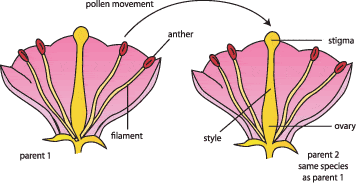
Moon

9.

A group of stars that form a pattern in the sky are called...

a)

Constellation

b)

drawing

c)

diagram

10.
The moon's orbit takes about how long to circle the Earth?
a)
27-29 days
b)
1 year
c)
365 days
d)
88 years
11.

2.It is what happens when two blocks of the earth suddenly slip past one another.

a)

Tropical Cyclone

b)

Landslide

c)

Earthquake

12.

4.It is the theory that Earth's crust is broken up into plates.

a)

Plate Tectonic Theory

b)

Modernized Theory

c)

Chromatography Theory

13.

6.They are Earth scientists, specialized in geophysics, who study the genesis and the propagation of seismic waves in geological materials.

a)

Virologists

b)

Biologists

c)

Seismologists

14.

7.It is an instrument for measuring earthquake (seismic) waves.

a)

microscope

b)

seismograph

c)

anenometer

15.

8.These are the waves of energy caused by the sudden breaking of rock within the earth or an explosion.

a)

seismic waves

b)

radio waves

c)

ultraviolet waves

16.

How does freezing water cause the weathering of rocks? The freezing water—

a)

keeps the rocks in place.

b)

makes the rocks last longer.

c)

expands cracks and breaks rocks.

d)

causes rocks to fall in landslides.

17.

Weathering, erosion, and deposition happen _____________.

a)

very quickly

b)

very slowly

18.

The BREAKING DOWN into small pieces of rock or sand

a)

deposition

b)

erosion

c)

weathering

19.

_____ is the process by which soil and sediment (weathered rock) are transported (moved) from one place to another by water, wind, glaciers, and gravity

a)

Erosion

b)

Deposition

c)

Weathering

d)

Running Water

20.

The PILING UP or GATHERING of small pieces of rock or sand.

a)

deposition

b)

erosion

c)

weathering

21.
A rock formed from fragments of other rocks is a(n)
a)
Metamorphic Rock
b)
Sedimentary Rock
c)
Extrusive Rock
d)
Igneous Rock
22.
This rock started as molten magma. What type of rock is this?
a)
Sedimentary
b)
Igneous
c)
Metamorphic
23.
You find a rock in which the grains are arranged in parallel bands of white and black crystals.  The rock is probably a(n)
a)
Igneous rock
b)
Sedimentary rock
c)
Metamorphic rock
d)
Extrusive rock
24.

Fossils are only found in

a)

Sedimentary rocks

b)

Foliated Metamorphic rocks

c)

Igneous Rocks

d)

Non-foliated Metamorphic rocks

25.

What is a trait?

a)

Your DNA

b)

The things that make an individual unique

c)

Common characteristics in a species

d)

Chromosomes

26.

Where are "Genes" found?

a)

Mitochondria

b)

Cytoplasm

c)

Centrosomes

d)

Chromosomes

27.

How many chromosomes do humans have?

a)

23

b)

92

c)

46

d)

184

28.

How do we write DOMINANT alleles?

a)

Capital letters

b)

Lower case

29.

How do we write recessive alleles?

a)

Capital letters

b)

Lower case

30.

An individual has the phenotype Bb. Will they express the dominant or recessive trait?

a)

Recessive

b)

Dominant

31.

Scientists like to study identical twins in genetics because..

a)

They are identical in every single way so scientists like to find out why.

b)

They have the same talents and that must therefore be part of their DNA.

c)

They have almost exactly the same DNA and this helps scientists figure out what traits come from the environment or from DNA

d)

Their environment always stays the same so they are useful to find out what diseases people can get.

32.

How many Chromosomes do we inherit from our parents?

a)

23 from dad and 23 from mom, or 46 total

b)

13 from dad and 13 from mom, or 26 total

c)

13 from dad and 33 from mom, or 46 total

33.

What are chromosomes?

a)

They are thread like structures containing DNA found inside the nucleus of our cells

b)

They are X shaped blobs made of ribosomes

c)

They are the inherited traits we recieve from our parents

d)

They are types of alleles found in the mitochondria of a cell

34.

What is a gene?

a)

An entire chromosome.

b)

A small part of DNA found in a chromosome that gives our body instructions to build for a specific trait that we have

c)

Things that are sometimes refered to as XX and XY inside of our cell membranes

d)

Kind of like a "flavor" because there are 23 kinds from each parent.

35.

What is a Chromosome?

a)

a threadlike structure found in the nucleus of most living cells, carrying genetic information in the form of genes.

b)

An X shaped thing found in the mitochondria of the cell that helps create energy in the form of ATP.

c)

A threadlike structure found in the lysosome carrying genetic information in the form of proteins.

d)

A colorful and fluorescent type of sugar that our body uses to break down and get energy.4

36.

Pigeons have Chromosomes.

a)

True

b)

False

37.

What is a mutation?

a)

A mistake that happens when our cells code for a type of base.

b)

A genetic defect caused by our genes that always leads to cancer

c)

Another way to name the proteins that make up a strand of DNA

d)

What happens to the chromosomes when our cells are ready to reproduce.

38.

Our genes are ______ % the same when compared to another human

a)

99

b)

99.9

c)

50-60

d)

80

39.

Select the living organism that has DNA

a)

Pigeons

b)

Humans

c)

Trees

d)

All the other answers

40.
 which is heterozygous ?  
a)
Tt
b)
TT
41.
Which is homozygous ?
a)
Zz
b)
SS
42.
the genetic makeup of an organism
a)
heterozygous
b)
punnet square
c)
genotype
43.
The passing of traits from parent to offspring 
a)
Heredity 
b)
Genetics 
c)
Hybrid 
d)
Probability 
44.
What is a phenotype
a)
The genetic make up (code)
b)
The physical trait
45.
A human usually has _____ total chromosomes.
a)
6
b)
22
c)
4
d)
46
46.
An allele whose trait always shows up in the organism when the allele is present.
a)
recessive allele
b)
dominant allele
c)
hidden allele
d)
present allele
47.
An allele whose trait only shows up when no dominant allele is present.
a)
hidden allele
b)
dominant allele
c)
recessive allele
d)
present allele
48.
one set of instructions for an inherited trait
a)
heredity
b)
allele
c)
trait
d)
gene
49.
one of the alternative forms of a gene that governs a characteristic, such as hair color
a)
allele
b)
gene
c)
trait
d)
DNA
50.
an organism's appearance or other detectable characteristic
a)
genotype
b)
phenotype
c)
genetics
d)
heterozygous
51.
having two of the same genes for the trait (sometimes called purebred).
a)
homozygous
b)
hetrozygous
c)
protein
d)
chromosome
52.
having two different genes for a trait (sometimes called hybrid).
a)
protein
b)
homozygous
c)
heterozygous
d)
genotype
53.
father of genetics
a)
Gregor Mendel
b)
James Watson
c)
Dr. Robbins
d)
Francis Crick
54.
A single piece of coiled DNA found in the cells; contains genes that encode traits.
a)
gene
b)
chromosome
c)
trait
d)
DNA
55.
A characteristic that an organism can pass on to its offspring through its genes
a)
protein
b)
trait
c)
DNA
d)
gene
56.
Green plants are
a)
producers
b)
consumers
c)
herbivores
d)
omnivores
57.

What type of relationship is this?

a)

parasitism

b)

mutualism

c)

commensalism

d)

competition

58.

symbiotic relationship in which both organisms benefit

a)

competition

b)

mutualism

c)

predation

d)

commensalism

59.
What does a food web represent?
a)
All connections of energy flow throughout all organisms in a habitat.
b)
The specific ways that mutualism is carried out.
c)
A single pathway or energy flow between organisms. 
d)
How carnivores get their food. 
60.

symbiotic relationship in which one organisms benefits and the other organism is not affected

a)

competition

b)

mutualism

c)

parasitism

d)

commensalism

61.
Organisms that breaks down and absorbs nutrients from dead organisms 
a)
consumer
b)
trophic level
c)
decomposer
d)
species
62.
An organism that needs to eat other organisms to obtain energy is known as a:
a)
Autotroph
b)
Producer
c)
Consumer
d)
Mutualist
63.
Consumer that eats plants
a)
heterotroph
b)
herbivore
c)
producer
d)
community
64.
The rabbit in this food web would be considered a:
a)
Decomposer
b)
Producer
c)
Secondary Consumer
d)
Primary Consumer
65.
An illustration that uses arrows to show the MANY possible directions in which matter and energy can pass through the organisms in an ecosystem.
a)
Food chain
b)
Food web
c)
Energy Pyramid
d)
Succession Map
66.

What are plants that convert energy from the sun called?

a)

decomposer

b)

primary consumer

c)

secondary consumer

d)

producer

67.
Which one is NOT an example of a decomposer?
a)
mushroom
b)
leaves
c)
mold
d)
worm
68.
What is a producer?
a)
an organism that gets energy from eating other organisms
b)
an organisms that uses sunlight to make its own food
c)
an organism that gets energy from eating dead organisms, non-living material or waste
d)
an organism that uses chemical energy to make its own food
69.
The shrew provides energy for the _______?
a)
cricket
b)
grasshopper
c)
frog
d)
snake
70.

An organism's place in the biotic environment and its role in an ecosystem is

a)

Niche

b)

Epitope

c)

Habitat

d)

Habit

71.
Members of a species in a defined area
a)
Ecosystem
b)
community
c)
biodiversity
d)
population
72.
Consumer that eats plants
a)
heterotroph
b)
herbivore
c)
producer
d)
community
73.
Series of steps in which organisms transfer energy by eating and being eaten
a)
foodweb
b)
consumer
c)
food chain
d)
omnivore
74.
Organisms that relies on other organisms for food; consumer
a)
herbivore
b)
decomposer
c)
heterotroph
d)
species
75.
All the organisms in a particular location, including their nonliving environment
a)
ecosystem
b)
carnivore
c)
niche
d)
population
76.
What does fungi do to dead plants and animals?
a)
Leave them there
b)
Decompose them
c)
Wait for other animals to eat them
d)
Move away
77.
What may happen if the snowshoe hare was removed from the food web pictured?
a)
The insects in the habitat would increase.
b)
The shrew population would decrease due to being only hawk food source.
c)
The willow tree population would decrease.
d)
Foxes would dies due to no food source. 
78.
In the energy pyramid here, how much of the energy in the producers gets passed to the herbivores?
a)
10%
b)
20%
c)
80%
d)
90%
79.
Which of the following leads to a decrease in biodiversity?
a)
protection of ecosystems
b)
pollution control
c)
selective cutting
d)
introduction of exotic or invasive species
80.
A carbon "sink" is best described as:
a)
a reservoir that readily releases carbon to another reservoir
b)
a carbon reservoir that stores more carbon that it is releasing
c)
something that causes carbon to leak out to the atmosphere
d)
a carbon reservoir that is releasing more carbon than it is taking in
81.
Nitrogen fixation processes nitrogen from which of the following sources?
a)
lightning
b)
fertilizers
c)
dead plants
d)
atmosphere
82.
What is it called when water is changed from a liquid to a gas?
a)
EVAPORATION
b)
PRECIPITATION
c)
TRANSPIRATION
83.
Nitrogen makes up _____ percent of the atmosphere.
a)
66%
b)
78%
c)
90%
84.
In the food web shown, the snail would be considered...
a)
primary consumer
b)
secondary consumer
c)
tertiary consumer
d)
producer
85.
Which biome, because of its climate and amount of rainfall, has the largest number of species of plants and animals?
a)
Tundra
b)
Rainforest
c)
Desert
d)
Pineforest
86.
An individual belonging to a specific species
a)
Biotic
b)
Community
c)
Organism
d)
Reptile
87.
All of the living and nonliving things in an area that interact with each other are called a/an ______.
a)
community
b)
habitat
c)
population
d)
ecosystem
88.
Which part may develop into a fruit?
a)
E
b)
D
c)
C
d)
A
89.
The tip of the style that has sticky hairs to trap pollen is the ___.
a)
stamen
b)
stigma
c)
ovary
d)
style
90.
The part of the stamen that produces pollen grains is the ___.
a)
anther
b)
pistil
c)
filament
d)
ovary
91.
The male reproductive structure of a flower is the ___.
a)
pistil
b)
ovary
c)
stamen
d)
ovule
92.
The part of the flower on which the pollen grains land.
a)
anther
b)
stamen
c)
style
d)
stigma
93.
The part of a flower that produces the male reproductive cells.
a)
anther
b)
style
c)
stigma
d)
filament
94.
Which part produces pollen?
a)
A
b)
B
c)
C
d)
E
95.
Pollination can occur between flowers of the same plant. 
a)
True 
b)
False 
96.
What is the function of nectar?
a)
To provide food for the flower
b)
To attract pollinators
c)
To attract animals to disperse the fruits
d)
To produce perfumes for Man
97.
Pollination is the process by which pollen
a)
causes people to sneeze
b)
is formed inside a plant
c)
moves from stamen to stigma
d)
moves from stigma to stamen
98.
Brightly colored parts of flowers that attract insects.
a)
petals
b)
pistils
c)
stamen
d)
filaments
99.
Small grains that contain a plant's male reproductive cells.
a)
stamen
b)
pollen
c)
anther
d)
stigma
100.
What is the female part of the flower used during reproduction?
a)
Pistil
b)
Petal
c)
Stigma
d)
Stamen
101.
What is the male part of the flower used during reproduction?
a)
Pistil
b)
Stigma
c)
Stamen
d)
Pollination
102.
The stalk connecting the ovaries and stigmas.
a)
filament
b)
pistil
c)
style
d)
anther
103.
An ovum of a certain flowering plant has 32 chromosomes. Which other cell from this species would also have 32 chromosomes.
a)
A zygote.
b)
A sperm cell.
c)
A cell from it's leaf.
d)
A cell from it's roots.
104.
Which 2 cells have the same chromosome number, if taken from the same species?
a)
An egg, and a liver cell
b)
A sperm, and a zygote
c)
A zygote, and a brain cell
d)
A zygote, and an ovum.
105.
The seeds of apple would probably be disbursed by?
a)
animals
b)
wind
c)
water
d)
fire
106.
Seeds can be disbursed by animals, water, and __________ ?
a)
wind
b)
earthquakes
c)
fire
d)
blizzards
107.
Pollen comes from the male or female parts of the flower?
a)
male
b)
female
108.

True or False.

Grasses are not part of the group of flowering plants.

a)

True

b)

False

109.
A coconut would probably be disbursed by ?
a)
animals
b)
wind
c)
water
d)
volcanos 
110.

These are the male parts of a flower.

a)

Anther, filament.

b)

Anther, pistil.

c)

Anther, stamen.

111.

These are the female parts of a plant.

a)

Pistil, style, ovary.

b)

Stigma, style, ovary, ovules.

c)

Stigma, pistil.

112.

Together the stigma, style, ovary and ovules are called _______.

a)

Pistil

b)

Stamen

113.

In which part of the plant do you find the pollen grains?

a)

Pistil

b)

Stamen

c)

Anther

114.

Pollen grains help the plant _______.

a)

eat

b)

reproduce

c)

breathe

115.

To be pollinated the pollen grains need to fall on the ____.

a)

Stigma, the sticky surface of the pistil.

b)

Petals, the colorful part of the corolla.

c)

Stamen, a part of the anther.

116.

Inside the ovary a _______ is formed.

a)

plant

b)

egg

c)

seed

117.

The petals protect the ___________ and attract insects.

a)

style and stigma.

b)

anther and filament.

c)

style and filament.

118.

Broccoli is a _______.

a)

plant.

b)

seed.

c)

flower.

119.

After pollination the ovary of a plant becomes a _________.

a)

flower.

b)

fruit.

c)

seed.

120.

The fertilized embryo of the newly formed plant is a

a)

a seed

b)

a sprout

c)

a fruit

d)

it stays an ovule