Wayground logo

Free Printable Worksheets

Font size

S
M
L
XL
Worksheets

unit 4 review

Total questions: 84

Worksheet time: 51mins

Name
Class
Date
1.
Which organelle is found in plant cells only?
a)
Cell Membrane
b)
Cell Wall
c)
Many Small Vacuoles
d)
Cytoplasm
2.
Which organelle is found in plant cells only?
a)
Cell Membrane
b)
Large Central Vacuole
c)
Many Small Vacuoles
d)
Cytoplasm
3.
Which organelle is found in animal cells only?
a)
Cell Membrane
b)
Large Central Vacuole
c)
Many Small Vacuoles
d)
Cytoplasm
4.
Which organelle is found in plant cells only?
a)
Cell Membrane
b)
Chloroplast
c)
Many Small Vacuoles
d)
Cytoplasm
5.
To provide a protective barrier between the interior of the cell and the outside environment is a function of _________.
a)
Cell Membrane
b)
Cell Wall
c)
Nucleus
d)
Mitochondria
6.
To control what enters or leaves the cell is a function of _________.
a)
Cell Wall
b)
Cell Membrane
c)
Nucleus
d)
Mitochondria
7.
To identify the cell as part of an organism is a function of _________.
a)
Cell Wall
b)
Chloroplast
c)
Cell membrane
d)
Mitochondria
8.
To aid in the transport of necessary materials throughout the cell llis a function of _________.
a)
Cell Wall
b)
Chloroplast
c)
Cell membrane
d)
Cytoplasm
9.
To identify the cell as part of an organism is a function of _________.
a)
Cell Wall
b)
Chloroplast
c)
Cell membrane
d)
Mitochondria
10.
To convert the energy of glucose into  the  usable form of ATP is a function of _________.
a)
Cell Wall
b)
Cytoplasm
c)
Nucleus
d)
Mitochondria
11.
To identify the cell as part of an organism is a function of _________.
a)
Cell Wall
b)
Chloroplast
c)
Cell membrane
d)
Mitochondria
12.
To control the processes of the cell through the use of DNA and RNA is a function of _________.
a)
Cell Wall
b)
Cytoplasm
c)
Nucleus
d)
Mitochondria
13.
To convert the energy of glucose into the usable energy of ATP is a function of _________.
a)
Cell Wall
b)
Cytoplasm
c)
Nucleus
d)
Mitochondria
14.

We can see cells because of

a)

magnifying lenses

b)

microscopes

c)

telescopes

d)

stethoscopes

15.
Which statement is a part of the cell theory?
a)
all cells come from preexisting cells
b)
bacteria are prokaryotic cells
c)
eukaryotic cells are complex
d)
humans are multicellular
16.
Who looked at cork and named the cell?
a)
Robert Hooke
b)
Van Leeuwenhoek
c)
Robert Brown
d)
Francesco Redi
17.
The Cell Theory states...
a)
atoms create all matter
b)
living things evolve
c)
the cell is the backbone of all matter
d)
cells are the basic unit of structure and organization of organisms
18.
Rocks are not living because
a)
they never move
b)
they aren't needed for humans
c)
they are not made of cells
d)
they don't break down
19.
Cells are often called "the ____ of life."
a)
bread
b)
road map
c)
building blocks
d)
meaning
20.

What is the force done by water inside of a vacuole that applies a force necessary for the plant to stand upright?

a)

The Force

b)

Turgor Pressure

c)

Water Pressure

d)

Plant Bones

21.

What do these plant cell vacuoles exhibit?

a)

Low Turgor Pressure

b)

Medium Turgor Pressure

c)

High Turgor Pressure

d)

All of these are correct

22.

What do the vacuoles in this picture convey?

a)

Low Turgor Pressure

b)

Medium Turgor Pressure

c)

High Turgor Pressure

d)

All of these are correct

23.

What cell is turgid?

a)

Left

b)

Right

c)

None

d)

Both

24.

What does the xylem transport?

a)

Water

b)

Oxygen

c)

Glucose

d)

All of these are correct

25.

What does the phloem transport?

a)

Glucose

b)

Water

c)

Carbon Dioxide

d)

All of these are correct

26.

A plant that is wilted is said to have . . .

a)

No Water

b)

Plenty of Water

c)

Low Water

d)

All of these are correct

27.

Where is light absorbed in a plant?

a)

Roots

b)

Leaves

c)

Chloroplast

d)

Stem

28.

What do plants need to survive?

a)

Water

b)

Light

c)

Nutrients in Soil

d)

Carbon Dioxide

e)

All of these are correct

29.

Why don't animals have turgor pressure?

a)

Animals have veins and arteries, not xylems.

b)

Animals have bones

c)

Animals have muscles

d)

All of these are correct

30.
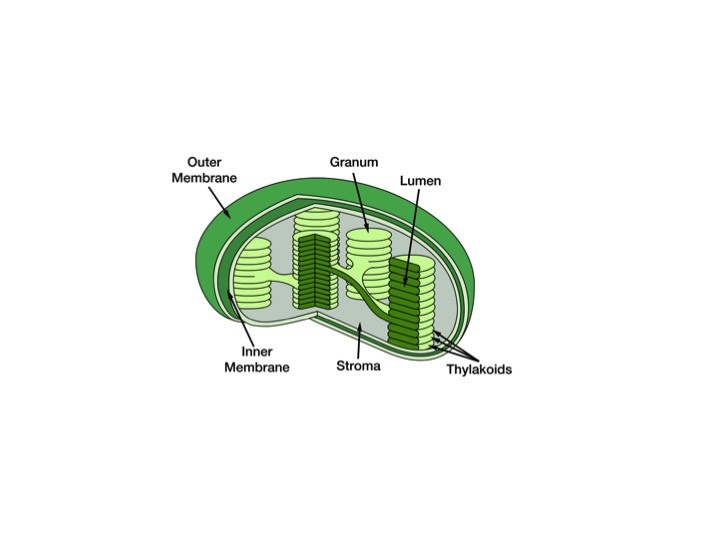
Which organelle performs PHOTOSYNTHESIS?
a)
Chloroplast
b)
Mitochondria
31.
Which of the following is the correct equation for PHOTOSYNTHESIS?
a)
CO2 + light + H2O --> O2 + Sugar
b)
CO2 + sugar + H2O --> O2 + light
c)
O2 + light + H2O --> CO2 + Sugar
d)
CO2 + O2 + H2O --> Light+ Sugar
32.
What process occurs when light energy is captured in autotrophs and converted into sugar?
a)
Photosynthesis
b)
Cellular Respiration
33.
What is the ultimate ORIGINAL source of energy for living things
a)
Sugar
b)
Sun
c)
Moon
d)
Carbon Dioxide
34.
Which organisms perform Photosynthesis?
a)
Only Autotrophs
b)
Only Heterotrophs
c)
Autotrophs and Heterotrophs
35.
Which of the following is an example of an AUTOTROPH?
a)
Appletree
b)
Dog
c)
Mushroom
d)
Human
36.
Which of the following is an example of a HETEROTROPH?
a)
Grass
b)
Algae
c)
Lemon Tree
d)
Bear
37.
What is the pigment in chloroplasts that performs photosynthesis?
a)
Chlorosynthesis
b)
Chlorophyll
c)
ADP
d)
Electron Transport
38.
Which gas is removed from the atmosphere during photosynthesis?
a)
hydrogen
b)
oxygen
c)
nitrogen
d)
carbon dioxide
39.
What are the products of photosynthesis?
a)
water and carbon dioxide
b)
oxygen and glucose
c)
oxygen and carbon dioxide
d)
oxygen and water
40.
Plants need ________ for photosynthesis
a)
oxygen
b)
soil
c)
carbon dioxide
d)
sugar
41.
What is photosynthesis?
a)
The process in which humans eat their food
b)
When a photographer takes a photo.
c)
To get your pictures from the photo lab.
d)
The process in which plants make their food.
42.
Chloroplasts are...
a)
Structures of animal cells to produce ATP
b)
Organelles where lipids are elaborated
c)
Specialized structures of plants where food is made
d)
Waste organelle of plants
43.
When a starfish grows a new body off a broken arm, what kind of reproduction is this?
a)
Sexual
b)
Differentiation
c)
Asexual 
d)
Specialization
44.
Where does an off spring get its traits in asexual reproduction?
a)
From both parents
b)
From only one parent
c)
From neither parent
d)
There are no traits handed down
45.
What percentage of chromosomes are handed down by a sperm cell?
a)
75%
b)
25%
c)
50%
d)
100%
46.
Sexual reproduction requires _____ parents and asexual reproduction requires ___ parents
a)
1,1
b)
2,2
c)
2,1
d)
1,2 
47.
What is an advantage of sexual reproduction?
a)
Allows genetic variation
b)
Only needs one parent
c)
Happens very quickly
d)
Offspring are exact copies of parent
48.
What is one disadvantage of sexual reproduction?
a)
Only one parent needed
b)
Off spring are exact copies of parents
c)
Happens very quickly
d)
Needs two parents
49.
Which is a type of Asexual Reproduction
a)
Sexual 
b)
Binary fission
c)
Cells 
d)
organism 
50.

In humans, traits can be determined by one or many pairs of...

a)

genes

b)

microbes

c)

cells

d)

organs

51.

What are genes composed of?

a)

nuclei

b)

chromosomes

c)

DNA

d)

cells

52.

What term identifies a single unit of heredity information?

a)

egg cell

b)

sperm cell

c)

nucleus

d)

gene

53.

A cell's chromosomes contain...

a)

nuclei

b)

cells

c)

DNA

d)

chlorophyll

54.
What is an inherited trait
a)
a dominant trait
b)
a trait
c)
a learned behavior
d)
a characteristic passed on from parents to offsring 
55.
what is an example of an inherited trait ?
a)
walking
b)
flying
c)
eye color
d)
fighting
56.
A individual who has two of the same alleles is said to be
a)
Homozygous
b)
Homologous
c)
Heterozygous
d)
Heteromologous
57.
What are the genotypes for the dominant phenotype of " A Tall Head". 
a)
Tall
b)
TT, Tt
c)
Short
d)
tt
58.
The genotype "TT" is ___
a)
Heterozygous
b)
Homozygous
59.
the passing of genetic traits from parent to offspring.
a)
heredity
b)
trait
c)
gene
d)
allele
60.
Dominant alleles are represented by a:
a)
Male gene
b)
lowercase letter
c)
recessive trait
d)
capital letter
61.
AA and Aa always show up as
a)
dominant
b)
recessive
62.
aa always shows up as
a)
dominant
b)
recessive
63.
aa always shows up as
a)
dominant
b)
recessive
64.
G = green, g = yellow
The genotype for a yellow plant is...
a)
GG
b)
Gg
c)
gg
d)
all of the choices result in yellow
65.
Which of the following is heterozygous
a)
Ww
b)
ii
c)
DD
d)
kk
66.
What does the prefix hetero- in heterozygous mean?
a)
same
b)
different
c)
dating
d)
human
67.
Which of the following is homozygous dominant?
a)
Jj
b)
Rr
c)
MM
d)
ee
68.
How many letters does a genotype contain?
a)
1
b)
2
c)
3
d)
4
69.
The two-letter code that describes the genetic traits of an organism is called a-
a)
Phenotype
b)
Genotype
c)
Physical Appearance
d)
Intelligence
70.
Hh
a)
Homozygous Dominant
b)
Homozygous Recessive
c)
Heterozygous
d)
Heterozygous Dominant
71.
TT
a)
Homozygous Dominant
b)
Homozygous Recessive
c)
Heterozygous
d)
Heterozygous Dominant
72.
rr
a)
Homozygous Dominant
b)
Homozygous Recessive
c)
Heterozygous
d)
Heterozygous Recessive
73.
Which of the following is heterozygous
a)
Dd
b)
dD
c)
DD
d)
dd
74.
Which of the following is homozygous dominant?
a)
Rr
b)
Hh
c)
ii
d)
DD
75.
The purpose of selective breeding is to 
a)
Get bigger animals
b)
get smaller animals
c)
create animals with desirable traits
d)
create animals with bad traits
76.
All of the following statements are reasons for selective breeding except:
a)
To produce offspring with desirable characteristics
b)
Farmers increase their profit by improving crops
c)
To improve the quality of food products
d)
To increase migration patterns
77.
A farmer has bred his pineapple plants from the sweetest pineapples from his last harvest to get even sweeter pineapple plants. What is this an example of?
a)
Selective breeding
b)
Natural selection
c)
Extinction
d)
Mutagenesis
78.
Organisms within a population have genetic differences in their traits called.
a)
Genotypes
b)
Variation
c)
Natural Selection
d)
Heterozygous
79.
T - tall and t = short
In the punnett square below, what belongs in the missing square
a)
tt
b)
Tt
c)
Bb
d)
TT
80.
B = brown fur  b = white fur
In the punnett square, what is the probability for white fur? 

a)
0%
b)
25%
c)
50%
d)
75%
81.
In plants, tall (T) is dominant to short (t). Perform the following cross: Tt x Tt. What is the probability of producing a short plant?
a)
0%
b)
25%
c)
50%
d)
75%
82.
Which of the following is NOT a genotype?
a)
heterozygous
b)
a trait
c)
Bb
d)
homozygous recessive
83.
Which of the following alleles is homozygous (purebred) recessive?
a)
Tt
b)
tt
c)
TT
d)
t
84.
Two brown eyed parents (Bb) have a baby. What is the chance the baby is blue eyed?
a)
0 %
b)
25%
c)
50%
d)
75%